
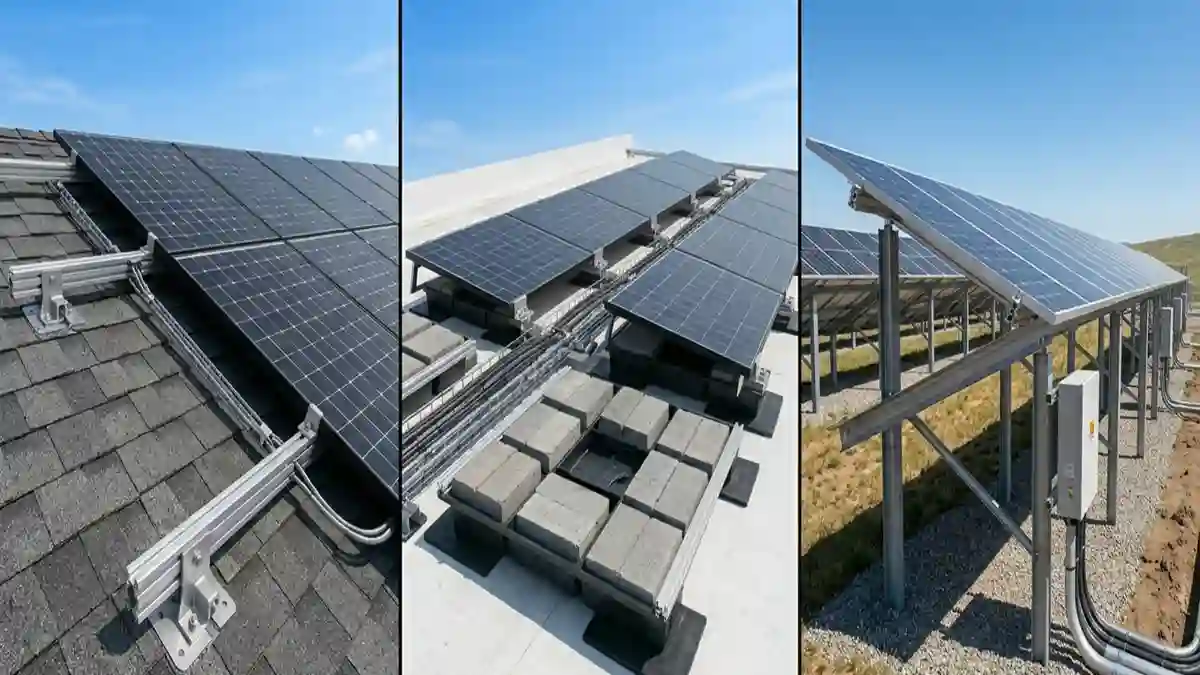
Solar PV panel mounting systems selection — how panel technology, inverter architecture, and US wind zones drive the right mounting choice for commercial and residential installs.
The term ‘solar PV panel mounting system’ describes an entire category of engineered products — not a single item you can select from a catalog. The correct selection depends on the panel technology being installed, the building or site structure, the electrical architecture of the solar power system, and the long-term performance targets the system needs to meet.
This guide approaches mounting system selection from the engineering side — connecting panel technology and electrical architecture to mounting system requirements. For the structural engineering framework that underpins all of this — load calculations, material specifications, and system types — see the Solar Mounting Systems hub.
1. How Panel Technology Affects Solar PV Panel Mounting Systems Selection
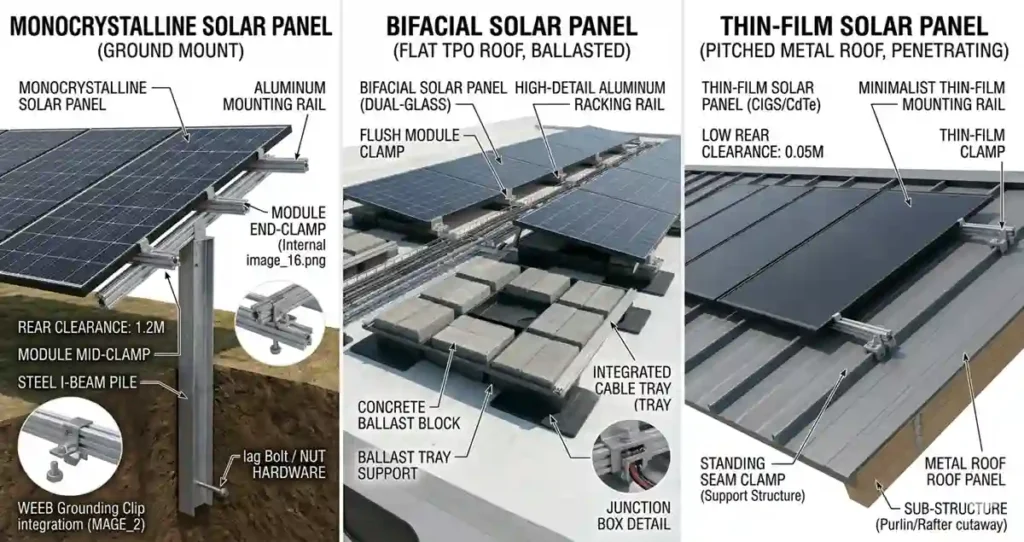
Monocrystalline and polycrystalline silicon panels use standard aluminum frames with consistent mounting groove dimensions. Most commercial mounting systems are designed around these frame geometries.
Thin-film panels (primarily CdTe and CIGS products) use different frame geometries and in some cases frameless designs that require a different clamping approach. Frameless modules use specialized adhesive or clamp attachment at the module edge rather than conventional mid and end clamps in the module frame groove. Verify mounting system compatibility with the specific panel manufacturer’s mounting guidelines before specifying the hardware.
Bifacial panels require a minimum 300 mm clearance between the rear of the module and any surface below. This affects ballast tray selection on flat roofs and row spacing on ground mounts. The ground mount structural frame that accommodates this clearance requirement is covered in the Solar Panel Ground Mounting Systems guide.
2. PV System Architecture and Mounting System Interaction
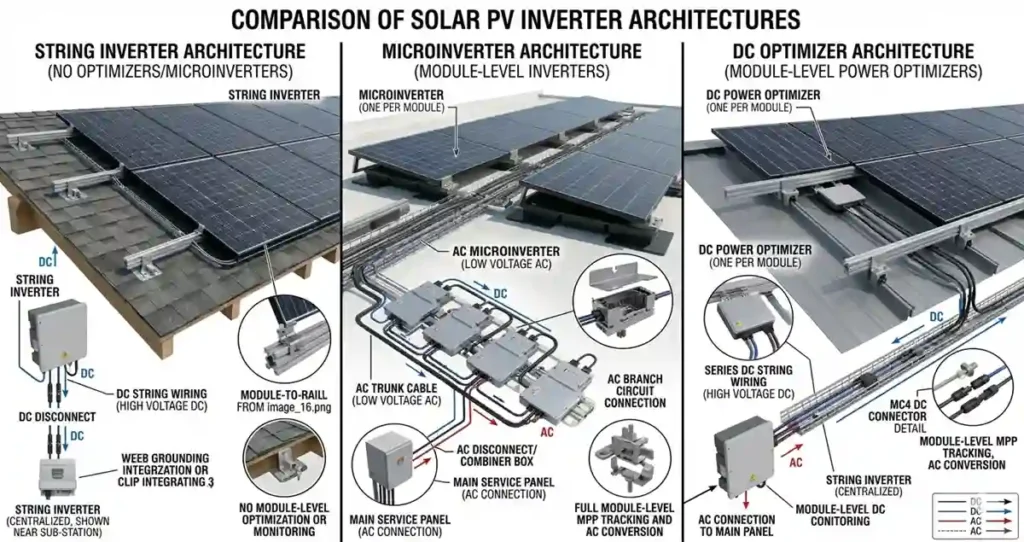
String Inverter Architecture
String inverter systems wire panels in series strings, typically 8 to 20 panels per string. The mounting layout should be designed to minimize home run length and organize strings by orientation — do not mix east and west-facing panels in the same string on a multi-slope roof.
Microinverter Architecture
Microinverter systems mount one AC inverter per panel or per two panels. The mounting system must accommodate the microinverter mounting (typically hanging below the rail between module rows) and the AC trunk cable that connects microinverters in sequence.
DC-Optimized String Architecture
Power optimizer systems mount one optimizer per panel, with optimizer mounting clips attaching to the rail below the module. Wiring routing follows similar principles to microinverters but with DC voltage — which requires careful voltage labeling and conduit separation from AC systems.
3. Mounting System Selection Criteria for Commercial PV
| Selection Criterion | What to Specify | Why It Matters |
| UL 2703 listing | Full system listing — not individual component | Provides documentation basis for permit and PE stamp |
| Rail alloy | 6063-T5 minimum; 6061-T6 for high-wind or long-span | Yield strength determines maximum allowable span |
| Published load tables | Attachment spacing per wind/snow zone | Enables site-specific layout without custom engineering |
| Module compatibility | Clamping range for your specific module frame dimensions | Mis-matched clamp range = improper module retention |
| Grounding method | UL 2703 integrated bonding or listed external bonding hardware | NEC 690 compliance; AHJ inspection requirement |
| Thermal expansion accommodation | Slip joints or expansion brackets at rail splices | Prevents rail buckling or bracket pull-out from thermal cycling |
| Manufacturer warranty | System warranty — minimum 10 years | Coverage for defects in the assembled system |
The rail alloy row points directly to the Solar Mounting Rails guide for alloy selection, span tables, and T-slot geometry. The hardware kit specification — including grounding hardware and thermal expansion provisions — is in the Solar Panel Mounting Brackets with Hardware guide.
4. The Flat Roof PV Mounting System — Specific Considerations
Flat roof PV mounting systems have a different engineering logic than pitched roof systems. Tilt is a design variable — optimizing it involves balancing solar yield (higher tilt captures more irradiance at low sun angles) against wind load (higher tilt increases wind uplift force on ballasted systems) and row spacing (higher tilt requires wider row spacing and reduces array density).
The practical optimum for flat-roof ballasted systems in the continental US is typically 5 to 12 degrees. At this range, the ballast requirement remains manageable (typically 8 to 20 lbs/sq ft average across the array) and the row spacing is compact enough to achieve 60 to 80% roof coverage factor.
Engineer’s Note: Never specify a flat-roof PV mounting system without a completed wind load analysis. The ballast calculation is zone-based — it recognizes higher uplift forces at array edges and corners. Corner modules in a 120 mph wind zone may require three times the ballast of interior modules. A uniform ballast specification across the array will either over-ballast the interior or under-ballast the perimeter.
5. Solar Power Mounting Systems — Commissioning Verification
- Torque verification: All fasteners at design torque — documented by fastener marking and inspection log
- Module clamping: Mid and end clamps at design torque, modules seated fully in the clamping groove
- Grounding continuity: Continuity measurement from module frame to grounding conductor — maximum resistance per NEC 690.47
- Rail alignment: Rail deflection under live load within specified limits
- Waterproofing inspection: All roof penetrations inspected for proper sealant application and gasket compression
- Thermal expansion provisions: Splice connector slip joints confirmed not clamped; thermal gap at each splice within specification
The complete step-by-step installation and commissioning procedure for a rail-mounted PV system is in the Solar Panel Rail Mounting Kit: Complete Installation Guide.
Frequently Asked Questions (FAQ)
What is a solar PV panel mounting system?
A solar PV panel mounting system is the structural framework that secures photovoltaic modules to rooftops, ground foundations, carports, or other supporting structures while providing proper orientation, load transfer, grounding continuity, and long-term durability.
Are all solar panels compatible with every mounting system?
No. Mounting system compatibility depends on the solar panel’s frame dimensions, clamping zones, weight, and manufacturer requirements. Frameless and thin-film modules often require specialized mounting hardware that differs from conventional crystalline silicon panels.
Why do bifacial solar panels require different mounting considerations?
Bifacial panels generate electricity from both the front and rear surfaces. To maximize rear-side energy production, mounting systems typically require increased clearance between the panel and the surface below, along with optimized row spacing and reduced shading.
What is UL 2703 certification and why is it important?
UL 2703 is a safety standard that evaluates solar mounting systems for mechanical strength, grounding, bonding, and fire performance. Many building departments and permitting authorities require UL 2703-listed mounting systems for code compliance and project approval.
How do microinverters affect mounting system design?
Microinverters are installed directly beneath solar modules and require additional rail space, cable management provisions, and equipment mounting locations. The mounting system must accommodate both the solar panels and the associated microinverter hardware while maintaining proper ventilation and accessibility.
Related guides on SolarVisionAI.com
Solar Panel Installation: Complete Engineering Guide (2026)
Solar Panel Installation Cost: The Complete 2026 Breakdown
Commercial Solar Panel Installation: Engineering Guide 2026
When Is the Best Time to Install Solar Panels?
Solar Power System in 2026: Types, Cost, ROI & AI Optimization