
What the lumen rating won’t tell you about solar powered lanterns — battery mAh, panel efficiency, and real runtime math explained by a licensed engineer
The phrase ‘solar powered lantern’ covers an enormous range of products — from a 10-lumen garden accent that runs six hours on a good summer day, to a 150-lumen portable unit with a 4000 mAh battery capable of lighting a campsite through three consecutive overcast days. The number of lumens, solar panel size, and battery capacity are the specifications that determine performance, yet many product listings provide little information beyond a marketing photo and a solar panel icon.
This guide covers the engineering specs that determine whether a solar-powered lantern will perform in your application. It is the companion to the full solar lanterns buying guide.
1. The Lumen-to-Battery Ratio — The Spec That Matters Most
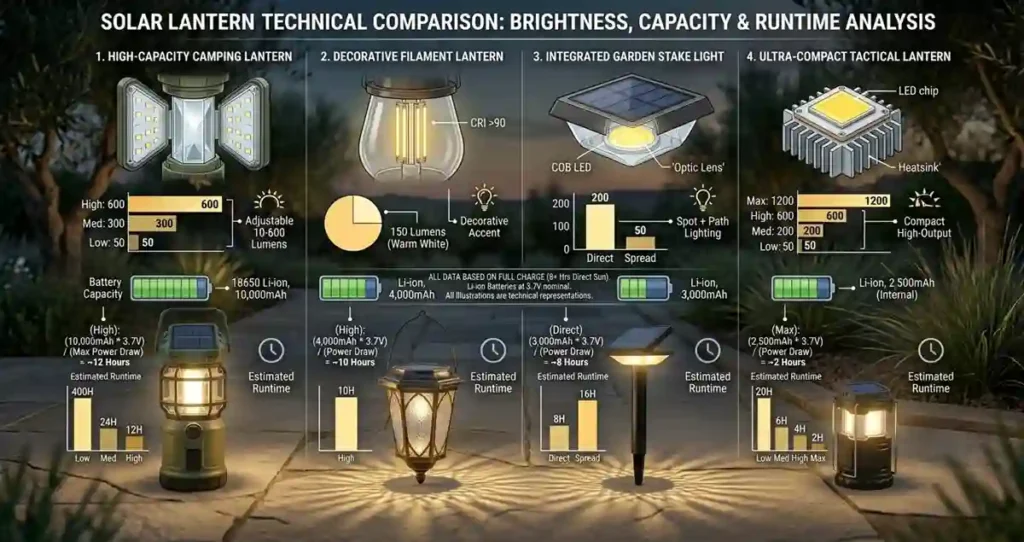
The lumen output determines how much light the lantern produces. The battery capacity determines how long it produces it. These two numbers must be matched. A high-lumen lantern on an undersized battery is not a solar powered lantern — it is a lantern with a short runtime that happens to recharge from sunlight.
| Lumen output | Min battery (8hr runtime) | Min battery (12hr runtime) | Panel min (summer) | Typical application |
| 10–20 lm | 400 mAh | 600 mAh | 3×3 cm | Garden decoration |
| 20–40 lm | 800 mAh | 1200 mAh | 4×5 cm | Patio, pergola |
| 40–60 lm | 1500 mAh | 2000 mAh | 5×6 cm | Pathway, perimeter |
| 60–80 lm | 2000 mAh | 3000 mAh | 6×7 cm+ | Driveway entry |
| 100–150 lm | 3500 mAh | 5000 mAh | Separate panel | Camping, security |
Engineer’s Note: The 8-hour and 12-hour columns assume 100% charge state — a full summer day of direct sun on the rated panel size. In winter, the same panel may reach 40–65% charge state, cutting runtime proportionally. Size for 12-hour runtime in summer if you want 6–8 hours in winter.
2. Panel Efficiency Losses — What the Spec Sheet Ignores
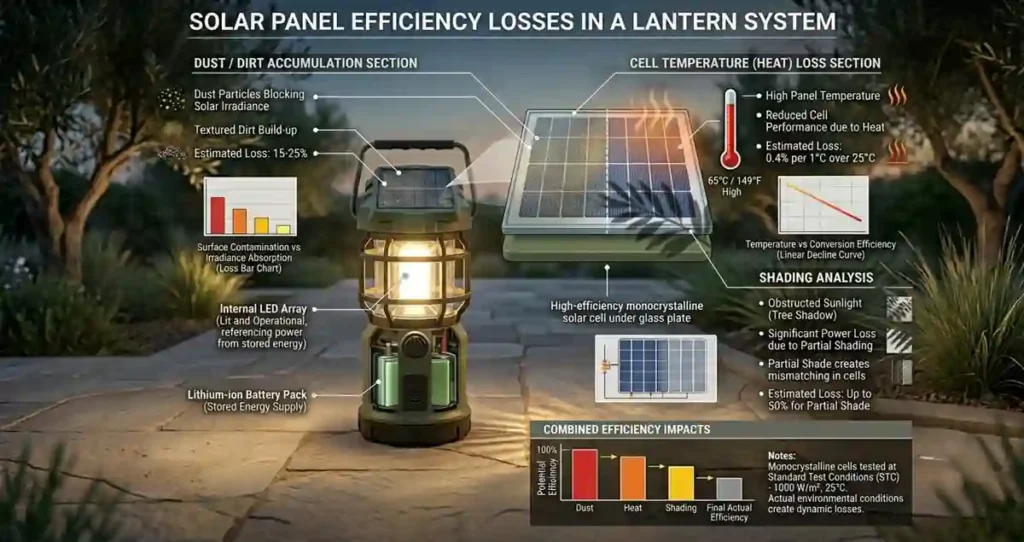
Solar panel efficiency ratings are measured under Standard Test Conditions: 1000 W/m² irradiance, 25°C cell temperature, AM1.5 spectrum. Real outdoor conditions are rarely Standard Test Conditions. Losses from panel soiling, elevated operating temperature, non-perpendicular sun angle, and cable resistance reduce real-world output by 15 to 30% compared to the rated spec.
The practical multiplier: take the rated panel output and multiply by 0.75. If that adjusted figure can charge your required battery capacity within the available sun hours for your location, the panel is adequate.
Field Note: A solar powered lantern rated at 5V / 120 mA panel output — 0.6W — will deliver approximately 0.45W in real conditions after losses. At 6 hours of useful sun, that is 2.7 Wh of daily charge energy. A 1200 mAh / 3.7V battery holds 4.44 Wh at full charge. This panel cannot fully charge this battery in a single summer day. The product will run at partial charge from day two onwards.
3. Battery Chemistry — NiMH vs Lithium in Solar Lanterns
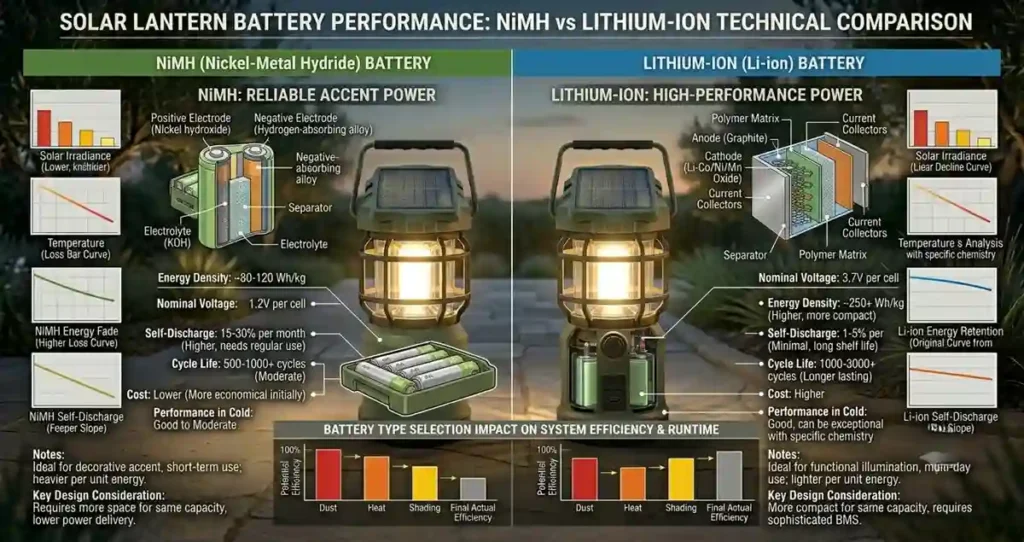
| Property | NiMH (AA/AAA) | Lithium-ion (integrated) | Better for solar lanterns |
| Cold weather | Good — minimal loss above -10°C | Poor below 0°C — significant capacity loss | NiMH |
| Replaceability | Standard AA/AAA — hardware store | Integrated pack — supplier required | NiMH |
| Energy density | Lower — larger for same capacity | Higher — more capacity, smaller size | Lithium |
| Cycle life | 500–1000 cycles typical | 300–500 for small cells | NiMH |
| Cost | Lower cell cost | Higher integrated pack cost | NiMH |
For the full replacement procedure when either chemistry reaches end of life, see the solar lantern replacement parts guide.
4. What to Buy by Application
| Application | Lumen target | Battery minimum | IP rating | Key feature to verify |
| Garden / decorative | 10–20 lm | 600 mAh NiMH | IP44 | Warm white (2700–3000K) |
| Patio / outdoor dining | 25–40 lm | 1000 mAh | IP44 covered / IP65 exposed | Dusk-to-dawn sensor |
| Driveway / perimeter | 50–80 lm | 2000 mAh | IP65 | Battery capacity listed |
| Camping / portable | 80–150 lm | 3000–4000 mAh | IP65–IP67 | USB charge input backup |
| Emergency / off-grid | 100–200 lm | 4000+ mAh | IP67 | Multiple brightness modes |
Engineer’s Note: If a solar powered lantern listing does not state the battery capacity in mAh, the manufacturer is concealing a spec that would deter purchase. Require it. If it is not available, move to a product that publishes it.
5. Seasonal Performance — The Calculation Most Buyers Skip
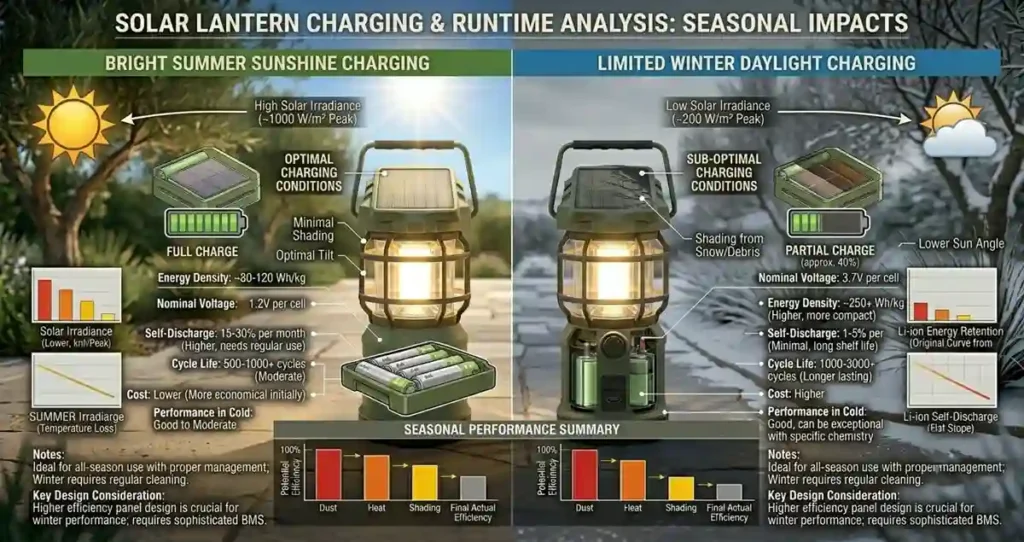
Most buyers test a solar powered lantern in summer and assume it will perform equivalently year-round. It will not. Peak sun hours × panel output × efficiency factor = daily charge energy. If charge energy is less than the required discharge energy, the battery depletes over consecutive days.
The seasonal performance table in the full solar lanterns guide maps lumen output to expected runtime across seasons. For camping-specific performance including cold-weather battery behaviour, see the solar camping lanterns guide.
Frequently Asked Questions
What battery size should a solar powered lantern have?
It depends on the light output and required runtime. Decorative lanterns producing 10–20 lumens typically need at least 600 mAh, while driveway, camping, and security lanterns often require 2000–4000 mAh or more for reliable overnight operation.
Are lithium or NiMH batteries better for solar powered lanterns?
Both have advantages. NiMH batteries perform well in cold weather, are inexpensive, and are usually easy to replace. Lithium batteries offer higher energy density and longer runtime in a smaller package but can lose capacity more quickly in freezing conditions.
How long do solar powered lanterns last?
A quality solar powered lantern can last several years. The LED light source often lasts 25,000 to 50,000 hours, while the battery typically requires replacement after 2 to 5 years depending on chemistry, usage patterns, and environmental conditions.
Do solar powered lanterns work in winter?
Yes, but runtime is usually reduced. Shorter daylight hours and lower solar panel output mean the battery receives less charge during the day. A lantern that runs all night in summer may only operate for a few hours during winter conditions.
Can solar lantern batteries be replaced?
In most cases, yes. Many solar lanterns use replaceable AA or AAA NiMH batteries, while others use integrated lithium battery packs. Before purchasing, verify that replacement batteries are available and that the battery compartment is accessible.
Final Thoughts
The best solar powered lantern is not the one with the highest lumen rating — it is the one with the correct balance of battery capacity, solar panel size, and runtime for your application. Understanding the relationship between these specifications helps you avoid products that look impressive on paper but fail in real-world conditions.
Related Guides on SolarVisionAI
Solar Lanterns: The Complete Engineer’s Buying Guide
Outdoor Wall Solar Lanterns: Installation, Sizing & Buying Guide
Best Hanging Solar Lanterns for Outdoors
Best Solar Lanterns for Camping: Lumens, Runtime & Field Performance
Solar Lantern Replacement Parts: Cells, Panels & What’s Fixable
Solar Lanterns vs Costco & Walmart: An Engineer’s Honest Comparison