
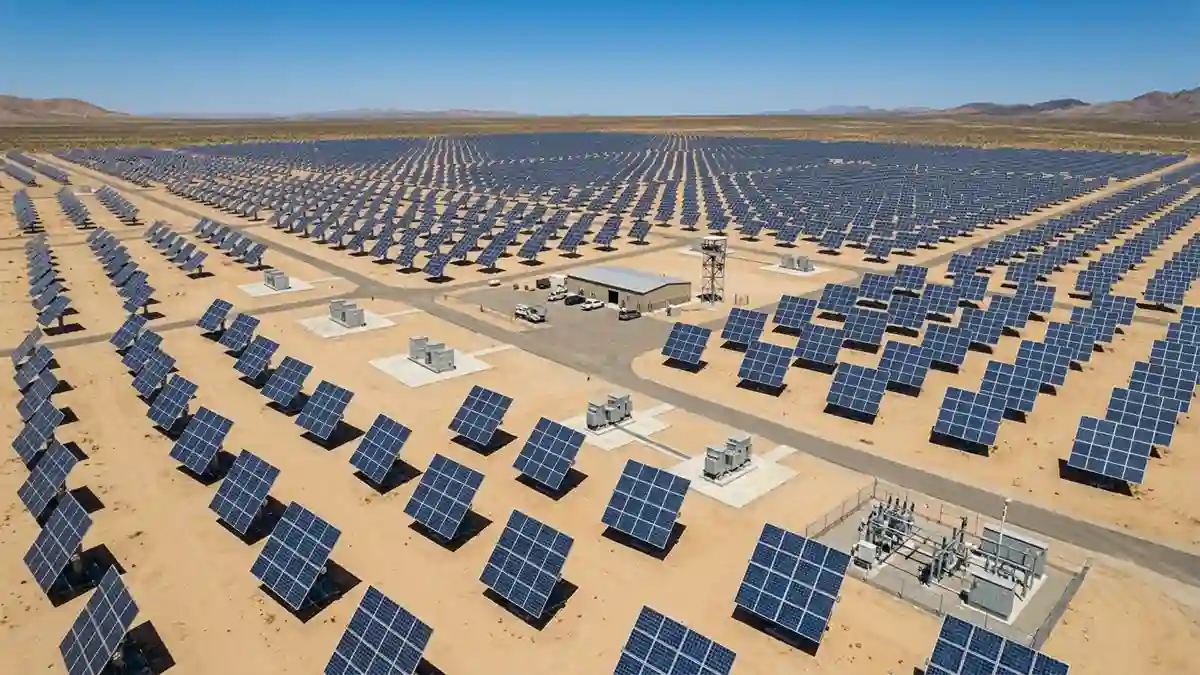
Dual axis solar tracking system — X and Y axis drive engineering, structural loads in all orientations, AI optimization algorithms, US commercial yield data, and when dual axis beats single axis.
A dual axis solar tracking system continuously repositions solar panels along two independent axes — east to west to follow the sun’s daily movement and north to south to compensate for seasonal changes in solar elevation. By maintaining the optimal orientation of the solar panels throughout the year, dual axis tracking systems maximize solar irradiance capture and increase energy production compared to fixed-tilt installations.
That precision comes at a cost. Dual axis systems are mechanically more complex than single axis trackers, impose higher structural loads on foundations, require more maintenance, and carry a higher capital cost per watt. The financial case for dual axis tracking depends on site irradiance, project scale, available incentives, and — increasingly — the availability of AI-driven optimization that extracts additional performance from the dual axis capability.
This guide covers the engineering of dual axis solar tracking systems, the X and Y axis drive mechanisms, the structural loading implications, and the AI optimization systems that are making dual axis tracking economically viable in an expanding range of US commercial applications. For a comparison with single axis tracking — the more common commercial choice — see the Single Axis Solar Tracker System guide. For the broader tracker type comparison, see the Solar Tracker System hub.
1. How a Dual Axis Solar Tracking System Works
The Two Axes Explained
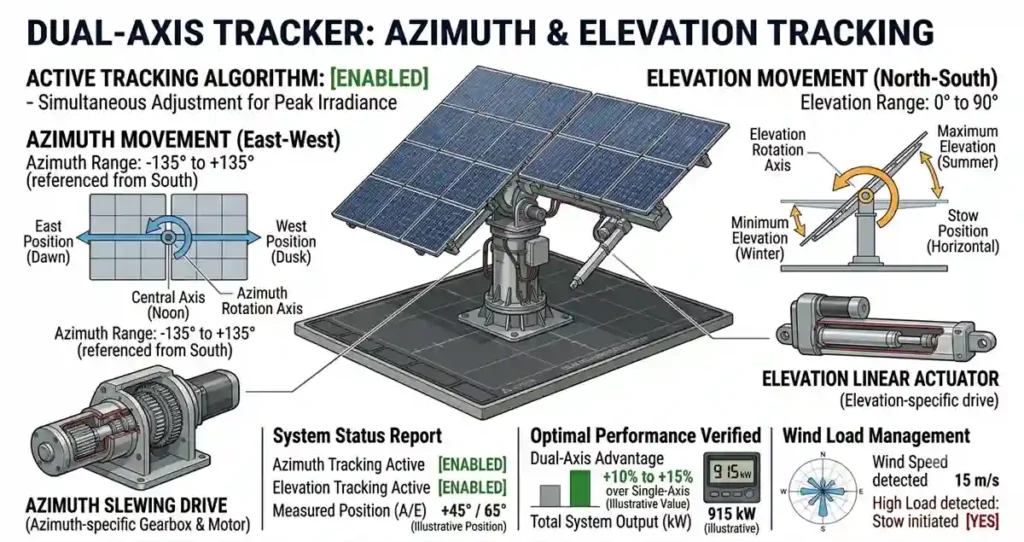
A dual axis tracker moves on two independent mechanical axes:
- X axis (azimuth / horizontal): Rotation in the horizontal plane — east to west tracking. This is the same axis that a single axis tracker uses. It compensates for the sun’s daily arc across the sky from sunrise to sunset.
- Y axis (elevation/tilt): Rotation in the vertical plane — north to south tilt adjustment. This compensates for the sun’s seasonal declination change — the fact that the sun is higher in the sky in summer and lower in winter. A single axis tracker ignores this seasonal variation; a dual axis tracker corrects for it continuously.
The combination of both axes means the panel can maintain near-perfect perpendicularity to the sun’s rays at any time of year — which is why dual axis yield gains over fixed systems (25 to 45%) are larger than single axis gains (15 to 25%).
Pedestal vs Carousel Design
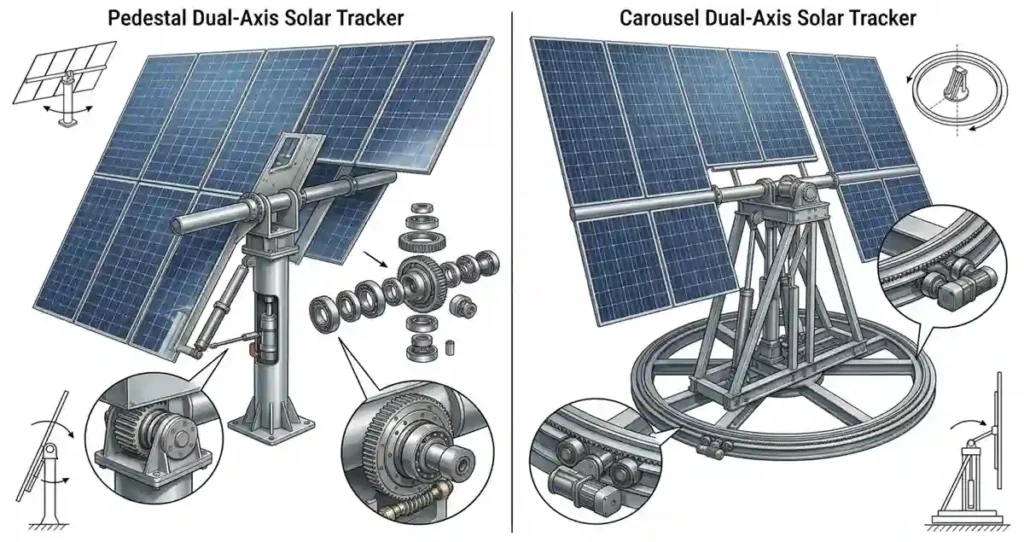
Dual axis trackers are built in two main mechanical configurations. The pedestal design mounts the panel array on a single central column (the pedestal), with the dual axis drive mechanism at the top of the column. The panel array pivots around the column center on both axes. This is the most common configuration for smaller dual axis systems — typically 10 to 100 kW per pedestal unit.
The carousel (or azimuth-elevation) design uses a larger rotating base structure — the carousel — that rotates on the azimuth axis, with the panel array tilting on the elevation axis independently. This configuration scales better for larger arrays — some carousel designs accommodate 100 to 500 kW per unit — but requires more complex structural engineering for the rotating base.
2. Dual Axis Solar Tracking System — Structural Engineering
X and Y Axis Drive Mechanism
The X axis drive — azimuth rotation — typically uses a slewing ring bearing and a ring gear driven by a gear motor. The slewing ring must support the full weight of the panel array while rotating — a design requirement that scales directly with array size and imposes significant bearing load specifications.
The Y axis drive — elevation tilt — typically uses a linear actuator (a motorized screw jack or hydraulic cylinder) that pushes or pulls the panel frame to the required tilt angle. Linear actuators are simpler and more robust than rotary drives for the elevation axis, but they require more clearance for the stroke range and must be sized for the full wind load on the panel array at every tilt position.
Foundation Loading — More Complex Than Single Axis
| Load Case | Fixed Ground Mount | Single Axis Tracker | Dual Axis Tracker |
| Dead load path | Rail to bracket to pile — simple vertical | Torque tube to pile — primarily vertical | Pedestal to pile — vertical and moment |
| Wind load direction | Fixed — worst case from one direction | Variable — changes with tracker angle | Variable in both azimuth and elevation simultaneously |
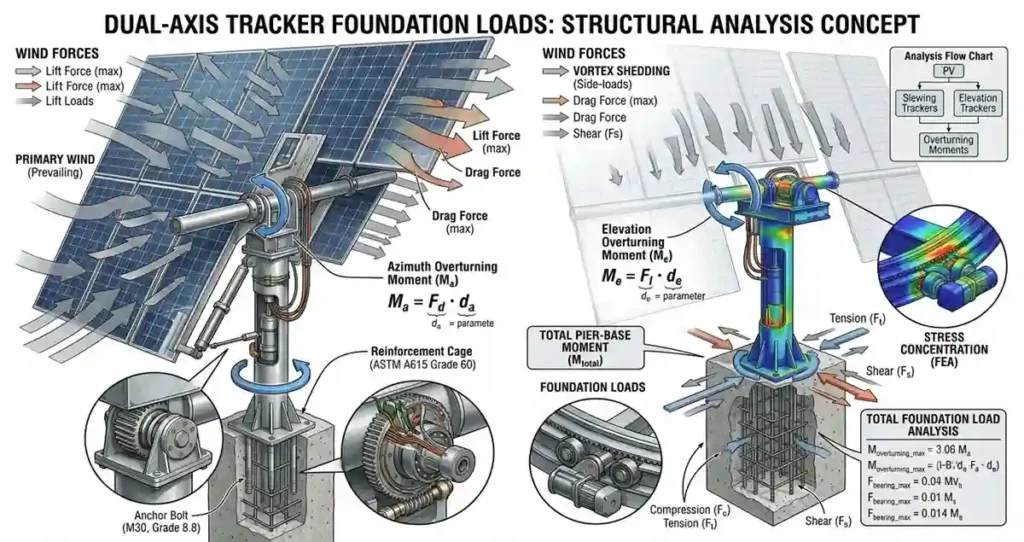
| Maximum moment at foundation | Calculated for fixed panel position | Dynamic — varies with tracker rotation | Dynamic — varies in both axes; worst case requires CFD analysis |
| Foundation type | Driven pile or helical pier | Driven pile or helical pier | Typically concrete pier or large-diameter helical pier for pedestal |
| Structural analysis complexity | Standard ASCE 7-22 | Manufacturer wind load package required | CFD analysis or wind tunnel testing typically required |
Engineer’s Note: The foundation for a dual axis pedestal tracker is a moment-resisting connection — the pedestal transfers significant overturning moment to the foundation, particularly under combined wind load and gravity in off-perpendicular orientations. I require a geotechnical report and structural engineering package from the tracker manufacturer before approving foundation design on any dual axis tracker project. The foundation cost premium over a fixed-mount system is real and must be included in the project financial model.
3. Dual Axis Solar Tracking System — When It Is the Right Choice
The financial case for dual axis tracking is stronger in specific conditions:
- High direct normal irradiance (DNI): Sites with high DNI — primarily the US Southwest (Arizona, New Mexico, Nevada, and parts of California and Texas) — benefit most from dual axis tracking because clear-sky conditions are when the angle difference between a perfectly tracking panel and a fixed panel creates the largest power differential.
- Smaller project scale: On small commercial projects (10 to 200 kW), the per-watt cost premium of single axis tracking (which requires a full row infrastructure) can approach or exceed the per-watt cost of a pedestal-type dual axis tracker. At these scales, dual axis sometimes competes favorably with single axis on a cost-per-yield basis.
- Agrivoltaic applications: Dual axis pedestal trackers on tall columns can create clearance for agricultural use of the land beneath the array. The vertical clearance of the pedestal design — typically 3 to 5 meters — accommodates many crop types and agricultural equipment under the array, which is more difficult with the low-profile torque tube of a single axis tracker row.
- Precision monitoring applications: Research installations, meteorological stations, and calibration facilities use dual axis tracking to maintain reference irradiance measurements with maximum accuracy throughout the year.
4. AI Optimization in Dual Axis Solar Tracker Systems
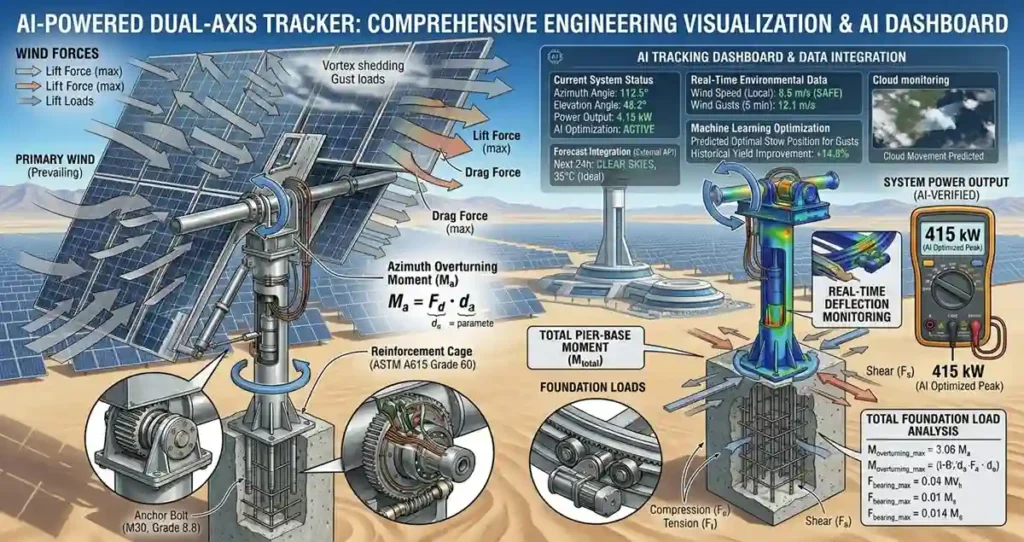
The integration of artificial intelligence into dual axis solar tracker control systems is one of the most significant developments in commercial solar tracking over the past three years. Traditional tracker controllers use astronomical algorithms — calculating the theoretical sun position from GPS coordinates and time — to set the tracking angle. AI-optimized tracker controllers go beyond this to maximize actual power output rather than theoretical sun-facing angle.
How AI Optimization Works
An AI-optimized dual axis tracker controller combines the astronomical sun position calculation with real-time power output data from the inverter or optimizer to continuously adjust the tracker angle for maximum actual power production — not maximum theoretical irradiance.
The distinction matters because the optimal panel angle for maximum power output is not always the angle that faces directly at the sun. Reflected irradiance from clouds and ground surfaces, partial shading from nearby structures, and soiling patterns on the panel surface all mean that the maximum power point occurs at an angle that deviates from the theoretical optimal — sometimes by 5 to 15 degrees.
AI Optimization Performance Data
| Optimization Feature | Traditional Astronomical Algorithm | AI-Optimized Control | Typical Improvement |
| Tracking basis | Calculated sun position only | Sun position + real-time power output feedback | 2-5% additional yield over astronomical |
| Cloud response | Fixed to calculated sun position during clouds | Optimizes for diffuse irradiance — may flatten tilt during overcast | 1-3% additional on cloudy days |
| Soiling compensation | No — assumes clean panel | Adjusts angle to minimize soiling impact on output | Site-dependent — more in dusty US regions |
| Shading optimization | Standard backtracking algorithm | ML-based backtracking optimized for specific site shading patterns | 1-2% additional in shade-affected sites |
| Seasonal learning | Fixed algorithm year-round | Self-learns site-specific optimal angles from historical performance | Improves over time — better in year 3 than year 1 |
| Total yield improvement over astronomical | Baseline | 3-8% additional | Meaningful at utility scale |
At utility scale, a 3 to 8% additional yield improvement from AI optimization on top of the baseline dual axis tracking gain represents significant additional revenue over a 25-year project life. At a 200 kW dual axis installation with a $0.10/kWh electricity rate, a 5% additional yield improvement from AI optimization generates approximately $8,000 to $12,000 in additional annual revenue — which at a 7% discount rate has a present value of $85,000 to $125,000 over 25 years.
AI Solar Tracker — US Commercial Availability
AI-optimized dual axis tracker controllers are now available from several commercial suppliers in the US market, including integrated solutions from tracker manufacturers and third-party optimization controllers that can be retrofitted to existing tracker systems. The technology is mature enough for commercial deployment but early enough that performance data from long-term US installations (5+ years) is still accumulating.
When evaluating AI-optimized tracker systems for US commercial projects, require the following from the supplier: minimum 2 years of performance data from a comparable US installation showing the incremental yield improvement above the baseline astronomical algorithm; documentation of the machine learning training methodology; and clarity on data privacy for the real-time production data used by the optimization algorithm.
Engineer’s Note: I am cautiously optimistic about AI optimization in dual axis tracking. The physics of why it works — the difference between maximum theoretical irradiance angle and maximum actual power angle — is real and measurable. The performance data from early US installations is consistent with the theoretical improvement range. The risk is that the incremental yield improvement is small enough that a single equipment failure or extended maintenance outage can erase a full year’s worth of optimization gain. The AI optimization value proposition is strongest on sites with reliable power off-take agreements where every kWh of additional yield has a guaranteed price.
5. Dual Axis Solar Tracking System — Performance vs Single Axis vs Fixed
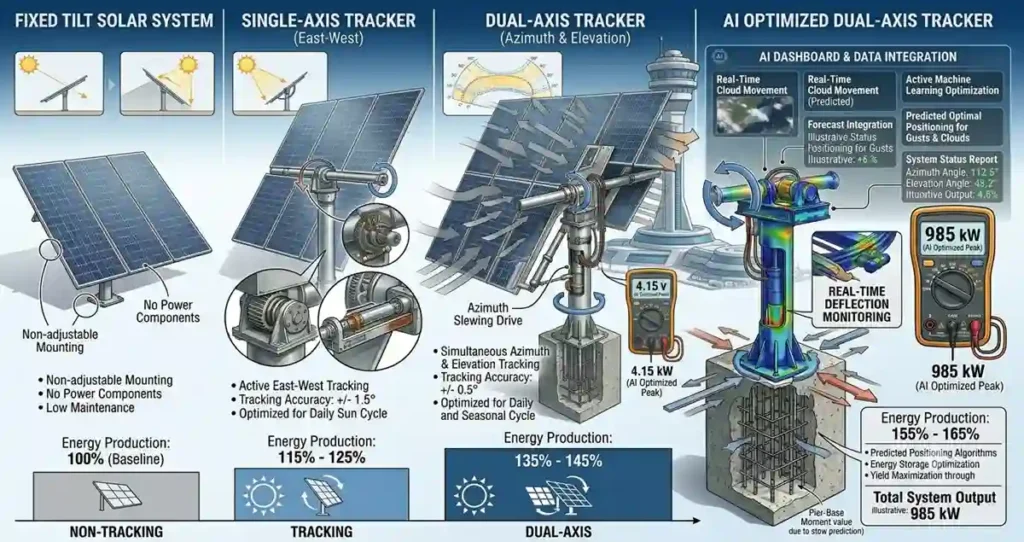
| US Region | Fixed (kWh/kWp) | Single Axis (kWh/kWp) | Dual Axis (kWh/kWp) | Dual Axis + AI (kWh/kWp) |
| Southwest (AZ, NV, NM) | 1,900-2,100 | 2,300-2,600 | 2,600-2,900 | 2,700-3,100 |
| Southeast (FL, GA) | 1,500-1,700 | 1,750-2,000 | 1,900-2,200 | 2,000-2,300 |
| Mountain West (CO, UT) | 1,600-1,900 | 1,900-2,200 | 2,100-2,500 | 2,200-2,600 |
| Midwest (IL, IN, OH) | 1,300-1,500 | 1,500-1,750 | 1,600-1,900 | 1,650-1,950 |
These figures are representative ranges based on typical site conditions. Site-specific modeling with actual meteorological data is required for project financial analysis. The dual-axis and dual-axis + AI figures assume a clear-sky fraction appropriate to each region.
6. Commissioning a Dual Axis Solar Tracking System
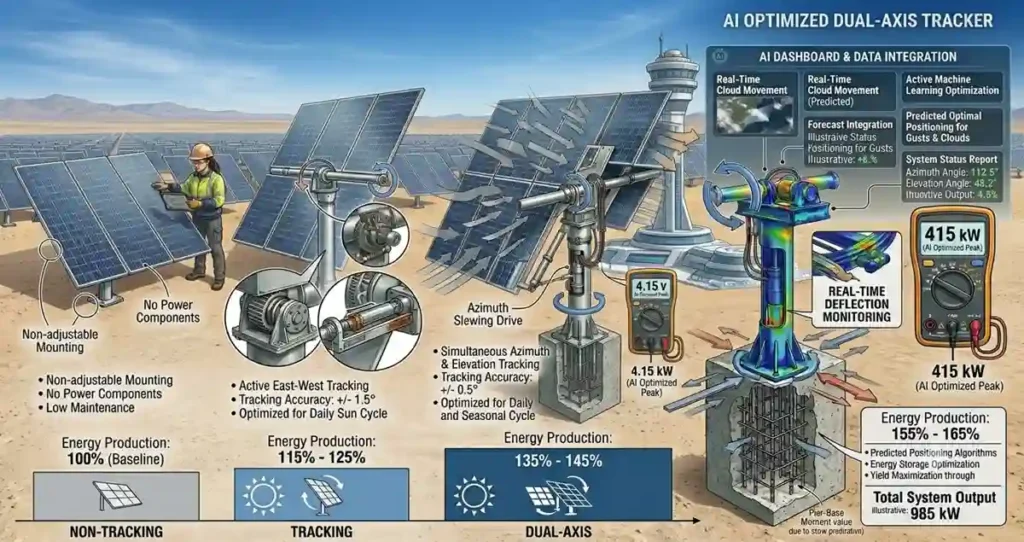
- Axis alignment verification: Both X and Y axis zero positions verified against the manufacturer’s magnetic north reference. Misalignment of 2 to 3 degrees in the zero position creates a systematic tracking error that reduces yield and is difficult to diagnose after commissioning.
- Drive system functional test: Full rotation range on both axes under no-load conditions. Verify motor current draw is within specification at all points in the rotation range — high current at any position indicates a mechanical interference or bearing preload issue.
- Controller calibration: GPS coordinates, time zone, and magnetic declination entered and verified. Astronomical position calculation verified against a reference sun position at three times of day.
- AI optimization initialization: If AI optimization is installed, confirm the baseline data collection period is active. AI controllers require 30 to 90 days of operational data before optimization algorithms are fully active.
- Wind stow function test: Trigger the stow position manually and verify both axes return to the correct stow angle within the specified response time. Verify the stow position wind speed trigger is set to the design value.
- Communication verification: SCADA or monitoring system connection verified. Real-time position data and power output data flowing correctly to the monitoring platform.
For the full mounting system engineering context — including ground mount foundations, rail systems, and bracket specifications for fixed systems — see the Solar Mounting Systems hub. For the single axis tracker comparison, see the Single Axis Solar Tracker System guide.
Frequently Asked Questions
What is a dual axis solar tracker?
A dual axis solar tracker is a motorized mounting system that moves solar panels on both horizontal (azimuth) and vertical (elevation) axes, allowing the panels to follow the sun throughout the day and across seasonal changes.
How much more electricity does a dual axis solar tracker produce?
Dual axis trackers typically increase annual energy production by 25% to 45% compared with fixed-tilt systems. Actual gains depend on location, solar resource quality, weather patterns, and system design.
Is a dual axis tracker better than a single axis tracker?
Dual axis trackers generally produce more energy because they compensate for both daily and seasonal solar movement. However, they are more expensive, mechanically complex, and require stronger foundations than single-axis trackers.
What are the main applications of dual axis solar trackers?
Dual axis trackers are commonly used in research facilities, agrivoltaic projects, commercial solar installations, utility-scale projects, and locations where maximizing energy production is a priority.
How does AI improve dual axis solar tracking?
AI-based controllers analyze weather conditions, cloud cover, shading patterns, and real-time power output to optimize tracker positioning beyond traditional astronomical algorithms, potentially increasing energy production by an additional 3% to 8%.
Are dual axis solar trackers worth the additional cost?
They can be economically attractive in high-irradiance regions where additional energy production offsets the higher capital and maintenance costs. Project-specific financial modeling should always be performed.
How do dual axis trackers handle strong winds?
Modern systems automatically move to a predefined stow position when wind speeds exceed operational limits. This reduces structural loading and helps protect the tracker from storm damage.
What maintenance is required for dual axis solar trackers?
Routine maintenance typically includes inspection of motors, actuators, slewing bearings, controllers, electrical connections, structural fasteners, and foundation components.
How long do dual axis solar trackers last?
Commercial dual axis tracker systems are typically designed for service lives of 25 years or more when properly maintained, although some drive components may require replacement during operation.
What certifications should a commercial dual axis tracker have?
Commercial buyers commonly look for compliance with UL 3703, IEC 62817, applicable structural engineering standards, wind load documentation, and manufacturer-supported performance certifications.
Related guides on SolarVisionAI.com
Solar Panel Installation: Complete Engineering Guide
Solar Power System : Types, Cost, ROI & AI Optimization