
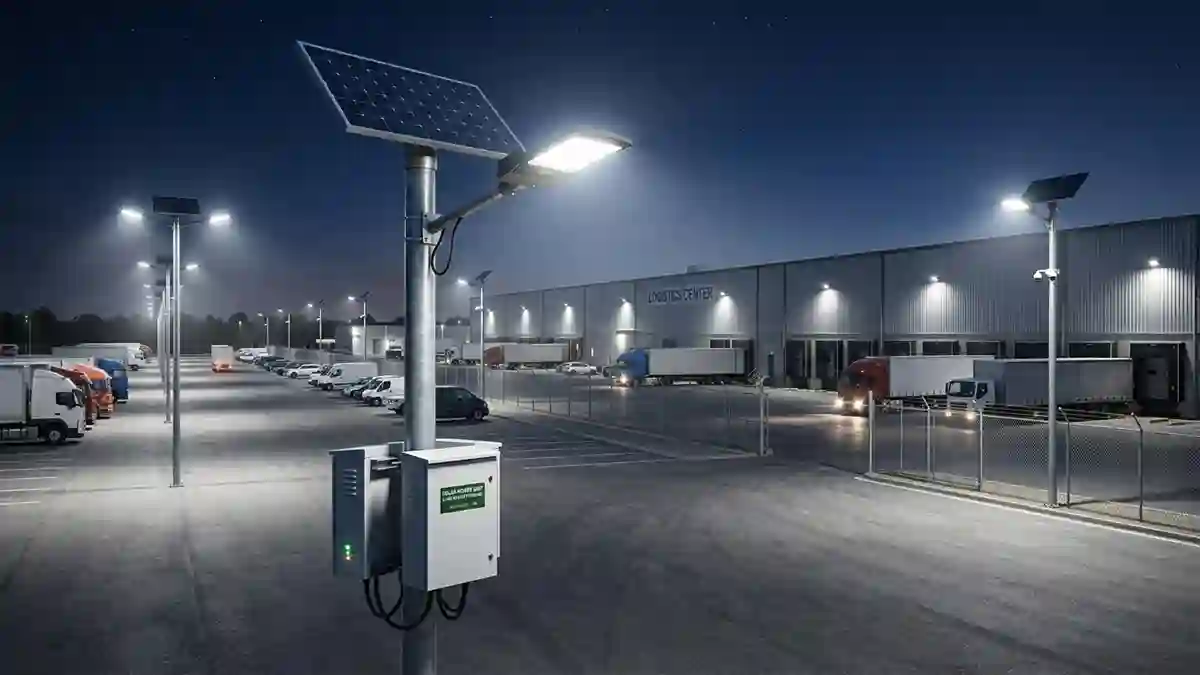
Commercial solar flood lights require engineering-level sizing — lux targets, panel arrays, LiFePO4 battery banks, pole mounting loads, and when AI load optimisation and grid-tie make sense.
Commercial solar flood lighting operates on a different engineering scale from residential applications. The lumen requirements are higher, the battery storage is larger, the mounting structures require structural engineering input, and the decision about whether to use standalone solar, grid-tie hybrid, or full grid power has real financial and operational consequences.
This guide covers the engineering framework for commercial solar flood light installations — from lux target calculation through panel sizing, battery bank specification, pole mounting engineering, and the conditions under which AI-driven load optimisation and grid-tie integration make economic sense.
For residential and mid-range flood light applications, the solar flood lights sizing guide and the motion sensor detection angles guide are the starting points.
1. Lux Targets: Starting with What the Application Actually Requires
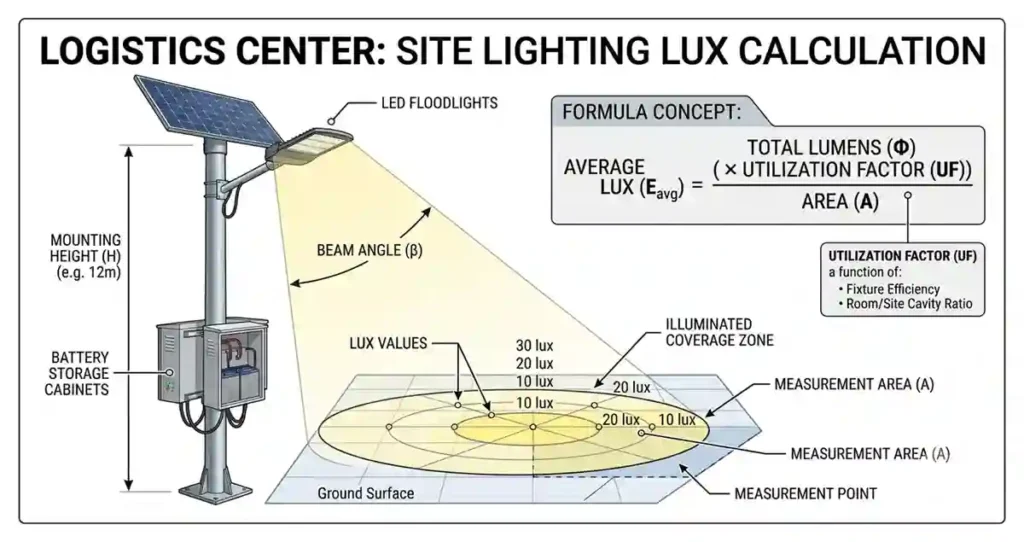
Commercial lighting design starts with lux — illuminance at the working plane — not lumens. Lumens measure total light output from the source; lux measures light arriving at the surface that matters. The relationship between them depends on mounting height, beam angle, and fixture efficiency.
Lux formula for a single fixture: Lux = (Lumens × CU × LLF) ÷ Area
Where CU = Coefficient of Utilisation (fixture efficiency and beam distribution, typically 0.5–0.7 for flood lights) and LLF = Light Loss Factor (accounting for soiling, temperature, and ageing, typically 0.7–0.85).
| Site Type | Area (m²) | Target Lux | Lumens Needed | Panel Size | Battery (min) |
| Parking lot (50 cars) | 1200 | 20–30 lux | 24,000–36,000 | 4×50W panels | BESS recommended |
| Warehouse perimeter | 2000 | 10–20 lux | 20,000–40,000 | 6×50W panels | BESS recommended |
| Construction site | 500 | 50 lux (work area) | 25,000 | 2×100W panels | 100Ah LiFePO4 |
| Commercial entry | 200 | 30–50 lux | 6,000–10,000 | 2×30W panels | 30Ah LiFePO4 |
| Sports court | 400 | 200–300 lux | 80,000–120,000 | Grid-tie required | Grid-tie required |
Engineer’s Note: The sports court row in the table illustrates the boundary of practical solar flood lighting. At 200–300 lux requirement over 400 m², the energy demand is 80,000–120,000 lumens — requiring 60–90kW of LED load for a typical match duration. That’s a grid-tie application. Standalone solar battery storage at that scale would require a battery bank of 400–600kWh — economically unjustifiable compared to a grid connection with solar supplementation.
2. Panel Array Sizing for Commercial Applications
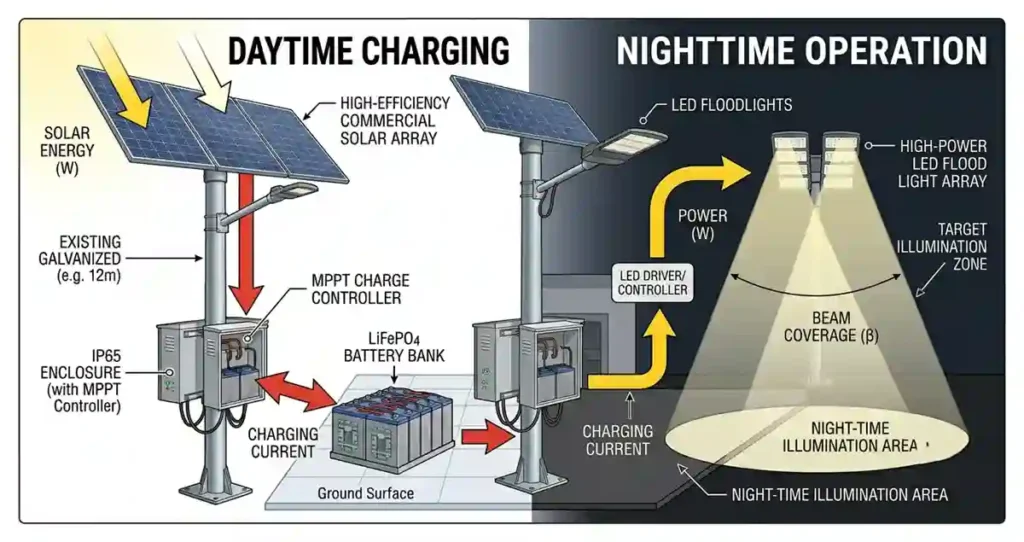
Commercial solar flood lighting almost always requires a separate panel array rather than integrated panels. The energy demand is too high for panel-integrated fixtures, and the optimal panel orientation (south-facing, optimum tilt) rarely coincides with the optimal fixture mounting position.
Panel sizing calculation:
Daily energy demand (Wh) = Total fixture wattage × Operating hours per night
Panel array output (Wh/day) = Panel rated wattage × Peak sun hours × Panel efficiency factor (0.75–0.85)
Required panel Wp = Daily energy demand ÷ (Peak sun hours × 0.80)
Example: A 5000-lumen commercial flood light array drawing 150W total, operating 6 hours per night:
Daily demand: 150W × 6h = 900Wh
Required panel: 900Wh ÷ (5h × 0.80) = 225Wp minimum
In practice, size up 20–25% for system losses and winter sun hour reduction: 225 × 1.25 = 280Wp panel array
Engineer’s Note: Panel sizing for commercial solar flood lighting must account for the worst-case month — not average annual sun hours. If your site receives 5 peak sun hours in summer but 2.5 in December, size the panel for the December condition. This typically means doubling the panel capacity compared to a summer-only calculation. The alternative is a BESS buffer large enough to carry through consecutive low-sun days — which brings its own sizing requirements.
3. Battery Bank Specification
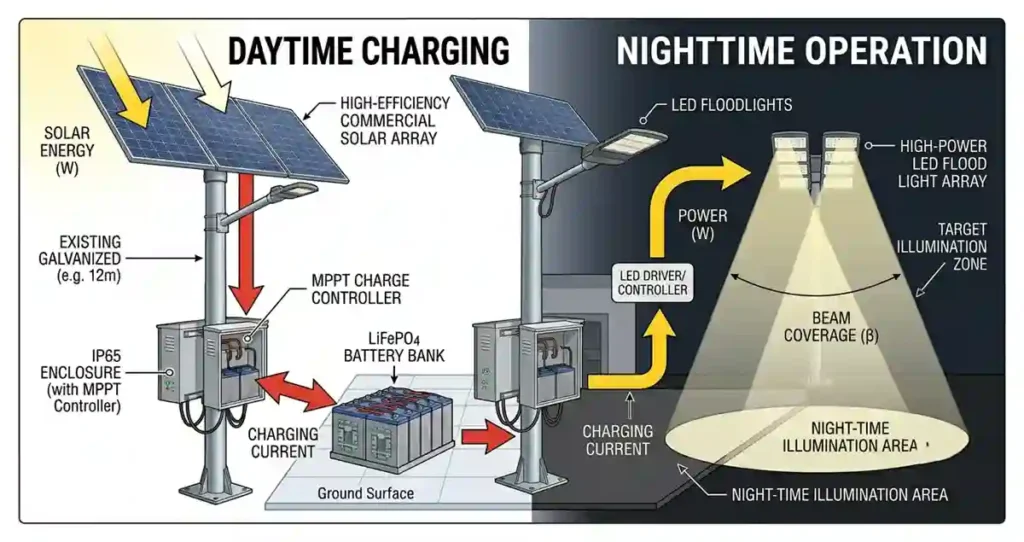
Commercial solar flood lighting battery banks are typically specified in kWh rather than mAh. LiFePO4 (Lithium Iron Phosphate) is the engineering standard for commercial applications — the cycle life (2000–3000+ cycles at 80% depth of discharge), temperature performance, and safety profile justify the higher upfront cost over the system lifetime.
Battery bank sizing: Daily energy demand × Days of autonomy ÷ Depth of discharge
Example using the 900Wh/night figure above with 2 days autonomy at 80% DoD:
Battery bank = 900Wh × 2 ÷ 0.80 = 2,250Wh = 2.25kWh minimum
For commercial installations, round up to the next standard battery module size and maintain a minimum 20% reserve above calculated requirements.
The battery sizing and management principles used in commercial flood lighting are covered in depth in the BESS guide on SolarVisionAI — the same methodology applies at both residential and commercial scale.
4. Mounting Engineering for Commercial Flood Lights
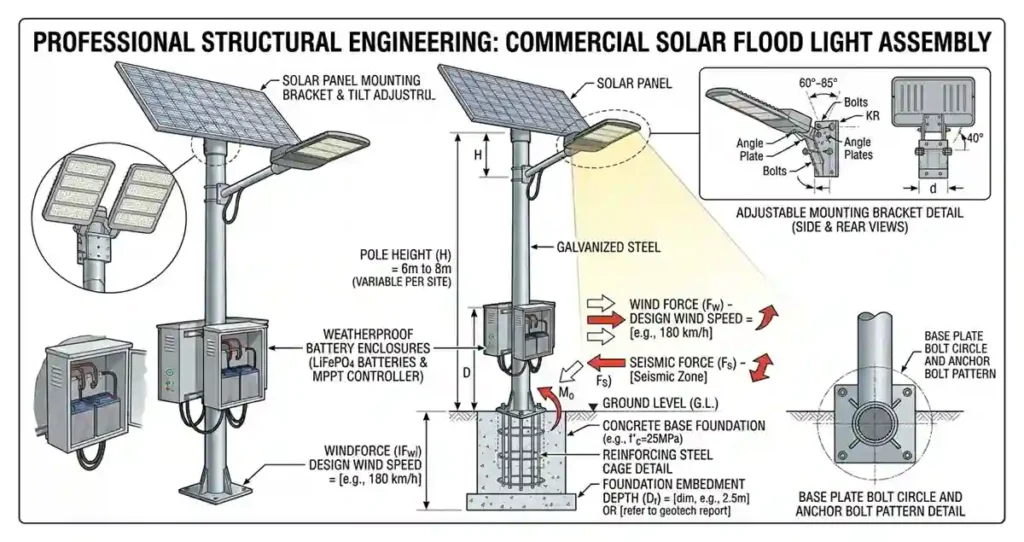
Commercial flood light mounting — particularly pole-mounted fixtures — involves structural engineering considerations that residential wall-bracket installations don’t. Wind load on a pole-mounted fixture at 6–8m height is a significant engineering input, not an afterthought.
| Mount Type | Height Range | Coverage Area | Wind Load Risk | Best Application |
| Wall bracket | 3–5m | Medium | Low | Building perimeter, entry |
| Pole mount (single) | 4–8m | Large — 360° possible | Medium | Parking, open areas |
| Pole mount (dual arm) | 5–8m | Very large | High — requires engineering | Commercial lots, roads |
| Portable tripod | 2–4m | Medium — adjustable | Low | Construction sites, events |
| Rooftop | Building height | Very large | Structural assessment needed | Large commercial perimeters |
Pole Mounting Structural Requirements
A pole-mounted solar flood light at 6m height with a dual-arm bracket and two 50W fixtures presents a combined wind load that must be calculated for the site’s design wind speed. In the US, ASCE 7 provides the wind speed maps and load calculation methodology. For commercial installations, the pole foundation and pole section must be engineered for the calculated wind load — not selected from a standard product catalog without verification.
Key parameters for pole mounting engineering:
Effective projected area (EPA) of the fixture and bracket — provided by the manufacturer
Design wind speed for the site — from ASCE 7 or local code
Drag coefficient for the fixture shape — typically 1.2–2.0 for flat rectangular fixtures
Pole section modulus — must exceed the calculated bending moment at the base
Foundation design — concrete embedment depth and diameter for the calculated overturning moment
Engineer’s Note: In my experience reviewing commercial solar flood light installations, pole foundation undersizing is the most common structural deficiency. Contractors often use generic ‘standard’ pole embedment depths from supplier catalogs without verifying against site-specific wind loads. In high-wind regions — coastal areas, open terrain — a pole embedded to catalog standard may be structurally inadequate. For any pole above 5m height carrying commercial flood fixtures, have the foundation designed by a licensed structural engineer.
5. AI Load Optimisation in Commercial Solar Flood Lighting
This is an area where AI-driven control systems provide genuine engineering value at commercial scale — not marketing language, but measurable performance improvement.
Commercial solar flood lighting AI controllers analyse: battery state of charge, historical trigger frequency by time of night, weather forecast data (predicted sun hours for the following day), and seasonal solar irradiance patterns. Based on this data, the controller dynamically adjusts fixture output levels and motion sensor sensitivity throughout the night to optimise the balance between light output and battery reserve.
Practical outcomes from AI load optimisation in commercial installations:
15–25% reduction in battery bank size requirements for equivalent performance — the controller prevents unnecessary full-output operation when battery reserve is low
Improved winter reliability — the system pre-adjusts for forecast low-charge days rather than reacting after battery depletion
Reduced maintenance interventions — the system self-adjusts rather than requiring manual reprogramming each season
Fault detection — AI controllers can identify degraded battery cells, panel soiling events, and PIR sensor drift before they become visible performance issues
At the residential scale, smart scheduling (as covered in the motion sensor guide) is the entry-level version of this capability. At commercial scale, full AI load optimisation with weather forecast integration and predictive battery management is the engineering standard for quality installations.
6. Grid-Tie Hybrid: When It Makes Engineering Sense
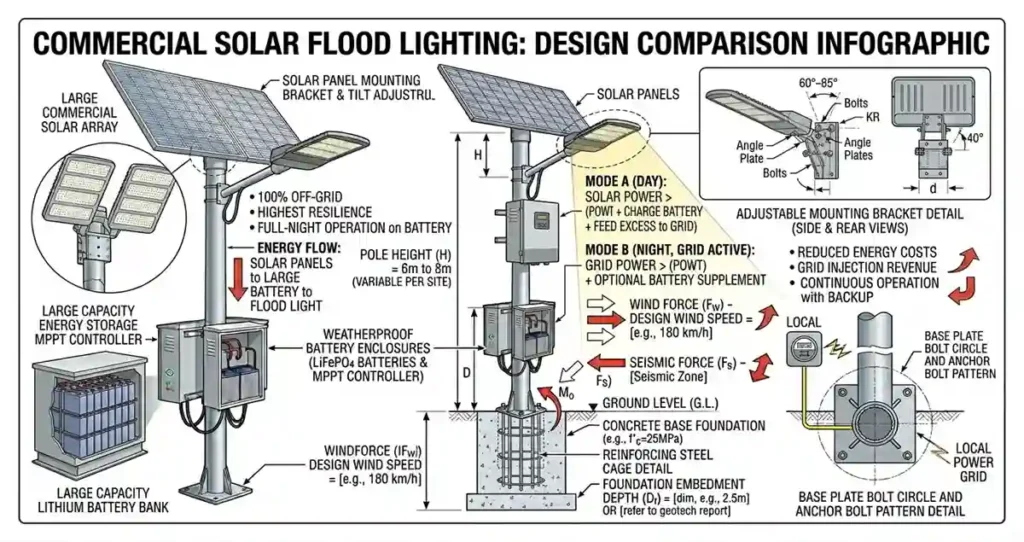
Standalone solar flood lighting has practical limits defined by panel area, battery capacity, and winter sun hours. Grid-tie hybrid systems — where a solar panel array supplements grid power rather than replacing it — extend those limits significantly.
Grid-tie hybrid makes engineering sense when:
The standalone solar battery bank required for reliable all-night operation exceeds 10kWh — grid supplementation becomes cost-competitive
The application requires guaranteed uptime regardless of weather — critical safety lighting, access control, emergency egress
The site already has a grid connection — the marginal cost of adding solar supplementation is lower than standalone solar storage
Export tariffs or net metering make daytime solar generation commercially attractive — flood lights that charge during the day and export surplus provide an additional revenue stream
For a detailed analysis of net metering and solar ROI in commercial applications, the commercial solar panel installation guide on SolarVisionAI covers the financial and engineering framework.
Field Note: I worked on a commercial perimeter lighting project for a 2000 m² warehouse site that initially specified standalone solar flood lighting. The calculated battery bank for 6 hours of 3000-lumen perimeter coverage with 2 days autonomy came to 18kWh — a significant capital cost. A grid-tie hybrid design using a 6kWh battery bank with grid fallback reduced battery capital cost by 65% while maintaining guaranteed uptime. The solar panels still covered 70% of annual energy demand. The hybrid approach was the correct engineering and financial choice for that site.
7. Charge Controller Selection for Commercial Installations
Commercial solar flood light installations require MPPT (Maximum Power Point Tracking) charge controllers rather than the PWM controllers common in consumer solar products. MPPT controllers extract 15–30% more energy from the panel array under real-world conditions — the difference is significant at commercial scale.
For commercial installations, select MPPT controllers rated for the full panel array Voc (open circuit voltage) with a 25% safety margin, and sized for the battery bank voltage (typically 24V or 48V for commercial applications — higher voltage reduces cable losses at commercial current levels).
The charge controller selection and sizing methodology is covered in the solar charge controller complete guide — the same principles apply from residential to commercial scale.
Frequently Asked Questions
What wattage solar flood light do I need for a commercial parking lot?
For a 50-car parking lot (~1200 m²) at 20–30 lux target: approximately 24,000–36,000 lumens total. At 150 lm/W LED efficiency, that’s 160–240W of LED load. At 6 hours operation per night, daily energy demand is 960–1440Wh. Panel array requirement: 240–360Wp. This is well above the capacity of self-contained flood light units — a separate panel array with a 3–5kWh LiFePO4 battery bank is the correct engineering specification.
Do commercial solar flood lights need planning permission?
In most US jurisdictions, outdoor lighting installations above a certain height (typically 5m) or lumen output require a building permit and compliance with local lighting ordinances. Light trespass limits, maximum mounting heights, and curfew requirements (automatic dimming after a specified hour) vary by municipality. For commercial installations, verify local lighting codes before finalising fixture specifications and mounting heights.
How long do commercial solar flood light batteries last?
LiFePO4 batteries specified for commercial solar applications typically deliver 2000–3000 full charge cycles at 80% depth of discharge before capacity drops to 80% of rated — the standard end-of-life threshold. At one cycle per day, that’s 5.5–8.2 years of service life. In practice, partial cycling (the battery doesn’t fully charge and discharge every day) extends this further. A properly specified LiFePO4 battery bank in a commercial solar flood light installation should deliver 8–12 years of reliable service.
When should I choose a grid-tie hybrid over standalone solar for commercial flood lighting?
When the calculated standalone battery bank exceeds 10kWh, when guaranteed uptime regardless of weather is a specification requirement, or when the site already has a grid connection that makes hybrid integration straightforward. The financial crossover point between standalone solar and hybrid depends on local electricity tariffs, battery capital costs, and the value of guaranteed uptime. For most commercial sites in the US with existing grid connections, hybrid is the economically rational choice for daily energy demand above 5kWh.
Final Thoughts
Commercial solar flood lighting is an engineering discipline, not a product purchase. The difference between a system that works reliably for a decade and one that underperforms from the first winter is almost entirely in the upfront design — lux targets calculated correctly, panel array sized for the worst-case month, battery bank specified with adequate autonomy, and mounting structures engineered for the site’s wind load.
AI load optimisation and grid-tie hybrid integration are not premium add-ons for commercial installations — they’re engineering tools that reduce battery bank sizing requirements and improve long-term reliability. At commercial scale, they’re worth specifying from the start.
For the residential and mid-range context that feeds into commercial applications, the complete solar lights cluster on SolarVisionAI covers everything from fence post caps through security lights and residential flood lighting — all written from the same engineering foundation.
Related guides on SolarVisionAI.com
Solar Motion Sensor Flood Light: IP Ratings & Sizing Guide — solarvisionai.com/solar-flood-lights/
Commercial Solar Panel Installation — solarvisionai.com/commercial-solar-panel-installation/