
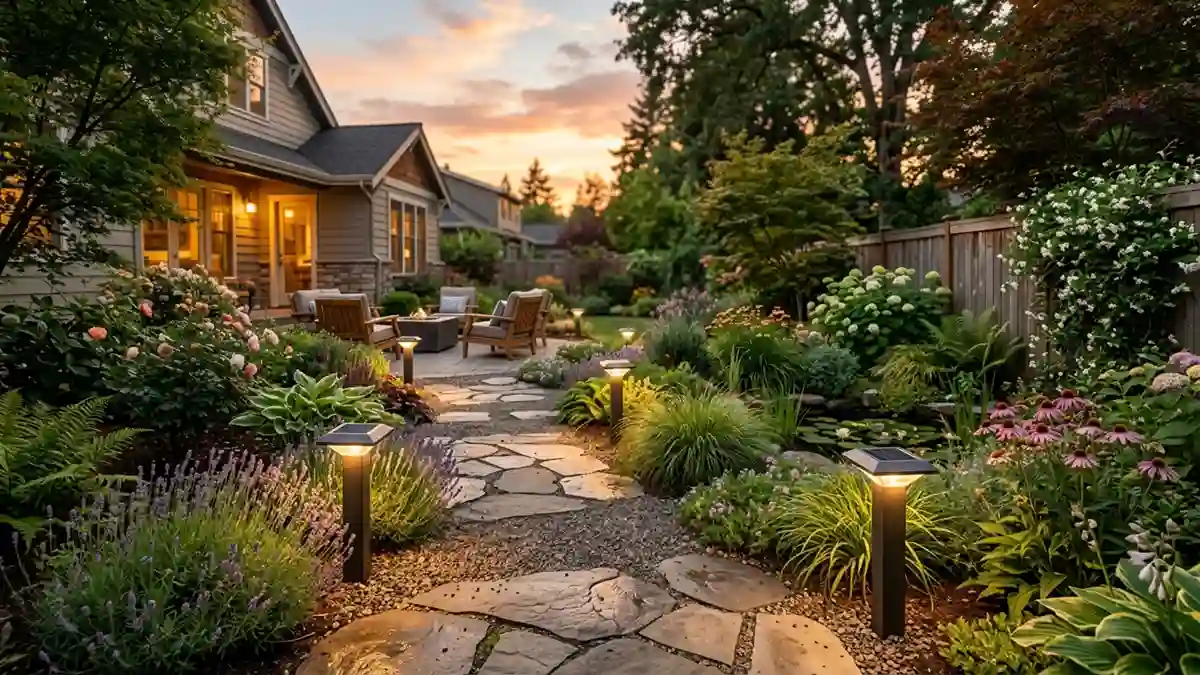
Solar garden lights explained by a PE — types from pathway stakes to string lights, placement spacing, lumen sizing by application, and what separates reliable units from early failures.
A practical engineering guide to solar garden lights — covering every type from pathway stakes to string lights and dock fixtures, placement spacing, lumen requirements by application, IP rating selection, and the specs that determine long-term reliability. Written by a Registered Professional Engineer (PEC ELECTRO/15141).
Solar garden lights cover a wider range of products than most people realise when they start shopping. The category includes everything from 5-lumen stake lights that define a pathway border to 3000-lumen pole-mounted solar street lights that illuminate a full driveway. They use the same basic technology — solar panel, battery, LED — but the scale, application, and performance requirements vary enormously.
Most purchasing mistakes in this category occur when the buyer chooses a product based on appearance without verifying the specs for the actual application. A pathway stake that looks perfect in a product photo may be completely inadequate for its intended location, or overspecified for a simple decorative use.
This guide covers the full range of solar garden and outdoor light types, with placement guidance and lumen sizing for each application. It’s the hub article for the decorative and garden lighting cluster on SolarVisionAI — the specific guides for flagpole lights, string lights, dock and deck lights are linked throughout.
1. Solar Garden Light Types: What’s Available and What Each Does
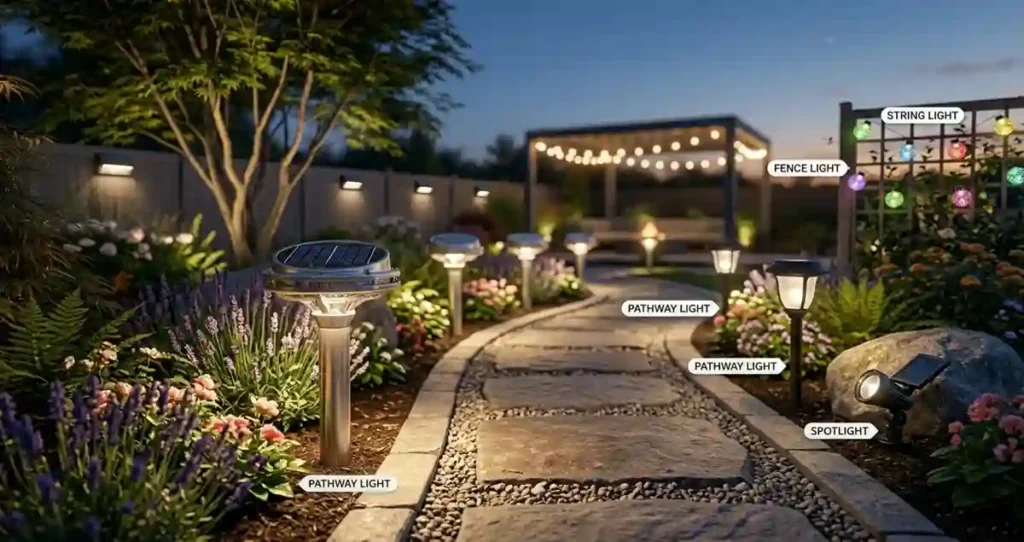
Here’s a straightforward breakdown of the main solar garden light categories, their output range, and what they’re actually for:
| Type | Lumen Range | Battery | IP Rating | Best Application | AI/Smart |
| Fence post caps | 5–60 lm | 400–1200 mAh | IP44–65 | Perimeter definition | Motion cap variants |
| Pathway stakes | 5–30 lm | 400–800 mAh | IP44–65 | Walkway borders | No |
| Garden spotlights | 30–200 lm | 1000–3000 mAh | IP65 | Plant & feature uplighting | No |
| String lights | 5–20 lm/bulb | 1000–3000 mAh | IP44–65 | Decorative overhead | No |
| Flagpole lights | 100–600 lm | 3000–8000 mAh | IP65 | Flag illumination | No |
| Dock/deck lights | 30–150 lm | 1000–2000 mAh | IP67 | Waterside structures | No |
| Street/pole lights | 1000–5000 lm | Separate battery | IP65 | Road/pathway | Smart scheduling |
A few things worth noting in this table:
Pathway stakes are the most commonly purchased solar garden light. They’re also the most commonly returned — usually because the buyer expected more light output than 5–15 lumens delivers. Pathway stakes define a border, they don’t illuminate it. Set expectations accordingly.
Garden spotlights in the 50–200 lumen range are where solar garden lighting gets genuinely useful for illuminating specific features — a tree, a sculpture, a garden bed. The solar panel on a spotlight is typically larger than a stake light, which means better winter charging performance.
Solar street lights at 1000–5000 lumens are the high end of this category. These require separate panels and battery banks — self-contained units at that output level can’t reliably sustain all-night operation on an integrated panel and battery. For solar street light applications, the engineering approach is the same as for commercial flood lighting.
Engineer’s Note: The IP rating column matters more than it appears in product listings. IP44 is adequate for sheltered garden locations — under tree canopy, in a garden bed away from direct rain exposure. For any fixture in a fully exposed location — pathway stakes on an open driveway, dock lights, exposed post caps — IP65 is the practical minimum. The additional cost between IP44 and IP65 variants is usually negligible; the difference in service life in exposed locations is significant.
2. Placement and Spacing: The Decisions That Determine Results
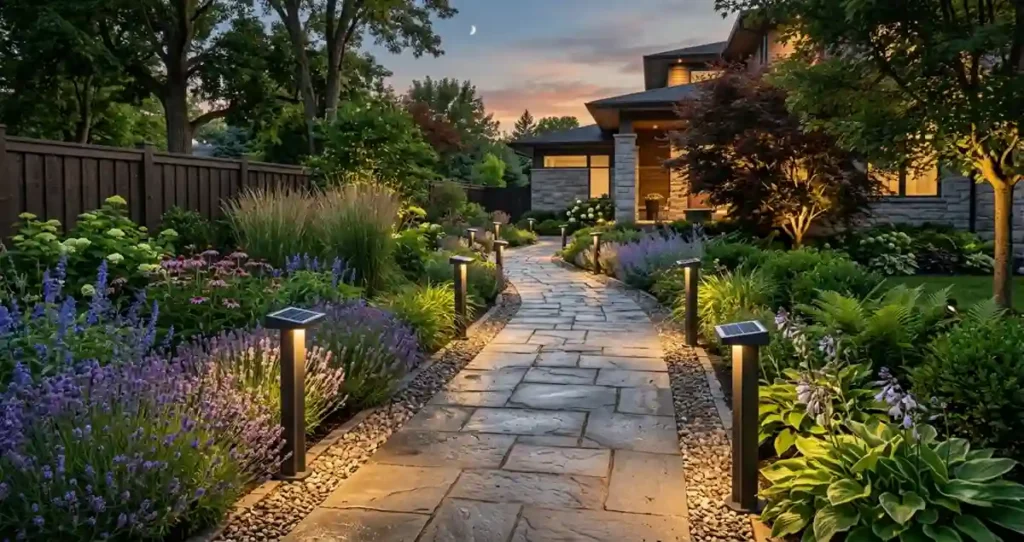
The most common solar garden lighting mistake isn’t wrong product selection — it’s wrong placement. Even well-specified products perform poorly when placed without considering light overlap, panel exposure, and the visual effect of the spacing decisions.
| Light Type | Typical Spacing | Lumen Needed | Height/Position | Coverage Effect |
| Pathway stakes | 1–1.5m apart | 10–20 lm | Ground level | Continuous border definition |
| Garden spotlights | 1 per feature | 50–100 lm | Ground, angled up | Accent — plant or structure |
| Fence post caps | Every post | 15–40 lm | Post top | Perimeter line definition |
| String lights | Continuous span | Total 200–500 lm | Overhead 2–3m | Ambient canopy effect |
| Dock/deck edge | 1–2m apart | 30–60 lm | Deck edge/step | Safety + ambiance |
Panel Orientation in Garden Installations
Solar garden lights are often placed based on aesthetic considerations — where the light looks good — without checking whether the solar panel has adequate sun exposure. A pathway stake positioned under dense tree canopy may receive 1–2 hours of direct sun per day instead of the 5–6 hours needed for full battery charge. The result is 2–3 hours of dim output rather than 8 hours of rated output.
Before finalising any solar garden light placement, check sun exposure at the panel position from late morning to mid-afternoon. This is the peak solar window that determines most of the day’s charge. Anything blocking that window will proportionally reduce performance.
Avoiding the Common Spacing Mistakes
Too far apart: the most common mistake. Pathway stakes at 3m intervals create isolated pools of dim light rather than a continuous, defined edge. For a visually effective pathway border, 1–1.5m maximum spacing is the practical standard.
All at the same height: mixing ground-level pathway stakes with mid-height post cap lights and overhead string lights creates layered lighting that looks intentional. All ground-level creates a flat, one-dimensional effect.
Ignoring the view from inside, garden lighting is as much about the view from indoors as the view from the garden. Before installing, stand at your most-used indoor window at night and visualise where light points would improve the view.
Field Note: On a garden lighting project with 20 pathway stakes, the homeowner initially spaced them at 2.5m intervals along a 50m path. The result was isolated light points with significant dark gaps between them. Reducing spacing to 1.5m — adding 14 stakes — transformed the effect from isolated dots to a continuous glowing border. The additional stakes cost less than the original 20. Spacing is the cheapest design decision with the highest visual impact.
3. Battery and Panel Sizing for Garden Lights
Garden lights cover such a wide output range that battery and panel sizing guidance needs to be type-specific. Here’s the practical framework:
Pathway stakes (5–15 lm): 400–800 mAh NiMH or Li-ion battery, 2×3 cm panel minimum. These are low-drain, and most commercial units are adequately specified. The main failure mode is panel soiling reducing charge over time — clean panels annually.
Garden spotlights (50–200 lm): 1000–3000 mAh Li-ion, 5W panel minimum. At this output level, a separate adjustable panel (not integrated in the fixture head) is worth specifying — it allows optimal panel orientation independent of fixture position.
String lights (total system): See the dedicated string lights guide for the full sizing table. As a quick reference: 10m of string lights needs a 2000–3000 mAh battery for 7–9 hours runtime.
Flagpole lights: Output requirements are higher than most garden lights — 200–600 lumens for standard residential flags. See the dedicated flagpole lights guide for lumen-to-flag-size matching.
Engineer’s Note: For any solar garden light where you’re specifying the panel and battery separately — spotlights, dock lights, solar street applications — use the same energy balance calculation as larger solar systems: daily energy demand (Wh) = LED wattage × runtime hours. Size the panel to replenish that in one winter charge day. Size the battery for 2 days autonomy. The arithmetic doesn’t change with scale.
4. IP Ratings for Garden Lighting: Matching Protection to Location
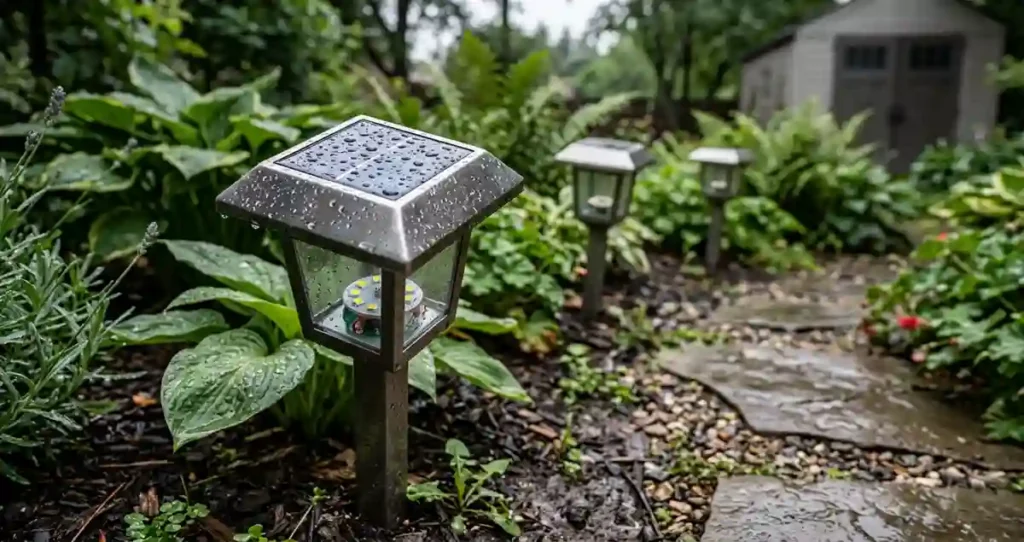
IP ratings in garden lighting follow the same principles as in security and flood lighting — the two digits indicate dust and water protection. The difference in garden applications is that many fixtures are at ground level, in soil contact, or in locations where water accumulates.
IP44: adequate for fixtures that are sheltered from direct rain — under eaves, in a covered patio, or in a garden bed where the fixture is angled and the rain doesn’t directly hit the panel or LED enclosure. Most pathway stakes in garden beds qualify for IP44.
IP65: the standard for any exposed location. Pathway lights on an open driveway, post cap lights, garden spotlights in open areas. The water jet protection means they survive direct rain from any angle without water ingress.
IP67: relevant for dock and waterside applications where the fixture may be temporarily submerged — a dock fixture at water level during high water, or a step light on a dock that gets wave splash. For pure garden applications, IP67 is rarely necessary but adds peace of mind in wet climates.
5. Solar Lights for Yard: Planning a Complete Layout
Planning a complete yard lighting layout is where the individual product decisions come together into a coherent scheme. The approach I use for yard layouts follows a simple hierarchy:
Layer 1 — Perimeter definition: fence post cap lights or pathway stakes defining the property or garden boundary. Low output, consistent spacing, sets the outer frame of the lighting scheme.
Layer 2 — Access paths: pathway stakes or embedded path lights guiding movement through the yard. Functional first — people need to see where they’re walking. 15–25 lumens at 1–1.5m spacing.
Layer 3 — Feature accent: garden spotlights on specific plants, sculptures, water features, or architectural elements. These provide the visual interest in the scheme. 50–200 lumens, positioned to illuminate from below or the side.
Layer 4 — Ambient overhead: string lights over a patio, pergola, or seating area. Creates atmosphere rather than task lighting. Works with layers 1–3 rather than replacing them.
Most yard lighting schemes that look good use at least three of these layers. A yard with only pathway stakes looks functional but flat. Adding feature spotlights and string lights over a seating area creates the depth that makes the lighting feel designed rather than installed.
For fence post cap lights specifically — the Cluster 5 articles cover sizing, material compatibility, and installation in detail. The solar fence post lights guide and the lumen sizing guide are the reference articles for that component of a yard layout.
6. What Not to Buy: Common Mistakes in Solar Garden Lighting
A few purchasing patterns consistently lead to disappointment:
Buying on appearance only: The product photos are taken in carefully controlled lighting. The actual output of a 5-lumen stake light in a real garden at night is much less dramatic than the photo suggests. Check the lumen rating before buying.
Underestimating quantity: Eight pathway stakes for a 15m garden path looks fine in the cart and sparse in the ground. Buy 20–25% more than you think you need — solar garden lights are inexpensive individually, and the visual difference between adequate and generous quantity is significant.
Ignoring seasonal performance: A stake light that runs 10 hours in July may run 3–4 hours in December. If you need garden lighting that performs reliably through winter, check the battery capacity and winter performance specs before purchasing — or accept that winter performance will be reduced and plan accordingly.
Mixing colour temperatures: Warm white (2700–3000K), neutral white (4000K), and cool white (5000–6500K) look very different in a garden at night. Mixing them creates an incoherent result. Choose one colour temperature and stick to it across all fixtures in a zone.
Frequently Asked Questions
How many solar garden lights do I need?
For pathway borders: one stake per 1–1.5m of path length. For a 20m path, that’s 14–20 stakes. For perimeter definition with fence post caps: one per post, which is determined by your fence layout. For feature spotlights: one per significant garden feature. For string lights: measure the span and match the string length, allowing 10–20% extra for draping rather than straight runs.
Do solar garden lights work in shade?
They work, but with significantly reduced battery charge and therefore reduced runtime. A fixture receiving 2 hours of direct sun rather than 6 hours will charge to roughly 30–40% of full capacity — resulting in proportionally shorter runtime. For genuinely shaded locations, either accept reduced performance or specify a fixture with a larger panel that can be positioned in sun separately from the light head. Several spotlight designs offer this configuration.
What colour temperature is best for garden lighting?
Warm white (2700–3000K) is the standard for residential garden lighting. It renders plants and natural materials well, creates a welcoming atmosphere, and is less intrusive to wildlife and neighbours than cool white. Neutral white (4000K) is acceptable for functional areas like pathways and driveways. Cool white (5000K+) tends to look harsh in garden settings and is better suited to security and work area lighting.
How long do solar garden lights last?
The LED arrays in quality solar garden lights typically last 20,000–50,000 hours — effectively the life of the product. The limiting factor is the battery. NiMH batteries (common in budget pathway stakes) last 500–800 charge cycles — 18 months to 2 years of daily cycling. Li-ion batteries last 1000–1500 cycles — 3–4 years. LiFePO4 batteries in quality spotlights and dock lights last 2000–3000+ cycles — 5–8+ years. Battery replacement, not fixture replacement, is the correct maintenance approach when runtime decreases.
Can I leave solar garden lights out in winter?
Yes for IP65-rated fixtures. Most solar garden lights are designed for year-round outdoor use. Performance will be reduced in winter due to shorter charge days and lower sun angles. In climates with extended hard frost, NiMH batteries may suffer accelerated capacity loss if left in very cold conditions while at low charge state. For quality Li-ion or LiFePO4 batteries, winter outdoor storage is not a problem.
Final Thoughts
Solar garden lights are one of the most accessible solar applications — low cost, no electrical installation required, and immediate visual impact. The decisions that determine whether they work well are simple: match the lumen output to the application, check the panel has adequate sun exposure, space them correctly, and verify the IP rating for the mounting location.
The specific guides in this cluster cover the products with more complex specification requirements — flagpole lights where lumen output needs to match flag size, string lights where the battery-to-string-length relationship matters, and dock and deck lights where waterproofing and load ratings add complexity beyond standard garden lighting.
Related guides on SolarVisionAI.com
Solar Flagpole Lights: How to Pick the Right Lumen Output — solarvisionai.com/solar-flagpole-lights/
Solar String Lights: What the Specs Actually Mean — solarvisionai.com/solar-string-lights/
Solar Fence Post Lights Lumens Guide — solarvisionai.com/solar-fence-post-lights-lumens/