
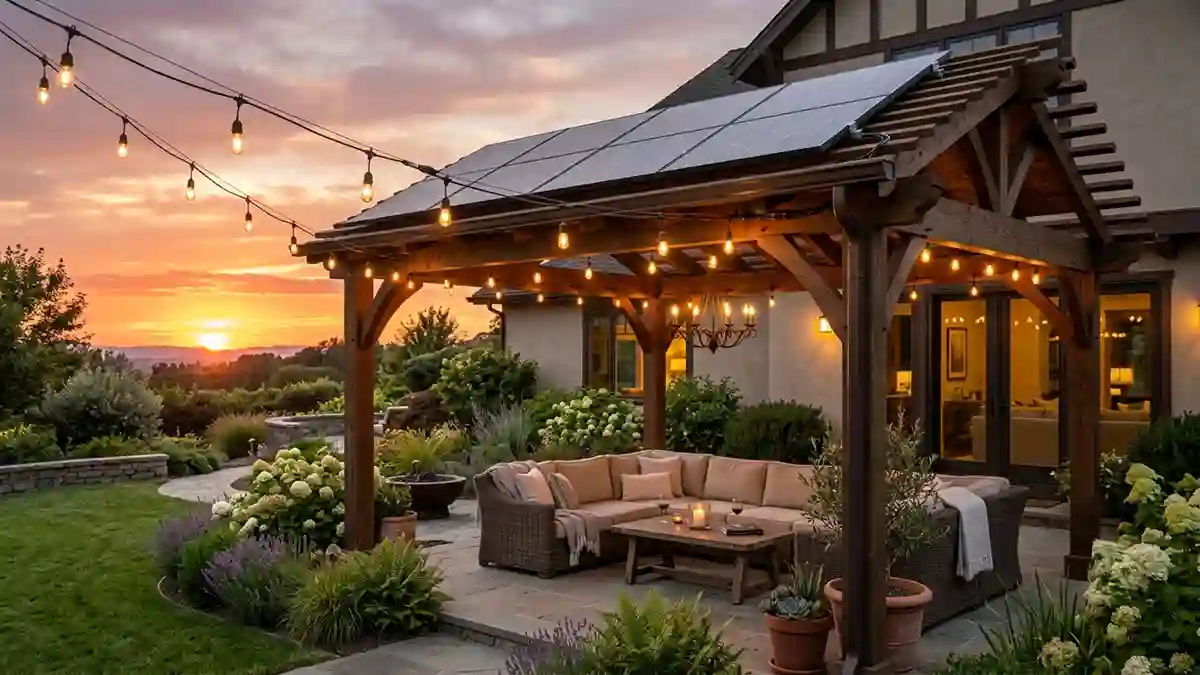
Solar string lights specs decoded — bulb types, IP ratings, battery-to-string-length ratios, winter performance, and what separates units that last from ones that fail after one season.
Solar string lights combine decorative lighting with a small solar panel, rechargeable battery, and LED bulbs. While they are one of the most visually impactful outdoor lighting products, real-world performance depends far more on the battery, solar panel, and IP rating than the product photos suggest. Written by a Registered Professional Engineer
Solar string lights are the most visually impactful solar garden product for the price — a set of well-placed string lights over a patio or pergola transforms the space in a way that pathway stakes and post caps don’t. They’re also the category where the gap between the product photo and real-world result is widest.
The disappointments follow a consistent pattern: lights that dim significantly after 3–4 hours, string lengths that don’t reach the intended span, bulbs that fail in the first wet season, and winter performance that drops off to the point of being barely visible. All of these are predictable from the specs — if you know which specs to look at.
This guide decodes the string light spec sheet and gives you the framework to select units that will actually perform for the application you have in mind.
1. Bulb Types: More Than Just Aesthetics
The bulb style in solar string lights isn’t just an aesthetic choice — it affects light output, IP rating suitability, and how the string performs in outdoor conditions.
| Bulb Type | Output/Bulb | Power Draw | IP Rating | Lifespan | Best Use |
| G40 globe (incandescent look) | 5–8 lm | Low | IP44 | 20,000 hrs | Pergola, patio, decorative |
| S14 Edison style | 8–15 lm | Low | IP44–65 | 25,000 hrs | Outdoor dining, garden canopy |
| Fairy light (micro LED) | 0.5–2 lm | Very low | IP44 | 30,000 hrs | Trees, hedges, delicate features |
| Weatherproof globe | 10–20 lm | Medium | IP65 | 20,000 hrs | Exposed locations, year-round |
G40 globe and S14 Edison-style bulbs are the most popular for outdoor use because they most closely replicate the look of traditional incandescent string lights. Both use LED filament arrays inside a clear or frosted glass globe, which produces a warm, omnidirectional glow rather than the directional point source of a standard LED.
Fairy lights (micro LED): at 0.5–2 lumens per point, these are purely decorative — they create the visual impression of many small light points in foliage or along a structure, not functional illumination. The very low power draw per point means a long string can run from a small battery, which is why most solar fairy light sets come with relatively modest battery specs and still achieve long runtimes.
Weatherproof globe variants: the IP65-rated string lights use rubber or silicone encapsulation around each bulb socket rather than open glass globe mounts. Less elegant visually, but significantly more durable in exposed outdoor locations. For a permanently installed outdoor string in a climate with real weather, the weatherproof variant is the engineering choice over the decorative glass globe type.
Engineer’s Note: The IP rating on a string light applies to the bulb socket and connection points — not the wire itself. Most outdoor string light wire is rated for outdoor UV exposure but is not submersion-rated. In practice, this means standard IP44 string lights can handle rain but shouldn’t be installed in positions where water pools along the wire or sits in the socket. Vertical hanging reduces water accumulation at sockets; horizontal runs in areas with poor drainage can shorten socket life significantly.
2. Battery Capacity vs String Length: The Ratio That Matters
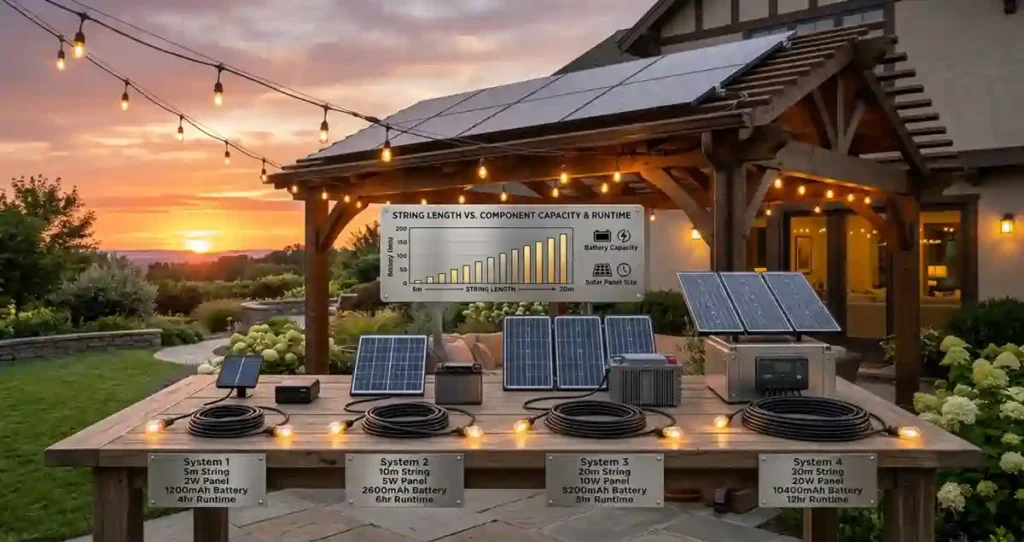
This is the specification that most solar string light listings handle poorly. The battery capacity, panel size, and string length need to be matched to each other — but most products are sold with a fixed configuration that may or may not be appropriate for how you intend to use them.
| String Length | Bulb Count (typ.) | Total Draw | Battery Needed | Runtime (full charge) |
| 5m | 10–15 bulbs | 0.5–1W | 1000–1500 mAh | 8–10 hrs |
| 10m | 20–30 bulbs | 1–2W | 2000–3000 mAh | 7–9 hrs |
| 20m | 40–60 bulbs | 2–4W | 4000–6000 mAh | 6–8 hrs |
| 30m+ | 60–100 bulbs | 4–8W | Separate panel | Depends on panel size |
The panel size column deserves attention. A 30m+ string on a self-contained panel and battery is typically specified with a panel too small to fully charge the battery in winter—the math: a 30m string at 6W draw over 8 hours needs 48Wh of storage. At 2.5 winter peak sun hours and 15% panel efficiency, a 6W panel generates approximately 15Wh — replenishing only 31% of the overnight draw in one winter day.
For string lengths above 20m, either accept that winter performance will be significantly reduced, or specify a system with a larger separate panel and battery rather than relying on the integrated unit.
3. Solar Christmas Lights: What’s Different
Solar Christmas lights are string lights optimised for seasonal outdoor decorative use — most commonly on trees, rooflines, bushes, and fences. The engineering requirements differ slightly from permanent patio string lights:
Higher LED count per meter: Christmas lights are typically denser — 50–100 LEDs per 10m rather than the 20–30 of patio strings — creating a fuller visual effect in foliage.
Lower output per LED: individual LED output is typically 0.5–2 lumens — lower than patio string bulbs. The visual effect comes from density rather than individual brightness.
Colour options: multicolour LEDs draw the same power as white LEDs of equivalent count but produce a different visual effect. Colour-changing modes (fade, flash, strobe) draw slightly more power due to the controller circuit — expect 10–15% shorter runtime in dynamic modes vs static.
Winter performance: this is the most common complaint with solar Christmas lights. December and January are the worst months for solar charging in the northern hemisphere — short days, low sun angle, and frequent cloud cover all reduce available charge. For reliable Christmas lighting performance, specify a unit with at least 2× the battery capacity you’d need for summer use, or plan for partial charging and reduced runtime on cloudy days.
Field Note: The most consistent solar Christmas light complaint I encounter is the lights going dark by 10–11 PM. In December at 45° N latitude, peak sun hours average 2–3 per day. A string that needs 30Wh per night and charges at 3W effective panel output only stores 6–9Wh per day — 20–30% of what it needs. The unit isn’t defective; it’s undersized for winter solar resource. Specifying a unit with a larger separate panel positioned for maximum winter sun exposure resolves this. If that’s not possible, accept that December runtime will be 2–3 hours rather than 8 hours.
4. IP Ratings for String Lights: Matching Protection to Location
String light IP ratings require understanding both the string wire and the individual socket ratings, which are sometimes different in the same product.
IP44 string lights are adequate for installations where the lights hang freely (allowing water to drain away from sockets) and where they’re not in a position for direct driving rain to pool in horizontal socket openings. Pergola overhead installations and vertical tree wrapping typically qualify for IP44.
IP65 string lights are needed for fully exposed roofline installations, fence wrapping in exposed locations, and any installation where water may pool in the socket area. The sealing in IP65 socket construction prevents water entry even when water sits directly on the socket.
For string lights near or on dock structures, IP65 minimum and consideration of salt-air exposure (for coastal installations) applies. At the water surface, IP67 splash-rated connectors are appropriate — though most string lights don’t reach this rating and aren’t intended for dock edge mounting.
5. Lighting Solar Lights: Panel Positioning for String Applications
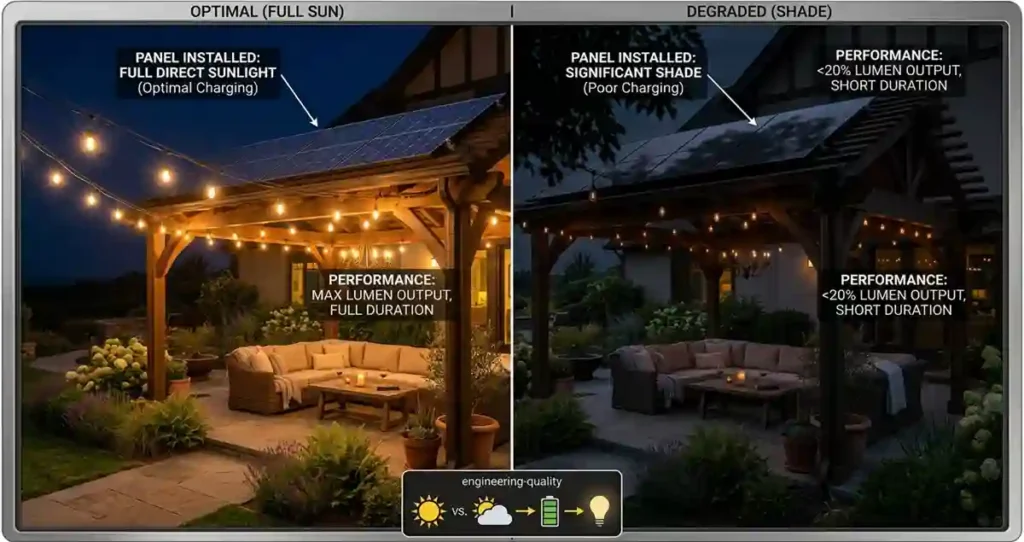
The solar panel placement for string lights is often an afterthought — the panel is on a short cable attached to the battery pack, and it gets placed wherever is convenient near the string run. This is a common cause of underperformance.
For patio and pergola string lights, the battery and panel pack is typically at one end of the string. The optimal position for the panel is the end of the string, where the panel can face south with minimum shading. If the patio structure creates shade over part of the day, positioning the panel at the sunniest end makes a measurable difference.
Some solar string light systems include a separate panel on a longer cable (2–5m) that can be positioned independently of the string. This is worth specifying for covered patio installations where the string location is naturally shaded — the panel can be placed in an open area while the string runs under the cover.
Engineer’s Note: A solar panel tilted 30–35° toward the south in the northern hemisphere captures approximately 20–25% more energy annually than a flat-mounted panel. For permanent string light installations, securing the panel at this tilt rather than lying flat on a surface is a simple adjustment that meaningfully improves winter charging. Most solar string light panel mounts include a stake or hook that can be angled — use the angle, not the flat position.
Frequently Asked Questions
Why do my solar string lights go dim after a few hours?
Battery capacity is insufficient for the string’s power draw, or the panel isn’t generating enough charge to fully replenish the battery. Check the battery mAh rating against the string wattage and your intended runtime (mAh ÷ (wattage × 1000 ÷ voltage) = hours). If the math doesn’t work for your expected runtime, the product is undersized for your application. Also check that the panel is getting adequate direct sun — partial shade significantly reduces charging.
Can solar string lights stay up year-round?
IP65-rated string lights can stay up year-round. IP44 lights in exposed locations should be taken down in climates with hard winter weather — the reduced protection can allow water infiltration at socket connections during freeze-thaw cycles. For year-round permanent installations, IP65 is the specification to use. Winter performance will be reduced in northern climates due to reduced solar charging, but the hardware will survive outdoor conditions if properly rated.
How long is the longest solar string light available?
Standard self-contained solar string lights run up to 20–25m with integrated panel and battery at adequate performance. Above that length, either multiple independent strings running end-to-end (with separate panels and batteries per section) or a larger dedicated solar panel and battery system powering a longer wired string is the practical approach. Trying to run 40m+ of string lights from a single small integrated solar unit will result in underperformance regardless of what the product listing claims.
What is the difference between solar string lights and solar fairy lights?
Scale and output. Solar string lights typically use G40 or S14 bulbs at 5–15 lumens each, on strings of 10–30m with 20–60 bulbs. Solar fairy lights use micro-LED points at 0.5–2 lumens each, on strings of 5–30m with 50–200+ points. String lights create defined points of warm light; fairy lights create a diffuse sparkle effect. Both are decorative, but they produce different visual results. Most patio and pergola applications use string lights; tree wrapping, hedge decoration, and close-range decorative applications typically use fairy lights.
Final Thoughts
Solar string lights deliver impressive visual results for the investment — but only when the battery capacity matches the string length, the panel gets adequate sun exposure, and the IP rating suits the installation location.
The specifications that matter are battery mAh (matched to string wattage and desired runtime), panel wattage (adequate to replenish the battery in winter sun hours for your location), and IP rating (IP65 for exposed locations, IP44 for sheltered ones). Everything else is aesthetics.
For the complete solar garden lighting context, the solar garden lights guide covers all outdoor solar light types with placement and sizing guidance.
Related guides: Net Metering Complete Guide · AI Solar Optimization Guide · NEM 3.0 California Guide · BESS Battery Storage Guide
Frequently Asked Questions.
What is the best IP rating for outdoor solar string lights?
IP65 is recommended for solar string lights installed in fully exposed outdoor locations because it provides reliable protection against rain and dust. For covered patios, pergolas, and other sheltered areas, IP44 is generally sufficient.
Do larger solar panels make solar string lights brighter?
No. Larger solar panels do not increase the brightness of solar string lights directly. Instead, they recharge the battery more efficiently, helping the lights maintain their rated brightness for a longer period, especially during long nights or cloudy weather.
Related guides on SolarVisionAI.com
Solar Garden Lights: Types, Placement & What to Buy — solarvisionai.com/solar-garden-lights/
Solar Flagpole Light: How to Pick the Right Lumen Output — solarvisionai.com/solar-flagpole-lights/
Solar Fence Post Lights Lumens Guide — solarvisionai.com/solar-fence-post-lights-lumens/
Solar Fence Post Lights Lumens Guide — solarvisionai.com/solar-fence-post-lights-lumens/