
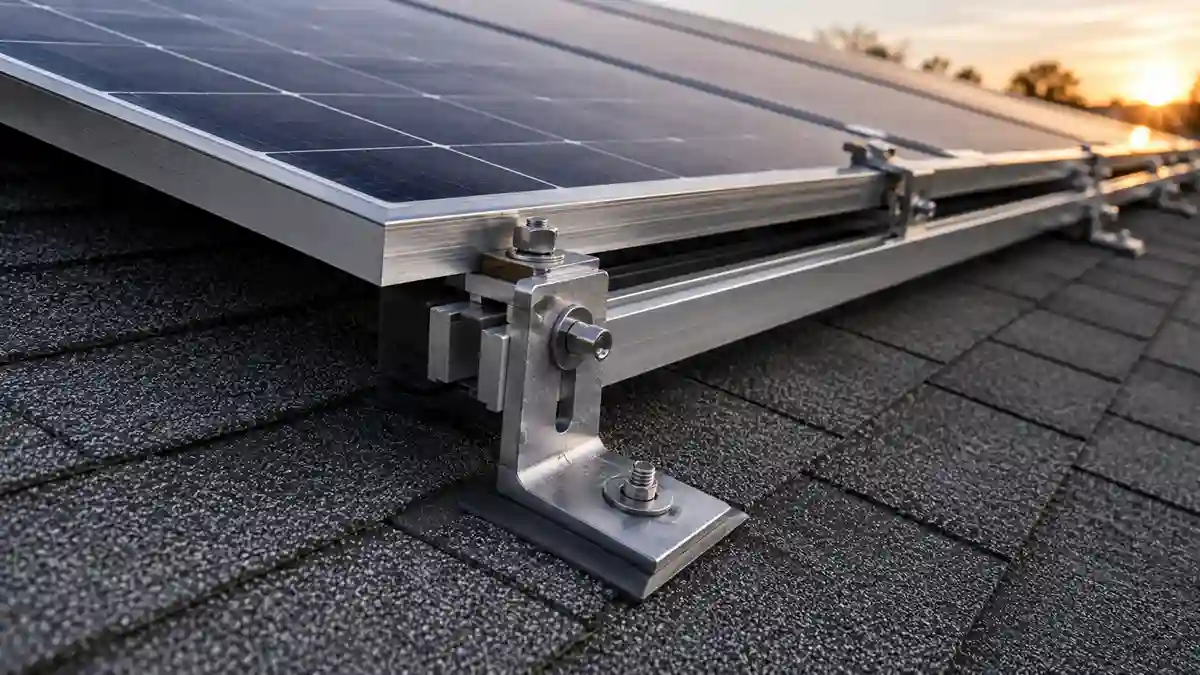
Mounting brackets for solar panels — how pull-out capacity actually works, substrate compatibility assessment, ASCE 7 wind uplift, and roof type selection matrix for every install.
The phrase ‘mounting bracket’ appears in almost every conversation about solar panel installations, usually in the same sentence as a per-unit price and a lead time. What rarely gets discussed is the engineering behind the load ratings — the pull-out capacity methodology, the substrate compatibility requirements, and the factors that determine whether the bracket you select can actually do its job on your specific roof for the next 25 years.
This guide is the engineering layer beneath the Solar Panel Mounting Brackets buying guide and the Solar Panel Mounting Brackets with Hardware guide. Where those cover what to buy and what should be in the kit, this covers how the load ratings work and how roof compatibility is determined.
1. Load Rating Fundamentals: What the Numbers Mean
Mounting bracket load ratings are reported as either pull-out force (the force required to extract the bracket from its substrate) or the maximum system load (the rated load capacity of the complete bracket assembly, including substrate). These are not the same number, and the distinction matters significantly.
A bracket’s pull-out capacity from a specific substrate is determined by testing — not by calculation from bracket dimensions alone. Published pull-out capacities are substrate-specific: the same bracket will have a different rated pull-out capacity in a 2×6 Douglas fir rafter than in a 2×6 SPF rafter, and a different capacity again in a steel purlin or a concrete ledger.
Engineer’s Note: The safety factor of 3.0 on lag screw connections is not optional. A bracket with a tested pull-out capacity of 900 lbs has a design pull-out capacity of 300 lbs. If your calculated uplift at that location exceeds 300 lbs, you need a different bracket or attachment configuration. The full structural load calculation framework is in the Solar Mounting Systems hub (Post 4).
2. Bracket Types and Their Load Characteristics
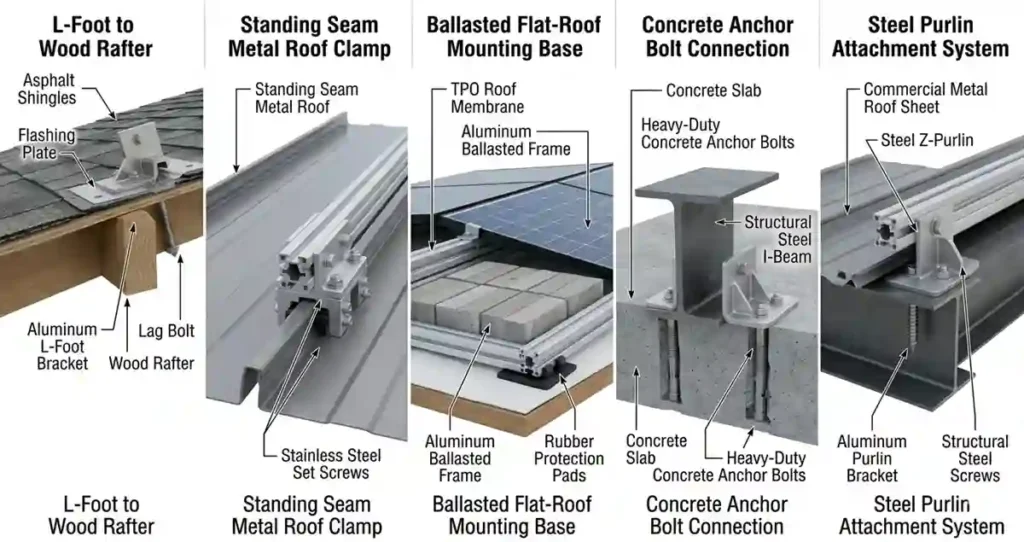
| Bracket Type | Typical Pull-Out Range | Critical Load Path | Limiting Factor |
| L-foot with lag into wood rafter | 250-800 lbs (substrate dependent) | Lag screw in rafter — shear and withdrawal | Rafter species, lag diameter, embedment depth |
| Seam clamp on standing seam metal | 400-1,200 lbs (profile dependent) | Clamp grip on seam — friction and mechanical lock | Seam geometry match; clamp tightening torque |
| Ballasted base on flat roof | N/A (gravity-dependent) | Ballast weight vs. calculated uplift | Ballast weight per bracket; roof structural capacity for added dead load |
| Anchor bolt into concrete | 600-2,500 lbs (embedment dependent) | Bolt embedment — tensile and shear | Concrete compressive strength; embedment depth; edge distance |
| Through-fastener into steel purlin | 500-1,500 lbs (bolt size dependent) | Bolt in bearing/shear through purlin flange | Bolt diameter; purlin steel grade; number of shear planes |
3. Roof Compatibility — The Full Assessment
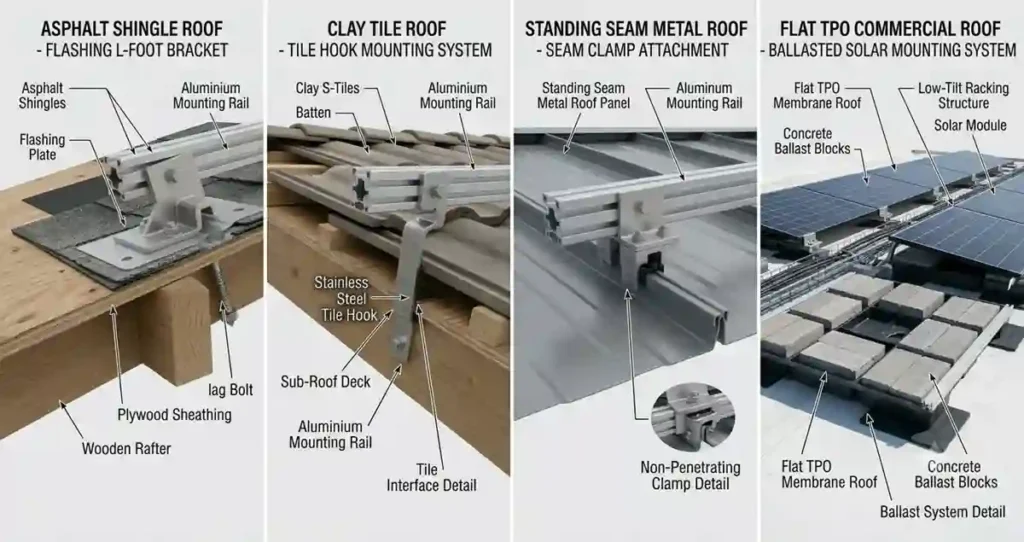
Structural Substrate Assessment
For wood-framed roofs, the rafter must be physically located at each bracket position — not assumed from a layout drawing. Probing with a small-diameter pilot hole at each attachment point is the only reliable method to confirm rafter location before installing the lag screw.
Roof Membrane Compatibility
On penetrating systems, the bracket’s flashing assembly must be compatible with the roof membrane type. The roof-type-specific bracket installation details — waterproofing method, sealant type, and inspection criteria — are covered comprehensively in the Roof Solar Panel Mounting Brackets post.
Roof Geometry and Array Layout
The bracket layout must be designed as an engineering document. The attachment spacing along the rail that this layout drives — and the span capacity of the rail between those attachment points — is specified in the Solar Mounting Rails guide.
4. The Mounting Bracket for Solar Panel — Single Module Applications
For mobile applications such as RV and motorhome installations where single-module or two-module systems are common, the Solar Panel Mount Brackets for RV, Polo & Motorhome guide covers the specific structural and vibration requirements that differ from fixed building installations.
5. Roof Mounting Brackets for Solar Panels — Roof Type Summary
| Roof Type | Correct Bracket Category | Penetration Required | Membrane Warranty Risk | Notes |
| Asphalt shingle, rafters | Flashing L-foot | Yes | Low if installed per NRCA protocol | Most common residential/light commercial type |
| Clay/concrete tile, rafters | Tile hook assembly | Yes | Low if full tile replacement used | Tile profile must match hook profile exactly |
| EPDM/TPO flat | Ballasted system | No | None | Structural capacity for ballast is critical constraint |
| Modified bitumen flat | Penetrating with bonded flashing | Yes | Medium — requires manufacturer approval | Full-surface bonded flashing, not lap-sealed |
| Standing seam metal | Non-penetrating seam clamp | No | None | Clamp must be rated for specific seam profile |
| Corrugated metal, purlins | Purlin clamp or through-bolt | Yes | Low — membrane not present | Rubber grommet isolation at through-bolt |
| Concrete deck (flat) | Anchor bolt | Yes | Requires waterproof cap on bolt | Structural engineer to specify anchor type and embedment |
For the complete hardware specifications — fastener grades, clamp ranges, and grounding hardware — see the Solar Panel Mounting Brackets with Hardware guide. For the structural engineering framework governing load calculations, see the Solar Mounting Systems hub.
Frequently Asked Questions
What is the load rating of a solar mounting bracket?
A load rating represents the maximum force a bracket assembly can safely withstand under specified testing conditions.
What is pull-out capacity in solar mounting systems?
Pull-out capacity is the force required to extract a bracket or fastener from its supporting substrate.
Why is substrate compatibility important?
A bracket’s performance depends on the material it is attached to, such as wood rafters, steel purlins, or concrete structures.
How do wind loads affect solar mounting brackets?
Wind uplift can create forces that exceed the weight of the solar panels, making proper bracket selection critical for system safety.
Are non-penetrating mounting systems available?
Yes. Ballasted systems and standing seam metal roof clamps can often be installed without roof penetrations.
What standard is commonly used for solar wind load calculations?
Many solar mounting systems use wind load calculations based on ASCE 7 requirements and local building codes.
Can solar mounting brackets be installed on any roof type?
Most roof types can support solar installations when the correct bracket system and engineering design are used.
Related guides on SolarVisionAI.com
Solar Panel Installation: Complete Engineering Guide (2026)
Solar Panel Installation Cost: The Complete 2026 Breakdown
Commercial Solar Panel Installation: Engineering Guide 2026
When Is the Best Time to Install Solar Panels?
Solar Power System in 2026: Types, Cost, ROI & AI Optimization