
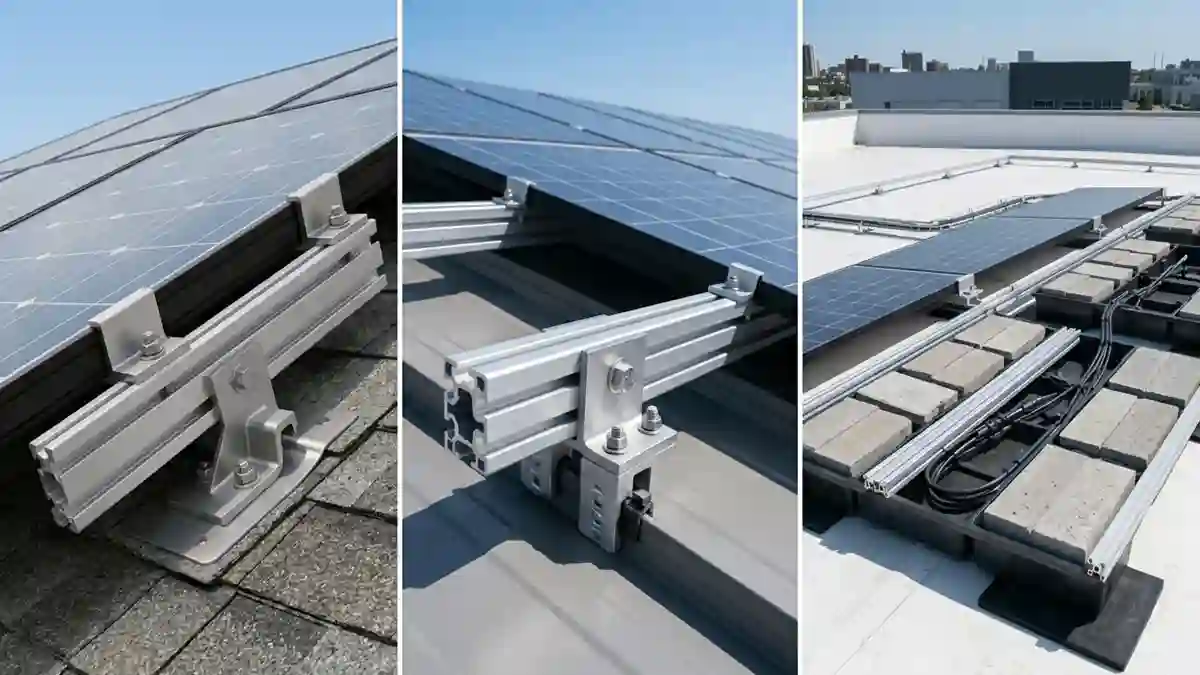
Roof solar panel mounting brackets for every US roof type — asphalt shingle, tile, TPO, EPDM, standing seam metal, and corrugated metal, with safety and waterproofing details.
A rooftop solar panel installation is a 25-year commitment that begins with a structural attachment through the roof envelope. The bracket that makes that attachment is simultaneously a structural component, a waterproofing element, and the foundation of your entire investment. Get it right, and it is invisible for 25 years. Get it wrong, and you will be talking to a roofer within five.
This guide is the roof-type-specific companion to the Solar Panel Mounting Brackets buying guide, which covers bracket types, load ratings, and the general engineering framework. The Solar Panel Mounting Brackets with Hardware guide covers the full hardware kit specification. This guide applies those foundations to each specific roof type you are likely to encounter on a commercial installation.
1. Why Roof Type Determines Everything
The load rating requirements that the bracket must meet at each attachment point are determined by the ASCE 7-22 wind uplift calculation methodology — explained in the Mounting Brackets for Solar Panels: Types, Load Ratings & Roof Compatibility guide. The rail that sits on top of these brackets — and the span requirements that drive attachment spacing — is specified in the Solar Mounting Rails guide.
2. Asphalt Shingle Roof — Bracket Type: Flashing L-Foot
The standard bracket for asphalt shingle residential and light commercial roofs is the flashing L-foot assembly: a flashing plate that slides under the overlying shingle course, a vertical standoff, and an L-foot that presents the horizontal attachment surface for the mounting rail.
Structural Requirement
The flashing bracket attaches to the roof rafter through a lag screw. The rafter must be physically located — not assumed from layout. Minimum lag engagement in the rafter is typically 2.5 inches.
Waterproofing Requirement
The flashing plate must overlap the shingle course below by a minimum of 2 inches, with butyl sealant on the underside of the plate at the lag hole locations. Do not substitute silicone — butyl has superior long-term adhesion on asphalt surfaces and remains flexible through temperature cycles.
3. Concrete and Clay Tile Roof — Bracket Type: Tile Hook
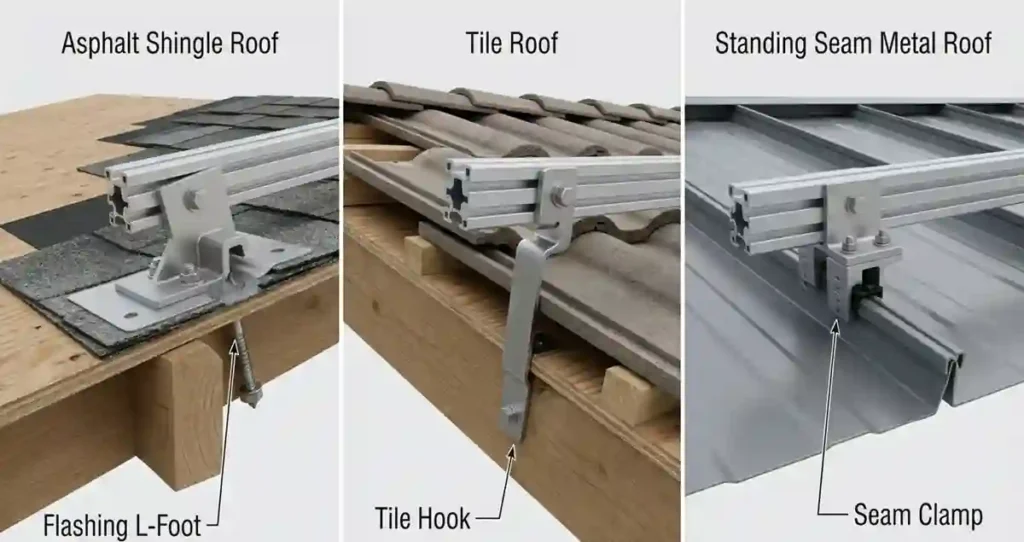
Clay and concrete tile roofs require a tile hook bracket — a stainless steel hook that passes through a replaced tile or under a cut tile, attaches to the rafter below, and presents an attachment point above the tile surface for the mounting rail. The tile hook must be profile-matched to the specific tile profile on the roof.
Engineer’s Note: Tile roofs increase the structural load. Clay tile roofs range from 9 to 12 lbs/sq ft; concrete tile from 12 to 18 lbs/sq ft. Verify that the combined dead load (tile + solar) remains within the roof framing capacity before installation. The dead load calculation methodology is in the Solar Mounting Systems hub (Post 4).
4. TPO / EPDM Flat Membrane Roof — Bracket Type: Ballasted Frame
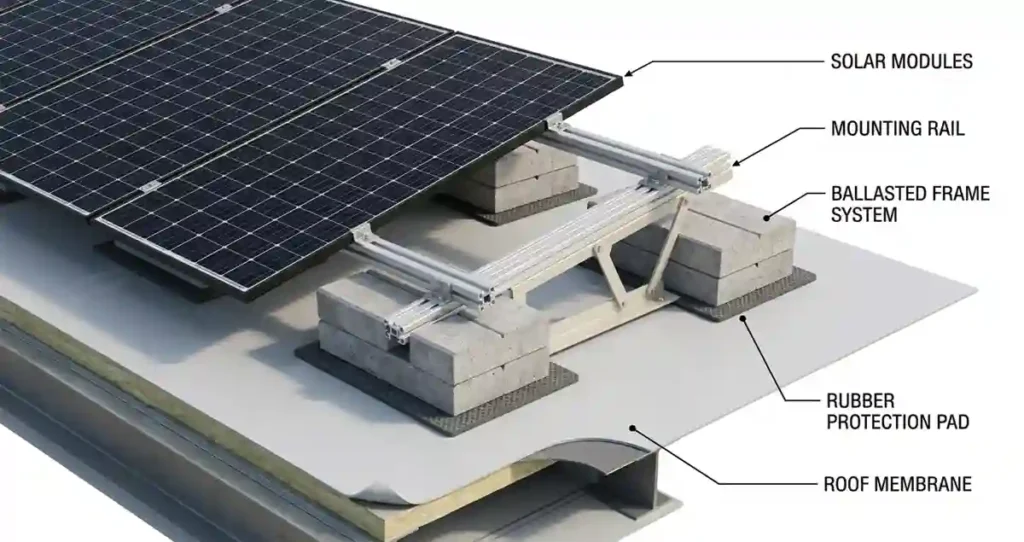
Flat commercial roofs with TPO or EPDM membrane should use ballasted mounting systems wherever possible to avoid roof penetrations.
Membrane Compatibility
The rubber pads must be compatible with the membrane chemistry. Petroleum-based rubber compounds are incompatible with EPDM membranes — the hydrocarbon content causes swelling and delamination over time. Use EPDM-compatible pads on EPDM roofs, and TPO-compatible pads on TPO roofs.
Structural Load Verification
Ballasted systems impose a distributed dead load of typically 10 to 20 lbs/sq ft for a 10-degree tilt system. The roof structure must be verified by a structural engineer before installation. The same structural verification applies to all rooftop systems — see the Solar Mounting Systems hub for the load calculation framework.
5. Standing Seam Metal Roof — Bracket Type: Seam Clamp
Standing-seam metal roofs are among the best substrates for solar installations. The seam clamp attaches to the raised seam without any roof penetration — no holes, no sealant, no leak risk. The structural capacity comes from the mechanical grip of the clamp on the seam geometry.
The clamp must be designed and rated for the specific seam profile on the roof. Seam dimensions vary by manufacturer and installation era. Key dimensions are seam height, seam cap width, and whether the seam is snap-lock or mechanically seamed.
6. Corrugated Metal Roof — Bracket Type: Purlin Clamp or Through-Bolt
Corrugated metal roofs use either purlin clamps or through-bolt assemblies that pass through the corrugated panel at the high point of the corrugation and into the purlin below. Both methods require isolation between steel hardware and aluminum mounting rail to prevent galvanic corrosion.
7. Roof Mounting Brackets for Solar Panels — Safety Requirements
- Roof slopes above 4:12 require fall protection for all workers — guardrails, personal fall arrest systems, or safety net systems (OSHA 29 CFR 1926.501-502 Subpart M)
- Flat roofs require fall protection within 6 feet of an unprotected edge — guardrails or personal fall arrest
- Leading edge work requires a dedicated personal fall arrest system for each worker
- Roof access and egress must be via a fixed ladder or scaffold — not via the solar array itself
8. Bracket Installation Quality Indicators
| Roof Type | Key Quality Indicator | Common Failure Mode |
| Asphalt shingle | Butyl sealant visible at flashing plate perimeter when shingle is lifted | Silicone sealant used; sealant only on lag head, not under plate |
| Tile | Full replacement tile installed under hook — no gap between hook and adjacent tiles | Hook installed through drilled hole in existing tile; tile-to-hook gap visible |
| TPO/EPDM flat | EPDM-compatible rubber pad — no petroleum odor; pad covers full base footprint | Incompatible pad material; exposed membrane contact at pad edges |
| Standing seam metal | Clamp bolts at specified torque; seam not deformed by over-tightening | Over-tightened clamp deforms seam; seam paint cracked at clamp contact |
| Corrugated metal | Rubber grommet at all through-bolt penetrations; grommet compression visible | Missing grommet; through-bolt at corrugation valley (not peak) |
For the complete mounting system context, see the Solar Mounting Systems hub. For the step-by-step installation process and commissioning verification, see the Solar Panel Rail Mounting Kit guide.
FAQs
What is the best roof mounting bracket for solar panels?
The best bracket depends on the roof type. Asphalt shingle roofs typically use flashing L-foot brackets, tile roofs use tile hooks, flat membrane roofs often use ballasted systems, and standing seam metal roofs use seam clamps.
Can solar panels be installed without roof penetrations?
Yes. Ballasted flat-roof systems and standing seam metal roof clamp systems can often be installed without penetrating the roof surface.
Why is butyl sealant preferred for asphalt shingle roofs?
Butyl sealant provides better long-term flexibility and adhesion on asphalt roofing materials than silicone, helping maintain waterproofing over decades.
Are standing seam metal roofs good for solar installations?
Yes. Standing seam roofs are often considered ideal because seam clamps can attach directly to the raised seam without drilling holes into the roof.
Do all solar roof brackets require structural verification?
Yes. The roof structure must be verified to ensure it can safely support the additional solar loads and environmental forces.
Related guides on SolarVisionAI.com
Solar Panel Installation: Complete Engineering Guide
Solar Power System : Types, Cost, ROI & AI Optimization