
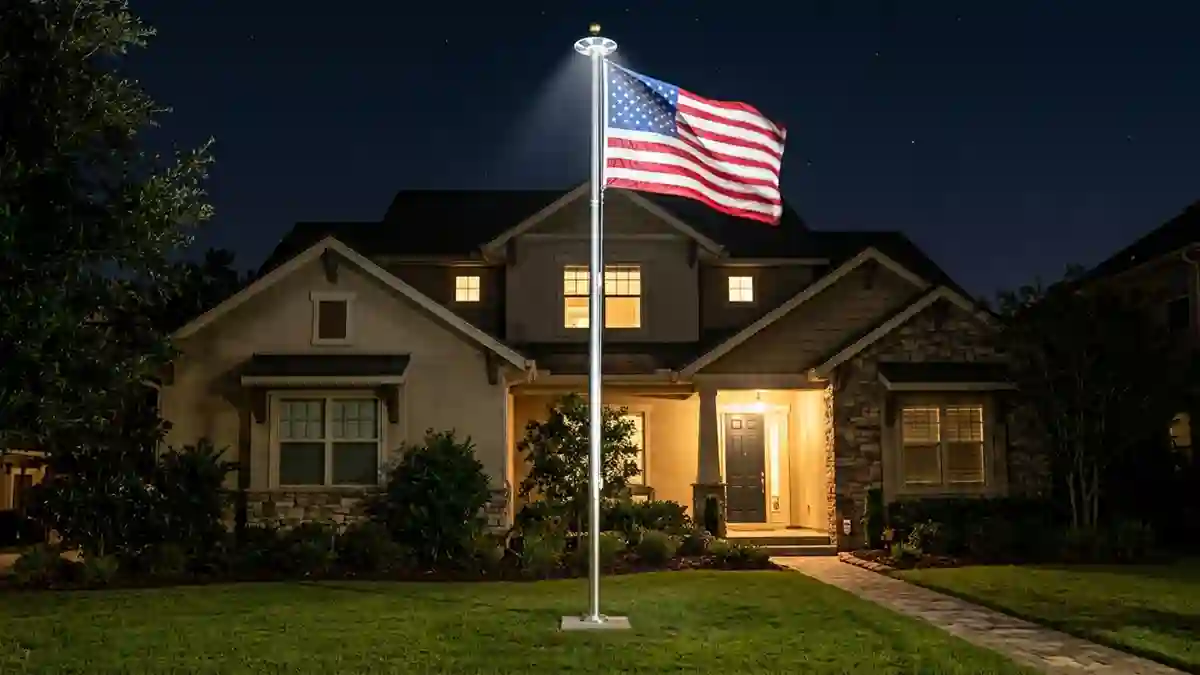
Solar flagpole light sizing by flag size and pole height — lumen output, beam angle, battery capacity, mount types, and why most residential flagpole lights are underpowered for the flag they’re meant to illuminate.
Solar flagpole light sizing starts with flag size and pole height, not product photos. Engineer’s guide to lumen output by flag dimensions, beam angle requirements, battery capacity, mount types, and the specs that most listings don’t give you. Written by a Registered Professional Engineer.
Solar flagpole lights are one of the more straightforward solar lighting applications in theory — illuminate a flag at night without running wiring to the pole. In practice, most residential solar flagpole lights on the market are underpowered for the flag and pole combination they’re sold alongside.
The reason is simple: flag size and pole height determine lumen requirement, and most product listings don’t make that connection explicit. A 200-lumen flagpole light that looks adequate in a product photo may produce an underwhelming result on a 20-foot pole with a 3×5 foot flag.
This guide gives you the sizing framework to match lumen output to your actual flag, and the mount type guidance to ensure the solar panel gets adequate charge regardless of pole orientation.
For the broader solar garden and outdoor lighting context, the solar garden lights hub guide covers the full range of outdoor solar lighting types.
1. Why Flag Size and Pole Height Determine Lumen Requirement
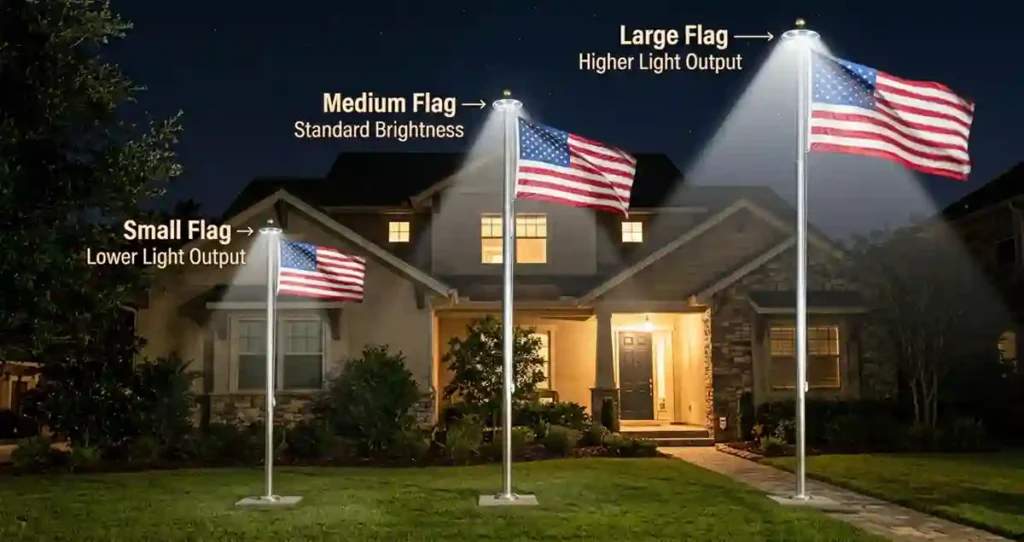
Illuminating a flag requires enough light output to make the flag visible and its colours recognisable at night from a reasonable viewing distance. The further the flag is from the light source (pole height determines this), and the larger the flag (surface area determines how much light it needs to appear evenly illuminated), the more lumens are required.
The inverse square law applies: double the distance between the light source and the flag, and the illuminance on the flag drops to one quarter. A flagpole light mounted at the base illuminating a flag at 20 feet needs to deliver significantly more lumens than one illuminating a flag at 10 feet — the light has to travel further and the flag is larger.
2. Lumen Output by Flag Size and Pole Height
| Flag Size | Pole Height | Min Lumens | Beam Angle | Battery Needed |
| 2×3 ft | 10–15 ft | 100–150 lm | 120° | 2000–3000 mAh |
| 3×5 ft (standard) | 15–20 ft | 200–300 lm | 120° | 4000–6000 mAh |
| 4×6 ft | 20–25 ft | 300–400 lm | 120–180° | 6000–8000 mAh |
| 5×8 ft | 25–30 ft | 400–600 lm | 180°+ | 8000–10000 mAh |
| 6×10 ft+ | 30 ft+ | 600+ lm | 360° or dual | Separate panel recommended |
The most common residential flag in the US is a 3×5-foot flag on a 15–20 foot pole. For that combination, 200–300 lumens is the practical minimum for a result that looks intentional rather than underwhelming. Most budget solar flagpole lights in the $20–40 range deliver 100–150 lumens — adequate for a small flag on a short pole, undersized for the standard residential combination.
Engineer’s Note: The beam angle matters as much as lumen output for flagpole lighting. A narrow beam (60–90°) concentrates light on a specific area but may not illuminate the full flag width at the top of the pole if the flag is wider than the beam covers at that distance. A 120° beam at the standard 3×5 flag distance covers approximately 12–14 feet in width at 20 feet in height — adequate for standard flags. For larger flags or corner pole configurations, a 180° or dual-head unit is the correct specification.
3. Mount Types: Getting the Panel Into the Sun
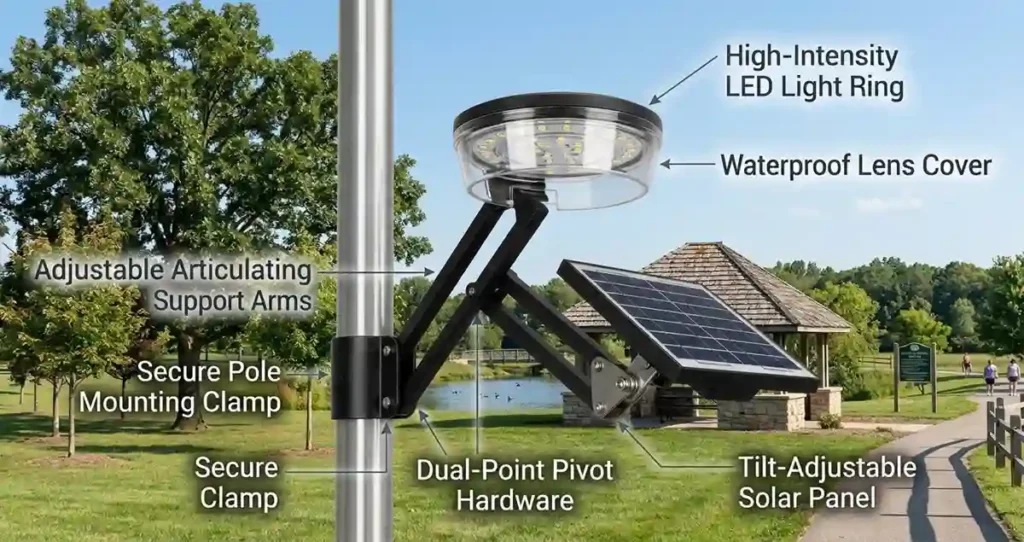
Flagpole light mount type determines two things: how securely the light is attached and whether the solar panel can be positioned for adequate sun exposure. Both matter — an insecure mount fails in the wind, and a panel facing the wrong direction charges poorly regardless of how sunny the location is.
| Mount Type | How It Works | Best For | Install Note |
| Ground stake | Stake into ground at pole base | In-ground pole, single flagpole | Orient panel south. Check for shade from pole. |
| Clamp mount | Clamps to pole at adjustable height | Existing poles, no ground access | Ensure clamp rating matches pole diameter |
| Wall/bracket | Mounts on wall near pole | Wall-mounted flagpoles | Panel needs clear south-facing sky |
| Top-of-pole ring | Ring fixture sits at pole top, lights downward | Decorative poles, short flags | Panel integrated in ring — verify output |
The most common installation problem with solar flagpole lights is the panel facing the wrong direction. A ground-stake mount on the north side of a pole in the northern hemisphere has the panel facing north — the worst possible orientation for solar charging. Most flagpole light installations require the stake or clamp to be positioned on the south side of the pole so the panel faces south toward the sun.
Field Note: I reviewed a flagpole light installation where the homeowner reported the light going dark by 10 PM despite a new battery. The unit was a ground-stake type, installed by driving the stake into the ground on whichever side was convenient — which happened to be north. The panel received approximately 1.5 hours of direct sun per day rather than the 5–6 hours needed. Repositioning the stake to the south side of the pole resolved the issue completely. The light ran through until 6 AM the following night on the next charge cycle.
4. Battery Capacity for All-Night Flag Illumination
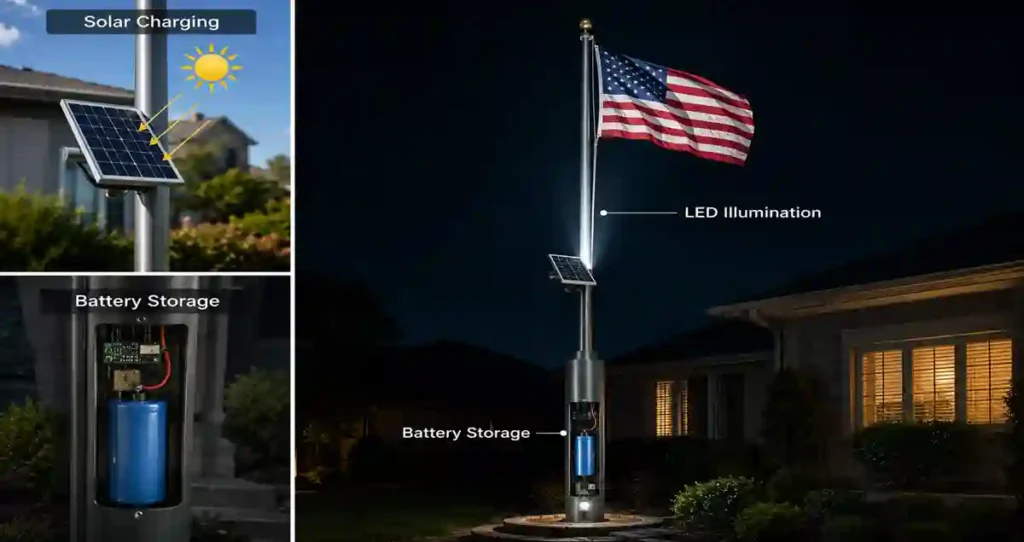
Flag illumination is typically expected to run all night — it’s a visibility and respect issue for most flag owners, not a casual preference. That means the battery needs to support the full overnight runtime even in winter when charge capacity is reduced.
For a 300-lumen flagpole light (adequate for a standard 3×5 flag) drawing approximately 3–4W:
Summer runtime on full charge: 8–10 hours (typical)
Winter runtime at 60% charge: 5–6 hours
For all-night winter coverage (approximately 14 hours of darkness at northern latitudes): a 6000 mAh battery minimum, with a panel sized to charge it in 4–5 winter sun hours fully.
Most quality solar flagpole lights specify a 4000–6000 mAh battery for the standard 3×5 flag application. Units with smaller batteries are typically adequate for summer use and marginal for winter all-night coverage in northern climates.
Engineer’s Note: Some solar flagpole lights include a dawn-to-dusk mode (light on from dusk until dawn, every night) and a mode that limits operation to a set number of hours (e.g. 6 or 8 hours from dusk). The timed mode extends battery life significantly and is the practical choice for winter use when full overnight charging isn’t available. If all-night illumination is important, verify the unit has the battery capacity to support it in your winter conditions before purchasing.
5. Colour Rendering for Flag Illumination
Flag illumination has a specific colour rendering requirement that general garden lighting doesn’t. National flags and organisational flags use specific colours — red, white, blue, gold — that need to be rendered accurately for the flag to look correct at night.
Colour Rendering Index (CRI) measures how accurately a light source renders colours compared to natural daylight. A CRI of 80+ is adequate for most garden lighting. For flag illumination, CRI 90+ is the engineering recommendation — this ensures the flag colours are rendered accurately rather than shifted toward yellow (as warm white LEDs with lower CRI can do).
Colour temperature for flag illumination: neutral to cool white (4000–5000K) renders flag colours most accurately. Warm white (2700–3000K) can make blue areas appear slightly green and red areas more orange. For flag illumination specifically, this matters more than in general garden lighting where warm white is usually preferred.
6. Solar Flag Light vs Solar Pole Lights: What’s the Difference?
“Solar pole lights” is a broader category that includes pathway pole lights, garden area lights, and parking lot lights — not specifically designed for flag illumination. The beam geometry is different: pole lights spread light downward for ground illumination, while flagpole lights direct light upward toward the flag.
A solar pole light mounted at the base of a flagpole will illuminate the ground around the pole, not the flag above it. For flag illumination, the fixture needs to direct light upward at an angle that reaches the flag at pole height. Most dedicated flagpole lights have the LED array angled upward at 45–60° from horizontal for this reason.
Frequently Asked Questions
How many lumens do I need for a solar flagpole light?
For a 2×3-foot flag on a 10–15-foot pole, 100–150 lumens are adequate. For the standard 3×5-foot residential flag on a 15–20-foot pole: 200–300 lumens minimum. For a 4×6-foot flag on a 20–25-foot pole: 300–400 lumens. Most budget solar flagpole lights are rated at 100–150 lumens — adequate for small flags only.
Why does my solar flagpole light go out before morning?
Three possible causes: (1) Battery capacity is insufficient for overnight runtime — verify the mAh rating against the LED draw and expected runtime. (2) The solar panel isn’t getting adequate sun exposure — check the panel orientation and any shade from the pole itself or nearby trees. (3) The battery has degraded after 1–2 years of daily cycling — replacement cells typically restore full performance.
Can I use a solar flagpole light on a spinning/rotating flagpole?
Ground-stake units work well with rotating poles since the light is independent of the pole. Clamp-mount units that attach to the pole itself will rotate with the pole — which is usually not a problem for a single clamp mount but can cause issues if the rotation wraps the cable. Top-of-pole ring units are also unaffected by pole rotation. Check the mounting type against your pole configuration before purchasing.
Do I need a special solar light for a wall-mounted flagpole?
Yes. Wall-mounted poles require either a wall-bracket mount or a clamp that attaches to the pole itself at a position accessible from the wall. Ground-stake units don’t work for wall-mounted poles — there’s no ground near the pole base. Wall-bracket solar flagpole lights are available but less common than ground-stake units. Verify mount compatibility with your specific wall-mounted pole configuration.
Can I use a normal solar garden light to illuminate a flag?
Usually no. Solar garden lights are designed for downward landscape lighting, while flagpole lights are designed to direct light upward toward the flag.
Final Thoughts
Solar flagpole lights are a practical solution for flag illumination when pole wiring is impractical. The two decisions that determine whether the installation works well are lumen output matched to flag size and pole height, and panel orientation positioned for maximum sun exposure regardless of which side of the pole is convenient.
Get those two right, and a quality solar flagpole light with a 4000–6000 mAh battery will illuminate a standard residential flag reliably through summer, with acceptable performance through most US winter conditions.
For the broader solar garden lighting context including pathway, string, and deck lights, the solar garden lights guide is the hub article for this cluster.
Related guides on SolarVisionAI.com
Solar Garden Lights: Types, Placement & What to Buy — solarvisionai.com/solar-garden-lights/
Solar String Lights: What the Specs Actually Mean — solarvisionai.com/solar-string-lights/
Solar Fence Post Lights Lumens Guide — solarvisionai.com/solar-fence-post-lights-lumens/
Solar Fence Post Lights: Cap Sizes, Types & Install Guide
Solar Lights for Vinyl, Aluminum & Wood Fence Posts