
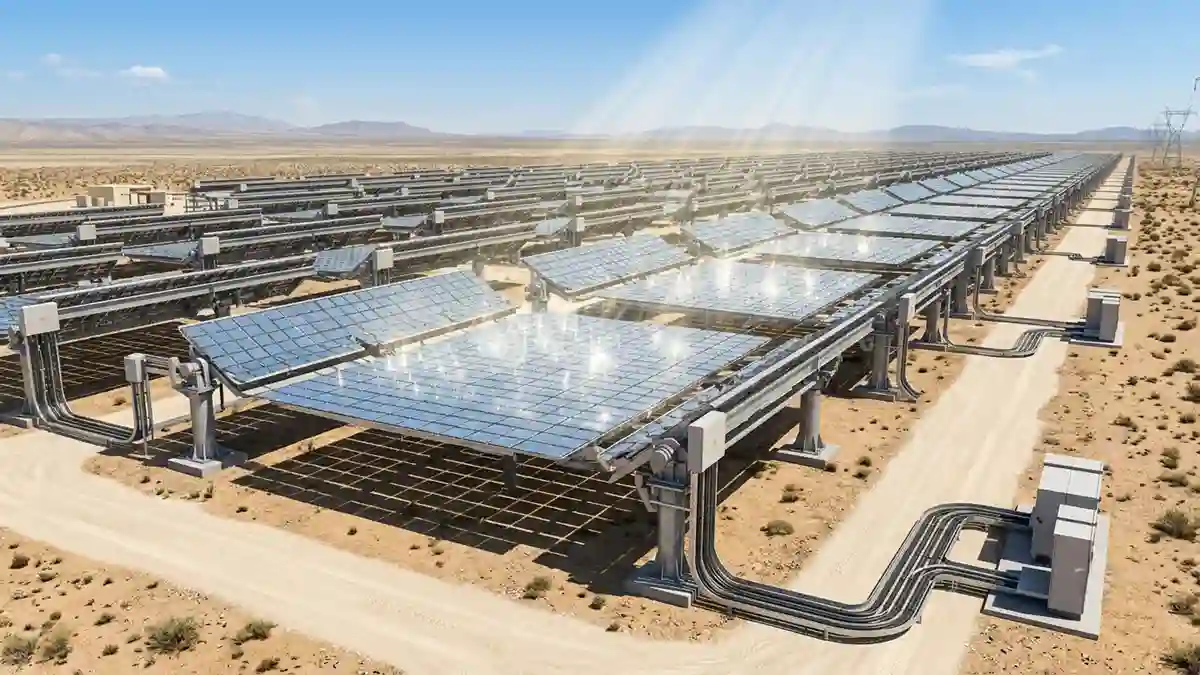
How CPV Solar Panels (Concentrated Photovoltaic) reach 40%+ efficiency, and why they’re limited to utility-scale, high-sun installations.
CPV holds the efficiency record of any panel technology on this site — and almost no residential buyer should ever consider it. That contradiction is exactly why it needs its own guide: understanding CPV means understanding why the “most efficient” technology on paper is often the wrong choice in practice.
I include CPV in this cluster precisely because readers deserve to know it exists and why it doesn’t come up more often. Understanding why the most efficient solar panel technology on the market isn’t the one I recommend teaches something important about how to evaluate every other panel type in this guide — efficiency is one input into a decision, never the whole decision.
This guide is part of our Types of Solar Panels hub.
How CPV Actually Works
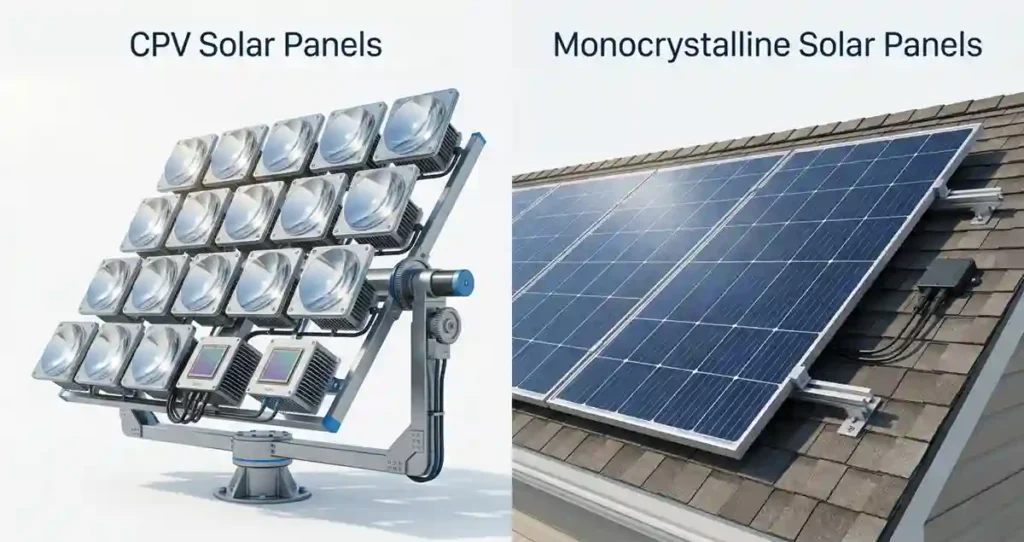
Rather than using a flat panel of standard-sized cells, CPV systems use lenses or curved mirrors to concentrate sunlight — sometimes 500x or more — onto small, extremely high-efficiency multi-junction cells derived from satellite/aerospace semiconductor technology.
Engineer’s Note: The efficiency numbers you’ll see quoted for CPV — 40%+ — are real, but they’re module-level lab numbers under direct concentrated sunlight. They’re not comparable to the efficiency percentage on a standard panel datasheet, because the entire operating principle is different.
Why It Requires Tracking
It’s worth pausing on just how precise this tracking has to be. A standard flat-panel array with basic single-axis tracking has meaningful tolerance for pointing error — a few degrees off doesn’t meaningfully hurt output. CPV’s optical concentration has nowhere near that tolerance, because the lens or mirror geometry is designed around a very specific angle of incidence. That precision requirement is baked into the system from day one, not an optional upgrade.
Because CPV concentrates sunlight to a precise focal point, the system must track the sun’s position continuously through the day — unlike flat panels, which tolerate a wide range of incidence angles without much output penalty. This tracking requirement is the primary reason CPV isn’t viable for residential rooftops: the mechanical tracking system adds cost, maintenance, and points of failure that a static rooftop array simply doesn’t have.
Advantages and Disadvantages
| Advantages | Disadvantages |
| Highest efficiency of any panel technology, by a wide margin | Requires continuous mechanical tracking — added cost and failure points |
| Best energy density per unit land area in ideal-sun climates | Performs poorly under cloud cover or diffuse light |
| Leverages proven aerospace-grade multi-junction cells | No viable residential or small-commercial product exists |
| Strong fit for utility-scale desert/high-DNI installations | Higher system complexity and maintenance burden overall |
Real-World Applications
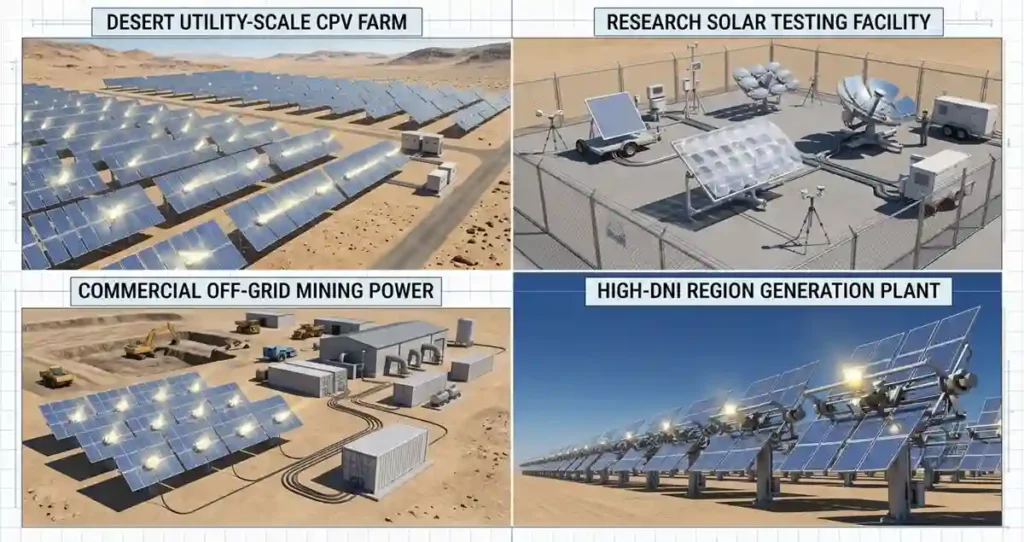
Every CPV conversation I’ve had in my career has been utility-scale, and every one has been in a genuinely high direct-normal-irradiance region — think open desert with consistent, near-cloudless skies for most of the year. In those specific conditions, the concentration ratio pays off because there’s enough direct beam sunlight to actually concentrate. Take that same technology to a coastal or temperate climate with regular cloud cover, and the whole premise collapses, because CPV can’t meaningfully use diffuse light the way a flat panel can.
One utility developer I consulted with was evaluating CPV specifically against bifacial tracking arrays for a large desert installation, and the analysis came down to maintenance burden more than raw efficiency. CPV’s mechanical tracking and optical alignment requirements meant a meaningfully higher long-term operations and maintenance cost per megawatt compared to a bifacial array with simpler single-axis tracking. That maintenance gap, more than the headline efficiency number, is what’s been steadily shrinking CPV’s market share even in the regions where its physics genuinely favor it.
Practical Considerations If You’re Evaluating CPV
If CPV is genuinely on the table for a utility-scale project, the questions worth asking go well beyond the module efficiency spec: what’s the tracking system’s expected maintenance interval, what’s the optical alignment tolerance and how often does it need recalibration, and what happens to output during the shoulder-season months when direct-beam irradiance is lower even in a desert climate. These operational questions tend to matter more to total project economics than the peak efficiency number that gets quoted in marketing material.
Where It Doesn’t Make Sense
Anywhere with variable weather, partial cloud cover, or limited space. CPV performs poorly under diffuse light (cloudy days), unlike flat-panel technology which still generates meaningfully in overcast conditions. It’s also entirely unsuited to residential rooftops — there’s no small-scale CPV product built for that market. For virtually every reader of this guide, Monocrystalline or Bifacial panels are the relevant comparison instead.
Field Note: I’ve never specified CPV on a residential or commercial rooftop project — it isn’t a viable option at that scale. It comes up exclusively in utility-scale conversations, and even there, standard flat-panel bifacial arrays have closed enough of the cost gap that CPV is a shrinking niche in the industry today.
Buying Checklist for CPV Solar Panels
| Specification | Why It Matters | What to Look For | Industry Reference |
|---|---|---|---|
| Direct Normal Irradiance (DNI) | CPV systems rely on direct sunlight rather than diffuse light. | Locations with consistently high DNI, such as desert or arid regions. | NREL, IEA |
| Dual-Axis Solar Tracking | CPV panels require precise sun tracking for maximum performance. | High-precision dual-axis tracking systems with proven reliability. | Fraunhofer ISE |
| Multi-Junction Solar Cells | Determines the overall conversion efficiency of the CPV system. | High-efficiency III-V multi-junction photovoltaic cells. | NREL |
| Optical Concentrators | Fresnel lenses or mirrors focus sunlight onto small solar cells. | Durable, high-quality concentrator optics with minimal optical losses. | Fraunhofer ISE |
| System Certification | Confirms the system meets international quality and safety standards. | IEC 61215 and IEC 61730 certified components. | IEC |
| Site Climate | CPV performs best in regions with clear skies and minimal cloud cover. | Utility-scale sites with high annual solar irradiance. | IEA |
| Operation & Maintenance | Tracking systems require periodic inspection and maintenance. | Reliable tracking hardware with long-term manufacturer support. | PV Magazine |
| Project Scale | CPV is designed primarily for large commercial and utility-scale projects. |
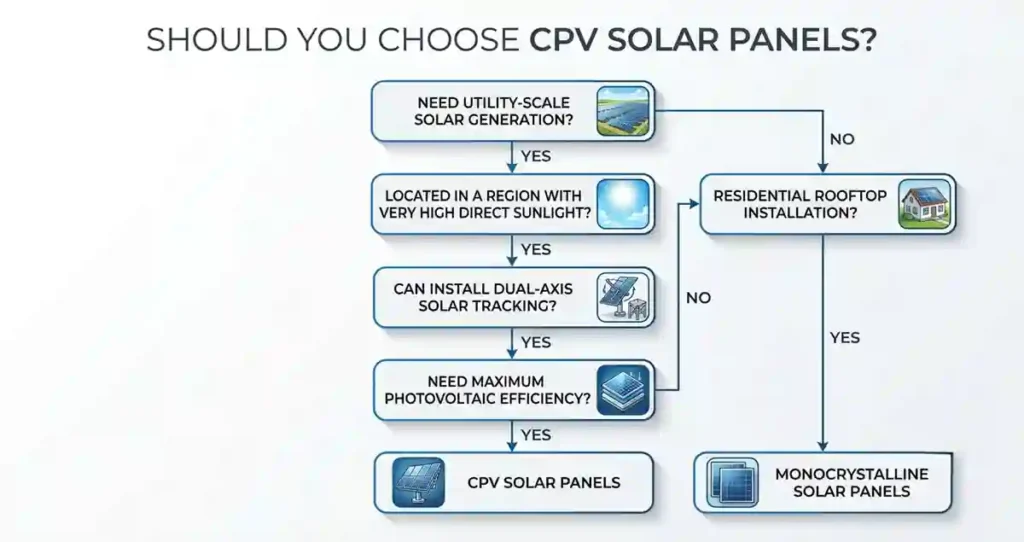
Who Should Buy CPV Solar Panels?
CPV solar panels are an excellent choice for:
- Utility-scale solar farm developers.
- Large commercial solar and industrial solar energy projects.
- Projects located in desert or high direct sunlight (DNI) regions.
- Organizations prioritizing maximum photovoltaic efficiency.
- Investors with sufficient land for solar tracking systems.
- Research institutions evaluating advanced photovoltaic technologies.
- Government and infrastructure projects focused on high-efficiency solar generation.
- Developers seeking long-term renewable energy production in optimal climates.
Who Should Avoid CPV Solar Panels?
CPV solar panels may not be the best option for:
- Residential homeowners with rooftop solar systems.
- Areas with frequent cloud cover or low direct sunlight.
- Small commercial buildings with limited installation space.
- Projects with tight installation or maintenance budgets.
- Locations where dual-axis solar tracking cannot be installed.
- Buyers seeking a simple, low-maintenance solar system.
- Off-grid, portable, or mobile solar applications.
- Anyone looking for an easy replacement for conventional rooftop solar panels.
Engineering Recommendation: CPV solar panels are a highly specialized technology. Their exceptional efficiency can justify the investment in the right environment, but for most residential and small commercial installations, high-quality monocrystalline solar panels remain the more practical and cost-effective choice.
Cost Perspective: Why CPV Keeps Losing Ground
The developer conversation I mentioned earlier boiled down to a simple realization: CPV’s efficiency advantage looks compelling on a spec sheet, but efficiency isn’t what utility-scale buyers are actually purchasing. They’re purchasing levelized cost of energy over a 25-30 year project life, and that number is driven as much by operations and maintenance cost as by generation efficiency. A tracking, optically-aligned CPV array simply carries more moving parts and more things that can drift out of calibration than a fixed or single-axis-tracked flat panel array, and every one of those parts represents a long-term maintenance line item.
That is the honest reason CPV has become a shrinking share of new utility-scale capacity even in regions where the physics genuinely favor it. It is not that the technology stopped working, it is that flat-panel bifacial arrays with simpler tracking have closed the generation gap enough that CPV’s added complexity no longer pays for itself over the project lifetime in most bid comparisons I have seen.
Common Misconceptions Worth Clearing Up
The most persistent misconception I run into is people assuming CPV is simply “a better solar panel” because it has the highest efficiency number of anything in the industry. Efficiency in isolation isn’t the metric that matters — delivered energy per dollar over the system’s lifetime is, and CPV’s tracking and maintenance overhead means that the headline efficiency number doesn’t translate into a proportionally better cost outcome in most real-world bid comparisons.
The second misconception is that CPV and standard solar tracking systems are the same category of product. A tracker on a standard flat-panel array simply reorients the panel toward the sun to capture more total irradiance — it doesn’t require the precision that CPV’s optical concentration demands. Conflating the two leads buyers to underestimate how much more exacting CPV’s alignment and maintenance requirements actually are.
Key Takeaway
If you take one thing away from this guide, let it be this: the most efficient technology on a spec sheet is not automatically the right engineering choice for a given project. CPV proves that point better than any other panel category I write about — it genuinely holds the efficiency crown, and it is still the panel I recommend least often, because efficiency divorced from tracking cost, weather tolerance, and maintenance burden does not tell you what a project will actually cost to run over 25 years.
If your interest in CPV came from wanting the “best” panel technology available, I’d gently redirect that instinct. “Best” only means something in the context of a specific site, a specific climate, and a specific budget. For almost every reader of this guide, that means monocrystalline, bifacial, or one of the other categories covered in the Types of Solar Panels hub — not CPV, however impressive its lab numbers look on paper. I’d rather see a client end up with a slightly lower efficiency number and a system that runs reliably for 25 years with minimal intervention than chase a headline percentage that comes with a maintenance contract attached.
CPV is worth knowing about to understand the outer limits of solar efficiency, not because it’s a realistic buying option for most readers. If you came here comparing panel types for a home or business, see the Types of Solar Panels hub for the categories that actually apply to you.
Frequently Asked Questions (FAQs)
Are CPV solar panels worth buying in 2026?
CPV solar panels are worth considering for utility-scale projects in regions with high direct sunlight. Their exceptional efficiency can justify the higher upfront cost, but they are generally not practical for most residential rooftop installations.
Why are CPV solar panels more efficient than conventional solar panels?
CPV solar panels use optical concentrators, such as Fresnel lenses or mirrors, to focus sunlight onto high-efficiency multi-junction solar cells. This design allows them to achieve significantly higher conversion efficiencies than conventional photovoltaic panels.
Where do CPV solar panels perform best?
CPV solar panels perform best in locations with high direct normal irradiance (DNI), including desert and arid regions where clear skies and consistent sunlight maximize energy production.
Can CPV solar panels be installed on residential rooftops?
Although technically possible, CPV solar panels are rarely used on residential rooftops because they require dual-axis solar tracking systems, making conventional monocrystalline solar panels a more practical choice for homes.
Do CPV solar panels require solar tracking?
Yes. Most CPV solar panels depend on precise dual-axis solar tracking to keep concentrated sunlight focused on their photovoltaic cells throughout the day, ensuring maximum efficiency.
How long do CPV solar panels last?
High-quality CPV solar panels are designed for long-term operation and typically have a service life comparable to other commercial photovoltaic technologies when properly maintained. Always review the manufacturer’s warranty and performance guarantees before purchasing.
Are CPV solar panels suitable for cloudy climates?
No. CPV solar panels rely primarily on direct sunlight and perform best under clear skies. Regions with frequent cloud cover or high levels of diffuse sunlight are generally better suited to conventional photovoltaic technologies.
What certifications should CPV solar panels have?
Choose CPV solar panels that comply with internationally recognized standards such as IEC 61215 for performance and IEC 61730 for electrical and safety requirements. These certifications help ensure product quality, durability, and long-term reliability.
Can CPV solar panels be used with battery storage systems?
Yes. CPV solar panels can be integrated with battery energy storage systems using compatible inverters and charge management equipment, making them suitable for utility-scale energy storage applications.
Which is better: CPV solar panels or monocrystalline solar panels?
Neither technology is universally better. CPV solar panels are ideal for utility-scale projects in high-sunlight regions, while monocrystalline solar panels remain the preferred option for most residential and commercial rooftop installations due to their simpler installation, lower maintenance, and wider compatibility.
References
The 40%+ efficiency figures cited for CPV in this guide are drawn from NREL’s Best Research-Cell Efficiency Chart, which tracks confirmed multi-junction and concentrator cell records. The current world record multi-junction cell — referenced in the efficiency discussion above — was achieved and confirmed by Fraunhofer ISE, documented in their Photovoltaics Report.
Related guides on SolarVisionAI.com
- Solar Fence Post Lights: Cap Sizes, Types & Install Guide
- Solar Charge Controller: The Complete Guide
- MC4 Connectors: Solar Safety & Installation Guide
- Solar Panel Types, Efficiency & Benefits
- Solar Water Pump Guide
- Commercial Solar Panel Installation: Engineering Guide
- Solar Fence Post Lights: Cap Sizes, Types & Install Guide — solarvisionai.com/solar-fence-post-lights/
- BESS — Battery Energy Storage System Guide — solarvisionai.com/bess-battery-energy-storage-system-guide/
- Commercial Solar Panel Installation — solarvisionai.com/commercial-solar-panel-installation/