
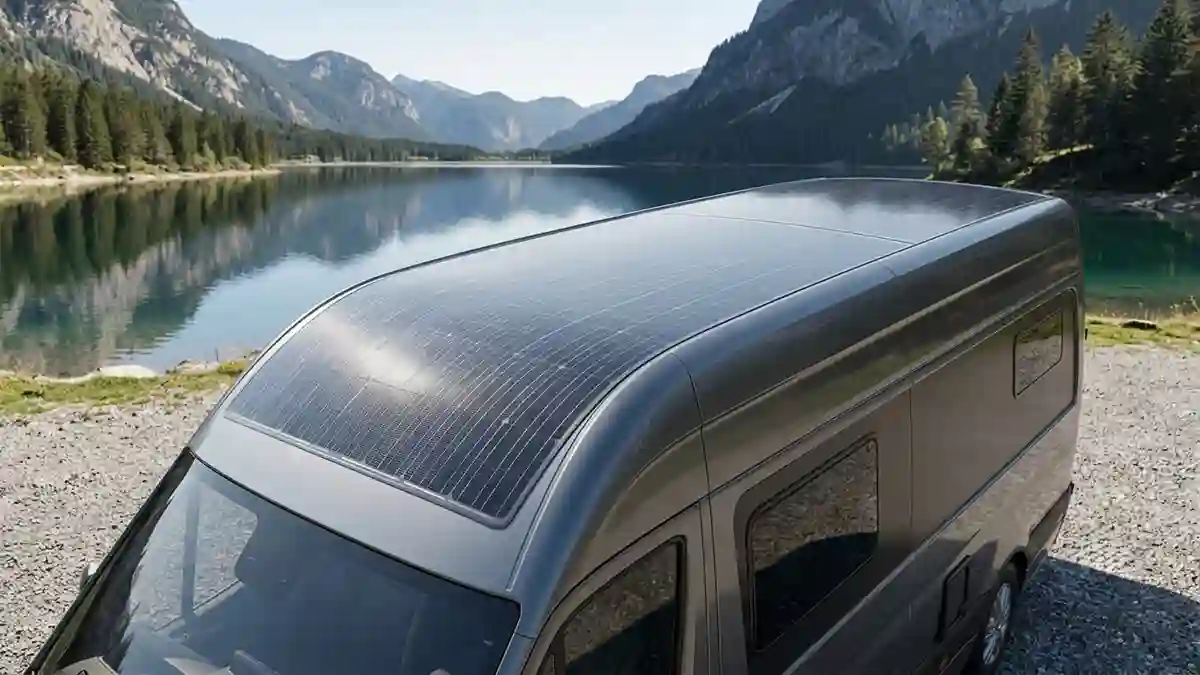
Skin Solar Panel guide: learn the difference between decorative solar skin overlays and true flexible ultra-thin modules — an engineer explains both and which one you actually need.
“Solar skin” is a term that gets used for two genuinely different products, and I want to clear that up before going further, because I’ve had clients bring me the wrong one more than once. If you’re picturing a printed vinyl wrap that makes your existing rooftop panels blend in with your roof tiles — that’s a decorative solar skin overlay, an accessory applied on top of a standard rigid solar panel, not a panel technology itself. If you’re picturing a panel thin and bendable enough to conform to a curved surface — a boat deck, a vehicle roof — that’s what I cover in this guide: skin-type flexible solar panels, sometimes now called “solar skin” in newer research contexts. Same phrase, two different products. This guide is about the second one — the actual hardware, not the cosmetic film.
I bring up that confusion constantly because it’s the single most common mistake I see buyers make in this category — assuming “flexible” is one product with one set of trade-offs, when in reality it spans a wide range of durability, lifespan, and price depending on which flexible technology is actually inside the panel.
This guide is part of our Types of Solar Panels hub.
Skin Solar Panel Technical Snapshot
| Feature | Details |
|---|---|
| Technology | Flexible Thin-Film (CIGS or Amorphous Silicon) |
| Typical Efficiency | 10–13% |
| Typical Lifespan | 5–10 Years |
| Best For | RVs, boats, camper vans, curved roofs, and portable off-grid applications |
| Flexibility | Excellent |
| Installation | Adhesive or low-profile mounting |
| Overall Recommendation | Best suited for curved or weight-sensitive surfaces where conventional rigid solar panels are impractical. |
What Makes a Panel “Skin-Type”
Skin-type flexible panels use thin-film cells (typically CIGS or amorphous silicon) laminated onto a flexible polymer substrate, without the rigid glass front layer or aluminum frame that standard panels use. This is what allows them to bend to a curve radius that a standard rigid panel simply cannot.
Engineer’s Note: “Flexible” and “durable” aren’t the same claim. Skin-type panels sacrifice the protective glass layer for flexibility, which means they’re generally more vulnerable to punctures and UV degradation over time than rigid panels. Don’t assume flexible means tougher — it usually means the opposite trade-off.
Efficiency and Durability Reality
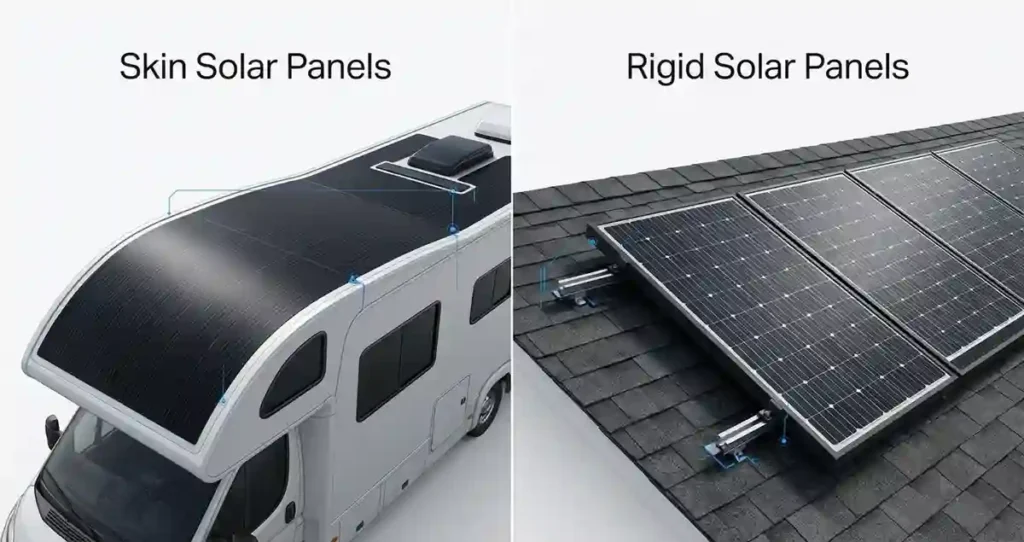
I want to give these numbers in context rather than in isolation. A 10% efficiency loss compared to standard portable panels sounds significant on paper, but in the applications where skin-type flexible genuinely gets chosen, efficiency was never the deciding factor to begin with — the decision was made the moment the surface turned out to be curved. Judge this category on whether it solves your actual physical constraint, not on how its efficiency number compares to a product you were never going to be able to use anyway.
| Metric | Skin-Type Flexible | Standard Portable (Semi-Rigid) | Rigid Monocrystalline | Industry Reference |
| Efficiency | 10% – 13% | 15% – 18% | 18% – 22% | NREL |
| Bend radius | Tight — true curved-surface capable | Limited — folds flat, doesn’t curve | None — fully rigid | PV Magazine |
| Lifespan | Shorter, typically 5–10 years | 10–15 years | 25+ years | Fraunhofer ISE |
| Puncture/impact resistance | Lower — no glass protection | Moderate | High | Industry Best Practice |
Advantages and Disadvantages
| Advantages | Disadvantages |
| True curved-surface conformity — no rigid alternative bends this far | Lower durability — no protective glass layer |
| Very lightweight, ideal for gear and vehicle applications | Shorter lifespan than rigid or semi-rigid panels |
| Enables solar on boats, backpacks, and unconventional shapes | Lower efficiency than rigid or standard portable panels |
| Growing product range for specialty/expedition markets | More vulnerable to punctures and UV degradation over time |
Real-World Applications
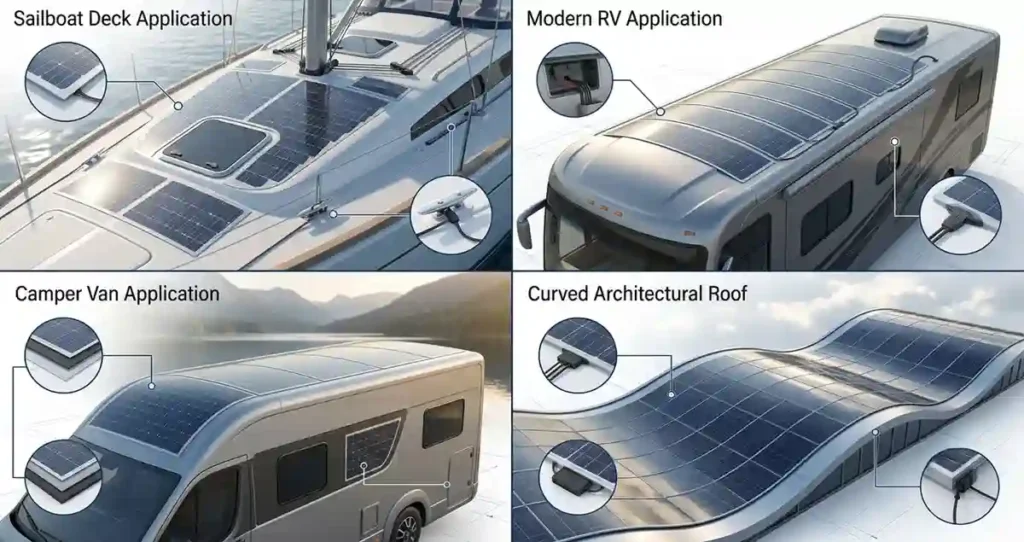
The clearest use case I’ve encountered is a marine client fitting panels to a curved cabin roof where nothing rigid would sit flush — skin-type flexible was genuinely the only physical option, not a preference. The same logic applies to vehicle-integrated solar on curved roof panels, where a rigid or semi-rigid panel simply wouldn’t conform to the sheet metal’s contour.
I’ve also seen it specified for expedition and lightweight backpacking gear where every gram counts and the trip duration is short enough that the shorter lifespan isn’t a real drawback — a few weeks of expedition use doesn’t expose the panel to the years of UV cycling that would matter for a permanent installation.
One client I worked with was retrofitting a narrowboat with a curved roofline and had already been turned down by two installers who only worked with rigid panels. Skin-type flexible modules, adhered directly to the roof’s curvature with a marine-grade adhesive, solved a problem that no amount of racking creativity could have solved with a rigid product. It’s a narrow use case, but it’s a real one, and it’s the reason this category exists at all.
Installation and Adhesion Considerations
Unlike rigid panels that mount on racking, skin-type flexible panels are typically adhered directly to the surface using a specified adhesive or mounting tape system — and the adhesive choice matters as much as the panel itself. Using a generic adhesive instead of the manufacturer-specified one is one of the most common installation mistakes I see, and it’s also one of the leading causes of premature failure, since poor adhesion allows moisture to work its way underneath the panel over time.
Surface preparation before adhesion is equally important — any residual wax, oil, or surface contamination on a boat deck or vehicle roof will compromise the bond. If you’re installing these yourself rather than through a specialist, follow the manufacturer’s surface prep instructions exactly rather than treating it as an afterthought.
Where It Doesn’t Make Sense
Any permanent installation, or any application where durability over years matters more than curve-conformity. For anything staying in place — a roof, a shed, a fixed off-grid setup — standard rigid panels or semi-rigid portable panels will outlast skin-type flexible by a wide margin. See Portable Solar Panels for the more durable folding alternative.
Field Note: Every skin-type flexible panel I’ve inspected after 3+ years of outdoor use showed measurable output decline. I only recommend this category when the curved form factor is a genuine hard requirement — not a convenience preference.
Cost and Where the Premium Actually Goes
Skin-type flexible panels typically cost 40–70% more per watt than an equivalent rigid monocrystalline panel, and that premium is entirely justified by the specialty manufacturing process and adhesive-mount engineering — not by any efficiency advantage, since efficiency is actually lower. Buyers sometimes assume “flexible” and “premium” mean better performance across the board, and it’s worth being direct that this isn’t the case. You’re paying for form factor, full stop.
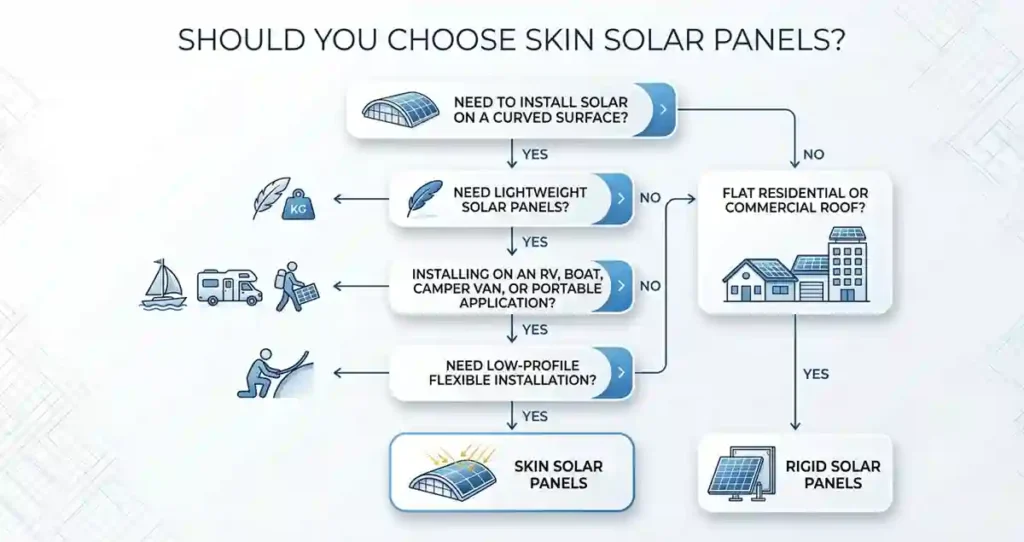
If your project doesn’t have a genuine curved-surface requirement, that premium buys you nothing — you’d get more watts, longer life, and lower cost from a standard portable or rigid panel instead. I say this to every client who brings me a skin-type flexible quote for what turns out to be a flat installation: the curve requirement has to be real before this category makes financial sense.
Common Misconceptions Worth Clearing Up
People frequently assume skin-type flexible panels are simply a more advanced, higher-tech version of standard portable panels — newer, therefore better. It’s actually the opposite trade-off in most of the ways that matter for typical use: less durable, shorter-lived, and lower-efficiency, in exchange for a bend radius most buyers don’t actually need. Advanced manufacturing doesn’t automatically mean a better product for your specific application.
The other misconception is treating peel-and-stick installation as inherently simpler than rigid panel mounting. In some ways it is — no racking, no roof penetrations — but the adhesion and surface preparation requirements are exacting in their own right, and getting them wrong causes failures just as costly as a poorly installed rigid mounting system. Simpler in concept doesn’t always mean simpler to execute correctly.
Skin Solar Panel Engineering Assessment
| Feature | Rating | Engineering Insight |
|---|---|---|
| Flexibility | ★★★★★ | Easily conforms to curved and irregular surfaces without compromising installation. |
| Efficiency | ★★★☆☆ | Lower than premium monocrystalline panels but well suited for specialized applications. |
| Durability | ★★★☆☆ | Reliable for mobile and lightweight installations when properly maintained. |
| Portability | ★★★★★ | Lightweight construction makes transportation and deployment simple. |
| Installation | ★★★★☆ | Quick installation using adhesive bonding or low-profile mounting systems. |
| Long-Term Value | ★★★☆☆ | Delivers excellent value where flexibility and reduced weight are more important than maximum power output. |
| Overall Recommendation | ★★★★☆ | An excellent choice for boats, RVs, camper vans, curved roofs, and other applications where rigid solar panels cannot be installed effectively. |
Buying Checklist
- Confirm the specific cell chemistry (CIGS vs amorphous silicon) — performance and lifespan vary significantly
- Check the manufacturer’s stated lifespan and degradation rate explicitly — it’s rarely printed anywhere on the front of the retail packaging
- Confirm IP rating for your environment
- If the curve requirement isn’t strict, compare cost, lifespan, and efficiency against standard Portable Solar Panels first
The honest test I’d apply before buying into this category: describe your installation surface out loud to someone else. If the word “curved” has to appear in that description in a way a standard portable panel genuinely couldn’t accommodate, skin-type flexible earns its premium. If you’re describing a flat roof, a flat wall, or a flat deck, you’re paying for a capability you don’t need, and a more durable, more efficient, cheaper alternative is sitting right there in the Portable Solar Panels guide instead. It’s a short conversation to have with yourself before you spend the extra money, and it’s saved more than one client from buying a panel that wasn’t right for their actual project.
Buying Checklist Table
| Specification | Why It Matters | What to Look For | Industry Reference |
|---|---|---|---|
| Cell Technology | Determines flexibility and performance | CIGS or Amorphous Silicon | NREL |
| Minimum Bend Radius | Indicates how tightly the panel can curve | Match the manufacturer’s specifications | Fraunhofer ISE |
| UV Resistance | Impacts long-term durability | UV-resistant polymer construction | PV Magazine |
| Adhesive System | Critical for secure installation | Manufacturer-approved marine or automotive adhesive | Industry Best Practice |
| IP Rating | Weather protection | IP65 or higher | IEC 60529 |
| Certifications | Ensures safety and reliability | IEC 61215 and IEC 61730 | IEC |
| Warranty | Indicates manufacturer confidence | Longer product warranty preferred | Industry Best Practice |
| Intended Surface | Confirms compatibility | Boats, RVs, curved roofs, backpacks | NREL |
Who Should Buy Solar Skin Panels?
Skin solar panels are an excellent choice for:
- Boat owners with curved decks or limited installation space.
- RV and camper van owners seeking lightweight, low-profile solar power.
- Overlanding and expedition enthusiasts who need flexible off-grid energy solutions.
- Marine applications where corrosion resistance and lightweight construction are important.
- Curved vehicle roofs that cannot accommodate conventional rigid solar panels.
- Portable solar power projects requiring easy transportation and installation.
- Specialty engineering applications where flexibility is more important than maximum efficiency.
- Anyone installing solar panels on surfaces where traditional rigid photovoltaic panels are impractical.
Who Should Avoid Solar Skin Panels?
Skin solar panels may not be the best option for:
- Residential homeowners with standard pitched rooftops.
- Flat-roof residential or commercial solar installations.
- Commercial buildings prioritizing maximum energy output.
- Utility-scale solar farms where high-efficiency rigid panels are the better choice.
- Buyers focused on achieving the highest possible photovoltaic efficiency.
- Long-term permanent installations requiring maximum durability and lifespan.
- Budget-conscious buyers looking for the lowest cost per watt.
- Anyone without a genuine need for flexible or curved-surface solar panel installations.
Frequently Asked Questions.
What are skin solar panels?
Skin solar panels are ultra-thin, flexible photovoltaic panels designed to conform to curved or lightweight surfaces where conventional rigid solar panels cannot be installed. They are commonly used on RVs, boats, camper vans, portable power systems, and specialty engineering applications.
Are skin solar panels worth buying in 2026?
Skin solar panels are worth buying if your project requires lightweight construction or installation on curved surfaces. For standard residential rooftops, however, conventional monocrystalline solar panels usually provide better efficiency, durability, and long-term value.
How efficient are skin solar panels?
Most skin solar panels achieve an efficiency of approximately 10–13%, depending on the cell technology, manufacturer, and operating conditions. While this is lower than premium monocrystalline panels, they offer advantages in flexibility and lightweight applications.
Can skin solar panels bend around curved surfaces?
Yes. One of the biggest advantages of skin solar panels is their ability to bend around gently curved surfaces such as RV roofs, boats, camper vans, and certain architectural structures. Always follow the manufacturer’s recommended minimum bend radius to avoid damaging the photovoltaic cells.
Are skin solar panels waterproof?
Most high-quality skin solar panels are designed for outdoor use and offer weather-resistant construction. Before purchasing, check the manufacturer’s IP rating to ensure the panel is suitable for your intended environment.
Can skin solar panels be installed on RVs and boats?
Yes. Skin solar panels are widely used on recreational vehicles, boats, yachts, camper vans, and other mobile applications because their lightweight design and flexible construction make installation easier than conventional rigid panels.
Which cell technology is used in skin solar panels?
Most skin solar panels use flexible thin-film photovoltaic technologies such as CIGS (Copper Indium Gallium Selenide) or amorphous silicon, both of which are designed to provide flexibility while maintaining reliable solar energy generation.
How long do skin solar panels last?
The typical lifespan of skin solar panels ranges from 5 to 10 years, although actual service life depends on installation quality, environmental conditions, maintenance, and the specific photovoltaic technology used.
What certifications should skin solar panels have?
Choose skin solar panels that comply with internationally recognized standards such as IEC 61215 for photovoltaic performance and IEC 61730 for electrical safety. These certifications help ensure product quality, durability, and long-term reliability.
Which is better: skin solar panels or rigid solar panels?
Neither option is universally better. Skin solar panels are the preferred choice for curved, lightweight, and portable installations, while rigid solar panels generally deliver higher efficiency, longer service life, and better long-term value for residential and commercial rooftop systems.
References
Flexible CIGS and thin-film efficiency records referenced in this guide are tracked through pv magazine’s CIGS solar cell reporting, which documents ongoing flexible-module efficiency developments from research institutions including EMPA and Fraunhofer ISE. Module safety qualification for flexible formats follows IEC 61730.
Related guides on SolarVisionAI.com
- Solar Fence Post Lights: Cap Sizes, Types & Install Guide
- Solar Charge Controller: The Complete Guide
- MC4 Connectors: Solar Safety & Installation Guide
- Solar Panel Types, Efficiency & Benefits
- Solar Water Pump Guide
- Commercial Solar Panel Installation: Engineering Guide
- Solar Fence Post Lights: Cap Sizes, Types & Install Guide — solarvisionai.com/solar-fence-post-lights/
- BESS — Battery Energy Storage System Guide — solarvisionai.com/bess-battery-energy-storage-system-guide/
- Commercial Solar Panel Installation — solarvisionai.com/commercial-solar-panel-installation/