
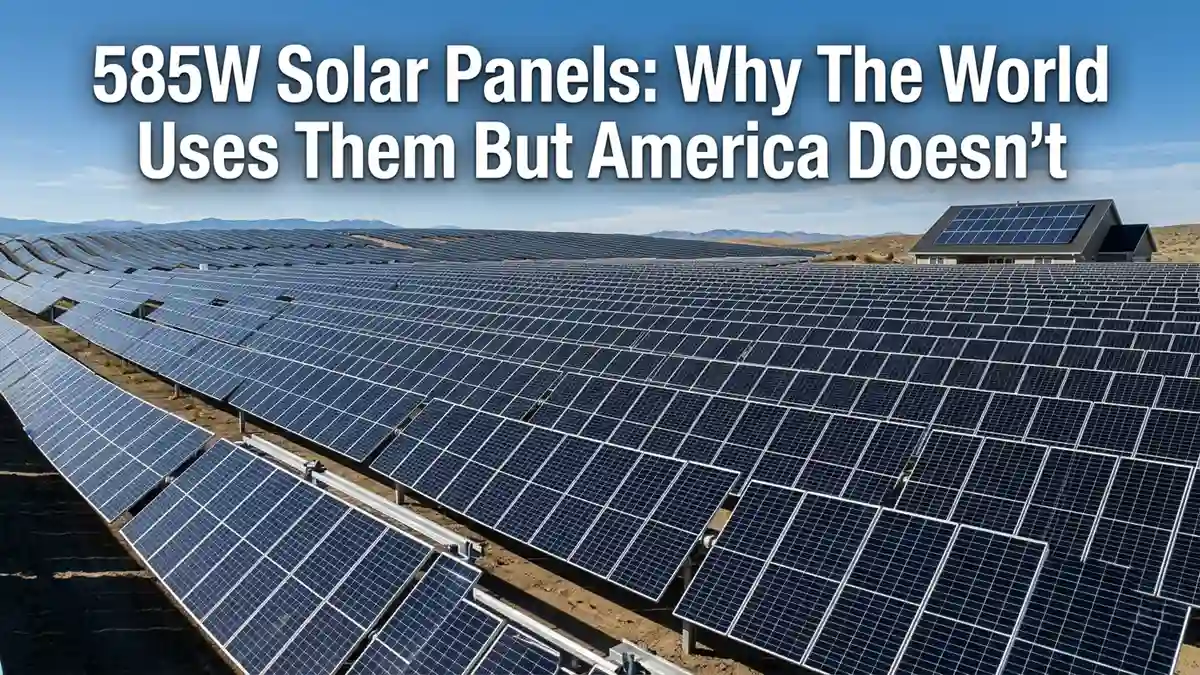
The 585W solar panel is the global commercial standard in 2026. Here’s why US tariffs, tax credit elimination, and microinverter architecture are blocking its adoption in America’s residential market.
The 585W solar panels are the global commercial standard in 2026. Here’s the engineering case for why it won, why it dominates utility and commercial markets globally, and why US tariffs and policy reversals have created a two-tier global market, written by a Registered Professional Engineer.
The 585W solar panels are the world’s most commercially adopted high-wattage modules in 2026. Utility farms in Texas, commercial rooftops in Dubai, and solar fields across Pakistan are running on it. Global manufacturers — LONGi, JA Solar, Jinko, Trina — have standardised their production lines around this format.
So why is the United States, the world’s second-largest solar market, struggling to absorb it at scale?
The answer isn’t engineering. It’s politics, tariffs, and a residential market in freefall.
1. The 585W Solar Panels: Why This Wattage Won
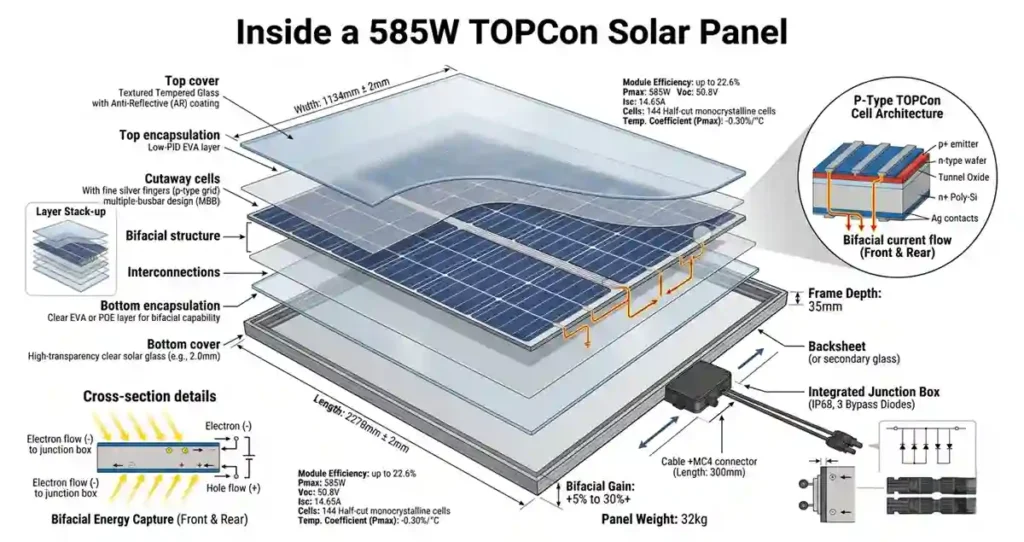
The solar industry doesn’t standardise around wattage by accident. The 585W module hit a commercial sweet spot that no other format has matched:
- 144 half-cut TOPCon cells delivering 22.5%+ module efficiency
- Physical dimensions of ~2278 × 1134mm — large enough to maximise output, small enough for commercial rooftop installation
- Temperature coefficient of -0.30 to -0.35%/°C — critical for hot climates like Pakistan and the Middle East where panel surfaces reach 55–65°C
- Degradation rate of 0.4–0.5% annually with 80% power guarantee at 30 years
For utility developers, the math is simple. Fewer panels per megawatt means fewer mounting structures, fewer connectors, less labour, and lower balance-of-system cost. The 585W panel reduces installed cost more effectively than any incremental efficiency improvement.
Engineer’s Note: The temperature coefficient advantage of TOPCon over PERC (-0.30 vs -0.38%/°C) translates to 16W more output per panel at 60°C panel surface temperature — a routine operating condition in Pakistan, India, and the Gulf. Over a 25-year project life, this compounds to 8–12% more total energy yield from an otherwise identical installation.
2. The US Market Reality in 2026: A Tale of Two Segments
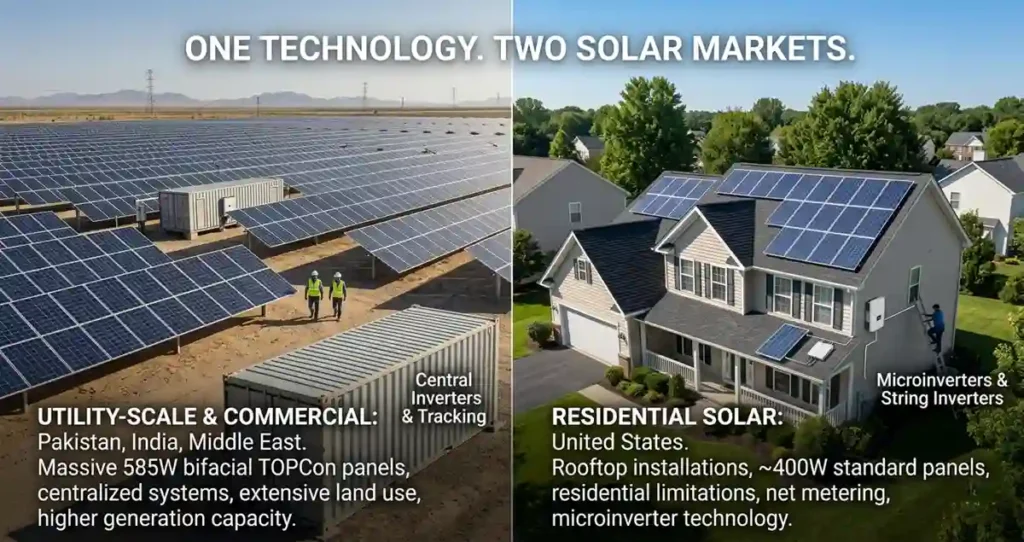
The United States solar market in 2026 is deeply divided between its utility-scale segment — where 585W solar panels are standard — and its residential segment, which is collapsing under the weight of policy reversals.
| Segment | 585W Adoption | Primary Inverter | Market Status 2026 |
| Utility-scale | Dominant standard | String inverter | Strong — 5.9 GWdc Q1 2026 |
| Commercial rooftop | Widely adopted | String inverter | Moderate — stable |
| Residential | Largely absent | Microinverter (Enphase) | Collapsing — down 15% YoY |
Utility-scale: 585W TOPCon bifacial is the dominant module. The US added 5.9 GWdc of utility-scale solar in Q1 2026 alone. Large ground-mounted farms in Texas, California, and the Southeast run almost exclusively on high-wattage bifacial panels.
Residential: Limited adoption. US residential solar systems are largely built around microinverter architecture (dominated by Enphase), which is typically optimized for 400–430W modules. Moving to 585W panels requires redesigning system configurations, including DC-to-AC ratio calculations, NEC voltage compliance, inverter compatibility, and roof load considerations.
3. Trump’s Tax Credit Elimination: The Real Reason US Residential Solar Is Struggling
In July 2025, President Trump signed the One Big Beautiful Bill into law, eliminating the 30% federal tax credit for residential solar installations effective December 31, 2025 — nearly a decade ahead of schedule.
The result was immediate and severe. US residential solar installations are projected to fall to their lowest level since 2020 in 2026, down 15% from 2025. Industry analysts at BloombergNEF have stated the market is not expected to recover to 2023 record levels for the foreseeable future.
Systems that previously paid for themselves in 8–10 years with tax credits may now take 15–20 years to break even. At a 15–20-year payback, many American homeowners rationally decide not to go solar.
Field Note: For a country-level comparison of how US policy dependency contrasts with the subsidy-free solar booms in Pakistan and India, see the companion article: Poor Countries Don’t Wait for Governments to Go Solar.
4. The Tariff Wall: Why Chinese 585W Panels Face 25–300% Duties to Enter the US
The global 585W solar panel supply chain is dominated by Asian manufacturing, with most high-wattage modules produced in China or using Chinese-origin cells. Major manufacturers, including LONGi, JA Solar, JinkoSolar, Trina Solar, and LESSO Solar, have standardized production around large-format TOPCon modules. In the US, trade policies and import regulations create additional cost barriers for these modules.
- Section 201 safeguard tariffs on all imported solar cells and modules
- Section 301 tariffs specifically targeting Chinese-origin goods
- Anti-dumping and countervailing duties (AD/CVD) on modules from Southeast Asian countries used as transshipment routes — Vietnam, Malaysia, Thailand, Cambodia — with rates reaching 300% for some Cambodian exporters
The result: US module prices in Q1 2026 reached $0.28/Wdc for imported panels not subject to the most severe penalties — versus $0.46/Wdc for panels using US-manufactured cells. For a 100MW utility project, that differential translates to millions of dollars in additional module cost.
Engineer’s Note: US domestic cell manufacturing capacity currently stands at approximately 3GW against annual installation demand of 40+ GW. Until domestic manufacturing scales meaningfully, the tariff regime creates a structural cost disadvantage for US solar buyers versus every other major market globally.
5. Where 585W Panels Are Thriving: Markets the US Is Missing
| Market | Tariff Barrier | Dominant Inverter | Key Driver | 585W Status |
| Pakistan | None | String Inverter | Grid cost PKR 50–70/kWh | Standard above 10kW |
| Middle East (UAE/KSA) | None | String Inverter | Utility + commercial scale | Default specification |
| Australia | None | String/Hybrid Inverter | 35% rooftop penetration | Standard commercial |
| India | Low (domestic MFG) | String Inverter | 500GW 2030 target | Utility standard |
| USA (utility) | 25–300% | String Inverter | Data centers, PPAs | Dominant but expensive |
| USA (residential) | 25–300% | Microinverter | No tax credit since 2026 | Largely absent |
For the hot climate engineering case for 585W TOPCon in Pakistan and the Gulf — temperature derating, degradation rates, and 25-year energy yield calculations — see the complete wattage evolution guide.
6. What Happens Next: The US Market Outlook
The US solar industry is not giving up on high-wattage panels. Utility-scale demand remains structurally intact — data center buildouts, corporate PPAs, and grid decarbonisation commitments require gigawatt-scale deployment that only large-format panels can deliver efficiently.
Two signals worth watching:
- Trade policy: The US Supreme Court is considering cases that could limit executive IEEPA tariff authority. A ruling narrowing that authority could reduce tariff costs on imported modules.
- Domestic manufacturing: US cell manufacturing must scale from 3GW to 40+ GW before tariff protection makes domestic solar genuinely cost-competitive rather than simply more expensive.
Until those structural issues are resolved, the 585W solar panels will continue to be a global standard that the US market adopts selectively — dominant at utility scale, largely absent in residential, and commercially viable only for developers with the scale to absorb tariff complexity.
Frequently Asked Questions
What is the standard solar panel wattage in 2026?
For commercial and utility-scale installations globally, 575–590W N-type TOPCon bifacial is the 2026 standard. For US residential, 400–430W microinverter-compatible panels remain dominant due to inverter architecture constraints. The 585W format is commercially standard in every major solar market except the US residential.
Why don’t US homeowners use 585W solar panels?
Three reasons: (1) Enphase and SolarEdge microinverter architecture dominates US residential and is optimised for 400–430W panels. (2) String voltage limits under NEC electrical code require system redesign for high-wattage panels. (3) US tariffs on Chinese-manufactured modules make 585W panels 25–64% more expensive than in other markets.
Are 585W solar panels worth it in hot climates?
Yes — TOPCon 585W panels outperform equivalent PERC panels in hot climates due to a better temperature coefficient (-0.30 vs -0.38%/°C) and lower annual degradation (0.4% vs 0.5%). In a 45°C ambient environment over 25 years, the cumulative energy yield advantage of TOPCon is 8–12% from an otherwise identical installation.
What is the price of a 585W solar panel in 2026?
FOB price from Tier 1 and Tier 2 manufacturers: $0.13–0.16/W in 2026, making a 585W panel approximately $76–$94 FOB. Landed price varies significantly by destination due to freight, duties, and import taxes.
Final Thoughts
Outside the United States, the market has already decided. The 585W TOPCon bifacial panel is the commercial standard for 2026 installations above 10kW. Its combination of watt-per-dollar economics, thermal performance, and long-term degradation profile has made it the default specification across Asia, the Middle East, Australia, and emerging markets.
The US will catch up — either through domestic manufacturing scale or trade policy normalisation. Until then, developers in Pakistan, the Gulf, and South Asia are installing the world’s most efficient commercial panels at prices US buyers cannot access.
Related guides on SolarVisionAI.com
Solar Fence Post Lights: Cap Sizes, Types & Install Guide
Solar Charge Controller: The Complete Guide
MC4 Connectors: Solar Safety & Installation Guide
Solar Panel Types, Efficiency & Benefits
Commercial Solar Panel Installation: Engineering Guide
Commercial Solar Panel Installation — solarvisionai.com/commercial-solar-panel-installation/