
Master solar mounting systems engineering. Complete guide to load calculations, ASCE 7 compliance, material selection, and structural roof type matching.
A solar panel that is not properly mounted is not an asset — it is a liability. It can shift in a windstorm, leak at its attachment points, impose unacceptable loads on a roof structure that was never analyzed for them, and degrade faster than modeled because misalignment causes shading and thermal stress the energy model did not account for. Every performance problem that emerges over a 25-year system life traces back, in whole or in part, to the mounting system.
This is the hub guide for the entire solar mounting content cluster on SolarVisionAI. It covers the full picture — system types, engineering requirements, material specifications, and selection framework — with each section pointing to the deeper guides where the topic warrants it.
1. What a Solar Mounting System Does
A solar mounting system performs five functions simultaneously: structural support (transferring panel weight and environmental loads to the building or ground), orientation and tilt setting, electrical isolation or grounding continuity, thermal expansion accommodation, and maintenance access structure. No other component in the solar system performs this many simultaneous functions, has longer direct weather exposure, or is more difficult and expensive to correct after installation.
2. Types of Solar Mounting Systems
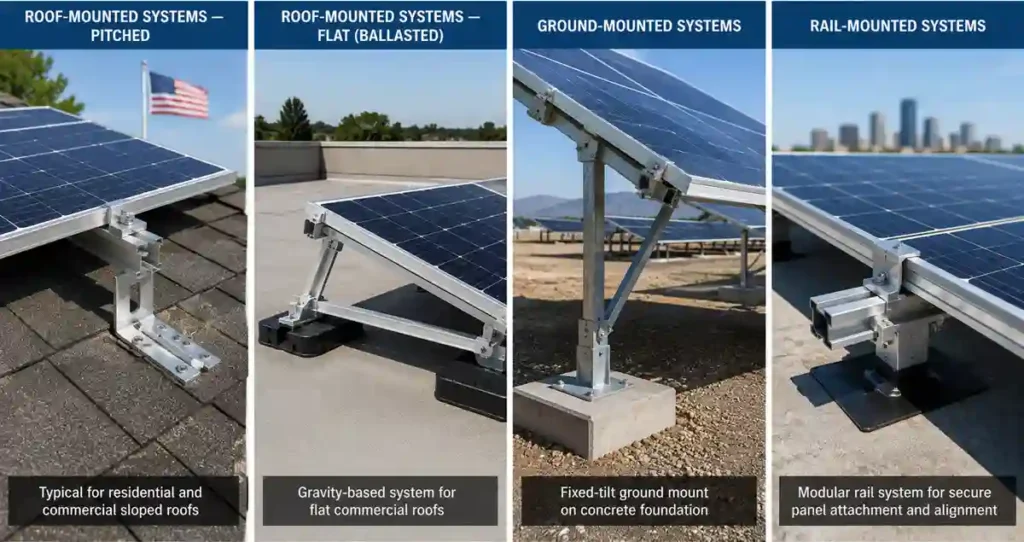
Roof-Mounted Systems — Pitched
Rail-based systems on pitched roofs are the most common configuration. The full structural and material specification for the rail component is in the Solar Mounting Rails guide. The brackets that attach the rail to the roof structure are covered in the Solar Panel Mounting Brackets guide, the Mounting Brackets with Hardware guide, and the Roof Solar Panel Mounting Brackets guide.
Roof-Mounted Systems — Flat (Ballasted)
The panel technology considerations that affect flat-roof mounting system selection — particularly for bifacial modules requiring elevated clearance — are covered in the Solar PV Panel Mounting Systems guide.
Ground-Mounted Systems
The decision between ground and rooftop is covered systematically in the Ground Mount vs Roof Mount Solar guide. The full engineering of ground-mount foundations, structural frames, and installation sequence is in the Solar Panel Ground Mounting Systems guide.
Rail-Mounted Systems
How the complete rail-mounted system works mechanically, structurally, and electrically is covered in the Rail Mounted Solar Panels guide. The installation kit specification and commissioning checklist are in the Solar Panel Rail Mounting Kit guide.
3. The Structural Engineering Framework
- Dead load calculation: panel weight, rail weight, hardware weight, and any ballast weight. Typical commercial solar dead load is 2.5 to 5 lbs/sq ft for flush-mount systems, 8 to 15 lbs/sq ft for ballasted systems at 10-degree tilt.
- Wind load calculation: calculated per ASCE 7-22 for the specific site — local wind speed, exposure category, roof height, and panel position. Edge and corner locations require separate calculation from interior locations.
- Snow load calculation (where applicable): ground snow load from ASCE 7-22 maps, converted to roof snow load using exposure and thermal factors for the roof type.
- Roof structure capacity verification: the existing building structure must be verified to carry the additional solar loads. For most roof-mounted commercial solar systems, this requires a structural engineer’s analysis of the existing roof framing.
Engineer’s Note: The structural analysis of the existing building for solar load is not the mounting system manufacturer’s responsibility — it is the project engineer’s. The manufacturer’s load tables tell you what the mounting system can do. A structural engineer tells you what the building can accept. These are different questions and they both need answers before installation begins.
4. Solar Mounting System Selection Guide
| Installation Type | Best System Type | Tilt Range | Key Constraint | Relative Cost/Watt |
| Pitched residential/light commercial roof | Rail-mount, flashing bracket | Set by roof pitch | Roof structure capacity; rafter spacing | Lowest |
| Flat commercial roof — membrane sensitive | Ballasted frame system | 5-15° | Roof dead load capacity for ballast | Low-medium |
| Flat commercial roof — structure limited | Penetrating with reduced ballast | 5-15° | Membrane warranty compliance | Medium |
| Open ground — fixed | Driven pile ground mount | 15-35° (optimize for latitude) | Soil bearing capacity; foundation design | Medium |
| Open ground — tracking | Single-axis tracker | Horizontal axis, ±60° tracking | Tracker drive maintenance; grading requirements | Medium-high |
| Parking lot | Steel carport canopy | 10-20° | Column foundation; clearance; steel structure cost | High |
5. Material Specifications for Solar Mounting Systems
The complete rail alloy specification — including span tables and T-slot geometry — is in the Solar Mounting Rails guide. The complete fastener specification — by bracket type and roof substrate — is in the Solar Panel Mounting Brackets with Hardware guide.
6. Common Solar Mounting System Failure Modes
Solar mounting systems are designed for decades of outdoor service, yet most premature failures can be traced back to a handful of recurring engineering and installation mistakes. The most common failure mode is inadequate structural attachment, where fasteners miss the intended structural member or fail to achieve the specified embedment depth. This reduces pull-out resistance and can lead to bracket movement during high-wind events.
Corrosion is another long-term concern, particularly in coastal regions of the United States where salt exposure accelerates degradation of improperly specified hardware. Galvanic corrosion between dissimilar metals can also reduce system lifespan if material compatibility is not verified during design.
Water intrusion remains one of the most expensive rooftop solar failures. Improper flashing, incorrect sealant selection, or damaged roof membranes can create leaks that may not become visible until months or years after installation. Regular inspection and adherence to manufacturer installation requirements are critical for long-term waterproofing performance.
7. Corrosion Protection and Material Selection
The service life of a solar mounting system depends heavily on material selection. Most utility-scale and commercial systems in the United States use aluminum mounting rails combined with stainless steel hardware to achieve long-term durability while minimizing maintenance requirements.
For installations in coastal environments such as Florida, California, Texas Gulf Coast, and the Carolinas, Grade 316 stainless steel fasteners are generally preferred due to their superior resistance to chloride-induced corrosion. In inland regions with lower environmental exposure, hot-dip galvanized steel and aluminum components often provide satisfactory long-term performance.
Material compatibility should always be evaluated during system design. Dissimilar metals in direct contact may create galvanic corrosion cells that accelerate deterioration and compromise structural integrity over time.
8. Inspection and Maintenance Requirements
Although solar mounting systems contain few moving parts, periodic inspections remain essential throughout the system lifecycle. Annual visual inspections should verify that mounting hardware remains secure, flashing components remain intact, and no evidence of corrosion, movement, or roof deterioration is present.
Following severe weather events such as hurricanes, tornadoes, hailstorms, or unusually high wind conditions, additional inspections may be warranted. Particular attention should be given to edge and corner zones where wind uplift forces are typically highest.
A properly maintained mounting system can support safe solar operation for 25 years or more while minimizing repair costs and preserving expected energy production.
9. U.S. Codes, Standards, and Compliance
Solar mounting systems in the United States are governed by multiple codes and standards that address structural performance, electrical safety, and installation practices.
Key standards commonly referenced include ASCE 7 for wind and snow load calculations, the National Electrical Code (NEC) Article 690 for photovoltaic installations, and UL 2703 for mounting system grounding, bonding, and mechanical performance. Local building departments may also adopt state-specific requirements based on regional weather conditions and construction practices.
Compliance with applicable codes is not merely a permitting requirement. These standards establish the engineering framework that helps ensure solar installations remain safe and reliable throughout their service life.
10. Frequently Asked Questions
What is a solar mounting system?
A solar mounting system is the structural framework that secures solar panels to rooftops, ground foundations, carports, or other supporting structures while safely transferring environmental loads.
What are the main types of solar mounting systems?
The most common types include pitched-roof systems, flat-roof ballasted systems, ground-mounted systems, tracking systems, and solar carport structures.
How long do solar mounting systems last?
High-quality solar mounting systems are typically designed for service lives of 25 years or longer when properly installed and maintained.
Are ballasted solar mounting systems better than penetrating systems?
Neither system is universally better. The appropriate choice depends on roof structure, wind loading, waterproofing requirements, and project-specific engineering constraints.
Can an existing roof support solar panels?
Many roofs can support solar installations, but structural verification should be performed before installation to confirm adequate load-carrying capacity.
What standards apply to solar mounting systems?
Common U.S. standards include ASCE 7, NEC Article 690, UL 2703, and local building code requirements adopted by the Authority Having Jurisdiction (AHJ).
What is the most important factor when selecting a solar mounting system?
Structural compatibility with the building or site is generally the most critical factor, followed by environmental loading requirements, material durability, and long-term maintenance considerations.
Related guides on SolarVisionAI.com
Solar Panel Installation: Complete Engineering Guide
Solar Power System : Types, Cost, ROI & AI Optimization