
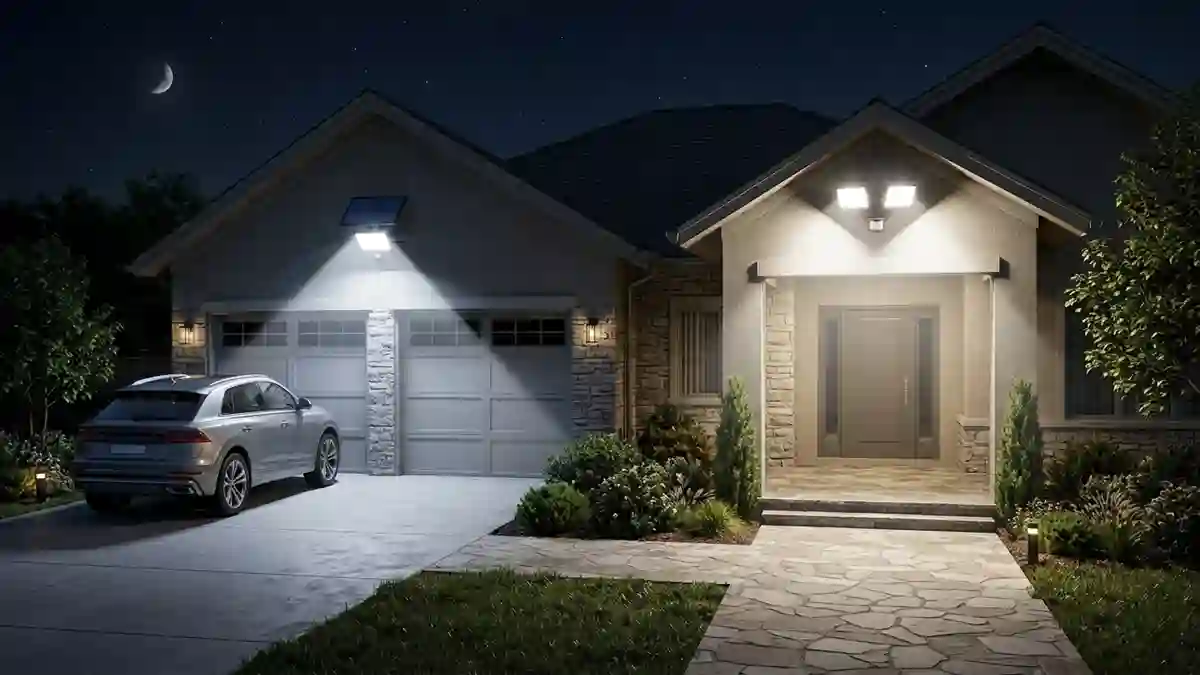
LED solar security lights vs wired grid fixtures — engineer compares system efficiency, PIR motion zone geometry, winter reliability, and placement principles for both.
A technical comparison of LED wired security lights and solar PIR security lights — covering energy efficiency, motion detection zone geometry, placement principles, and the conditions under which each technology is the right engineering choice. Written by a Registered Professional Engineer.
The LED vs solar question for security lighting isn’t as simple as it looks. Both technologies use LED arrays. The difference is the power source, the control logic, and the reliability profile under different operating conditions.
The right choice depends on your location, your winter sun hours, your mounting constraints, and what you actually need the light to do. Since LED solar security lights rely on a solar panel to capture and convert sunlight into stored energy, panel orientation and available solar exposure also affect real-world performance. This guide breaks down the engineering comparison and gives you the placement principles that apply to both technologies.
For a full overview of solar security light specifications, the solar security lights guide is the starting point for this cluster.
1. Efficiency: What the Numbers Actually Mean
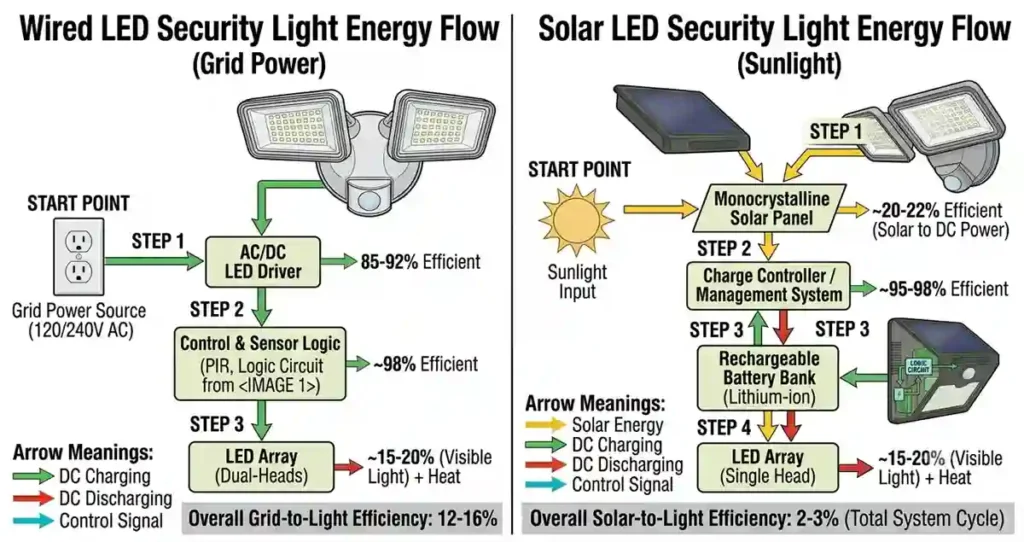
LED efficiency is measured in lumens per watt (lm/W). Modern LED arrays, whether in wired fixtures or solar security lights, operate in a similar efficiency range: 80–130 lm/W for quality units.
The efficiency difference between wired and solar LED security lights is minimal at the LED array level. The real efficiency comparison is at the system level — how much of the available energy actually reaches the LED array.
Wired LED Security Lights — System Efficiency
Power comes from the grid through a driver circuit. A quality constant-current LED driver operates at 85–92% efficiency. Grid power is delivered at consistent voltage regardless of season or weather. System efficiency is stable and predictable year-round.
Solar LED Security Lights — System Efficiency
Power flows from sunlight → solar panel (15–22% efficiency) → charge controller (93–97% efficiency) → battery storage (85–95% charge/discharge efficiency) → LED driver (85–92% efficiency). The solar panel conversion is where the largest efficiency loss occurs.
Total system efficiency for a solar security light, from sunlight to light output, is typically 12–18%. This sounds low compared to grid power — but the input energy is free, and the comparison is system cost and reliability, not conversion efficiency.
Engineer’s Note: The solar panel efficiency figure (15–22%) makes panel sizing critical in solar security lights. A 5W solar panel in full sunlight can provide around 4–4.5W after system losses. Combined with modern lithium batteries, the system stores energy more efficiently and delivers longer-lasting LED performance. Battery capacity, panel size, and daily runtime requirements must be balanced for reliable operation. Proper sizing ensures consistent illumination throughout the night.
2. The Real Performance Comparison
| Factor | LED Wired (Grid-Powered) | LED Solar (Battery-Powered) |
| Power source | Grid — consistent voltage, unlimited energy | Solar panel + battery — variable by season |
| Install complexity | Cable run, conduit, licensed electrician | Mount and aim — no wiring beyond fixture |
| Operating cost | $5–30/year depending on trigger frequency | Zero ongoing cost |
| Max sustained output | Unlimited — constrained only by fixture spec | Battery-constrained — typically 4–8 hrs at full output |
| Winter reliability | 100% — grid power is unaffected by season | Reduced — fewer charge hours, lower battery state |
| Failure modes | Driver failure, wiring fault, breaker trip | Battery degradation, panel soiling, PIR failure |
| Typical lifespan | 10–15 years (LED array); driver may need replacement | 5–8 years before battery replacement; LED array lasts longer |
| Best application | Commercial perimeter, high-security residential, locations above 50° latitude | Residential perimeter, remote structures, locations with 4+ winter sun hours |
3. Motion Detection Zone Geometry
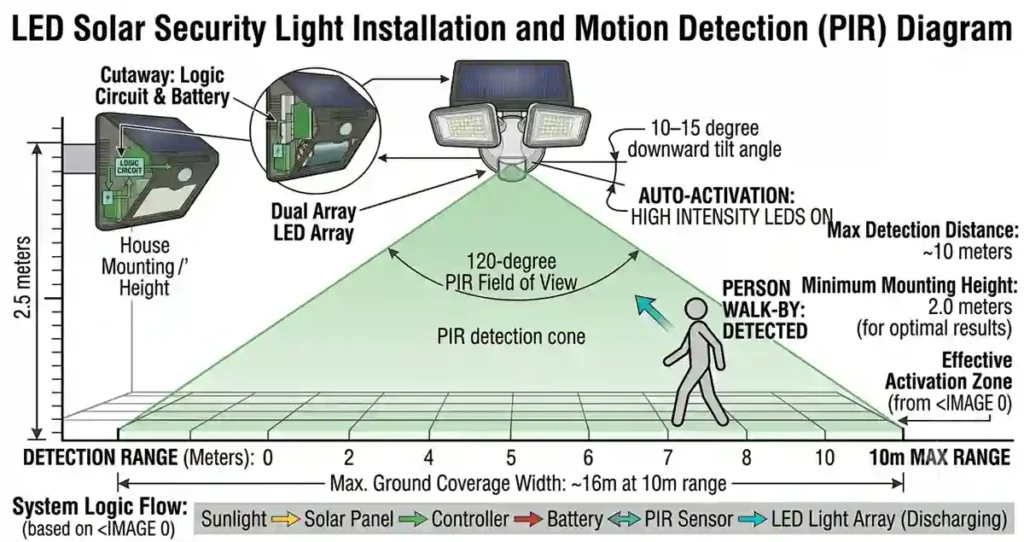
This applies equally to wired and solar security lights — the PIR physics are the same regardless of how the fixture is powered.
A PIR sensor detects infrared radiation change within its detection cone. The cone shape is defined by the fresnel lens geometry. Most security lights use a 120° horizontal detection angle with a 60–90° vertical angle. Understanding how that cone projects onto the ground plane at your mounting height is what determines whether the fixture actually covers the area you intend.
Detection Zone at Different Mounting Heights
At 2.5m mounting height with a 120° horizontal angle and 30° downward tilt:
Detection zone starts approximately 0.5m from directly below the fixture
Maximum detection range: 8–10m from the fixture base
Effective detection width at maximum range: approximately 10–12m
At 3m mounting height with the same sensor geometry:
Detection zone starts approximately 1m from below the fixture
Maximum detection range: 10–12m from the fixture base
Effective detection width at maximum range: approximately 12–15m
Engineer’s Note: The most common placement mistake I see is mounting security lights flat against a wall at head height (1.8–2m) with the PIR pointing horizontally. At that height, the detection cone sweeps at near-horizontal, meaning a person walking parallel to the wall 1.5m away may not trigger the sensor until they’re almost directly in front of it. Mount at 2.5–3m with a 10–15° downward tilt for reliable detection of lateral movement.
Overlapping Detection Zones for Perimeter Coverage
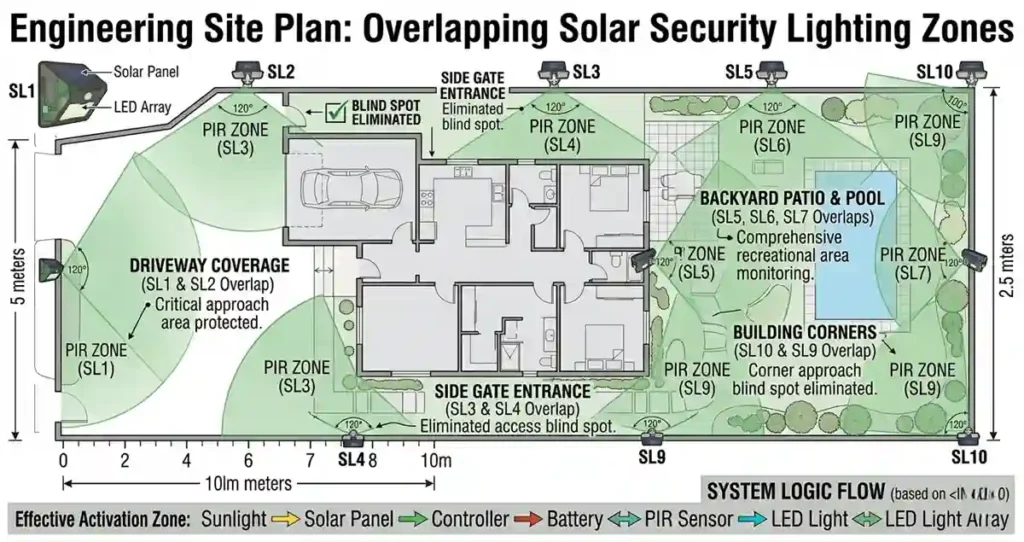
For continuous perimeter coverage without blind spots, detection zones from adjacent fixtures need to overlap. At 2.5m mounting height, a fixture with 10m detection range covers approximately 8m reliably. For continuous coverage, space fixtures at 6–7m intervals — allowing 1–2m of overlap between adjacent detection zones.
For corner coverage — the zone behind a building corner — a second fixture is almost always necessary. PIR sensors don’t detect around corners. Plan for fixture positions that give line-of-sight from the sensor to the intended coverage area.
4. Adaptive Motion Sensitivity: Where Solar Has an Advantage
Modern solar security lights with intelligent controllers can adjust PIR sensitivity based on battery state. When the battery is at high charge, the system runs at full sensitivity and full output. As battery charge decreases through the night, some units reduce sensitivity threshold to conserve energy while maintaining basic detection capability.
This adaptive behaviour — matching power consumption to available energy — is genuinely useful in winter when charge capacity is reduced. It’s not AI in any meaningful sense, but it’s smart power management that wired lights don’t need because they have unlimited power.
If you’re evaluating solar security lights for a location with variable winter sun, look for units that specify adaptive or multi-mode operation with separate standby and full-output modes. The difference in winter reliability is significant.
5. Westinghouse Solar Security Lights: Engineering Context
Westinghouse solar security lights appear frequently in search results and are a common consumer purchase. From an engineering standpoint, they’re mid-range consumer units — adequate for residential applications where the spec requirements are met, but not commercial-grade fixtures.
Key things to verify on Westinghouse units before purchase:
Listed lumen output — confirm whether the figure is peak or sustained
Battery capacity — look for 3000+ mAh for 1000 lm units
IP rating — most are IP44; for exposed locations, look for IP65 variants
Detection range — real-world is typically 70% of listed
The same checklist applies to any brand. Westinghouse has reasonable quality control for the residential market, but the brand name is not a substitute for verifying the actual specs against your application requirements.
6. Placement Principles for Both Technologies
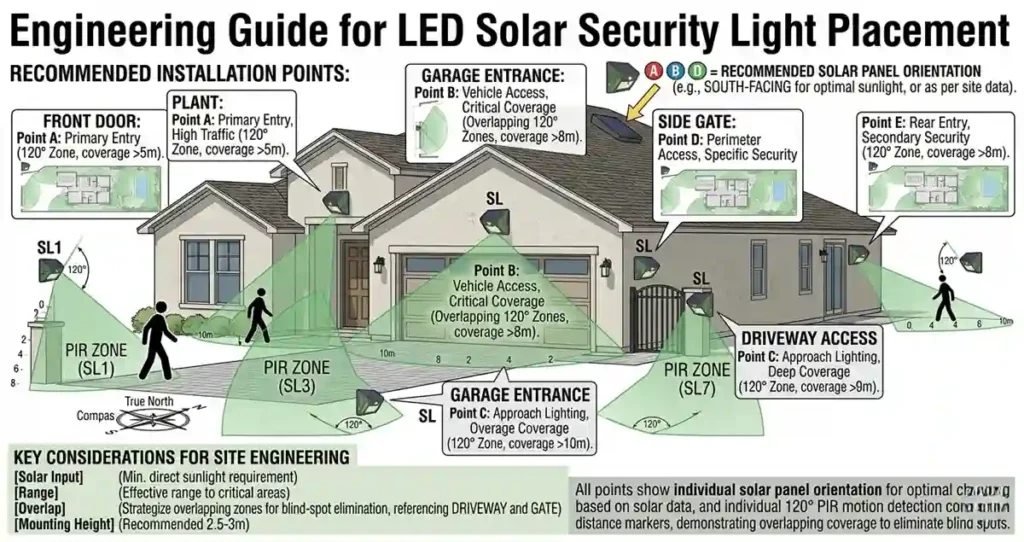
These placement rules apply regardless of whether you’re using solar or wired LED security lights:
Cover Entry Points First
Front door, garage door, side gates, and any secondary entry points. These are the locations that matter most for security lighting effectiveness. Secondary perimeter coverage is useful but less critical than entry point coverage.
Avoid Pointing at Roads or Neighboring Properties
Security lights that trigger from road traffic are nuisance lights — they activate constantly without providing useful security information. Angle the PIR away from public roads. Most units allow ±30° horizontal adjustment of the sensor.
Consider the Light Pollution Footprint
1000+ lumen security lights trigger at full output in a defined cone. If that cone illuminates a neighbor’s bedroom window, you’ll have a problem. Plan the detection zone footprint before mounting, not after.
Position the Solar Panel for Maximum Exposure
For solar units, the panel orientation matters as much as the fixture placement. South-facing panels (northern hemisphere) capture the most energy year-round. If the fixture location has the panel facing east or west due to mounting constraints, expect 15–25% reduced charge capacity compared to south-facing orientation.
For technical guidance on maximising solar panel output including tilt and orientation, the solar panel types and efficiency guide on SolarVisionAI covers the principles in detail.
Frequently Asked Questions
Are LED solar security lights as bright as wired lights?
At the same lumen rating, yes — an LED is an LED regardless of power source. The practical difference is that solar units are typically limited to 400–2000 lumens by battery capacity constraints, while wired fixtures can run at 3000–10,000 lumens continuously. For residential applications, 800–1500 lm solar units are adequate. For commercial perimeter lighting requiring sustained high output, wired fixtures are the engineering choice.
What causes solar security lights to have poor motion detection?
Three common causes: (1) Mounting height too low or sensor angle too flat — the detection cone doesn’t project to the intended area. (2) PIR sensitivity set too low — adjust the sensitivity dial if present. (3) Ambient temperature too close to body temperature — summer performance is typically worse than winter for this reason. Check mounting geometry first, then sensor settings, before concluding the unit is defective.
Can I use solar security lights in a location with partial shade?
Yes, but size up the battery. Partial shade reduces panel output proportionally. A panel receiving 50% of full sun generates 50% of rated power — meaning a 5W panel behaves like a 2.5W panel. In that scenario, a 4000 mAh battery covers what a 2000 mAh battery would provide in full sun. Quantify the shade impact before selecting specs.
How do I set up overlapping motion zones for full perimeter coverage?
Map your perimeter and mark entry points. Position fixtures so detection zones overlap by 1–2m between adjacent units. Use the mounting height and listed detection range to estimate zone size (apply the 70–80% real-world factor to listed range). Corners require dedicated coverage — plan one fixture per corner with the detection zone aimed into the blind area. Test the complete coverage by walking the perimeter after installation and marking any spots that don’t trigger detection.
Final Thoughts
LED wired and LED solar security lights both use the same light-producing technology. The engineering choice between them is about power source reliability, installation constraints, and output requirements for the specific application.
For most residential applications in locations with reasonable winter sun, solar security lights are a practical and cost-effective solution. For commercial applications, high-output requirements, or locations with extended winter cloud cover, wired LED fixtures remain the more reliable engineering choice.
Placement geometry matters as much as product specification. A well-placed 800-lumen solar security light outperforms a poorly placed 2000-lumen wired fixture every time.
If security camera integration is part of your requirement, the solar security camera lights guide covers the specific engineering tradeoffs of dual-function units.
Related guides on SolarVisionAI.com
Solar Security Lights: What Actually Works (2026) — solarvisionai.com/solar-security-lights/
Solar Fence Post Lights Lumens Guide — solarvisionai.com/solar-fence-post-lights-lumens/
Solar Fence Post Lights: Cap Sizes, Types & Install Guide
Solar Charge Controller: The Complete Guide
MC4 Connectors: Solar Safety & Installation Guide