
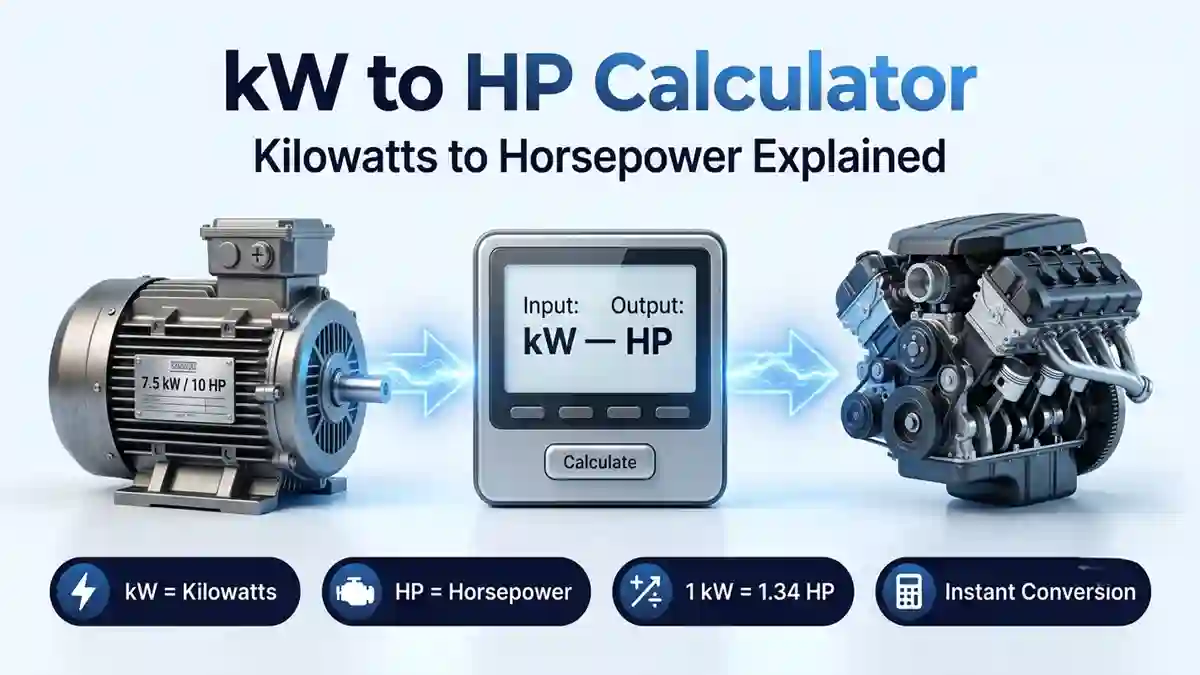
Free kW to HP Calculator — Convert Kilowatts to Horsepower and HP to kW instantly. Perfect for motors, electric vehicles, generators, home appliances, and solar energy systems.
Please enter a valid value greater than zero.
Formula: HP = kW × 1.34102
Use our free kW to HP Calculator to instantly convert Kilowatts to Horsepower and Horsepower to Kilowatts. Whether you are working with electric motors, generators, electric vehicles, or solar inverters, this tool gives you fast and accurate results.
1. What Is the Difference Between kW and HP?
Kilowatts (kW) and Horsepower (HP) are both units of power, but they are used in different industries and regions. Kilowatts are the standard international unit (SI) used in electrical engineering, while Horsepower is commonly used for motors, engines, and vehicles.
Most engineers and electricians work in kW. Most mechanics, vehicle buyers, and pump installers work in HP. Knowing how to convert between the two prevents sizing errors when crossing between those worlds.
2. The Conversion Formula
kW to HP: HP = kW × 1.34102
HP to kW: kW = HP × 0.7457
Example 1: A 10 kW electric motor produces: 10 × 1.34102 = 13.41 HP
Example 2: A 100 HP engine produces: 100 × 0.7457 = 74.57 kW
Engineer’s Note: Always confirm which type of Horsepower is being used before sizing a system. Mechanical HP (0.7457 kW) is the international standard. Metric HP (0.7355 kW) is used across Europe. Using the wrong conversion in a motor-to-inverter sizing calculation can result in an undersized system that trips on overload.
3. Practical Applications
Electric Motors
Industrial and commercial motors are rated in both kW and HP. A 7.5 kW motor is equivalent to approximately 10 HP — a very common industrial standard size. When specifying a motor replacement, confirm whether the original nameplate rating is in kW or HP before ordering a substitute.
Electric Vehicles (EVs)
EV manufacturers rate motors in kW while traditional car buyers compare in HP. A 150 kW EV motor produces approximately 201 HP — comparable to a mid-size petrol engine. This conversion is useful when comparing EV performance specs to conventional vehicles.
Generators
Generator capacity is often listed in kW for electrical output and HP for the engine driving it. A 20 kW generator typically requires a 30-35 HP engine to operate efficiently. The difference accounts for mechanical and conversion losses between the engine shaft and the alternator output.
Engineer’s Note: Generator efficiency is typically 85-92%. A 30 HP engine does not deliver 30 HP of electrical output. Factor in this efficiency loss when sizing a generator for a critical load. Rule of thumb: divide the required electrical kW by 0.88 to estimate the minimum engine HP needed.
Home Appliances
Air conditioners and pumps are often rated in HP in some regions. A 1.5 HP air conditioner is equivalent to approximately 1.12 kW of electrical power consumption. This conversion is useful when calculating your total home electrical load or sizing a backup generator.
Solar Inverters and Pump Systems
Solar inverters are rated in kW. Understanding the HP equivalent helps engineers and installers match inverter output to motor loads in solar-powered pump systems and off-grid setups. A 5 kW solar inverter can drive a motor load of approximately 6.7 HP.
In solar pump applications, the inverter must be sized for the motor’s starting current, not just its running load. Most induction motors draw 3 to 6 times their rated current on startup. A solar inverter driving a motor load should have a surge capacity rating that covers this starting spike.
Engineer’s Note: For solar-powered pump systems, never size the inverter exactly to the motor HP rating. Add a 25-30% overhead for starting surge and efficiency losses. A 2 HP (1.49 kW) pump motor typically requires a minimum 2 kW inverter with surge capacity — a 3 kW inverter is the safer engineering choice.
4. Quick Reference Conversion Table
| Kilowatts (kW) | Horsepower (HP) | Common Application |
| 0.75 kW | 1.01 HP | Small Water Pump |
| 1.5 kW | 2.01 HP | Air Conditioner |
| 3.7 kW | 4.96 HP | Industrial Motor |
| 7.5 kW | 10.06 HP | Heavy Duty Motor |
| 15 kW | 20.12 HP | Large Generator |
| 37 kW | 49.62 HP | Commercial Motor |
| 75 kW | 100.58 HP | Industrial Machine |
| 150 kW | 201.15 HP | Electric Vehicle |
5. Types of Horsepower
There are three common types of Horsepower used in different industries. Using the wrong type in a calculation is a real source of error:
- Mechanical HP: 1 HP = 0.7457 kW — used for engines, motors, and most international standards
- Electrical HP: 1 HP = 0.746 kW — used in electrical motor ratings in some markets
- Metric HP: 1 HP = 0.7355 kW — used in Europe and some Asian countries
Our calculator uses Mechanical Horsepower — the most widely used international standard.
Engineer’s Note: The difference between Mechanical HP and Metric HP is about 1.4%. On a 100 HP motor that is roughly 1.5 kW — small enough to ignore for most estimates, but significant enough to matter when sizing protection equipment, cables, or inverters at the boundary of a rating class.
6. Frequently Asked Questions
How many HP are 1 kW?
1 kW = 1.34102 HP. A 1-kilowatt motor produces approximately 1.34 mechanical horsepower.
How many kW is 1 HP?
1 HP = 0.7457 kW. A 1 horsepower motor consumes approximately 0.746 kilowatts of electrical power at full load.a
Why do solar pump systems use kW and HP together?
Solar panels and inverters are specified in kW. Pump motors are traditionally rated in HP. Converting between the two is a routine step in any solar pump system design — the inverter kW rating must match or exceed the motor HP rating after conversion, with surge margin included.
What is the HP equivalent of a 5 kW solar inverter?
5 kW × 1.34102 = 6.7 HP. A 5 kW inverter can theoretically drive up to a 6.7 HP motor load at steady state. In practice, allow 25-30% overhead for starting surge, giving a practical motor limit of approximately 5 HP for reliable operation.
Does motor efficiency affect the kW to HP conversion?
The conversion formula itself does not change. But motor efficiency affects how much electrical kW the motor draws to deliver its rated HP at the shaft. A motor rated at 10 HP with 90% efficiency draws: (10 × 0.7457) ÷ 0.90 = 8.29 kW from the supply — not 7.46 kW. Always account for efficiency when sizing supply cables and protection device.
Engineer’s Note: Motor nameplate HP is the shaft output, not the electrical input. The electrical input is always higher due to efficiency losses. When calculating circuit breaker size, cable rating, or inverter capacity — use the electrical input kW, not the converted nameplate HP value directly.
Also, Check Our Related Calculators
- Watt-Hours to Watts Calculator
- Watts to Watt-Hours Calculator
- kWh to kW Calculator
- Amps to Watts Calculator
- Solar Battery Size Calculator
- Solar Panel Size Calculator
- mAh to Wh Calculator
- Solar ROI Calculator
- Inverter Size Calculator
- Watts to Amps Calculator
- Volts to Watts Calculator
Related guides on SolarVisionAI.com
Solar Fence Post Lights: Cap Sizes, Types & Install Guide
Solar Charge Controller: The Complete Guide
MC4 Connectors: Solar Safety & Installation Guide
Solar Panel Types, Efficiency & Benefits
Commercial Solar Panel Installation: Engineering Guide
Commercial Solar Panel Installation — solarvisionai.com/commercial-solar-panel-installation/