
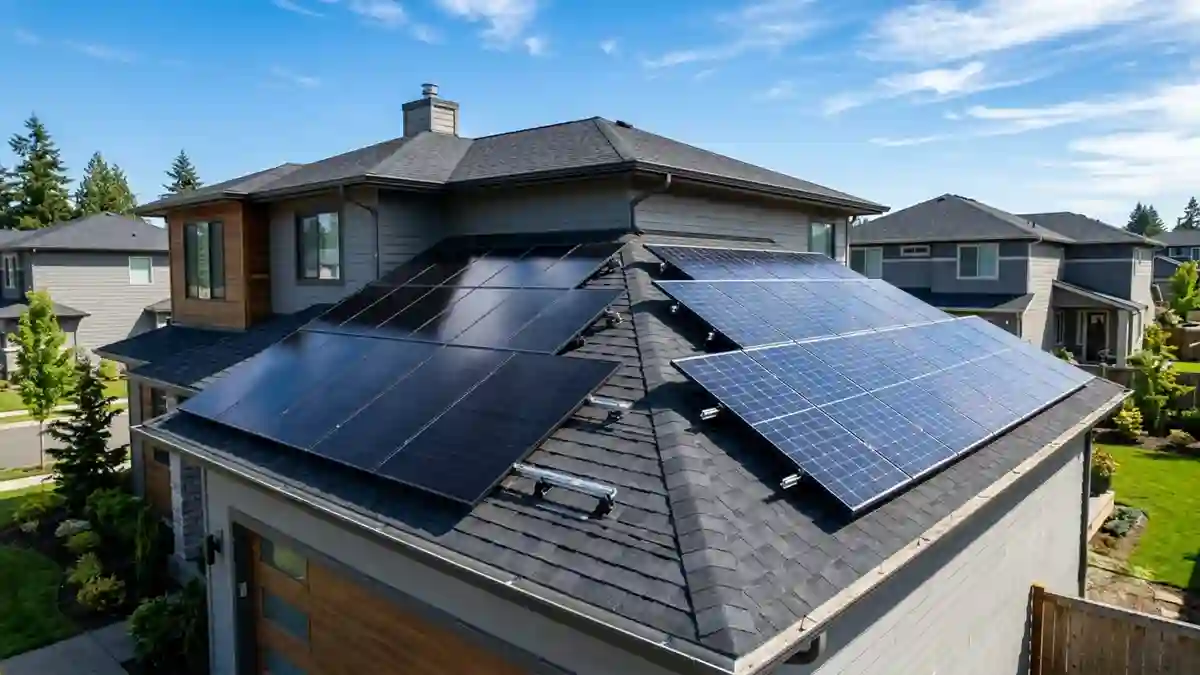
N-type vs P-type solar panels explained by an engineer — real efficiency and degradation differences, and which one actually matters for buyers.
N-type and P-type refer to how a silicon wafer is chemically doped, and it’s become a genuinely important spec-sheet distinction over the past few years as N-type has moved from a niche premium option to the mainstream direction the entire industry is shifting toward. Most buyers have never heard the terms, but understanding this one distinction explains why TOPCon panels command a price premium over PERC solar panels and why that premium is likely to keep shrinking.
This guide is part of our Technology cluster and pairs directly with our PERC Solar Panels guide, since PERC vs. TOPCon is really a P-type vs. N-type comparison at its core.
Quick Facts: N-Type vs P-Type Solar Panels
| Feature | N-Type | P-Type |
|---|---|---|
| Base Dopant | Phosphorus | Boron |
| Typical Efficiency | 22–24%+ | 18–22% |
| First-Year Degradation | ~1% or less | ~2% |
| LID Resistance | Excellent | Moderate |
| Best For | Premium residential, commercial, utility | Budget residential, large rooftops |
| Main Advantage | Higher efficiency and lower degradation | Lower upfront cost |
| Typical Lifespan | 30+ Years | 25–30 Years |
What N-Type and P-Type Actually Mean
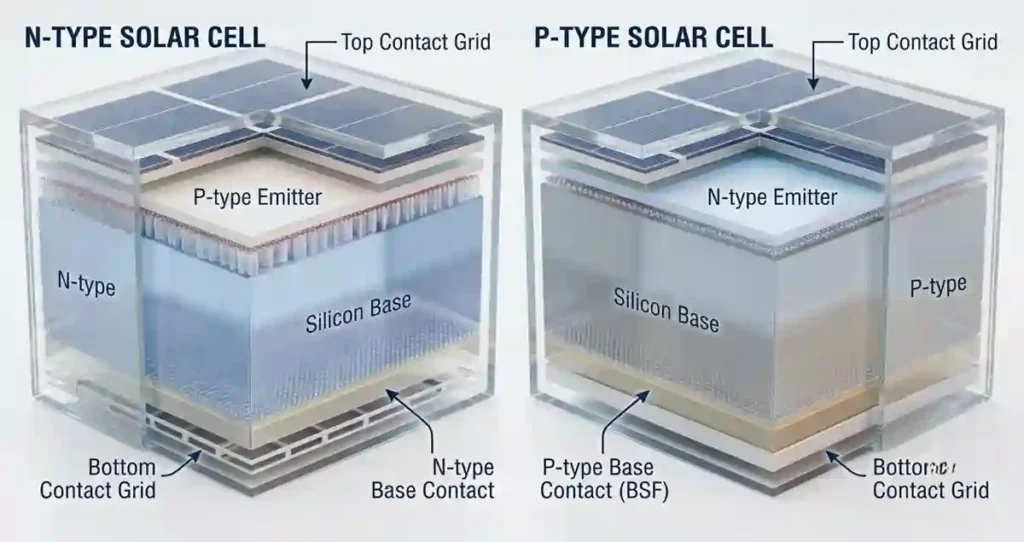
Silicon on its own doesn’t generate current — it needs to be doped with trace elements to create the electrical properties that make a solar cell work. P-type silicon is doped with boron, creating a material with a slight positive charge imbalance. N-type silicon is doped with phosphorus, creating a negative charge imbalance. For decades, P-type was the industry default simply because it was cheaper and easier to manufacture at scale. N-type has a fundamental advantage — it’s less susceptible to certain impurity-related efficiency losses — but manufacturing it affordably at scale is a more recent achievement, which is exactly why it’s only become mainstream in the last several years.
Engineer’s Note: If a client asks me to explain the single biggest reason TOPCon outperforms PERC, the honest answer is: TOPCon panels use N-type silicon, and N-type silicon has fundamentally lower recombination losses than P-type. The tunnel-oxide layer TOPCon adds on top of that is a second, separate improvement — but the base material switch from P-type to N-type is doing a lot of the work.
Performance Comparison
| Metric | N-Type | P-Type | Industry Reference |
| Typical efficiency ceiling | 22% – 24%+ | 18% – 22% | NREL |
| Boron-oxygen light-induced degradation | Not applicable — no boron doping | Present, requires mitigation | Fraunhofer ISE |
| Manufacturing cost | Historically higher, now converging | Lower, mature process | IRENA |
| Typical first-year degradation | ~1% or less | ~2% (LID-related) | Fraunhofer ISE |
Engineering Assessment
| Feature | N-Type | P-Type | Engineering Assessment |
|---|---|---|---|
| Efficiency | ★★★★★ | ★★★★☆ | N-Type delivers higher energy density. |
| Degradation | ★★★★★ | ★★★☆☆ | N-Type retains output better over time. |
| Heat Performance | ★★★★★ | ★★★★☆ | Better performance in hot climates. |
| Cost | ★★★★☆ | ★★★★★ | P-Type remains the budget leader. |
| Availability | ★★★★★ | ★★★★★ | Both technologies remain widely available. |
| Overall Recommendation | ★★★★★ | ★★★★☆ | N-Type is the preferred long-term technology for most new installations. |
Advantages and Disadvantages
| Advantages | Disadvantages |
| No boron-oxygen light-induced degradation, since N-type isn’t boron-doped | Historically higher manufacturing cost, though this gap is closing fast |
| Higher efficiency ceiling, underpinning TOPCon and HJT performance | Requires more careful handling during manufacturing (higher purity needed) |
| Better long-term degradation profile in most field data reviewed | Less market history than P-type, though this is changing quickly |
| Becoming the mainstream direction for premium panel product lines | Still commands a price premium over equivalent P-type PERC panels |
Real-World Applications
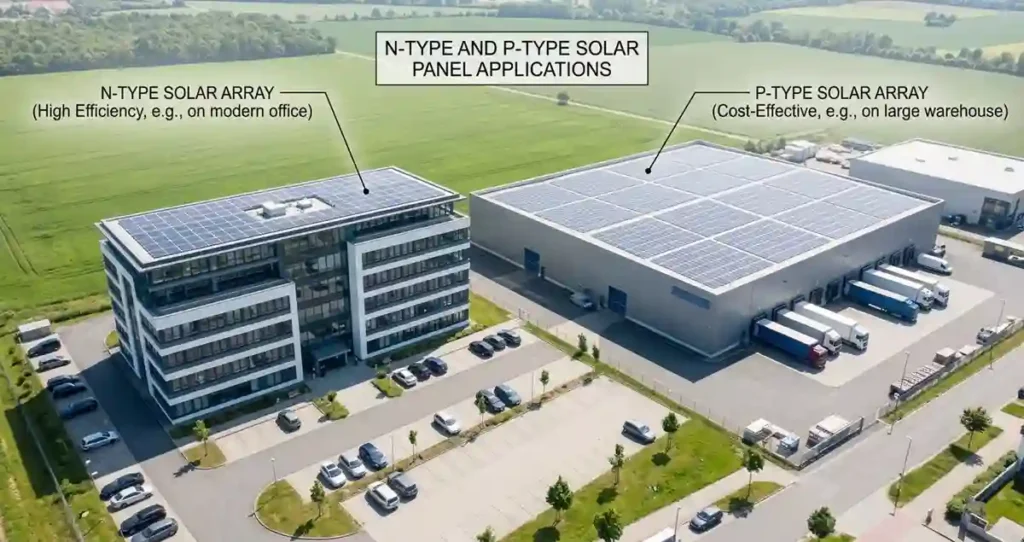
Every premium panel quote I put together today for a US-based client prioritizing maximum long-term output specifies N-type cells, almost always in TOPCon form, since most current federal and state solar incentive calculations reward higher lifetime energy yield. The degradation advantage compounds meaningfully over a 25-year system life — a panel with 1% first-year degradation versus 2% isn’t a huge difference in year one, but by year fifteen that gap has widened enough to matter for total energy yield.
For cost-driven projects, I still regularly specify P-type PERC, and I don’t consider that a compromise recommendation — it’s a legitimate trade-off for a client who’s told me upfront that upfront cost matters more to them than squeezing out the last few percentage points of 25-year yield. Both are valid answers depending on what the client is actually optimizing for, and that conversation happens on nearly every project I take on, regardless of where in the world the client is based.
Field Note: I once had a client insist that a P-type panel they’d been quoted must be inferior simply because their neighbor’s newer system used N-type. Their situation was pure cost optimization on an oversized roof with no space constraint — the P-type panel was, if anything, the better fit for their actual priorities. Cell doping type isn’t a universal quality hierarchy; it’s a trade-off that matters differently depending on what you’re solving for.
Where P-Type Still Makes Sense
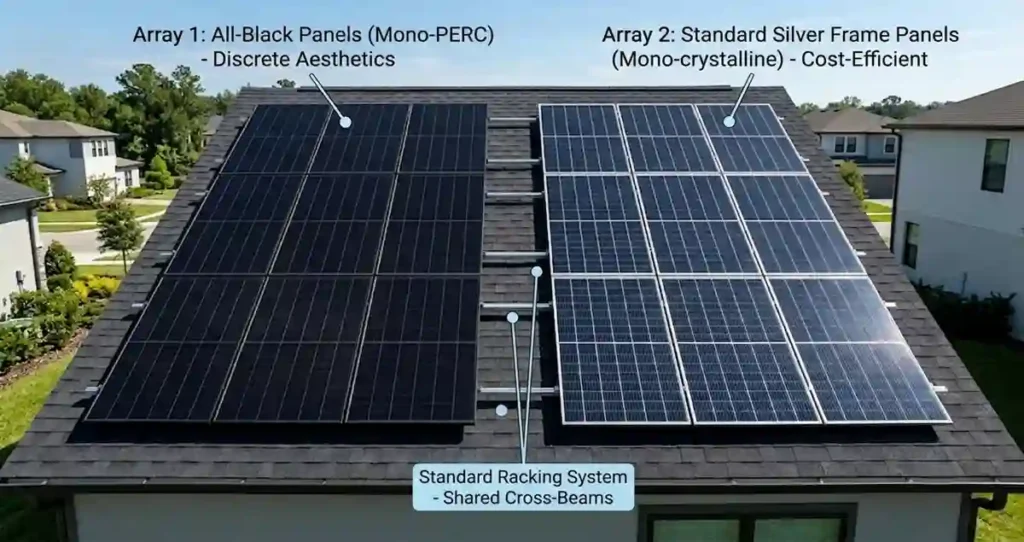
Budget-conscious projects with ample roof space, where the modest degradation and efficiency disadvantage of P-type don’t outweigh its lower upfront cost. This is largely the same logic covered in our PERC Solar Panels guide, since most P-type panels on the market today use PERC cell architecture.
Common Misconceptions Worth Clearing Up
People sometimes treat “N-type” and “TOPCon” as synonyms. They’re related but not identical — N-type is the base silicon doping; TOPCon is a specific cell architecture built on N-type silicon that adds a tunnel-oxide passivation layer. Not every N-type cell is a TOPCon cell, though in practice today, most commercially available N-type panels are TOPCon.
Engineering Specifications to Compare Before Buying
| Specification | Why It Matters | What to Look For | Industry Reference |
|---|---|---|---|
| Silicon Type | Determines degradation characteristics | N-Type or P-Type clearly specified | NREL |
| Cell Architecture | Influences efficiency | TOPCon, HJT or PERC | Fraunhofer ISE |
| Module Efficiency | Higher output | Manufacturer datasheet | IEC |
| Temperature Coefficient | Better hot-weather performance | Lower negative value preferred | NREL |
| Annual Degradation | Lifetime production | Lower degradation | PV Magazine |
| Certifications | Safety & durability | IEC 61215 & IEC 61730 | IEC |
| Warranty | Manufacturer confidence | Longer warranty preferred | Industry Best Practice |
| Manufacturer | Overall quality | Tier 1 supplier | BloombergNEF |
Who Should Buy N-Type Solar Panels?
Recommended for:
• Homeowners with limited roof space
• Premium residential installations
• Commercial rooftop projects
• Utility-scale solar farms
• Buyers seeking maximum efficiency
• Long-term investors
• Hot climate installations
• Customers planning 25–30 years of ownership
Who Should Choose P-Type Solar Panels?
Recommended for:
• Budget-conscious homeowners
• Large residential rooftops
• Agricultural buildings
• Warehouses
• Ground-mounted systems
• Cost-sensitive commercial solar projects
• Projects where installation space is abundant
• Buyers prioritizing lower upfront investment
Buying Checklist
- Before selecting N-Type or P-Type solar panels, verify the following:
- Confirm whether the datasheet specifies genuine N-Type or P-Type silicon.
- Compare lifetime energy production rather than only initial purchase price.
- Review first-year degradation and annual degradation values.
- Check IEC 61215 and IEC 61730 certifications.
- Compare temperature coefficients for installations in hot climates.
- Verify the manufacturer’s product and performance warranties.
- Choose Tier 1 manufacturers whenever possible.
- Compare N-Type TOPCon pricing against premium P-Type PERC alternatives before purchasing.
For the leading N-type cell architecture, see our TOPCon Solar Panels guide. For the budget-friendly P-type option most panels use, see our PERC Solar Panels guide.
A practical note for US homeowners comparing quotes: installers don’t always volunteer whether a proposed system uses N-type or P-type cells unless asked directly. I’d encourage anyone reviewing multiple quotes to ask this question explicitly, since two systems quoted at similar prices can have meaningfully different long-term output profiles depending on which doping type underlies the numbers.
A Note on How This Decision Actually Gets Made
In practice, most of my clients don’t consciously choose “N-type” or “P-type” as a standalone decision — they choose a product line (TOPCon, PERC, HJT) and the doping type comes along with it. I still walk through the underlying distinction with every client who asks, because understanding why a premium panel costs more helps people evaluate competing quotes on their actual merits rather than just trusting whichever number looks biggest on a glossy brochure.
The pattern that’s held consistently across every project I’ve specified, regardless of client budget or system size, is that N-type’s advantage compounds with time. A client optimizing purely for the lowest possible upfront cost may reasonably choose P-type, but a client optimizing for the lowest cost per kilowatt-hour delivered over 25 years should take the N-type degradation advantage seriously, since it’s a real, measurable difference rather than a marketing claim.
Engineering Reality Check
| Marketing Claim | Engineering Reality |
|---|---|
| “N-Type panels are always worth the extra cost.” | Only when higher efficiency and lower degradation improve your project’s economics. |
| “P-Type panels are outdated.” | P-Type PERC panels remain a practical solution for many cost-driven installations. |
| “All N-Type panels are TOPCon.” | No. TOPCon is one N-Type cell architecture. HJT and IBC also use N-Type silicon. |
| “Efficiency is the only specification that matters.” | Roof space, climate, degradation, warranty, and budget are equally important. |
Frequently Asked Questions
Are N-Type solar panels worth buying in 2026?
Yes. N-Type panels offer higher efficiency, lower degradation, and better long-term performance, making them the preferred option for most new premium solar installations.
Do N-Type panels perform better in hot climates?
Generally yes. Their improved temperature performance helps maintain higher energy output during high-temperature operation.
Can N-Type and P-Type panels be mixed?
Yes, but only when electrical characteristics such as voltage and current are properly matched by a qualified installer.
How long do N-Type solar panels last?
Most premium N-Type panels are designed for service lives exceeding 30 years and typically include 25–30 year performance warranties.
Are P-Type panels still worth buying?
Absolutely. P-Type panels remain an excellent value for projects where installation space is plentiful and minimizing upfront cost is the primary goal.
Which certifications should I look for?
Choose panels certified to IEC 61215 and IEC 61730. For North America, UL certification is also recommended.
Which technology is better for residential rooftops?
If roof space is limited, N-Type usually provides better long-term value. For larger roofs where budget is the priority, P-Type remains a strong option.
References
The takeaway I’d leave any US buyer with: doping type is a real, legitimate spec-sheet detail worth understanding, but it should inform your decision alongside cost, roof space, and climate, not override those factors on its own. A well-matched P-type PERC system on the right project will outperform a poorly matched N-type TOPCon system on the wrong one, in terms of actual client satisfaction.
Efficiency and degradation comparisons between N-type and P-type cells are drawn from NREL’s Best Research-Cell Efficiency Chart and Fraunhofer ISE’s Photovoltaics Report. Manufacturing cost trend data references IRENA’s Power Generation Costs.
Related guides on SolarVisionAI.com
- Monocrystalline Solar Panels 2026: Still Worth It or Hype
- Polycrystalline Solar Panels: Worth Buying in 2026?
- Thin-film Solar Panels: When They Beat Silicon (2026)
- BIPV Solar Panels: Building-Integrated PV Complete Guide
- Portable Solar Panels: Engineer’s Buyer’s Guide 2026
- CPV Solar Panels: Concentrated Photovoltaic Explained
- Skin Solar Panel: What “Solar Skin” Actually Means
- Solar Fence Post Lights: Cap Sizes, Types & Install Guide
- Solar Charge Controller: The Complete Guide
- MC4 Connectors: Solar Safety & Installation Guide
- Solar Panel Types, Efficiency & Benefits
- Solar Water Pump Guide
- Commercial Solar Panel Installation: Engineering Guide
- Solar Fence Post Lights: Cap Sizes, Types & Install Guide
- BESS — Battery Energy Storage System Guide
- Commercial Solar Panel Installation