
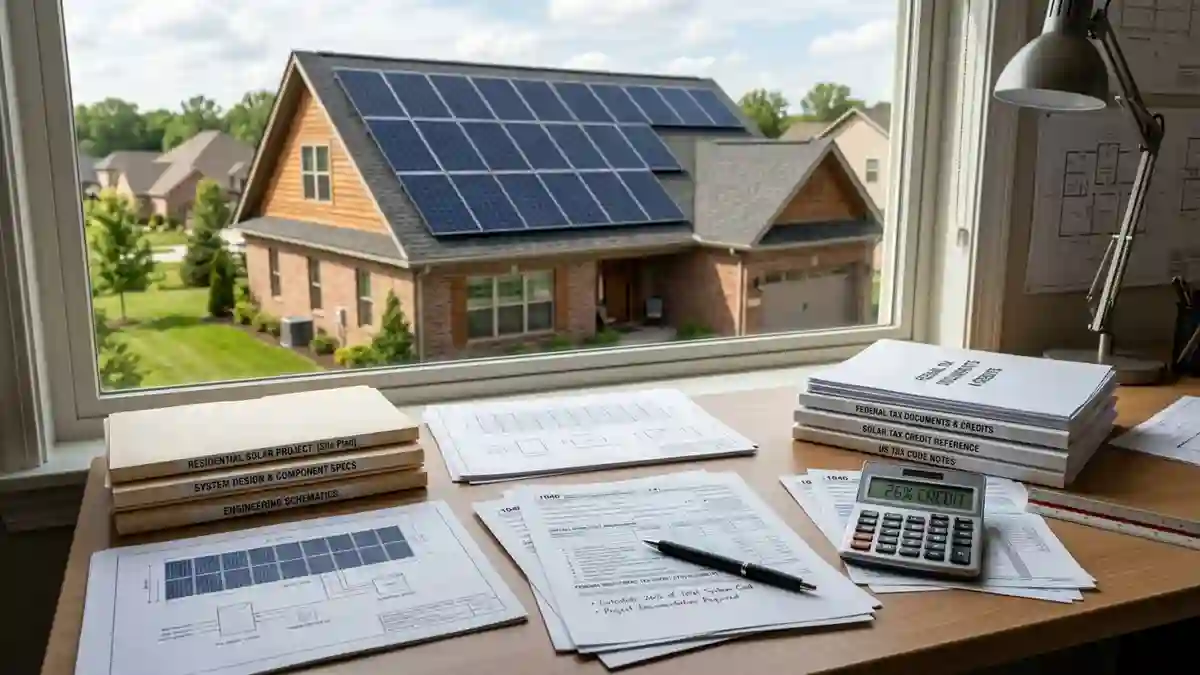
Learn how IRS Form 5695 works for the 2025 solar tax credit, including eligibility, qualifying costs, battery storage, installation timing, documentation, and filing.
As a solar engineer working on projects and providing engineering services as a freelancer, I have followed how different markets support solar panel adoption. The United States has been particularly interesting, with a multi-layered framework of federal tax incentives, clean-energy programs, and state and utility-level support. The Residential Clean Energy Credit was an important part of this framework, providing a 30% credit for qualifying residential clean-energy expenditures during its applicable period.
However, the rules changed in 2025. Federal legislation ended the Residential Clean Energy Credit for expenditures made after December 31, 2025.
This makes IRS Form 5695 especially relevant for homeowners with qualifying 2025 solar and energy projects. In this guide, I explain the eligible solar and battery costs, how the credit is calculated, what documentation to keep, and common mistakes to avoid.
This is not tax advice. My focus is the solar engineering perspective, while tax requirements should be confirmed with the IRS or a qualified tax professional.
Engineer’s Note: I have reviewed and worked with hundreds of residential solar designs over the past decade. One of the questions homeowners frequently ask is whether they can recover part of their solar investment through a federal tax credit. For 2025 installations, understanding the timing, qualifying costs, and documentation is particularly important because the federal Residential Clean Energy Credit changed after 2025.
Important: This article is for general educational information and is intended primarily for U.S. homeowners. Tax rules can depend on your individual circumstances. Always verify your situation with the IRS or a qualified tax professional before filing.
What Is Form 5695?
IRS Form 5695, Residential Energy Credits, is used to calculate residential energy tax credits. For 2025, the form covers two different credits:
- The Residential Clean Energy Credit
- The Energy Efficient Home Improvement Credit
For solar homeowners, Part I of Form 5695 is the section that matters most. It can cover qualifying solar electric property, battery storage, solar water heating, small wind energy property, geothermal heat pump property, and certain fuel cell property.
For qualifying residential clean energy expenses in 2025, the credit rate is 30%. The Residential Clean Energy Credit is nonrefundable, meaning it generally cannot reduce your tax below zero, but an unused portion may be carried forward under the applicable rules.
What Happened to the 30% Solar Tax Credit?
The federal Residential Clean Energy Credit under Section 25D was originally available for qualifying property installed during the applicable credit period. However, federal legislation enacted in 2025 terminated the credit for expenditures made after December 31, 2025.
This timing point is important.
For Section 25D, the IRS states that an expenditure for an item is generally treated as made when the original installation is completed. Therefore, paying for a solar system before the end of 2025 does not by itself preserve the credit if the installation is completed after December 31, 2025.
This means homeowners should not assume that a deposit, contract, or payment date alone determines eligibility.
Who Could Claim the Residential Clean Energy Credit?
For 2025, the credit was available for qualifying clean energy improvements to a home located in the United States.
The IRS rules allow qualifying improvements to certain main homes and, under specific conditions, certain second homes. The treatment can also differ where part of a home is used for business.
This is one reason homeowners should evaluate their individual circumstances rather than relying on a simple “30% of the solar system” calculation.
What Qualifies for Form 5695?
For the Residential Clean Energy Credit, qualifying costs can include:
Solar Electric Property
This includes qualifying solar equipment used to generate electricity for a home located in the United States.
The IRS instructions also state that certain solar roofing tiles and solar shingles can qualify because they perform both roofing and solar-generation functions. Traditional structural roofing components that do not perform a solar function generally do not qualify.
Battery Storage
Battery storage technology can qualify when it meets the applicable requirements. For 2025, the IRS specifies a minimum capacity of 3 kilowatt-hours.
This is important because battery storage does not necessarily have to be treated simply as an accessory to the solar panels. Qualifying battery storage has its own place within the Residential Clean Energy Credit.
Other Qualifying Technologies
The credit can also cover qualifying:
- Solar water heating property
- Small wind energy property
- Geothermal heat pump property
- Fuel cell property
Each technology has its own eligibility requirements and limitations.
What Solar Installation Costs Can Be Included?
The IRS instructions allow certain labor costs that are properly allocable to the onsite preparation, assembly, or original installation of qualifying residential clean energy property.
Certain piping or wiring costs needed to interconnect the property with the home can also qualify.
However, homeowners should not automatically assume that every expense appearing on a solar contractor’s invoice qualifies.
For example, traditional roof construction or unrelated roof replacement generally should not be treated as qualifying solar energy property simply because it was completed during the same project.
The safest approach is to maintain an itemized invoice showing equipment, installation, and other project costs separately.
How to Use Form 5695 for Solar
If solar is your only qualifying clean energy improvement, the process is relatively straightforward conceptually.
You first determine the qualifying solar electric property costs. On the 2025 Form 5695, these costs are reported in Part I, beginning with the solar electric property entry on Line 1.
The form also provides separate entries for qualifying solar water heating, small wind, geothermal, battery storage, and fuel cell property.
The applicable labor and interconnection costs can be included where permitted by the IRS instructions.
The form then calculates the Residential Clean Energy Credit and applies the relevant tax-liability limitation.
Because Form 5695 can change between tax years, homeowners should use the instructions for the specific year being filed rather than copying line numbers from an older article or previous year’s form.
A Simple Solar Tax Credit Example
Suppose a qualifying residential solar installation completed in 2025 has total eligible costs of $22,000.
A simplified calculation would be:
$22,000 × 30% = $6,600
The resulting $6,600 represents the calculated credit before applying the taxpayer’s individual tax-liability limitation.
Because the Residential Clean Energy Credit is nonrefundable, a taxpayer may not necessarily use the entire calculated credit against the current year’s tax liability.
Under the 2025 IRS instructions, an unused portion of the Residential Clean Energy Credit can be carried forward to 2026.
This is why the credit should not be described simply as a $6,600 cash refund.
Does the Solar Tax Credit Mean You Get 30% Cash Back?
No.
This is one of the most common misunderstandings.
The Residential Clean Energy Credit is a tax credit, not a cash rebate from the installer or the IRS.
For example, if the calculated credit is $6,600, that does not automatically mean the homeowner receives a $6,600 check.
The credit is applied against eligible federal income tax liability according to the applicable IRS rules. Any unused Residential Clean Energy Credit may be carried forward under the rules for the relevant tax year.
What Documentation Should You Keep?
The IRS recommends keeping supporting documentation even though you generally do not send all of it with Form 5695.
For a residential solar project, I would keep a dedicated digital and physical record containing:
- Final itemized solar invoice
- Proof of payment
- Solar equipment documentation
- Manufacturer certification where applicable
- Installation records
- Evidence showing when the system was originally installed
- Completed Form 5695
- Supporting worksheets and calculations
The IRS specifically states that a taxpayer can rely on a manufacturer’s written certification that a product qualifies, but the certification should be kept for your records rather than attached to the return.
Engineer’s Note: Keep the Final Invoice
From a solar engineering perspective, I always recommend keeping the final project documentation organized.
A quotation is not the same thing as a final invoice.
During a solar installation, equipment quantities, labor, electrical work, change orders, and other costs can change. Keeping the final itemized documentation makes it much easier to determine which expenses were actually incurred and which may qualify under the applicable tax rules.
The same principle applies to installation timing. Keep documentation showing when the original installation was completed rather than relying only on a contract date or deposit receipt.
What About Solar Loans?
Financing does not automatically make the entire amount of loan-related payments a qualifying solar expense.
The IRS specifically states that interest and loan origination fees should not be included in the Residential Clean Energy Credit calculation.
Therefore, homeowners should distinguish between the qualifying cost of the solar energy property and financing charges.
What About Rebates and Utility Incentives?
Some subsidies, rebates, and other incentives can affect the amount of expenses used to calculate the credit.
The IRS explains that certain public utility subsidies and certain rebates may need to be subtracted from qualifying expenses. However, not every incentive is treated the same way.
For example, utility payments associated with electricity sold back to the grid, such as net-metering credits, are treated differently from purchase-price rebates.
This is another area where homeowners should verify the treatment of a specific incentive rather than automatically subtracting every payment they receive.
What About a Solar Lease or Power Purchase Agreement?
The federal Residential Clean Energy Credit is generally associated with the taxpayer who owns the qualifying property.
If a solar company owns the system under a lease or power purchase agreement, the homeowner should not automatically assume that they can claim the federal residential clean energy credit.
The ownership structure and the applicable tax rules should be reviewed before claiming the credit.
What Changed After December 31, 2025?
The 2025 federal legislation terminated the Residential Clean Energy Credit for expenditures made after December 31, 2025.
The IRS specifically explains that, for Section 25D, an expenditure is treated as made when the original installation is completed. Therefore, a taxpayer cannot preserve the federal credit merely by paying for the system before the deadline if the qualifying installation is completed after December 31, 2025.
This makes installation timing particularly important for homeowners dealing with projects that crossed from 2025 into 2026.
State, local, utility, and other incentives are separate matters and may have different eligibility rules.
Common Mistakes Homeowners Should Avoid
Using the Quoted Price Instead of the Final Eligible Cost
A preliminary quotation may not represent the final project cost. Use your final documentation and determine which costs actually qualify.
Treating a Deposit as Proof of Eligibility
For Section 25D, the IRS has specific rules for when an expenditure is treated as made. A deposit or early payment does not automatically establish eligibility.
Assuming Every Roof Cost Qualifies
Traditional roofing components that do not perform a solar function generally do not qualify simply because solar panels are installed on the roof.
Including Loan Interest
Loan interest and loan origination fees should not be included in the Residential Clean Energy Credit calculation.
Confusing a Tax Credit With a Refund
A tax credit reduces eligible tax liability. It is not automatically a dollar-for-dollar cash payment from the government.
Using the Wrong Year’s Form
Tax forms and instructions can change. Always use the Form 5695 and IRS instructions applicable to the tax year being filed.
Frequently Asked Questions
What is Form 5695?
Form 5695 is the IRS form used to calculate residential energy credits, including the Residential Clean Energy Credit and the Energy Efficient Home Improvement Credit.
How much was the 2025 solar tax credit?
For qualifying Residential Clean Energy Credit expenses in 2025, the credit rate was 30%.
Can solar batteries qualify for Form 5695?
Yes. Qualifying battery storage technology can be included in the Residential Clean Energy Credit, subject to the applicable requirements. For 2025, the IRS specifies a minimum battery capacity of 3 kWh.
Can solar installation labor qualify?
Certain labor costs for onsite preparation, assembly, original installation, and qualifying interconnection work can be included when properly allocable to qualifying residential clean energy property.
Can I include solar loan interest?
No. The IRS states that interest and loan origination fees should not be included in the Residential Clean Energy Credit calculation.
Do I need to send my solar invoice with Form 5695?
Generally, supporting documentation such as invoices and certifications is retained for your records rather than automatically attached to the return. Keep the documentation in case you need to substantiate the credit.
Can unused Residential Clean Energy Credit carry forward?
Yes. Under the 2025 Form 5695 instructions, an unused portion of the Residential Clean Energy Credit can be carried forward to 2026.
Does paying for solar in 2025 automatically preserve the credit?
No. For Section 25D, the IRS states that an expenditure is generally treated as made when the original installation is completed. Paying before December 31, 2025 does not by itself preserve the credit if installation is completed after that date.
The Bottom Line
Form 5695 is an important document for homeowners claiming qualifying residential energy credits, but it should not be treated as a simple “30% solar refund” form.
For a 2025 solar project, the important questions include:
- Was the property eligible?
- Which project costs qualify?
- When was the original installation completed?
- What documentation supports the costs and equipment?
- What is the taxpayer’s applicable federal tax liability?
From my experience reviewing solar projects, the best practice is simple: keep the final invoice, installation documentation, equipment information, payment records, and tax forms together in one organized file.
For tax-specific questions, especially where installation crossed the 2025–2026 deadline or where a property has mixed residential and business use, confirm the treatment with a qualified tax professional.
Last reviewed: September 2026
This article provides general educational information and does not constitute tax, legal, or financial advice. Federal tax rules can change, and individual eligibility depends on the taxpayer’s circumstances. Verify current requirements with the IRS or a qualified tax professional before filing.
Related guides on SolarVisionAI.com
- Monocrystalline Solar Panels 2026: Still Worth It or Hype
- Polycrystalline Solar Panels: Worth Buying in 2026?
- Thin-film Solar Panels: When They Beat Silicon (2026)
- BIPV Solar Panels: Building-Integrated PV Complete Guide
- Portable Solar Panels: Engineer’s Buyer’s Guide 2026
- CPV Solar Panels: Concentrated Photovoltaic Explained
- Skin Solar Panel: What “Solar Skin” Actually Means
- Solar Fence Post Lights: Cap Sizes, Types & Install Guide
- Bifacial Solar Panels in 2026: How to Boost Energy Output
- Solar Charge Controller: The Complete Guide
- MC4 Connectors: Solar Safety & Installation Guide
- Solar Panel Types, Efficiency & Benefits
- Solar Water Pump Guide
- Commercial Solar Panel Installation: Engineering Guide
- Solar Fence Post Lights: Cap Sizes, Types & Install Guide
- BESS — Battery Energy Storage System Guide
- Commercial Solar Panel Installation
- Solar Refrigerator & DC Fridge — Complete 2026 Guide
- Bifacial Solar Panel Albedo Effect Guide
- TOPCon: Why TOPCon Solar Panel is a Proven Smart Investment in 2026
- HJT: Why TOPCon Solar Panel is a Proven Smart Investment in 2026
- PERC: PERC Solar Panel: Still Relevant or Already Outdated?
- Perovskite: Perovskite Solar Panels: The 2026 Reality Check
- N-Type vs P-Type: N-Type vs P-Type Solar Panels: Honest Comparison
- ABC: ABC (all back contact) Solar Panel: Back Contact Technology Explained
- IBC: IBC Solar Panels: Interdigitated Back Contact Guide
- Tandem: Tandem Solar Panels: Are Stacked Cells Ready for Rooftops?