
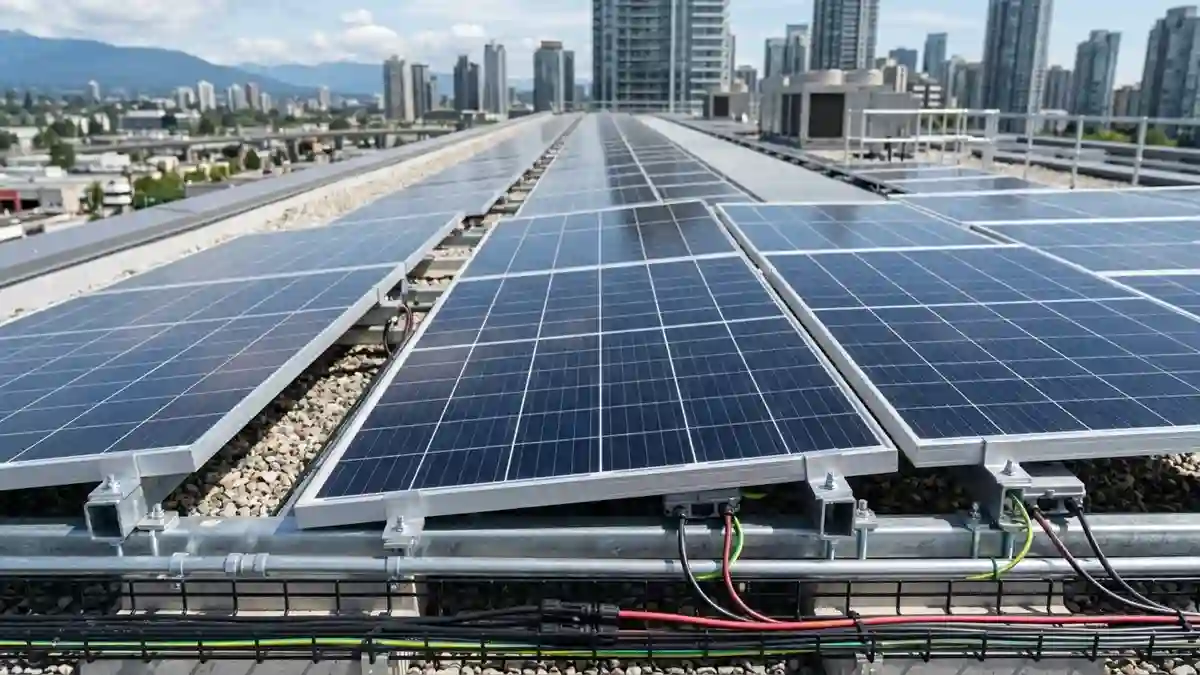
Learn how solar panel power ratings and tolerances work, from 550W and 600W modules to real-world output and applications.
When you see 550W, 600W, or 650W printed on a solar panel, that number represents its rated power under specified Standard Test Conditions (STC). But rated wattage is only one part of understanding real-world performance.
A panel’s power tolerance indicates how its measured power may vary from the nameplate rating. This matters when comparing manufacturers, reviewing datasheets, checking flash-test results, and estimating system capacity.
From my experience working with solar projects and evaluating different PV modules, I have found that buyers often focus too much on wattage alone. A higher-wattage panel can be useful, but efficiency, cell technology, temperature performance, dimensions, degradation, tolerance, and expected energy yield also need to be considered.
A 550W panel, for example, does not continuously produce 550W throughout the day. Sunlight, temperature, orientation, shading, soiling, and system losses all affect its actual output.
This guide is part of our Types of Solar Panels hub, and pairs with our Solar Panel Tier 1
How Much Power Does a Solar Panel Produce?
The power a solar panel produces depends on its rated wattage, sunlight conditions, temperature, orientation, shading, and system losses.
For example, a 550W solar panel has a rated maximum power of 550 watts under Standard Test Conditions (STC). This does not mean it will continuously produce 550W throughout the day.
Under strong sunlight and favorable operating conditions, a 550W panel may approach its rated output around the middle of the day. In the morning, late afternoon, cloudy conditions, or high module temperatures, its instantaneous output will normally be lower.
It is also important to distinguish power (W) from energy (kWh):
- Power: How much electricity the panel is producing at a particular moment.
- Energy: How much electricity the panel produces over a period of time.
A Real-World Example
Consider a 550W N-type TOPCon panel installed on a properly oriented rooftop with good sunlight exposure.
On a clear day, the panel may approach its rated output around peak sunlight. However, the output will gradually increase after sunrise, reach its highest level around the strongest sunlight period, and then decline toward sunset.
An example operating pattern could look like this:
Morning: 100–300W
Late morning: 350–500W
Around peak sunlight: 450–530W
Afternoon: 300–450W
Late afternoon: 50–250W
These are illustrative ranges, not guaranteed values. Actual output depends on solar irradiance, module temperature, orientation, shading, soiling, and other site conditions.
If the location receives approximately 5 peak sun hours, a simplified energy calculation would be:
550W × 5 hours = 2.75 kWh/day
However, actual energy delivered by the system will generally be lower after accounting for temperature, dust, wiring, mismatch, inverter losses, and other system losses.
Engineer’s Note: Don’t judge a solar panel by a single instantaneous wattage reading.
A 550W panel is not expected to show 550W on the inverter display throughout the day. Its 550W rating is a standardized reference point, not its continuous field output.
For engineering and financial calculations, I focus on daily and annual energy yield in kWh, together with the site’s solar resource and system losses. A panel producing 480W at a particular moment is not necessarily underperforming; the correct question is whether it is producing the expected power for the irradiance and temperature at that time.
This distinction becomes especially important when evaluating commercial and industrial solar projects, where decisions should be based on measured performance and long-term energy yield, rather than a single wattage reading.
A Simple Comparison
| Panel Rating | Rated Power | Theoretical Energy at 5 Peak Sun Hours* |
|---|---|---|
| 400W | 0.40 kW | 2.0 kWh/day |
| 450W | 0.45 kW | 2.25 kWh/day |
| 550W | 0.55 kW | 2.75 kWh/day |
| 600W | 0.60 kW | 3.0 kWh/day |
| 650W | 0.65 kW | 3.25 kWh/day |
These are simplified theoretical calculations before accounting for temperature, soiling, shading, wiring, inverter, mismatch, and other system losses.
What Is Solar Panel Power?
Solar panel power, normally expressed in watts (W), is the module’s rated maximum electrical output under defined test conditions.
For example, a panel rated at 550W has a nameplate power of 550 watts under the manufacturer’s specified test conditions.
The actual power of a module is determined by its electrical characteristics, primarily:
- Maximum power voltage (Vmp)
- Maximum power current (Imp)
- Cell technology and efficiency
- Module design and construction
- Irradiance and temperature during operation
The important point is that 550W is a rated power value, not a promise that the panel will produce 550W continuously in the field.
Real-world output changes with sunlight intensity, module temperature, shading, soiling, orientation, wiring losses, inverter conversion, and other operating conditions.
What Does Solar Panel Power Tolerance Mean?
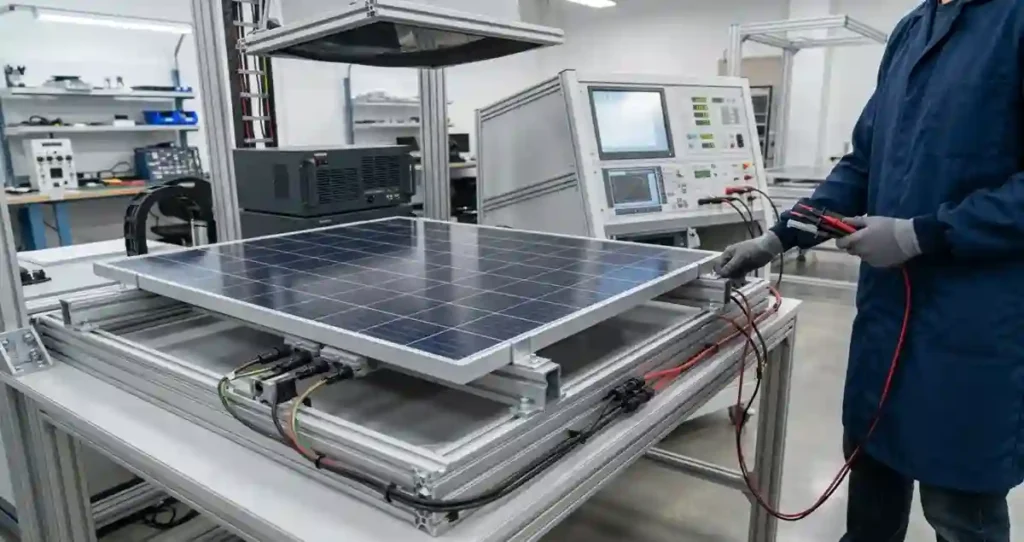
Power tolerance defines the permitted variation between a panel’s measured maximum power and its rated power.
For example, consider a 550W solar panel with ±3% power tolerance.
The tolerance would be:
550W × 3% = 16.5W
So the specified range would be:
533.5W to 566.5W
A module measuring within that range could still comply with the stated power tolerance.
Now consider a panel specified as 550W with 0/+5W tolerance.
Its permitted power range would be:
550W to 555W
This is known as positive-only power tolerance.
Engineer’s Note: Positive-only tolerance, such as 0/+5W, is useful when comparing otherwise similar modules because it establishes a minimum nameplate power for the delivered module.
However, it should not be interpreted as a guarantee of 550W output under normal operating conditions. The rating itself is still based on standardized test conditions, while actual field output depends heavily on environmental and system conditions.
Solar Panel Power Tolerance Compared
| Power Tolerance | Example for a 550W Panel | Meaning | Buyer Consideration |
|---|---|---|---|
| ±3% | 533.5–566.5W | Module may be above or below rated power within the specified range | Check the lower limit when modeling conservative capacity |
| 0/+5W | 550–555W | Module is specified at or above rated power | Preferable when minimum nameplate power matters |
| -3%/0 | 533.5–550W | Module is specified at or below rated power | Unusual; investigate carefully before purchasing |
The exact tolerance offered varies by manufacturer and product series, so always verify the current datasheet rather than assuming a particular specification.
Why Positive Power Tolerance Matters
Suppose you are comparing two otherwise similar 550W panels.
Panel A: 550W, ±3%
Panel B: 550W, 0/+5W
Panel A can have a measured power below 550W while still complying with its specification.
Panel B is specified to deliver at least its 550W nameplate power under the applicable test conditions.
For a large commercial installation, even a small difference in minimum module power can become significant when multiplied across hundreds or thousands of panels.
This is why I consider power tolerance an important specification when reviewing commercial solar quotations.
How Solar Panel Technology Affects Power and Tolerance
Solar panel power and tolerance should also be considered in the context of the technology used to manufacture the module. Different cell technologies can achieve different power levels, efficiencies, temperature coefficients, and module designs.
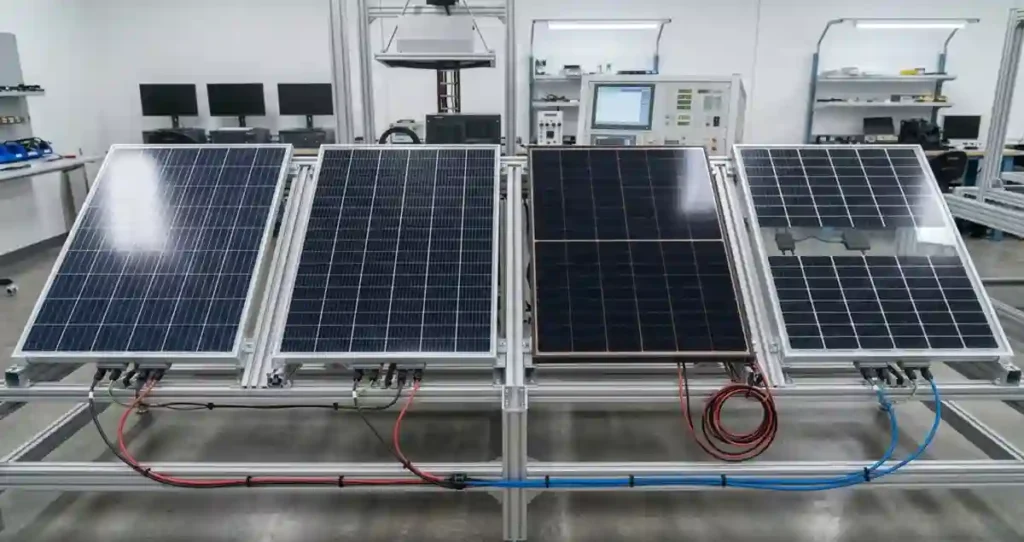
TOPCon Solar Panels
N-type TOPCon (Tunnel Oxide Passivated Contact) has become one of the most widely adopted high-efficiency technologies for modern solar modules.
TOPCon panels are available in high-power formats, including large modules above 600W. Their improved efficiency and strong performance characteristics make them suitable for residential, commercial, industrial, and utility-scale projects.
When comparing TOPCon modules, power rating should still be considered together with efficiency, temperature coefficient, degradation rate, and power tolerance.
HJT Solar Panels
Heterojunction Technology (HJT) combines crystalline silicon with thin-film layers to achieve high efficiency and strong temperature performance.
HJT modules can be particularly interesting in hot climates because their temperature coefficient can be favorable compared with some conventional module technologies.
For projects where roof area is limited, the combination of high efficiency and high rated power can help maximize installed capacity from the available space.
PERC Solar Panels
PERC (Passivated Emitter and Rear Cell) was one of the dominant technologies of the previous generation of mainstream solar panels.
Although newer N-type technologies such as TOPCon and HJT have gained significant market share, PERC modules are still found in many existing installations and some markets.
When evaluating older PERC panels, don’t compare wattage alone. Consider the module’s efficiency, degradation history, temperature coefficient, warranty, and actual measured performance.
Bifacial Solar Panels
Bifacial modules can generate electricity from both the front and rear sides of the module.
Their actual energy gain depends on factors such as ground reflectivity, mounting height, row spacing, rear-side shading, and installation geometry.
A bifacial panel’s headline wattage generally refers to its front-side rated power under the applicable test conditions. The additional rear-side contribution should therefore be evaluated separately rather than simply adding the bifacial gain to the nameplate wattage.
Thin-Film and Other Solar Technologies
Thin-film technologies use semiconductor layers deposited onto substrates rather than conventional crystalline-silicon cells.
They can have different efficiency, weight, temperature, and installation characteristics compared with crystalline-silicon modules.
The same principle applies: compare the rated power and power tolerance within the context of the specific technology, rather than treating wattage as the only measure of panel quality.
Rated Power vs. Real-World Power
One of the most common misunderstandings is assuming that a 600W solar panel should continuously produce 600W after installation.
It will not.
The 600W rating is established under defined laboratory test conditions. In the field, module temperature is usually higher, irradiance changes throughout the day, and losses occur through temperature effects, dirt, mismatch, cables, connectors, inverter conversion, and other factors.
For example, a 600W module may produce considerably less than 600W at a particular moment even though the module is performing exactly as designed.
Therefore:
Rated power ≠ continuous real-world power
Power tolerance describes manufacturing variation around the rated power; it does not describe normal operating losses.
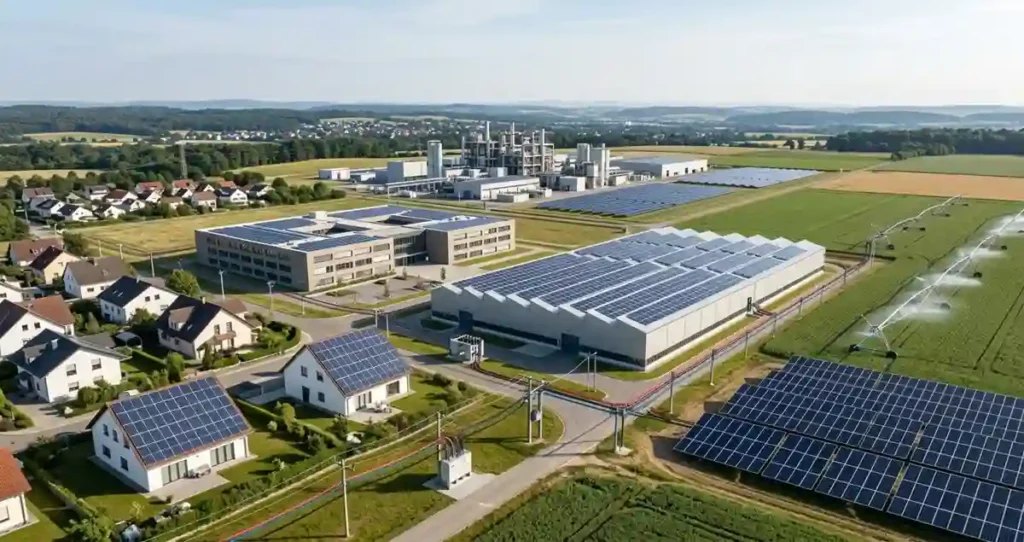
Why Solar Panel Power Matters for Different Applications
The importance of rated power and power tolerance changes depending on the size and purpose of the solar installation.
Residential Solar Systems
For homes, higher-power and higher-efficiency modules can be valuable when available roof area is limited.
For example, replacing several lower-power modules with fewer high-power modules may allow the installer to achieve similar system capacity while using fewer panels.
However, the module’s physical dimensions, inverter compatibility, voltage and current characteristics, roof layout, and installation constraints must also be considered.
For residential systems, power tolerance is usually a smaller financial factor than it is on a large commercial project, but it remains an important specification when comparing otherwise similar products.
Schools and Educational Facilities
Schools can have substantial daytime electricity consumption from lighting, computers, air conditioning, water pumping, and other equipment.
Solar power can help offset this daytime demand, making module efficiency and available roof area important considerations.
Schools also provide an excellent example of why system design should consider actual load profiles rather than simply selecting the highest-wattage panel available.
Commercial Buildings
Commercial facilities such as offices, shopping centers, warehouses, hotels, and retail buildings often have large daytime electrical loads.
For these projects, every module contributes to the overall system capacity. A small difference in module power multiplied across hundreds of panels can become significant.
This is where power tolerance becomes more relevant to technical and financial modeling.
Industrial Solar Systems
Industrial facilities can have high and continuous electricity demand from motors, compressors, production equipment, HVAC systems, pumps, and other heavy loads.
Large industrial installations often use hundreds or thousands of modules, so module power, efficiency, electrical characteristics, degradation, and tolerance can all influence the overall system design.
For larger projects, the difference between nameplate capacity and conservative minimum module capacity should be clearly understood when preparing technical and financial projections.
Agricultural and Farm Applications
Solar is increasingly used for agricultural applications such as irrigation pumps, tube wells, farm buildings, cold storage, livestock facilities, and remote agricultural loads.
In these applications, the available installation area may be large, but environmental conditions can be challenging.
Module selection should therefore consider power rating together with temperature performance, durability, soiling, mounting conditions, and system requirements.
For agricultural pumping systems, the solar array should also be matched carefully with the pump and inverter so that the available solar power is used effectively throughout the operating period.
Remote and Off-Grid Applications
In remote locations, solar panels may supply batteries, water pumps, telecommunications equipment, lighting, monitoring systems, or complete off-grid power systems.
Here, the relationship between module power and battery capacity becomes particularly important.
A panel’s rated power determines the nominal generation capacity, while the actual energy available to charge batteries depends on sunlight, temperature, system losses, and the overall design.
This is why off-grid systems should be designed around energy demand, solar resource, battery capacity, and system losses, rather than panel wattage alone.
Utility-Scale Solar Projects
At utility scale, even a small difference in module characteristics can become significant because thousands or millions of panels may be installed.
Module power, tolerance, efficiency, degradation, temperature coefficient, bifacial performance, and long-term reliability all contribute to the economics of the project.
For utility-scale projects, module selection should therefore be based on the total lifetime energy yield and project economics, not simply the highest wattage printed on the datasheet.
How Solar Panel Power Is Verified
Manufacturers use flash testing to measure the electrical performance of solar modules under controlled test conditions.
The test measures parameters such as:
- Maximum power (Pmax)
- Open-circuit voltage (Voc)
- Short-circuit current (Isc)
- Voltage at maximum power (Vmp)
- Current at maximum power (Imp)
The measured Pmax is then used to classify the module according to its specified power rating and tolerance.
This is why the flash test report is valuable when reviewing the actual characteristics of supplied modules.
A Practical Example
Imagine a 1 MW solar project using 550W modules.
The approximate number of modules required would be:
1,000,000W ÷ 550W ≈ 1,819 modules
If the modules have a symmetric tolerance specification, the lower tolerance limit should be considered when evaluating conservative module capacity.
With positive-only tolerance, the supplied modules are specified not to fall below their nameplate power under the applicable test conditions.
This distinction becomes more relevant when preparing detailed technical proposals, energy models, and contractual performance calculations.
Common Misconceptions About Solar Panel Power
A Higher Wattage Panel Is Always Better
Not necessarily.
A 650W panel may have a higher power rating than a 550W panel, but that does not automatically make it the better choice.
Panel dimensions, efficiency, voltage, current, temperature coefficient, degradation, installation space, inverter compatibility, and overall system economics also matter.
A 600W Panel Always Produces 600W
No.
600W is the module’s rated maximum power under specified test conditions. Actual field output varies throughout the day and is affected by environmental and system conditions.
Power Tolerance Is the Same as Efficiency
No.
Efficiency describes how effectively the module converts incident solar energy into electricity.
Power tolerance describes the permitted variation between the module’s measured power and its rated power.
They are related to module performance, but they measure different things.
Positive Tolerance Means More Energy in Every Situation
Not necessarily.
A positive-only tolerance means the module’s measured power is specified at or above its nameplate rating under the applicable test conditions.
It does not mean the panel will always produce more energy than another panel in actual field conditions. Temperature, irradiance, shading, soiling, orientation, degradation, and system design still determine energy yield.
Buying Checklist
When comparing solar panels, check:
- Rated power: 550W, 600W, 650W, etc.
- Power tolerance: ±3%, 0/+5W, or another specified range
- Pmax: Maximum power under the stated test conditions
- Vmp and Imp: Voltage and current at maximum power
- Flash test documentation: Where available
- Applicable test conditions: Especially STC and the manufacturer’s stated testing procedure
- Cell technology: TOPCon, HJT, PERC, bifacial, or another technology
- Efficiency: Especially important where installation area is limited
- Temperature coefficient: Important in hot climates
- Degradation specification: Relevant to long-term energy yield
- Product datasheet revision: Make sure the specification applies to the exact model being quoted
How Tolerance Interacts With Warranty Claims
Power tolerance can also become relevant when discussing module performance later in the project’s life.
If a system’s measured output falls below expectations, the first step is not automatically to assume a defective panel.
The analysis should consider operating conditions, irradiance, temperature, shading, soiling, system losses, degradation, and the manufacturer’s applicable warranty conditions.
The module’s original power rating and tolerance may provide useful context when evaluating its measured performance, but power tolerance should not be confused with a long-term performance warranty.
A panel can comply with its original power tolerance and still experience degradation over time. Conversely, a performance issue cannot be established simply because the instantaneous output is below the nameplate wattage.
The Bigger Picture
Whether a solar panel is installed on a house, school, farm, factory, warehouse, commercial building, or utility-scale solar plant, the basic principle remains the same:
Rated power tells you the module’s nominal output under defined test conditions. Power tolerance tells you how the measured module power can vary around that rating.
But neither number should be evaluated in isolation.
The best module for a project depends on the technology, efficiency, available installation area, climate, electrical characteristics, degradation, installation conditions, and the project’s actual energy requirements.
That is why experienced solar engineering starts with the complete module datasheet, not just the wattage printed on the front of the panel.
Solar Panel Power Degradation Over Time
Solar panel power does not remain exactly the same throughout its operating life. PV modules gradually lose some of their power-generating capability due to long-term exposure to sunlight, temperature cycles, humidity, and other environmental stresses.
This is why manufacturers provide a power degradation warranty, often covering a period of 25 to 30 years. Modern modules commonly use a linear degradation model, where the manufacturer specifies an initial degradation rate followed by a smaller annual degradation rate over the remaining warranty period.
For example, a manufacturer may specify a maximum degradation of 1% in the first year and 0.35% per year thereafter. The exact figures vary by manufacturer and module technology, so the warranty document should always be checked.
This is different from power tolerance. Power tolerance describes how a new module’s measured power may vary from its nameplate rating, while degradation describes how the module’s power capability changes over its operating life.
Engineer’s Note: When comparing solar panels, I do not look only at the highest wattage available today. For a long-term project, the warranted power after 25 or 30 years can be just as important as the initial rated power.
A panel with slightly lower initial wattage but better long-term degradation performance may deliver more useful energy over the life of the project.
Frequently Asked Questions
What is a good power tolerance for a solar panel?
A positive-only tolerance, such as 0/+5W, is generally attractive because the module’s specified power does not fall below its nameplate rating. However, tolerance should be evaluated alongside efficiency, degradation, temperature coefficient, warranty, construction quality, and overall product specifications.
Can a solar panel produce less than its rated wattage?
Yes, in normal operation. A panel’s rated wattage is measured under standardized test conditions. Actual field output can be lower because of temperature, irradiance, shading, soiling, orientation, system losses, and other factors.
With a symmetric manufacturing tolerance, the module’s measured power under the applicable test conditions may also be below its nameplate rating within the specified tolerance range.
What does 0/+5W mean on a solar panel?
It means the module’s specified maximum power can range from its nameplate rating up to 5 watts above it. For example, a 550W panel with 0/+5W tolerance is specified at 550W to 555W under the applicable test conditions.
How is solar panel power tolerance verified?
Module power is measured through electrical performance testing, commonly using flash testing under controlled conditions. The measured maximum power is then compared with the module’s rated power and applicable specification.
Does higher solar panel wattage mean higher efficiency?
Not necessarily.
Wattage and efficiency are different specifications. A larger physical module can have a higher wattage while having similar or even lower efficiency than a smaller high-efficiency module.
Does power tolerance affect system design?
Yes, particularly in large systems. When hundreds or thousands of modules are installed, the lower or upper limits of the specified power tolerance can affect calculated module capacity and should be considered in detailed technical and financial modeling.
References
Power tolerance should always be interpreted according to the specific manufacturer’s datasheet, product documentation, and applicable IEC testing requirements.
For detailed verification of module output, the manufacturer’s flash test documentation provides additional evidence of measured electrical performance.
Related guides on SolarVisionAI.com
- Monocrystalline Solar Panels 2026: Still Worth It or Hype
- Polycrystalline Solar Panels: Worth Buying in 2026?
- Thin-film Solar Panels: When They Beat Silicon (2026)
- BIPV Solar Panels: Building-Integrated PV Complete Guide
- Portable Solar Panels: Engineer’s Buyer’s Guide 2026
- CPV Solar Panels: Concentrated Photovoltaic Explained
- Skin Solar Panel: What “Solar Skin” Actually Means
- Solar Fence Post Lights: Cap Sizes, Types & Install Guide
- Bifacial Solar Panels in 2026: How to Boost Energy Output
- Solar Charge Controller: The Complete Guide
- MC4 Connectors: Solar Safety & Installation Guide
- Solar Panel Types, Efficiency & Benefits
- Solar Water Pump Guide
- Commercial Solar Panel Installation: Engineering Guide
- Solar Fence Post Lights: Cap Sizes, Types & Install Guide
- BESS — Battery Energy Storage System Guide
- Commercial Solar Panel Installation
- Solar Refrigerator & DC Fridge — Complete 2026 Guide
- Bifacial Solar Panel Albedo Effect Guide
- TOPCon: Why TOPCon Solar Panel is a Proven Smart Investment in 2026
- HJT: Why TOPCon Solar Panel is a Proven Smart Investment in 2026
- PERC: PERC Solar Panel: Still Relevant or Already Outdated?
- Perovskite: Perovskite Solar Panels: The 2026 Reality Check
- N-Type vs P-Type: N-Type vs P-Type Solar Panels: Honest Comparison
- ABC: ABC (all back contact) Solar Panel: Back Contact Technology Explained
- IBC: IBC Solar Panels: Interdigitated Back Contact Guide
- Tandem: Tandem Solar Panels: Are Stacked Cells Ready for Rooftops?