
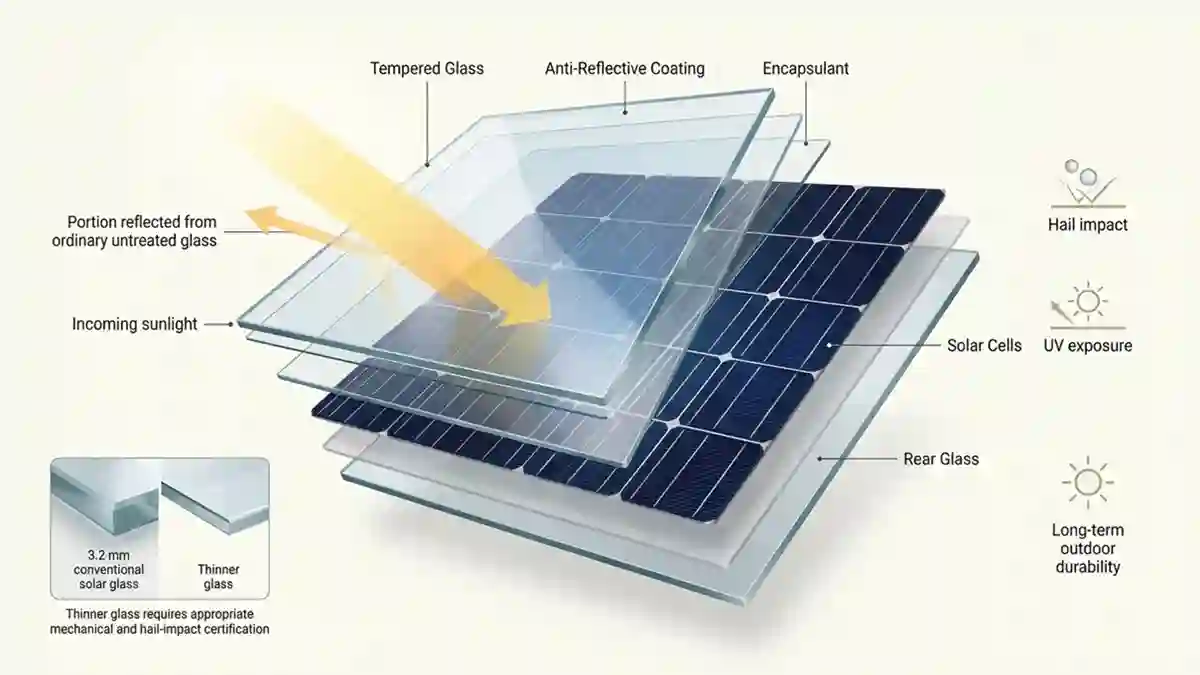
Solar Panel Glass explained: compare tempered, low-iron and anti-reflective glass, and learn how glass affects TOPCon, HJT, PERC and bifacial solar panels.
Solar panel glass looks simple, but it is doing far more than protecting the cells.
It has to withstand hail, wind, heat, humidity and decades of outdoor exposure while allowing as much sunlight as possible to reach the photovoltaic cells underneath. That creates an engineering balance: the glass must be strong enough to protect the module without becoming an unnecessary optical barrier.
This is why specifications such as glass thickness, low-iron composition, tempering and anti-reflective treatment deserve more attention than they usually receive.
This guide is part of our Anatomy of a Solar Panel guide and complements our Solar Panel Encapsulant guide covering the layer directly beneath the glass.
What Is Tempered Solar Panel Glass?
Most crystalline-silicon solar panels use specially manufactured glass designed for photovoltaic applications. Tempering is a heat-treatment process that increases the mechanical strength of the glass and improves its resistance to thermal and mechanical stresses.
Solar module glass is commonly made from low-iron glass because ordinary glass can absorb and reflect more light and has a noticeable green tint. Reducing iron content improves optical transmission and helps more sunlight reach the photovoltaic cells.
Glass thickness has traditionally been around 3.2 mm in many conventional modules, although modern module designs increasingly use thinner glass or different glass configurations to reduce weight.
Engineer’s Note: Glass thickness should never be evaluated by itself. A thinner glass design is not automatically inferior, and a thicker glass design is not automatically better.
What matters is whether the complete module construction has been tested and certified for the required mechanical and environmental conditions.
For buyers, the useful question is not simply “How thick is the glass?” but rather “What glass construction is being used, and what testing supports it?”
Why Low-Iron Glass Matters
Low-iron glass is widely used in quality solar modules because it provides higher optical transmission than ordinary soda-lime glass.
The difference may look insignificant when viewing a panel, but every optical loss between the sunlight and the solar cell matters. Reflection, absorption and scattering at the glass surface can reduce the amount of usable light reaching the cells.
Low-iron glass therefore serves a simple purpose:
Protect the cells while allowing as much usable sunlight through as practical.
This is now a mature and widely adopted approach in crystalline-silicon solar modules, so low-iron glass is better considered a quality baseline than a premium feature by itself.
What Does Anti-Reflective Coating Do?
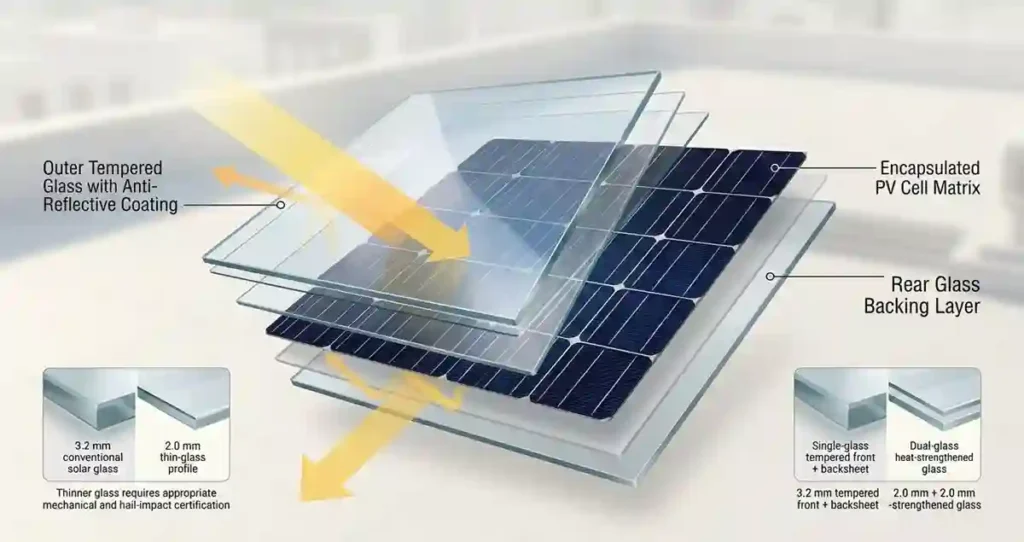
Even highly transparent glass reflects a portion of incoming light.
An anti-reflective (AR) treatment is designed to reduce this surface reflection and increase the amount of light entering the module. This can contribute to improved optical transmission and therefore to module performance.
However, it is important to distinguish optical transmission improvement from a direct percentage increase in the panel’s electrical output.
The final power benefit depends on the complete optical and electrical design of the module, including the glass, cell technology, encapsulant, surface structure and operating conditions.
Coating Quality Matters
The presence of an anti-reflective treatment on a datasheet does not tell the entire story.
A coating has to remain effective while exposed to:
- Ultraviolet radiation
- High temperatures
- Humidity
- Rain and dust
- Repeated thermal cycling
- Cleaning and environmental abrasion
For premium modules where optical performance is part of the product claim, coating durability is therefore worth checking rather than simply confirming that an AR coating exists.
3.2 mm vs Thinner Solar Glass
Glass thickness has become more interesting as manufacturers continue to reduce module weight and optimize manufacturing costs.
A thinner glass configuration can reduce the weight of a module, which can be useful for rooftop installations, transportation and handling.
However, reducing thickness changes the mechanical characteristics of the glass and the overall module structure.
This does not mean that every thin-glass module is less durable. Modern module designs can use different glass thicknesses and constructions while still meeting applicable certification requirements.
The correct approach is to evaluate the complete module rather than assuming:
Thicker = better
or
Thinner = weaker
For a buyer, the important checks are the module’s mechanical-load, hail and environmental test results and the exact glass construction used in the certified product.
Glass-Glass vs Glass-Backsheet Modules
Another important distinction is the overall module construction.
Traditional modules commonly use a glass front with a polymer backsheet. Modern bifacial and high-durability modules may instead use glass on both sides.
Glass-Backsheet
A glass-front/baksheet construction generally offers:
- Lower overall weight than some dual-glass designs
- Long-established manufacturing experience
- Familiar installation and handling characteristics
- Broad availability across the market
The backsheet, however, becomes an important part of long-term environmental protection.
Glass-Glass
Dual-glass construction replaces the conventional rear polymer backsheet with another glass layer.
Potential advantages include:
- Improved resistance to moisture and environmental exposure
- Strong long-term durability potential
- Good compatibility with many bifacial module designs
- Reduced dependence on a polymer rear layer
The trade-off can include higher module weight and different mounting and handling requirements.
For large commercial and utility-scale installations, the choice between glass-glass and glass-backsheet should therefore be evaluated alongside the mounting structure, module weight, transportation requirements and environmental conditions.
Solar Glass Specifications Compared
| Specification | What It Affects | What to Check |
|---|---|---|
| Glass thickness | Weight, stiffness and mechanical behavior | Actual thickness and certified module construction |
| Low-iron composition | Optical transmission | Manufacturer’s glass specification |
| Tempering | Mechanical strength and safety | Applicable IEC testing |
| Anti-reflective treatment | Surface reflection and optical transmission | Coating specification and durability information |
| Glass surface structure | Optical behavior and reflection | Manufacturer’s technical documentation |
| Glass-glass construction | Durability, moisture protection and weight | Complete module construction and warranty |
| Hail resistance | Resistance to impact | Certified hail-impact testing |
| Mechanical-load performance | Resistance to wind and snow loads | IEC 61215 certification and applicable load rating |
How Glass Affects Solar Panel Weight
Glass is one of the major contributors to the weight of a solar module.
That matters during:
- Rooftop structural assessment
- Transportation
- Manual handling
- Installation
- Mounting-system design
- Large-scale logistics
A lighter module can be attractive for weight-constrained rooftops, but weight reduction should never be evaluated separately from mechanical performance.
For commercial and industrial projects, I prefer to look at the complete module construction and its certified mechanical performance rather than selecting a panel simply because it is lighter.
How Solar Cell Technology Changes the Role of Glass
Glass should not be evaluated separately from the solar cell technology used inside the module. Different cell technologies can use different module constructions, and the move toward bifacial generation has made the rear side of the module increasingly important.
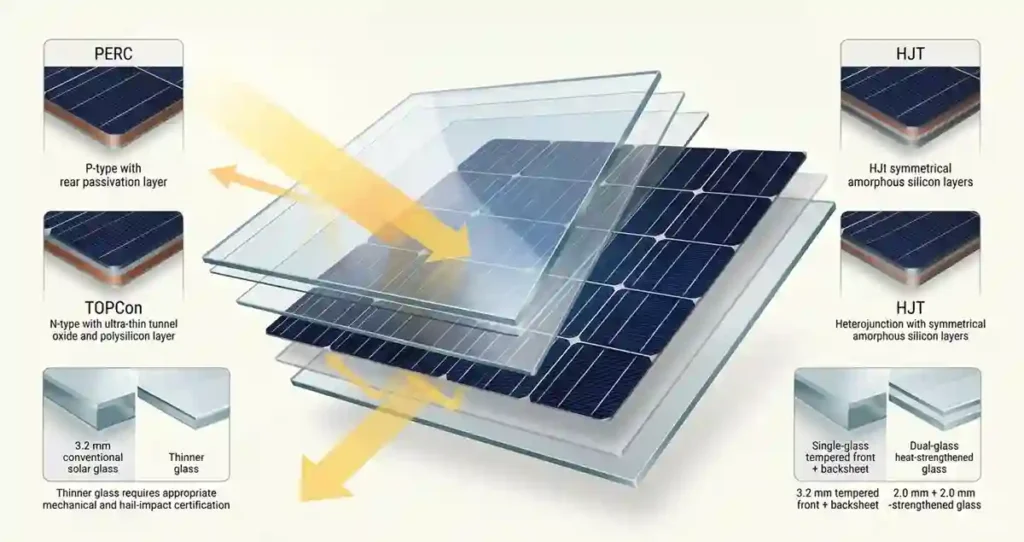
It is important to make one distinction clear:
TOPCon, HJT and PERC are cell technologies. Tempered glass, low-iron glass and anti-reflective glass describe the module’s glass and surface construction.
They are related, but they are not competing types of glass.
PERC Solar Panels
PERC, or Passivated Emitter and Rear Cell, was one of the dominant crystalline-silicon technologies used in the previous generation of mainstream solar modules.
PERC modules have been produced in both glass-backsheet and glass-glass configurations.
For conventional monofacial PERC modules, the front glass primarily has two jobs:
- Protect the cells from the environment
- Allow maximum useful sunlight to reach the cells
Low-iron tempered glass with an anti-reflective surface became a common combination because it provides a practical balance between optical transmission and mechanical protection.
Bifacial PERC modules can also use transparent rear glass, allowing some rear-side generation.
TOPCon Solar Panels
TOPCon, or Tunnel Oxide Passivated Contact, is a newer N-type crystalline-silicon cell technology that has become widely adopted in modern high-efficiency modules.
TOPCon itself does not require a particular type or thickness of glass.
However, many modern TOPCon modules are bifacial and use a dual-glass construction.
A current commercial TOPCon example uses 2.0 mm high-transmission AR-coated heat-strengthened front glass together with 2.0 mm heat-strengthened rear glass.
This illustrates an important change in module design.
Older modules are often associated with approximately 3.2 mm front glass, while modern large-format bifacial modules can use thinner glass on both sides.
Therefore, comparing a 3.2 mm conventional module with a 2.0 + 2.0 mm dual-glass TOPCon module purely by glass thickness can be misleading.
The complete module construction and certification matter more than thickness alone.
HJT Solar Panels
HJT, or heterojunction technology, combines crystalline silicon with thin semiconductor layers to create a high-efficiency cell architecture.
Like TOPCon, HJT is a cell technology rather than a glass technology.
HJT modules can be designed as bifacial products, making transparent rear glass useful for allowing light to reach the rear side of the cells.
The glass therefore has both a protective and optical role.
For an HJT module, I would look at:
- Front-glass optical transmission
- Anti-reflective treatment
- Rear-glass transmission for bifacial designs
- Glass thickness
- Mechanical-load performance
- Encapsulant compatibility
- Long-term environmental durability
The important point is that HJT does not automatically mean one specific glass specification. Manufacturers can use different module constructions.
Bifacial Solar Panels
Bifacial technology makes the rear side of the module much more important.
A conventional monofacial module primarily needs its front glass to transmit sunlight to the cells.
A bifacial module needs the module construction to allow useful light to reach the rear side of the cells as well.
This is why many bifacial modules use a glass-glass construction:
Front glass → encapsulant → bifacial cells → encapsulant → rear glass
The rear glass provides environmental protection while allowing light to reach the rear side of the bifacial cells.
The actual energy gain, however, depends heavily on the installation.
Factors such as:
- Ground albedo
- Module height
- Row spacing
- Rear-side shading
- Surface reflectivity
- Tilt angle
- Site layout
- Surrounding structures
all influence the amount of additional rear-side energy available.
So a bifacial module does not have one universal “bifacial gain” percentage.
Why Glass Matters More for Bifacial Modules
With a monofacial glass-backsheet module, the rear surface is primarily a protection and insulation layer.
With a bifacial glass-glass module, the rear side becomes part of the optical path.
That makes the rear glass specification more important.
For bifacial modules, I would therefore check:
| Glass consideration | Why it matters |
|---|---|
| Front-side transmission | Determines how much sunlight reaches the front cells |
| Rear-side transmission | Allows useful light to reach bifacial cells |
| Anti-reflective treatment | Can reduce surface reflection |
| Glass thickness | Influences weight and mechanical behavior |
| Glass construction | Affects durability and module design |
| Surface condition | Dirt and contamination can affect optical performance |
| Mechanical certification | Confirms suitability for expected environmental loads |
IEC 61215:2021 specifically includes qualification and testing provisions for bifacial PV modules, reflecting the fact that bifacial modules require appropriate consideration in module qualification.
Glass and Other Solar Technologies
The same principle applies beyond PERC, TOPCon and HJT.
| Solar technology | Typical glass consideration |
|---|---|
| PERC | Tempered low-iron front glass; glass-backsheet or glass-glass |
| TOPCon | Frequently paired with bifacial dual-glass construction |
| HJT | Often suitable for bifacial glass-glass designs |
| IBC | High-efficiency cell architecture; glass depends on module design |
| Thin-film | Glass construction can be more integral to the module architecture |
| Bifacial | Transparent rear construction is important |
| Monofacial | Rear side can use a conventional backsheet |
This is why I would not describe TOPCon glass, HJT glass or PERC glass as separate categories of solar glass.
The more accurate engineering description is:
Cell technology + glass construction + encapsulant + electrical architecture = complete module design.
Glass-Glass Construction Across Modern Technologies
The move toward bifacial N-type technologies has increased the use of dual-glass modules.
A modern module may therefore combine:
N-type TOPCon cell + low-iron front glass + AR coating + encapsulant + bifacial cell + encapsulant + rear glass
or:
HJT cell + front glass + encapsulant + bifacial cell + encapsulant + rear glass
The glass is not what makes the module TOPCon or HJT.
Instead, the glass construction is designed around the requirements of the cell and module architecture.
That distinction is important when comparing modern solar panels.
Engineer’s Note: I would avoid judging module quality simply by asking whether the panel has 3.2 mm, 2.0 mm or another glass thickness.
Modern module engineering is more complicated than that.
A thinner glass design can reduce weight, while a dual-glass construction can provide a different balance of mechanical performance, environmental protection and bifacial capability.
The correct question is:
Does the complete module design provide the required optical, mechanical and environmental performance for the intended application?
That is much more useful than treating glass thickness as a standalone quality ranking.
Real-World Considerations
In most reputable crystalline-silicon modules, the basic glass specification is no longer where I expect to see dramatic differences between manufacturers.
Quality tempered low-iron glass has become a mature and widely adopted technology.
Where I pay more attention is when a manufacturer makes a specific performance claim around optical transmission, anti-reflective treatment, ultra-thin glass or a specialized glass construction.
Those claims deserve to be examined against the complete technical documentation rather than accepted simply because they appear on a product brochure.
In hot, dusty or coastal environments, I would also consider the practical exposure of the glass surface. Dust accumulation, cleaning practices, humidity, salt exposure and long-term environmental conditions can affect the real-world performance of any module.
Advantages and Disadvantages
| Advantages | Disadvantages |
|---|---|
| Tempered glass provides strong mechanical protection | Glass contributes significantly to module weight |
| Low-iron glass provides good optical transmission | Thinner glass requires closer attention to the complete module construction |
| Mature technology with decades of field experience | AR coating quality and durability can vary |
| Glass-glass designs can provide strong long-term environmental protection | Dual-glass modules can be heavier |
| AR treatment can reduce surface reflection | Coating performance cannot be judged from its presence alone |
Common Misconceptions About Solar Panel Glass
“All solar panel glass is the same.”
Not exactly.
Most quality modules may share similar basic characteristics, but thickness, iron content, surface treatment, construction and coating technology can differ.
“Thicker glass is always better.”
Not necessarily.
A thinner glass configuration can be engineered successfully when the complete module meets the required mechanical and environmental tests.
“Anti-reflective coating automatically means a better panel.”
Not by itself.
AR treatment can improve optical transmission, but the quality, durability and integration of the coating into the complete module design matter.
“Glass-glass panels are always heavier and therefore worse.”
Weight is a consideration, not a quality ranking.
Glass-glass modules can provide significant durability advantages, particularly in demanding applications, but the additional weight needs to be considered during transportation and installation.
Buying Checklist
Before selecting a solar module, I would check the following:
- Confirm that the module uses suitable photovoltaic-grade low-iron glass.
- Check the actual glass thickness and complete module construction.
- Do not judge thin-glass modules solely by thickness; verify their certified mechanical and environmental performance.
- Check applicable IEC 61215 testing, including mechanical-load and hail testing.
- For panels marketed around anti-reflective technology, ask what optical-performance and durability information is available.
- For glass-glass modules, consider the additional weight during structural design, handling and installation.
- Check whether the glass construction specified in the technical documentation matches the actual product being supplied.
Frequently Asked Questions
How thick is solar panel glass?
Around 3.2 mm has been a common thickness in many conventional solar modules, but modern modules can use thinner glass or different glass configurations. Thickness should be evaluated together with the complete module construction and certification.
Does anti-reflective coating improve solar panel output?
It can. Anti-reflective treatment reduces surface reflection and can increase the amount of light entering the module. The resulting electrical benefit depends on the complete module design and operating conditions.
Is low-iron glass better for solar panels?
Low-iron glass generally provides higher optical transmission than ordinary glass and is therefore widely used in quality solar modules. It has become a common baseline specification rather than an unusual premium feature.
Can solar panel glass be damaged by hail?
Yes. No glass is completely immune to extreme hail. Quality solar modules are tested against specified hail-impact conditions under applicable standards, but exceptionally severe hail can exceed standardized test conditions.
Is glass-glass better than glass-backsheet?
Neither construction is universally better for every application. Glass-glass modules can offer strong durability and environmental resistance, while glass-backsheet modules can provide advantages in weight, handling and established installation practices. The right choice depends on the project.
References
For module qualification and environmental testing, refer to the applicable IEC 61215 requirements and the manufacturer’s certified technical documentation for the specific module model.
My Engineer’s Closing Thought
Solar panel glass is not a specification I would normally use to rank one reputable manufacturer above another.
The industry has largely converged on a reliable baseline: strong, low-iron photovoltaic glass designed to protect the cells while allowing high optical transmission.
The more interesting differences appear when manufacturers move beyond that baseline through thinner glass, dual-glass construction or specialized anti-reflective treatments.
That is where the datasheet deserves a closer look.
The important question is not simply “What type of glass does this panel use?”
It is:
“How does that glass construction perform as part of the complete module over 20 to 30 years of outdoor exposure?”
That is the engineering question that matters.
Related guides on SolarVisionAI.com
- Monocrystalline Solar Panels 2026: Still Worth It or Hype
- Polycrystalline Solar Panels: Worth Buying in 2026?
- Thin-film Solar Panels: When They Beat Silicon (2026)
- BIPV Solar Panels: Building-Integrated PV Complete Guide
- Portable Solar Panels: Engineer’s Buyer’s Guide 2026
- CPV Solar Panels: Concentrated Photovoltaic Explained
- Skin Solar Panel: What “Solar Skin” Actually Means
- Solar Fence Post Lights: Cap Sizes, Types & Install Guide
- Bifacial Solar Panels in 2026: How to Boost Energy Output
- Solar Charge Controller: The Complete Guide
- MC4 Connectors: Solar Safety & Installation Guide
- Solar Panel Types, Efficiency & Benefits
- Solar Water Pump Guide
- BESS — Battery Energy Storage System Guide
- Commercial Solar Panel Installation
- Solar Refrigerator & DC Fridge — Complete 2026 Guide
- Bifacial Solar Panel Albedo Effect Guide
- TOPCon: Why TOPCon Solar Panel is a Proven Smart Investment in 2026
- HJT: Why TOPCon Solar Panel is a Proven Smart Investment in 2026
- PERC: PERC Solar Panel: Still Relevant or Already Outdated?
- Perovskite: Perovskite Solar Panels: The 2026 Reality Check
- N-Type vs P-Type: N-Type vs P-Type Solar Panels: Honest Comparison
- ABC: ABC (all back contact) Solar Panel: Back Contact Technology Explained
- IBC: IBC Solar Panels: Interdigitated Back Contact Guide
- Tandem: Tandem Solar Panels: Are Stacked Cells Ready for Rooftops?