
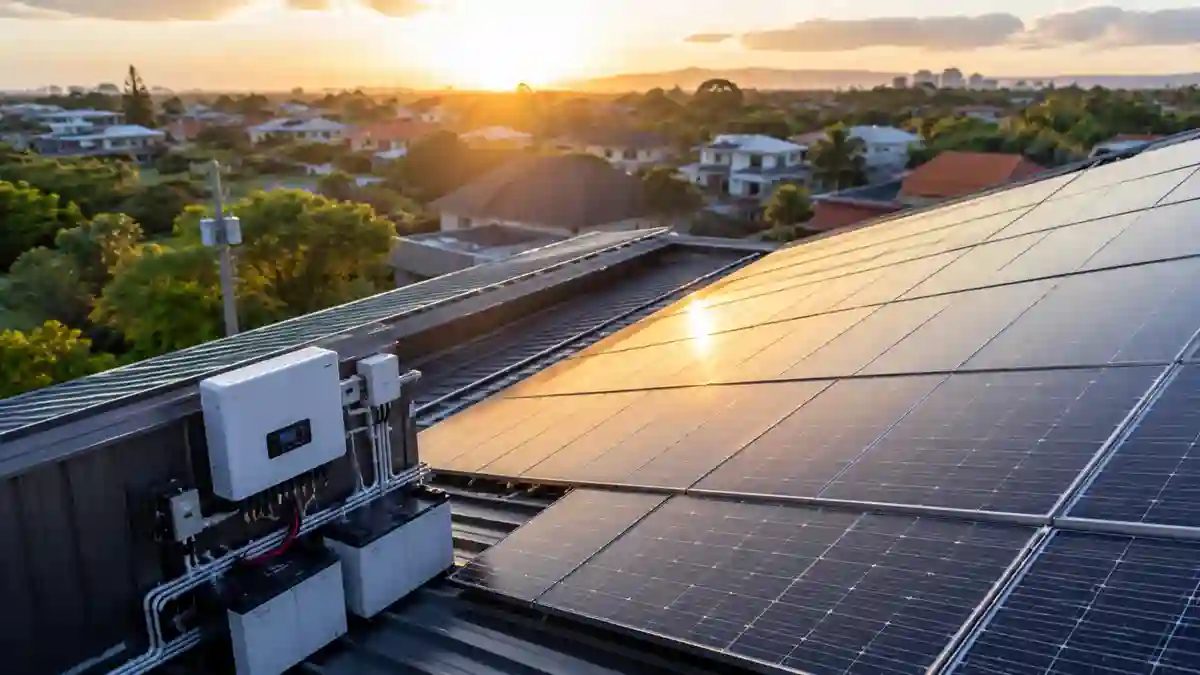
Professional Engineer explains AI solar energy management: MPPT, NEM 3.0 credit timing, platform comparison, and verified ROI numbers for 2026.
The solar power system you install today is not the same as the solar system your installer hands you the keys to. The panels, inverter, and battery are hardware — fixed at commissioning. The AI energy management system, layered on top of that hardware, determines whether your system performs at 80% or 100% of its financial potential.
As a professional engineer who has designed solar systems across residential, commercial, and industrial applications, I have watched the gap between AI-optimized and unoptimized systems grow significantly as utility rate structures have become more complex. Under simple flat-rate net metering, the financial difference was modest. Under California NEM 3.0’s time-varying avoided-cost structure — and similar rate designs spreading to other states — AI optimization is the difference between a system that fully repays its investment and one that takes years longer.
This guide explains exactly what AI solar optimization does at a technical level, which platforms lead the space, what the ROI numbers look like, and how to evaluate whether your existing system can be upgraded.
What AI Solar Energy Management Actually Does — The Four Layers
AI solar optimization is not a single technology — it is a stack of four interconnected machine learning applications, each addressing a different aspect of solar financial performance.
Layer 1: AI-Enhanced MPPT — Getting Every Watt From the Panels
Maximum Power Point Tracking (MPPT) is the inverter algorithm that continuously adjusts the electrical operating point of the solar array to extract maximum power under current irradiance and temperature conditions. Traditional MPPT uses deterministic algorithms — Perturb and Observe (P&O) and Incremental Conductance (INC) — that respond to current conditions but cannot anticipate changes.
AI-enhanced MPPT, now integrated into advanced inverters from SMA, SolarEdge, Huawei, and Fronius, adds a predictive layer: the algorithm learns the shading profile of your specific array, the thermal behavior of your panel model, and the irradiance variability pattern of your location. With this learned model, the AI can:
- Pre-adjust the operating point before partial shading conditions arrive (based on learned time-of-day shading patterns), reducing energy loss during shade transitions
- Apply different MPPT strategies to different strings based on their individual shading and soiling profiles
- Compensate for panel degradation patterns as individual modules degrade at slightly different rates over time
| Engineer’s Note: Traditional P&O MPPT loses 2–5% of potential energy during rapidly changing irradiance conditions (cloud transients) because the algorithm oscillates around the maximum power point rather than tracking it precisely. AI-enhanced MPPT reduces this oscillation loss by using irradiance sensors and learned cloud pattern models to anticipate the direction of the next power point shift — reducing convergence time and improving energy capture during partially cloudy periods by 3–7% compared to traditional P&O. For a 10 kW system in a variable-irradiance climate, this translates to 150–250 additional kWh per year. |
Layer 2: AI Solar Energy Management— Storing and Exporting at the Right Time
AI energy management (AI-EMS) is the system that decides, in real time, what to do with every kilowatt-hour your solar system produces: self-consume it now, store it in the battery, or export it to the grid. This decision determines your net metering credit value, your self-consumption savings, and your demand charge exposure.
AI-EMS platforms build predictive models from four data inputs:
- Solar generation forecast: Combining historical generation data with real-time satellite weather and irradiance forecasting models (Solargis, Tomorrow.io, NREL NSRDB), the AI predicts your system’s hourly generation for the next 24–48 hours with typical accuracy of ±5–8%.
- Load forecast: The AI learns your building’s consumption patterns from historical smart meter data — HVAC demand response to temperature, daily EV charging cycle, office equipment load profile, weekend vs. weekday variation. It predicts tomorrow’s consumption with hourly granularity.
- Rate schedule: The AI reads your utility’s current TOU rate schedule and, for programs like NEM 3.0, the next day’s published avoided-cost export rates. It builds an hour-by-hour economic map of when each kilowatt-hour has maximum value as self-consumption, stored energy, or grid export.
- Battery optimization: Combining the three inputs above, the AI solves an optimization problem: given forecast generation, forecast load, and the economic rate schedule, what is the charge-discharge profile that maximizes total financial value over the next 24 hours while maintaining battery health?
| AI Insight: Under California NEM 3.0, AI-EMS platforms achieve export credit values of $0.17–0.22/kWh compared to $0.07–0.09/kWh for unmanaged systems exporting the same energy. This 2–3× improvement comes entirely from export timing — shifting battery discharge from midday ($0.05–0.08/kWh) to evening ($0.18–0.24/kWh). On a system exporting 2,000 kWh per year, this timing optimization produces $200–$280 in additional annual credit value at zero additional hardware cost. Compounded over a 10-year battery operating life, the AI optimization premium on export timing alone exceeds $2,000–$2,800. |
Layer 3: AI Fault Detection — Protecting Your Net Metering Revenue Stream
Every kilowatt-hour your solar system fails to produce due to an undetected fault is a kilowatt-hour that does not appear in your net metering credit calculation. Undetected faults — soiling accumulation, module degradation, loose connections, inverter efficiency loss, shading changes — silently reduce your credits month after month.
AI fault detection continuously compares your system’s actual generation against the theoretically expected generation given current weather conditions — a metric called the Performance Ratio (PR). The AI’s expected generation model accounts for current irradiance (from satellite data), panel temperature (from irradiance and ambient modeling), system age, and expected annual degradation rate (0.4–0.7%/year for modern panels), and known shading patterns (learned from historical data).
When actual generation falls below the AI’s expected model by more than a defined threshold — typically 3–5% sustained over 48 hours — the platform generates an alert with a diagnosis: underperforming string, module-level fault, soiling event, or inverter efficiency degradation.
Studies across large monitored fleets show that AI fault detection identifies 85–90% of generation-reducing faults within 48 hours — compared to 30–60 days for faults identified through manual inspection or customer-noticed bill changes. For a 10 kW system, a 5% undetected generation loss costs approximately $140–$200 per year in lost net metering credits.
Layer 4: AI Demand Charge Management — Commercial Net Metering Value
For commercial buildings paying demand charges — typically $15–25 per kW per month based on the 15-minute peak demand interval — AI battery management adds financial return entirely independent of net metering credit rates.
Traditional battery systems set a manual demand limit and discharge when demand approaches it — a simple rule that works reasonably in predictable load environments but fails when demand peaks are irregular or weather-driven. AI demand management builds a real-time predictive model of your building’s demand: predicts when the monthly demand peak is likely based on weather forecast, day of week, and historical load; pre-positions battery state of charge before predicted peak events; and dynamically adjusts the demand limit target in real time as the billing month progresses.
| Engineer’s Note: On a commercial building with a $50,000/year electricity bill and $15,000 in demand charges, a well-configured AI battery management system typically achieves 25–35% demand charge reduction — saving $3,750–$5,250 per year in demand charges alone. This saving is additive to the net metering credit optimization and self-consumption improvement, and it produces a positive ROI on battery storage that stands independently of the net metering program’s export credit rate. For commercial buildings with significant demand charges, AI battery management is financially justified even in flat-rate net metering states where export timing optimization adds minimal value. |
AI Solar Energy Management Comparison — What’s Available in 2026
| Platform | Hardware Required | AI MPPT | AI-EMS | Fault Detection | NEM 3.0 ACC Optimized |
| SolarEdge Energy Hub | SolarEdge inverter + battery | Yes (HD-Wave MPPT) | Yes (SolarEdge EMS) | Yes (module-level) | Yes — ACC rate-aware scheduling |
| Tesla Powerwall 3 | Tesla inverter + Powerwall | Basic MPPT | Yes (Autobidder-lite) | Basic | Yes — TOU-aware |
| Enphase IQ8 + IQ Battery | Enphase microinverters only | Yes (per module) | Yes (IQ Controller 3) | Yes (module-level) | Partial — TOU-aware, not full ACC |
| SMA Sunny Home Manager 2.0 | SMA inverter (any battery) | Yes (SMA MPPT) | Yes (SMA EMS) | String-level | Partial — manual rate entry required |
| Sonnen sonnenOS | Sonnen inverter + battery | Basic | Yes (sonnenOS AI) | Yes | Yes — rate-aware scheduling |
| Span.io Smart Panel | Any inverter/battery | No (grid side only) | Yes (Span AI) | Partial | Yes — TOU + NEM 3.0 ACC |
| Emporia Energy | Hardware agnostic (CT clamps) | No | Basic load management | Basic | Partial — TOU scheduling only |
Selection note: ‘NEM 3.0 ACC Optimized’ means the platform reads the utility’s published Avoided Cost Calculator rates and schedules battery charge-discharge to maximize export during high-rate windows — not just a basic TOU schedule. For California NEM 3.0 systems, this distinction is financially significant. Verify with your installer that the platform has confirmed ACC rate integration, not just generic TOU support.
Can You Add AI Solar Energy Management to an Existing Solar System?
Yes — in most cases, AI optimization can be added to an existing solar system without replacing the inverter or panels:
- Inverter with monitoring API (SolarEdge, Enphase, Fronius, SMA): Third-party AI platforms (Span, Emporia) can connect via the manufacturer’s API and add an optimization layer on top of your existing monitoring data. Battery storage must be added if you do not already have it.
- No battery, any inverter: Add a compatible battery with AI-EMS capability. SolarEdge Energy Hub works only with SolarEdge inverters. Tesla Powerwall 3 integrates with a wide range of inverters through AC coupling. Enphase IQ Battery integrates only with Enphase microinverter systems. SMA battery systems support third-party inverters through AC coupling.
- Older inverters without monitoring API: A revenue-grade production meter at the inverter AC output provides the generation data stream for third-party AI platforms, even if the inverter has no native monitoring. This is the pathway for systems with older string inverters that predate cloud monitoring.
| Field Note: The most important specification to verify when adding AI optimization to an existing system is the communication protocol between the battery system and the AI-EMS platform. Systems communicating via Modbus TCP or SunSpec Alliance standards support the widest range of third-party AI platforms. Proprietary communication protocols (some older SolarEdge and Huawei systems) may require the manufacturer’s own EMS. Confirm compatibility before purchasing any battery or AI platform upgrade. |
The ROI of AI Optimization — What You Actually Gain
| Benefit | Residential (10 kW, NEM 3.0) | Commercial (100 kW, TOU + Demand) |
| Export timing optimization | $200–280/year additional credit | $1,800–2,400/year additional credit |
| Self-consumption improvement | $300–460/year on-peak saving | $2,500–3,600/year on-peak saving |
| Demand charge reduction | N/A (residential) | $3,750–5,250/year |
| Fault detection (annual loss prevented) | $140–200/year protected | $1,200–1,800/year protected |
| Total AI annual premium | $640–940/year | $9,250–13,050/year |
| AI premium over 10 years | $6,400–9,400 | $92,500–130,500 |
| AI system cost | $500–1,200 (software/EMS) | $2,000–5,000 (hardware + software) |
| AI premium payback | 12–22 months | < 6 months |
Bottom line: AI optimization is not a luxury feature in complex rate environments — it is a financial multiplier that pays for itself within 2 years for residential systems and within 6 months for commercial systems in states with time-varying net metering or net billing rates. In flat-rate retail net metering states, the payback is longer but still positive through fault detection and self-consumption improvement.
Key Takeaways
- AI solar optimization operates across four layers: MPPT enhancement, energy management (store/export timing), fault detection, and demand charge management.
- AI-EMS platforms achieve export credit values of $0.17–0.22/kWh under NEM 3.0 vs $0.07–0.09/kWh for unmanaged systems — a 2–3× improvement from export timing alone.
- AI fault detection identifies 85–90% of generation-reducing faults within 48 hours — protecting the net metering credit stream that undetected faults silently erode.
- Commercial buildings with demand charges see the highest AI ROI — 25–35% demand charge reduction that pays back AI system costs in under 6 months.
- AI optimization can be retrofitted to most existing systems through compatible battery additions and third-party EMS platforms — you do not need to replace your inverter.
- Under flat-rate retail net metering, AI adds value through self-consumption timing and fault protection. Under time-varying and net billing structures, AI is a financial necessity.
Frequently Asked Questions
What is AI solar optimization?
AI solar optimization uses artificial intelligence and machine learning to improve solar system performance by optimizing energy production, battery usage, fault detection, and net metering export timing.
Can AI improve solar panel efficiency?
Yes. AI-enhanced solar systems can improve energy capture by optimizing MPPT tracking, predicting shading conditions, and adjusting system performance based on weather and usage patterns.
How does AI help with net metering credits?
AI energy management systems analyze utility rate schedules and automatically decide when to store energy, self-consume electricity, or export power to the grid to maximize net metering value.
Can AI detect solar system faults?
Yes. AI solar monitoring platforms continuously compare expected and actual system performance to identify faults such as inverter issues, panel degradation, shading problems, or wiring losses before they significantly affect energy production.
Is AI solar optimization worth it?
In many residential and commercial systems, AI solar optimization delivers positive ROI through improved self-consumption, better export timing, demand charge reduction, and early fault detection.
Can existing solar systems be upgraded with AI optimization?
Most existing solar systems can be upgraded using AI-enabled battery systems, smart energy management software, or third-party monitoring platforms without replacing solar panels.
Which solar companies offer AI optimization systems?
Major companies offering AI-powered solar optimization include SolarEdge, Tesla, Enphase Energy, SMA Solar Technology, and Sonnen.
Does AI solar optimization work without batteries?
Basic AI monitoring and fault detection can work without batteries, but advanced AI energy optimization and export timing strategies typically require battery storage integration.
How is AI solar energy management different from AI solar optimization?
AI solar optimization is a broad term covering any use of artificial intelligence to improve solar system performance. AI solar energy management is the specific technical layer that makes optimization decisions — the EMS platform that reads NEM 3.0 avoided-cost rates, schedules battery charge-discharge cycles, enforces export caps, and cross-references your inverter’s production data against utility billing statements. Think of AI solar optimization as the goal and AI solar energy management as the engineering system that achieves it.
What is AI solar energy management?
AI solar energy management is an intelligent control system that coordinates every component of your solar installation — panels, inverter, battery, and grid connection — in real time. Unlike basic solar monitoring, an AI energy management system (AI-EMS) uses machine learning to predict solar generation, forecast building load, read utility rate schedules, and automatically decide when to self-consume, store, or export energy to maximize financial return every 15 minutes of every day
Related guides on SolarVisionAI.com
Solar Panel Installation: Complete Engineering Guide (2026)
Solar Panel Installation Cost: The Complete 2026 Breakdown
Commercial Solar Panel Installation: Engineering Guide 2026
When Is the Best Time to Install Solar Panels?
Solar Power System in 2026: Types, Cost, ROI & AI Optimization