
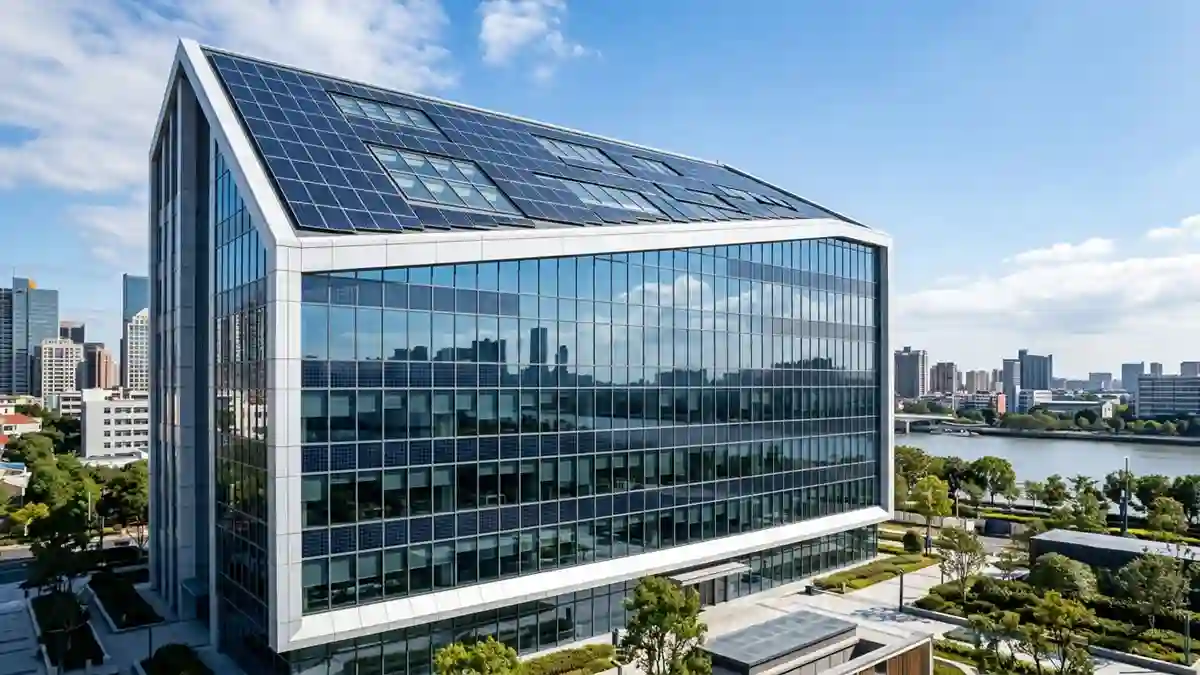
What BIPV solar panels (building-integrated photovoltaics) actually are, where they make sense, and what they cost versus standard rooftop solar.
Most solar panels are an addition to a building. BIPV panels are the building — or at least, part of it. Roof tiles, facade cladding, even glazing can be manufactured as functioning solar modules, replacing the material that would otherwise be there rather than mounting on top of it. It’s the category clients ask about when the honest answer to “will it look like solar panels?” has to be no.
This guide is part of our Types of Solar Panels hub.
What Qualifies as BIPV
The defining feature isn’t the cell chemistry — BIPV can use monocrystalline, thin-film, or specialty cells — it’s that the product replaces a conventional building material rather than sitting on top of an already-finished surface.
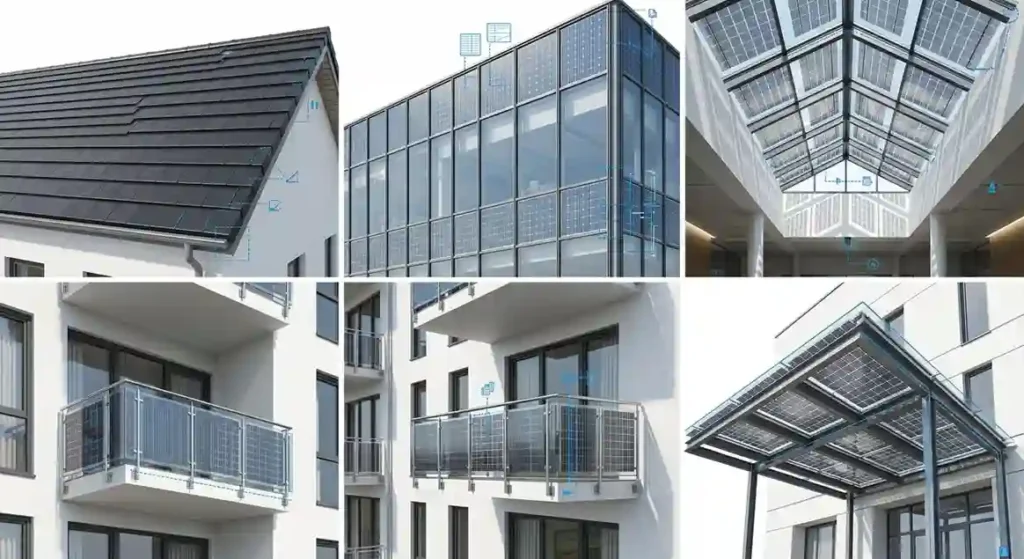
- Solar roof tiles — replace standard roofing tiles/shingles
- Solar facades — replace exterior wall cladding
- Solar glazing — semi-transparent PV integrated into windows or skylights
- Solar balcony/railing panels — replace balustrade or balcony infill panels
Engineer’s Note: The question I ask every BIPV client before quoting: “are you replacing a material you’d need anyway, or adding to a structure that’s already complete?” If it’s the former, BIPV’s cost premium is partially offset by the building material you’re not buying separately. If it’s the latter, you’re just paying more for the same energy output as a standard rooftop panel.
Cost and Efficiency Trade-offs
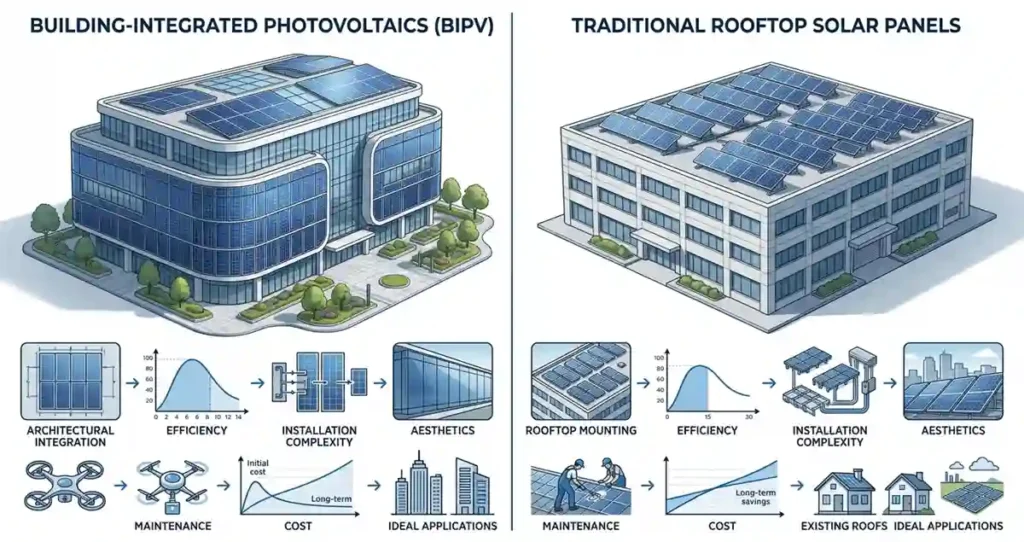
| Metric | BIPV Solar Panels | Standard Rooftop Panels | Practical Difference | Industry Reference |
| Typical Efficiency | 10–18% | 18–22% | Lower output but integrated into the building envelope | NREL, Fraunhofer ISE |
| Cost per Watt | 30–60% higher | Baseline | Premium is partially offset when replacing conventional building materials | IEA, IRENA |
| Aesthetic Integration | Excellent | Moderate | BIPV becomes part of the building rather than an add-on | PV Magazine |
| Installation Complexity | High | Moderate | Requires expertise in both roofing and photovoltaic installation | Industry Best Practice |
| Certification | Building + PV Certified | PV Certified | BIPV must satisfy structural and electrical standards | IEC 61215 & IEC 61730 |
Advantages and Disadvantages
| Advantages | Disadvantages |
| No visible “bolted-on panel” look — blends with the structure | 30–60% higher cost per watt than standard panels |
| Offsets cost when replacing planned building material anyway | Lower efficiency, especially for tile and glazing formats |
| Opens up facades, balconies, and windows as generation surfaces | Fewer qualified installers with genuine BIPV experience |
| Often the only option where visible panels aren’t permitted | Installation errors can compromise weatherproofing, not just output |
Real-World Applications
The clearest BIPV success I’ve reviewed was a new-build residential project where the architect specified solar roof tiles from the design stage — the client was never comparing BIPV against “free roofing,” because the roofing was going to cost money regardless. Comparing BIPV against the incremental cost of a standard tile made the numbers work in a way they never would on a retrofit.
I’ve also seen it used well on facade installations in dense urban apartment buildings, where there’s no accessible roof at all and the only generation surface available is a south-facing wall. In that situation BIPV facade panels aren’t competing against a cheaper rooftop option — they’re the only option, which changes the entire cost conversation. See Wall Facade Solar Mounting System, Wall Mounted Solar Panels Guide, and Balcony Solar Mounting System for the physical mounting side of these installs, and Balcony Solar for Apartments for the renter/unit-owner angle specifically.
A third scenario worth mentioning: a heritage-zoned property where the local planning authority explicitly prohibited any visible rooftop modification, including standard racked panels. BIPV roof tiles were the only path to solar approval at all in that case — not a preference, a regulatory requirement. That’s a category of project where cost comparisons against standard panels are somewhat beside the point, because standard panels were never actually on the table.
Installation and Long-Term Considerations
BIPV installation demands a different skill set than standard rack-and-panel work — installers need to be competent in both the electrical side and the building envelope/weatherproofing side simultaneously, since a poorly sealed BIPV tile is a roof leak waiting to happen, not just an underperforming solar module. This is the single biggest reason I steer clients toward manufacturers with an established, vetted installer network rather than a generic solar contractor working with an unfamiliar product for the first time.
Long-term, expect BIPV maintenance to more closely resemble building envelope maintenance than typical panel maintenance — periodic inspection of seals and flashing matters as much as monitoring electrical output. Get manufacturer-specific maintenance guidance in writing before installation, since generic solar panel maintenance advice doesn’t fully cover the building-integration half of the product.
Engineering Verdict: BIPV solar panels are not intended to replace conventional rooftop solar in every project. Their greatest value comes when solar generation and building materials are planned together from the design stage. For most retrofits, standard rooftop solar remains the more economical solution. However, for new construction, premium architecture, and projects where aesthetics or planning regulations are critical, BIPV offers a compelling combination of energy generation and architectural integration
Who Should Buy BIPV Solar Panels?
- Homeowners planning a new build
- Architects designing energy-efficient buildings
- Commercial developers
- Heritage or conservation projects
- Luxury residential developments
- High-end office buildings
Who Should Avoid BIPV Solar Panels?
- Existing homes with a good roof
- Budget-conscious homeowners
- Small residential retrofits
- Projects prioritizing the lowest cost per watt
- Temporary structures
- DIY solar installations
Where It Doesn’t Make Sense
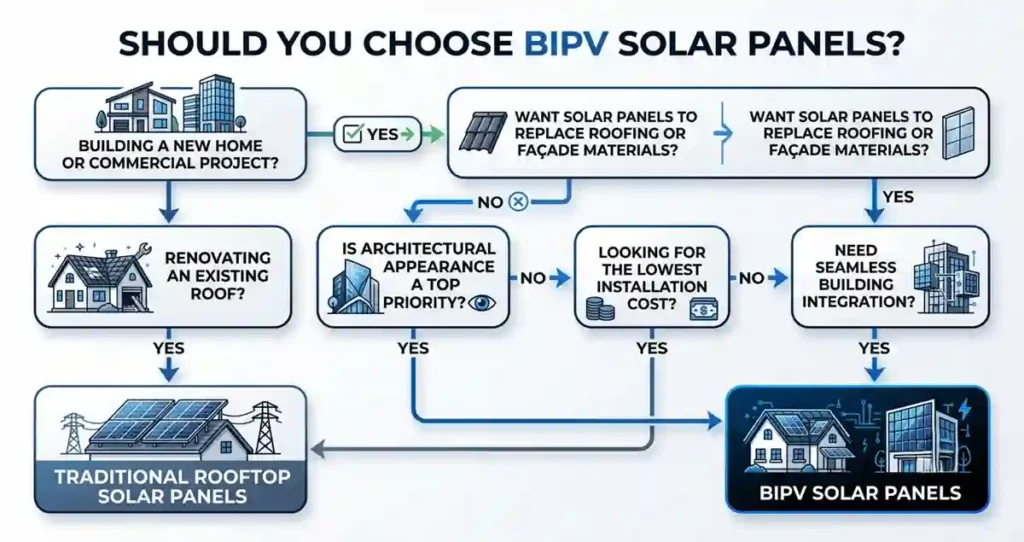
Retrofitting an existing, fully intact roof purely for BIPV’s aesthetic benefit rarely pencils out against a standard rooftop array of the same capacity — you’re paying the full premium with none of the offsetting material savings, since you’re not avoiding buying a roof you’d need anyway. For most retrofit projects, monocrystalline achieves a cleaner visual result at a fraction of the cost.
Field Note: Almost every successful BIPV project I’ve reviewed was specified at the design stage of new construction — not retrofitted afterward. That timing is the single biggest predictor of whether the economics work, more than any spec on the datasheet.
A Real Cost Comparison Worked Example
On the new-build project mentioned above, the client compared three options: standard asphalt shingles plus a bolted-on rooftop array, standard shingles plus BIPV roof tiles installed only on the south-facing slope, and full BIPV roof tiles across the entire roof. The middle option won, because it captured the aesthetic benefit where it mattered most — the street-facing elevation — while using conventional shingles (and conventional rooftop racking) on the sections nobody would ever see from the ground. That’s often the more sensible real-world compromise: partial BIPV where visibility matters, standard panels everywhere else.
On a pure retrofit, the math rarely works this way, because you’re not choosing between BIPV and “a roof you’d need anyway” — you’re choosing between BIPV and a roof you already have. That’s the single clearest signal for whether BIPV belongs in your project: are you specifying it alongside other building material decisions, or are you trying to justify it against a roof that’s already paid for and doesn’t need replacing.
Common Misconceptions Worth Clearing Up
Clients frequently assume BIPV is a single product category with a single price point, when in reality the spread between a basic solar roof tile and a premium solar glazing product is enormous — often a wider price range than the entire standard rooftop panel market. Treating “BIPV” as one buying decision rather than several distinct product categories is the fastest way to end up comparing quotes that aren’t actually comparable.
The other misconception worth addressing directly: that BIPV automatically means lower long-term maintenance because there’s nothing bolted onto the roof. In practice, because BIPV components are also structural or weatherproofing components, a failure in one system affects the other in a way a standard rooftop panel failure simply doesn’t. A leaking BIPV tile is simultaneously a roof leak and an electrical fault, which is a more serious problem than either issue would be on its own.
Buying Checklist If You’re Considering BIPV
- Confirm the product is certified as both a building material and a PV module — not all suppliers meet both standards
- Get a written efficiency and output guarantee in the contract itself, not just verbally promised, since BIPV efficiency varies far more between products than standard panels
- Confirm installer experience and ask for references from at least two prior BIPV projects — installation errors can compromise building weatherproofing, not just energy output
My closing advice on BIPV is simple: bring the question to your architect or designer before you bring it to a solar installer. Whether BIPV makes financial sense depends almost entirely on decisions that get made at the building design stage, long before anyone’s specifying panel wattage — and by the time a solar contractor is involved, that window has often already closed. Ask the design question early, get real quotes on both the BIPV and standard-panel-plus-conventional-material path, and let the actual numbers for your specific building settle it rather than the aesthetic appeal alone.
For the full type comparison across every category on this site, see Types of Solar Panels.
Frequently Asked Questions
Are BIPV Solar Panels Worth the Extra Cost?
Yes, in the right project. BIPV solar panels are typically more expensive than conventional rooftop solar systems, but they can offset part of that cost by replacing roofing, façade, or glazing materials. They offer the greatest value in new construction, premium architectural projects, and buildings where aesthetics and seamless integration are priorities.
Can BIPV Solar Panels Replace Traditional Roof Tiles?
Yes. Many BIPV roofing products are specifically designed to replace conventional roof tiles, metal roofing, or shingles while generating electricity. Instead of mounting solar panels on top of the roof, the photovoltaic material becomes part of the roof itself.
How Long Do BIPV Solar Panels Last?
Most high-quality BIPV solar panels have an expected service life of 25 to 30 years, with performance warranties comparable to conventional solar panels. Longevity depends on product quality, installation standards, and environmental conditions.
Are BIPV Solar Panels Waterproof?
Yes. Properly installed BIPV systems are designed to provide weather protection while generating electricity. Many BIPV roofing and façade products are engineered to meet the same waterproofing and building envelope standards as traditional construction materials.
Can BIPV Solar Panels Be Installed on Existing Buildings?
Yes, but retrofitting an existing building with BIPV is often more complex and expensive than installing conventional rooftop solar panels. BIPV is generally most cost-effective when incorporated into new construction or major building renovations where roofing or façade materials are already being replaced.
Which Is Better: BIPV or Rooftop Solar Panels?
Neither technology is universally better. BIPV solar panels excel in architectural integration, aesthetics, and new construction projects, while traditional rooftop solar panels generally provide higher efficiency, lower installation costs, and easier retrofitting for existing homes and commercial buildings. The best choice depends on your project goals, budget, and building design.
Do BIPV Solar Panels Qualify for Net Metering?
In many regions, yes. BIPV solar panels generate electricity in the same way as conventional photovoltaic systems and may qualify for net metering where local regulations permit. Eligibility depends on your utility provider, inverter compliance, and local renewable energy policies.
What Certifications Should BIPV Solar Panels Have?
Look for products certified to internationally recognized standards such as IEC 61215 for photovoltaic module performance and IEC 61730 for electrical safety. Depending on the application, BIPV systems may also require compliance with local building codes, structural standards, fire safety regulations, and glazing requirements. These certifications help ensure long-term reliability, safety, and building code compliance.
References
Market and technical developments in Building-Integrated Photovoltaics are tracked through pv magazine’s BIPV coverage, which follows product launches, IEA-PVPS technical guidance, and real installation case studies referenced in this guide. IRENA’s Power Generation Costs data inform cost premium figures. Where BIPV components also function as building materials, safety qualification follows IEC 61730
Related guides on SolarVisionAI.com
- Solar Fence Post Lights: Cap Sizes, Types & Install Guide
- Solar Charge Controller: The Complete Guide
- MC4 Connectors: Solar Safety & Installation Guide
- Solar Panel Types, Efficiency & Benefits
- Solar Water Pump Guide
- Commercial Solar Panel Installation: Engineering Guide
- Solar Fence Post Lights: Cap Sizes, Types & Install Guide
- BESS — Battery Energy Storage System Guide
- Commercial Solar Panel Installation