
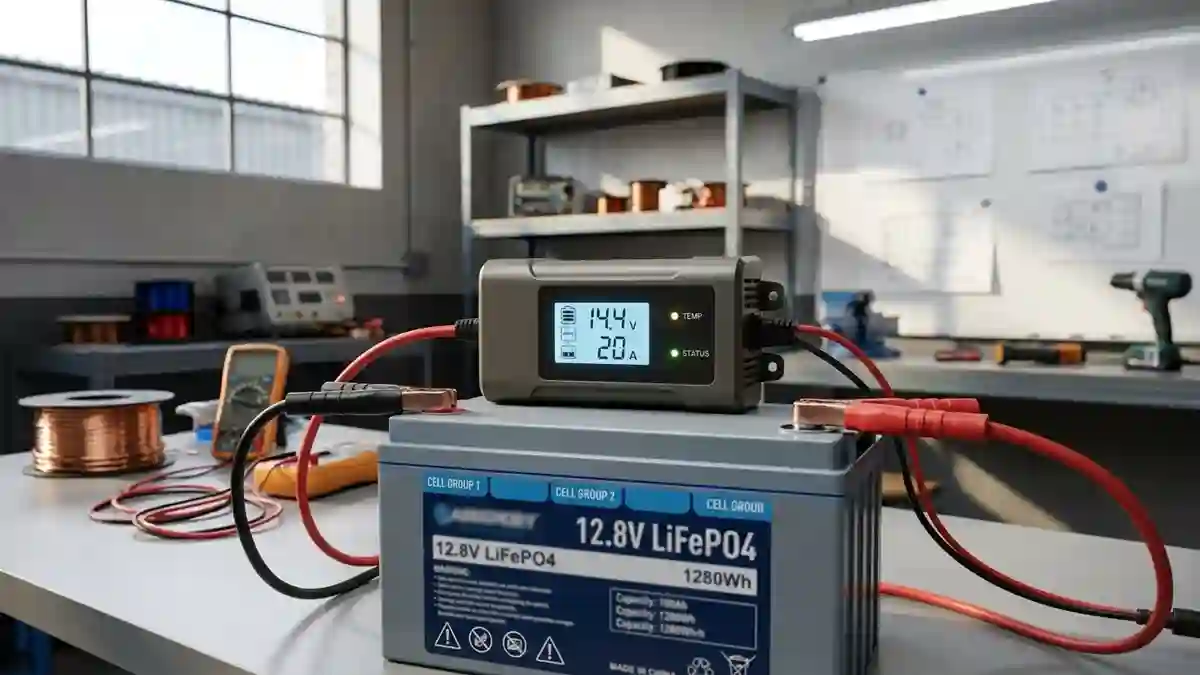
LiFePO4 Battery Charger settings explained: correct voltage, charging amps, CC/CV stages, 12V/24V/48V batteries, temperature limits, and common mistakes.
LiFePO4 batteries are known for their long service life, high usable capacity, and stable performance. But in the field, I have seen lithium battery problems that were not caused by the battery itself: overheating, cell damage, unexpected BMS cutoffs, reduced battery life, and batteries that never reach full charge. In many of those cases, the charging setup was a major part of the problem.
A common cause is replacing a lead-acid battery with LiFePO4 while keeping the old charger. In a solar power system, where the battery cycles every day, that mistake costs battery life faster. The chemistry is different, so the charger needs a different profile.
Quick answer: A LiFePO4 battery charger must use a lithium constant-current, constant-voltage (CC/CV) profile: about 14.4 V for a 12 V battery (range 14.2 to 14.6 V), 28.8 V for 24 V, and 57.6 V for a 48 V (51.2 V) battery, with no equalization and no desulfation mode. Charge current is usually 0.2C to 0.5C, which is 20 to 50 A for a 100 Ah battery. Always confirm the limits on your battery’s datasheet.
This guide covers the correct charging voltage for 12 V, 24 V and 48 V LiFePO4 batteries, how to size charging current, how CC/CV charging works, which charger types to use, and the mistakes that can damage a lithium battery.
Important: Generic voltage values are a useful starting point, but the battery manufacturer’s datasheet always takes priority over a general charging table.
1. How LiFePO4 Battery Charger Differs from Lead-Acid
Lead-acid batteries need a slow, multi-stage charge because they accept current less readily as they fill up. A LiFePO4 battery behaves differently. It accepts nearly full current until it is close to 100% charged, then stops accepting current quickly once the voltage limit is reached. That makes the charge simpler and faster, but the voltage limits matter more.
| Charging feature | Lead-acid (flooded or AGM) | LiFePO4 |
| Charge method | Bulk, absorption, float | Constant current, then constant voltage. Float is optional |
| Absorption voltage (12 V battery) | 14.4 to 14.8 V | 14.2 to 14.6 V |
| Float | 13.2 to 13.8 V, held continuously | Not required. If used, about 13.5 V or lower |
| Equalization | Periodic high-voltage equalization | Never |
| Temperature compensation | Yes | Not used. Disable it or select a lithium profile |
| Charge acceptance | Slows down early; last 20% is slow | Accepts full current until close to full |
| Full-charge signal | Voltage and specific gravity | Current tapering, confirmed by the BMS |
Solar charge controllers follow the same voltage rules. For the solar side of the topic, see our guide to solar charge controllers for lithium batteries.
2. Charging Voltage Settings for 12 V, 24 V and 48 V Batteries
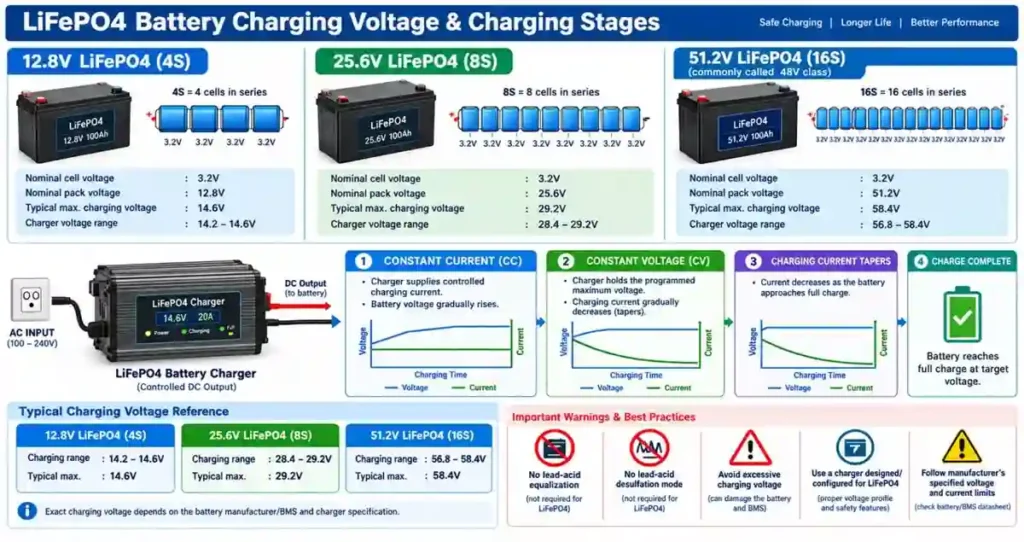
A LiFePO4 cell has a nominal voltage of 3.2 V and a maximum charge voltage of 3.65 V. Battery voltage is simply the number of cells in series multiplied by those values. A “12 V” LiFePO4 battery has four cells (4S), a 24 V battery has eight (8S), and a 48 V battery has sixteen (16S), which is why it is properly called a 51.2 V battery.
| Battery | Cells | Nominal voltage | Bulk / absorption | Float (optional) | Low-voltage cutoff |
| 12 V | 4S | 12.8 V | 14.2 to 14.6 V (14.4 V typical) | 13.5 V or lower | About 10.0 V |
| 24 V | 8S | 25.6 V | 28.4 to 29.2 V (28.8 V typical) | 27.0 V or lower | About 20.0 V |
| 48 V (51.2 V) | 16S | 51.2 V | 56.8 to 58.4 V (57.6 V typical) | 54.0 V or lower | About 40.0 V |
These are typical values based on 3.55 to 3.65 V per cell for charging and 2.5 V per cell for cutoff. Manufacturers differ, so the datasheet always wins over a generic table.
Engineer’s Note: Set the charger toward the lower end of the manufacturer’s range for daily use. Charging to 14.2 to 14.4 V on a 12 V battery gives up very little usable capacity, reduces time spent at high voltage, and leaves a safety margin so the BMS high-voltage cutoff never has to trip.
3. The Charging Stages
Bulk (constant current)
The charger delivers its set current until the battery reaches the absorption voltage. Most of the battery’s capacity goes in during this stage.
Absorption (constant voltage)
The charger holds the voltage steady while current falls. The charge is complete when current tapers to roughly 2 to 5% of the battery’s capacity (2 to 5 A on a 100 Ah battery), or when the manufacturer’s timer ends.
Float or rest
LiFePO4 does not need a float charge. Once full, the charger can stop or drop to a low holding voltage. Balancing inside the battery happens near the top of the charge, so the battery should reach the absorption voltage regularly rather than sitting permanently at partial charge.
4. Sizing a LiFePO4 Charger
Charge current is battery capacity multiplied by the charge rate (C-rate). A gentle rate of 0.2C is easy on the battery. Many batteries allow 0.5C and some allow 1C, but the datasheet sets the limit. Charge time is roughly capacity divided by charge current, plus about 10% for the tapering stage.
| Battery capacity (12.8 V) | Charger at 0.2C | Time | Charger at 0.5C | Time |
| 50 Ah | 10 A | About 5.5 h | 25 A | About 2.2 h |
| 100 Ah | 20 A | About 5.5 h | 50 A | About 2.2 h |
| 200 Ah | 40 A | About 5.5 h | 100 A | About 2.2 h |
Charger power in watts is voltage times current. A 14.4 V, 30 A charger delivers about 430 W to the battery. To convert between watts and amps for your own numbers, use our watts to amps calculator. Keep in mind that any loads running while you charge take current away from the battery, so charging takes longer than the table suggests.
5. Which Type of Charger Should You Use?
| Charging source | Best for | What to check |
| AC lithium charger | Home, garage and backup banks | A true lithium profile or adjustable voltage; current within the battery’s rating |
| Inverter/charger | Off-grid homes, RVs, boats | Battery type set to lithium or user-defined; charge current limit set correctly |
| DC-DC charger | Charging from a vehicle alternator | Sized below the alternator’s spare output; lithium profile selected |
| Solar MPPT controller | Off-grid and mobile solar | Lithium profile, temperature compensation off. See our MPPT charge controller guide |
| Generator with charger | Long cloudy periods | Charger sized to what the generator can supply continuously |
Hybrid inverters combine several of these roles. Our hybrid inverter guide explains how they manage grid, solar and battery charging together.
6. Charging in Cold and Hot Weather
Charging a lithium battery below 0°C (32°F) can cause lithium plating on the anode, which permanently reduces capacity and can create a safety risk. Most LiFePO4 batteries specify a charging window of about 0 to 45°C, and many BMS units block charging outside it. Discharging is more tolerant, typically down to about minus 20°C (minus 4°F).
If you charge in freezing conditions, use a battery with built-in heating or keep the battery in an insulated, warmed space. High temperatures shorten life too, so avoid charging in an enclosed compartment that regularly exceeds 45°C.
Engineer’s Note: A BMS that refuses to charge in the cold is doing its job. Do not bypass it. The correct fix is to warm the battery, not to override the protection.
7. Can You Use a Lead-Acid or AGM Charger?
Sometimes, but only if every one of these conditions is met:
- The maximum voltage can be limited to the lithium range (14.6 V or less on a 12 V battery).
- Equalization, desulfation and “repair” modes are switched off.
- Temperature compensation is disabled.
- Float is off or no higher than about 13.5 V.
- Maximum current is within the battery’s charge rating.
If the charger cannot meet all five, replace it. Many battery warranties also require a lithium-compatible charger, so check the terms before relying on a workaround.
8. Common Charging Mistakes
- Leaving equalization enabled. The high voltage pulse can trip the BMS or damage cells.
- Using a pulse “battery saver” charger. Desulfation pulses are designed for lead-acid and serve no purpose in lithium.
- Connecting a lithium bank directly to an alternator. A low-resistance lithium bank can pull far more current than a lead-acid battery, which can overheat the alternator. Use a DC-DC charger.
- Judging charge level by voltage. LiFePO4 voltage stays almost flat through most of the discharge, so a voltmeter cannot tell 30% from 70%. Use a shunt-based battery monitor or the BMS app.
- Undersized or long charging cables. Voltage drop makes chargers run hot and slows charging. Size cable for the charger’s maximum current.
- Setting the charger to 14.6 V or higher “to be safe.” Higher is not safer. It only moves you closer to the BMS cutoff.
9. Setup Checklist
Before putting a LiFePO4 charging system into service:
- Check the battery manufacturer’s datasheet for maximum charge voltage, maximum charge current, recommended charging profile and permitted charging temperature range.
- Select the lithium charging profile on the charger, or manually configure the voltage and current according to the battery manufacturer’s specifications.
- Disable equalization, desulfation and other lead-acid-specific charging modes. Temperature compensation should also be disabled unless specifically required by the battery manufacturer.
- Set the charge-current limit within the battery’s rated charging current, while accounting for any DC loads operating during charging.
- Monitor the first complete charging cycle and confirm that the charger transitions correctly from constant-current to constant-voltage operation and that current tapers as the battery approaches full charge.
- Verify the actual battery-terminal voltage with a calibrated multimeter rather than relying only on the charger’s display.
- For permanently installed or stationary energy-storage systems, verify the electrical installation, protection, disconnects, wiring and commissioning requirements against the applicable electrical code and the manufacturer’s installation instructions. In the U.S., this commonly includes NFPA 70 (NEC), Article 706, together with applicable NFPA 855 requirements for stationary ESS.
Engineer’s Note: Codes such as the NEC and NFPA 855 govern the installation and safety framework; they should not be used as a substitute for the battery manufacturer’s charging limits. The battery datasheet remains the primary reference for its permitted voltage, current and temperature limits.
Frequently Asked Questions
What voltage should I charge a 12 V LiFePO4 battery to?
Between 14.2 and 14.6 V, with 14.4 V the most common setting. Check your manufacturer’s maximum before choosing.
Do LiFePO4 batteries need a float charge?
No. Once the battery is full, the charger can stop. If your charger has a float stage, keep it at 13.5 V or lower on a 12 V battery.
How long does it take to charge a 100 Ah LiFePO4 battery?
About 5.5 hours with a 20 A charger, or about 2.2 hours with a 50 A charger, provided the battery allows that rate.
Can I charge a LiFePO4 battery with a car battery charger?
Usually not recommended. Many car chargers apply lead-acid profiles, and some use desulfation pulses. Use one with a lithium mode or adjustable voltage limits.
Can I charge LiFePO4 in freezing temperatures?
Not without protection. Charging below 0°C (32°F) can damage the cells. Use a heated battery or warm the battery first.
Related guides on SolarVisionAI.com
- Monocrystalline Solar Panels 2026: Still Worth It or Hype
- Polycrystalline Solar Panels: Worth Buying in 2026?
- Thin-film Solar Panels: When They Beat Silicon (2026)
- BIPV Solar Panels: Building-Integrated PV Complete Guide
- Portable Solar Panels: Engineer’s Buyer’s Guide 2026
- CPV Solar Panels: Concentrated Photovoltaic Explained
- Skin Solar Panel: What “Solar Skin” Actually Means
- Solar Fence Post Lights: Cap Sizes, Types & Install Guide
- Bifacial Solar Panels in 2026: How to Boost Energy Output
- Solar Charge Controller: The Complete Guide
- MC4 Connectors: Solar Safety & Installation Guide
- Solar Panel Types, Efficiency & Benefits
- Solar Water Pump Guide
- BESS — Battery Energy Storage System Guide
- Commercial Solar Panel Installation
- Solar Refrigerator & DC Fridge — Complete 2026 Guide
- Bifacial Solar Panel Albedo Effect Guide
- TOPCon: Why TOPCon Solar Panel is a Proven Smart Investment in 2026
- HJT: Why Heterojunction Is the Hot Climate Champion
- PERC: PERC Solar Panel: Still Relevant or Already Outdated?
- Perovskite: Perovskite Solar Panels: The 2026 Reality Check
- N-Type vs P-Type: N-Type vs P-Type Solar Panels: Honest Comparison
- ABC: ABC (all back contact) Solar Panel: Back Contact Technology Explained
- IBC: IBC Solar Panels: Interdigitated Back Contact Guide
- Tandem: Tandem Solar Panels: Are Stacked Cells Ready for Rooftops?