
Does homeowners insurance cover solar panels? A solar EPC consultant explains exactly what your policy covers, the 3 gaps most people miss, and what to fix before you install.
Of all the questions that come up in a solar EPC consultation, this is the one that matters most to a homeowner and gets answered the most carelessly. The short answer is yes — most standard homeowners insurance policies cover rooftop solar panels. The complete answer involves three coverage categories, two common gaps, and at least one endorsement that every solar homeowner should add to their policy.
This guide gives US homeowners the accurate, complete picture — the same one I give clients before they sign an installation contract.
| Disclaimer: This article is written by a Solar EPC Consultant based on real client inquiries and project experience. It is educational only. For your specific insurance decisions, consult a licensed insurance advisor in your state. |
1. The Short Answer — And Why It’s Incomplete
Yes. In most US states, rooftop solar panels are covered under a standard homeowners insurance policy (HO-3) as part of Coverage A — Dwelling. Because solar panels are permanently attached to the roof structure, they are treated as part of the home itself — the same as the roof, walls, and any other permanent fixture. But that coverage has conditions, limits, and gaps that most homeowners do not discover until after a loss event.
| What “Covered” Means | What It Does NOT Mean |
| Panels covered for open perils: fire, wind, hail, falling objects, theft, vandalism | Covered for mechanical breakdown or gradual deterioration — that requires a separate endorsement |
| Coverage A limit applies to panels as part of the dwelling | Your coverage limit automatically increased when you added the panels — you must update it |
| Replacement cost coverage if your policy is RCV (Replacement Cost Value) | ACV policies pay depreciated value — a 10-year-old panel system pays out much less than replacement cost |
| Ground-mounted arrays are covered | Under Coverage B at 10% of Coverage A — which may not be enough for large systems |
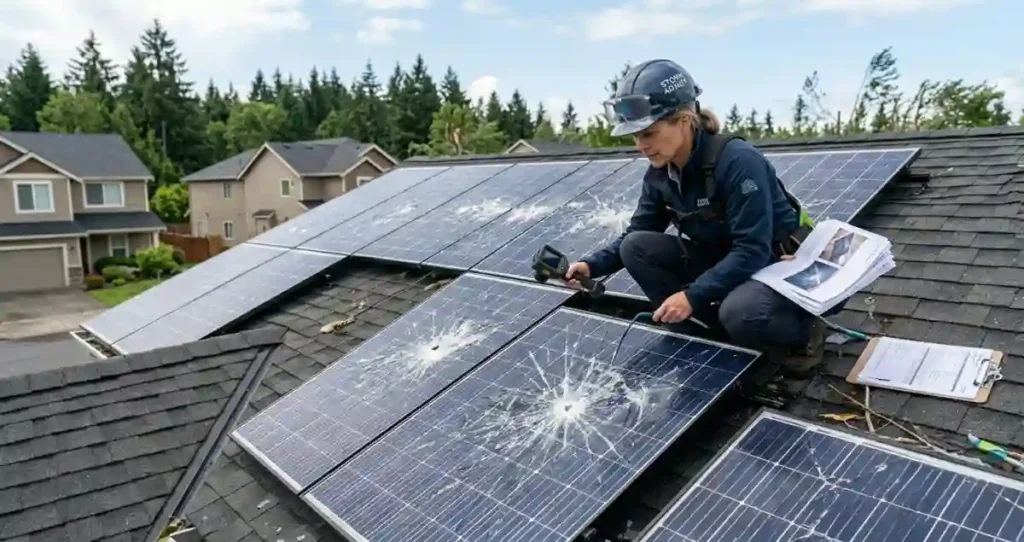
| Field Note: A client in Arizona installed a $32,000 rooftop system without notifying their insurer. Two years later, a hailstorm caused $18,000 in panel damage. The insurer denied the claim — the Coverage A limit had not been adjusted to reflect the system addition. The panels were technically covered, but the claim was denied because the insured value had not been updated. This is the most common and most preventable solar insurance mistake I see in client consultations. |
2. Which Homeowners Policy Types Cover Solar — And Which Don’t
| Policy Form | Solar Panel Coverage | Coverage Basis | US Prevalence |
| HO-3 (Special Form) | Yes — open perils on dwelling | Coverage A — all perils except exclusions | ~70% of US homeowners — most common |
| HO-5 (Comprehensive Form) | Yes — broadest coverage | Coverage A & C — open perils on everything | Premium homes — strongest solar coverage |
| HO-1 / HO-2 (Basic/Broad Form) | Limited — named perils only | Coverage A — named perils list only | Rare; less common in modern policies |
| HO-4 (Renters) | No dwelling coverage | Coverage C — personal property only | Renters — panels on rented property not covered |
| HO-6 (Condo) | Interior only — HOA covers exterior | Coverage A — walls-in typically | Condo owners — roof/panel coverage is the HOA’s policy |
| HO-8 (Older Homes) | Limited — ACV basis | May not cover full replacement cost | Older properties — undercoverage risk is high |
3. The Three Coverage Gaps Solar Homeowners Miss
Gap 1 — Coverage A Limit Not Updated
The most common gap. You install a $25,000 solar system. Your Coverage A limit was set before the system was installed. Your insurer does not automatically increase your limit. After a total loss, your payout is based on the pre-solar dwelling value.
Fix: Call your insurer immediately after installation. Request a Coverage A limit increase equal to the full installed system cost.
Gap 2 — Equipment Breakdown Not Covered
HO-3 covers perils like fire, wind, and hail. It does not cover your inverter failing because a capacitor burned out at year 8. Inverter replacement costs $1,000–$2,500. Battery replacement costs $9,000–$12,000.
Fix: Add an equipment breakdown endorsement. Typically $25–$50/year. Covers inverter, battery, and monitoring system failures from internal faults.
Gap 3 — Ground-Mount Systems Underinsured Under Coverage B
Ground-mounted solar arrays are classified as other structures under Coverage B — typically 10% of Coverage A. On a home insured for $350,000, Coverage B is $35,000. A 15 kW ground-mount system can cost $35,000–$55,000 installed.
Fix: Request a Coverage B limit increase or a scheduled inland marine policy specifically for the ground-mount system.
| Engineer’s Note: I check three things on every residential solar consultation before the client signs: Coverage A limit vs system value, equipment breakdown endorsement status, and whether the battery is classified as Coverage A or Coverage C personal property. These three checks take 15 minutes with the insurer and prevent the most expensive claims disputes I have seen. |
4. What Your Insurer Needs to Know About Your Solar System
| Information to Provide Your Insurer | Why They Need It |
| Total installed system cost (panels + inverter + battery + installation) | To update Coverage A limit to reflect full replacement cost |
| System type: rooftop vs ground-mounted | Determines whether Coverage A or Coverage B applies |
| Battery storage: make, model, installed cost | To classify correctly — Coverage A hardwired vs Coverage C portable |
| Panel manufacturer and model | For replacement cost verification in a claim settlement |
| Installation date | Establishes baseline for depreciation under ACV policies |
| Monitoring system value | May require scheduled endorsement if over personal property sub-limit |
| Permit number and inspection pass date | Documents code compliance — relevant in hurricane and high-wind states |
5. Does Solar Affect Your Homeowners Insurance Premium?
For the full breakdown on premium impact, see: Do Solar Panels Increase Your Home Insurance Premium? — the short answer is that the premium increase from updating your Coverage A limit is typically $50–$150/year on a $20,000–$30,000 system. That is a small cost relative to the replacement value being protected.
For information on what specific solar components are covered and how to insure each one correctly, see: Solar Panel Insurance: What It Covers & How to Get It
For Florida-specific coverage considerations, including hurricane and windstorm endorsements, see: Solar Panel Insurance in Florida: Which Companies Cover You
Frequently Asked Questions
Does homeowners insurance cover solar panels?
Yes. In most cases, permanently installed rooftop solar panels are covered under the dwelling portion of a homeowners insurance policy because they are considered part of the home’s structure. Coverage details vary by insurer and policy type.
Do I need to tell my insurance company after installing solar panels?
Yes. Homeowners should notify their insurer immediately after installation. Adding solar panels increases the value of the home, and failing to update coverage limits could result in underinsurance or claim disputes.
Does homeowners insurance cover solar panel hail damage?
In most states, hail damage is covered if hail is a covered peril under the policy. However, the payout depends on policy limits, deductibles, and whether the system’s value was properly reported to the insurer.
Does homeowners insurance cover solar panels damaged by hurricanes or windstorms?
Many policies cover wind damage, but coverage may be subject to separate hurricane or windstorm deductibles in certain states, particularly in coastal areas such as Florida and Texas.
Does homeowners insurance cover solar panel theft?
Yes. Permanently installed rooftop solar panels are generally covered against theft under standard homeowners insurance policies. Ground-mounted systems may be subject to different coverage limits.
Does homeowners insurance cover solar batteries?
It depends on how the battery system is installed. Permanently installed batteries are often covered as part of the dwelling, while portable battery systems may fall under personal property coverage.
Are ground-mounted solar panels covered by homeowners insurance?
Usually, ground-mounted solar systems are covered under “other structures” coverage rather than dwelling coverage. The available limit may be lower, so homeowners should verify that the coverage amount is sufficient.
Does homeowners insurance cover inverter failure?
Not usually. Standard homeowners policies generally cover sudden external events such as fire, hail, or lightning. Internal mechanical or electrical failures often require an equipment breakdown endorsement.
Will installing solar panels increase my homeowners insurance premium?
In most cases, yes. However, the increase is often modest compared to the value of the solar system being protected. Many homeowners see premium increases ranging from $50 to $150 per year.
What information should I provide my insurer after installing solar panels?
Homeowners should provide the total installed cost, system type, panel manufacturer, inverter information, battery details, installation date, permits, and inspection records.
What happens if I don’t update my insurance after installing solar panels?
You may not have enough coverage to fully replace the system after a loss. This is one of the most common insurance mistakes made by homeowners with solar.
Does homeowners insurance cover solar panel replacement after a fire?
If fire is a covered peril under the policy and the coverage limit is adequate, homeowners insurance typically pays to repair or replace damaged solar panels, subject to policy terms and deductibles.
Related Guides on SolarVisionAI
Solar Panel Insurance: What It Covers & How to Get It
Do Solar Panels Increase Your Home Insurance Premium?
Commercial Solar Panel Insurance: Installers, Cleaners & Buildings
Solar Panel Hail Damage: What Your Insurance Covers