
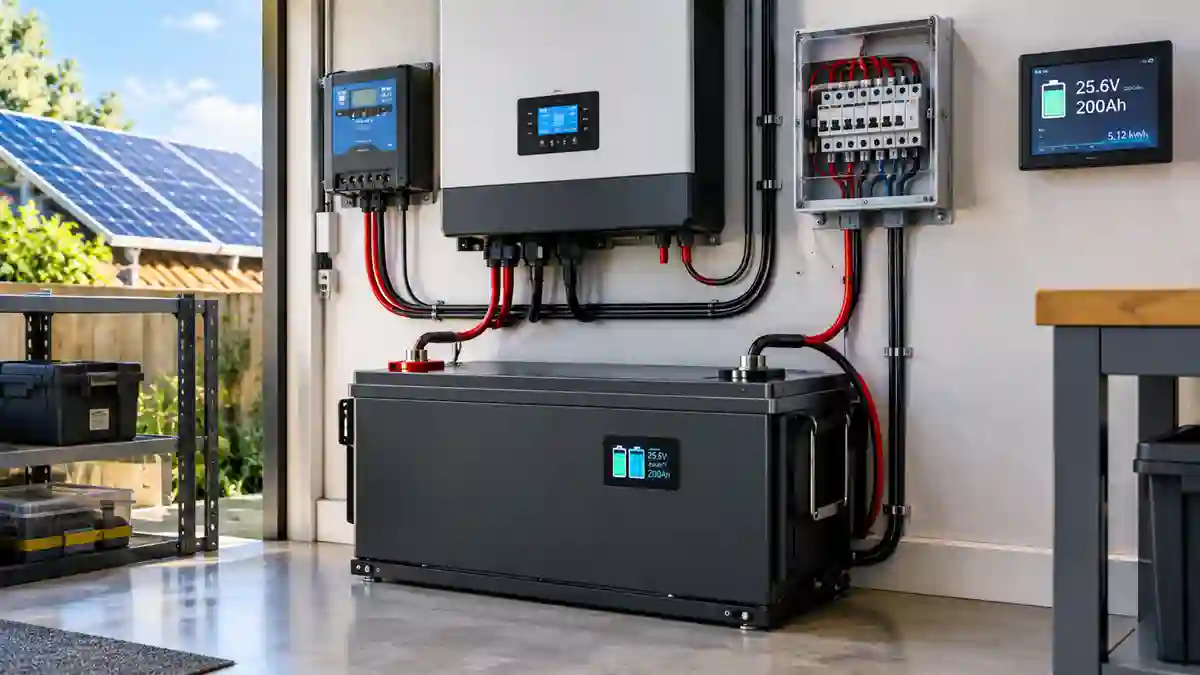
24V 200Ah LiFePO4 battery guide: specs, energy, RV & golf cart builds, solar charging, and how it compares to 12V and 48V systems.
Quick answer: A 24V 200Ah LiFePO4 battery has a true nominal voltage of 25.6V (8 cells in series, 8S) and stores 5.12 kWh (25.6V x 200Ah). It is a common choice for mid-size RVs, golf carts, and small off-grid systems running inverters up to about 3,000W. Many are sold as custom-built packs, assembled from smaller 50Ah or 100Ah cells wired in parallel to reach 200Ah.
A 24V 200Ah LiFePO4 battery sits in the middle of the voltage range: powerful enough for a real inverter load, but still compact enough for mobile applications like RVs and golf carts. It is also one of the more commonly customized capacities, since manufacturers frequently build 200Ah packs from smaller cell groups depending on the intended use.
This guide covers what the numbers mean, how these batteries are typically built and customized, where they are used, and how 24V compares to 12V and 48V for different systems.
1. 24V 200Ah LiFePO4 Battery Specs
| Specification | Value | Notes |
| Nominal voltage | 25.6 V (8S) | Rounded down to “24V” for labeling |
| Capacity | 200 Ah | Usually parallel-summed from smaller cells |
| Energy | 5.12 kWh | 25.6 V x 200 Ah |
| Charge voltage | 28.4 to 29.2 V | 28.8 V typical |
| Low-voltage cutoff | About 20.0 V | Set by the BMS |
| Typical weight | About 20 to 26 kg | Varies by cell type |
| Continuous discharge | Commonly 100 to 200 A | Always check the datasheet |
A LiFePO4 cell has a nominal voltage of 3.2 V. Eight cells in series (8S) give 25.6 V, which is the “24V” label, rounded down the same way “48V” rounds down from 51.2V. The 200Ah figure is the parallel-summed capacity of the cells, not a single cell’s rating.
2. 24V 200Ah Battery Packs: How They’re Built and Customized
Most 24V 200Ah batteries are not built from a single 200Ah cell. They are commonly assembled from smaller cells wired in parallel to reach the target capacity, for example two 100Ah cells or four 50Ah cells grouped in parallel, then arranged into the 8S series string for voltage.
This is also why 24V packs are frequently customized by manufacturers for specific applications. It is common to see the same base cell offered in 50Ah, 100Ah, or 200Ah configurations, built to order for RVs, golf carts, or other mobile equipment where space and mounting constraints vary.
Engineer’s Note: When a pack is custom-built from smaller cells, the parallel wiring and BMS balancing matter as much as the cells themselves. Ask the manufacturer whether the pack was assembled and tested as a complete 200Ah unit, or field-assembled by a reseller. Quality control differs significantly between the two.
3. Using a 24V 200Ah Battery for RVs and Golf Carts
24V is a practical middle ground for both RVs and golf carts.
- RVs. A 24V 200Ah battery (5.12 kWh) comfortably runs a mid-size RV’s lighting, water pump, fridge, and a modest inverter load, while keeping current roughly half of what a 12V system would draw for the same power.
- Golf carts. Many golf carts originally run on 36V or 48V lead-acid banks, but 24V LiFePO4 packs are also used in smaller carts and utility vehicles, especially where a lighter, more compact battery is preferred over a larger lead-acid bank.
Custom 24V packs built specifically for these applications often prioritize a compact case shape and mounting pattern that matches OEM lead-acid battery bays, making replacement more straightforward.
4. 24V 200Ah LiFePO4 Battery Compatibility with Solar Systems
A 24V 200Ah LiFePO4 battery pairs naturally with mid-size solar setups, but “compatible” depends on matching several components correctly, not just connecting a panel to a battery.
Charge controller type and voltage window
Use an MPPT controller rated for a 24V nominal battery, with a lithium (LiFePO4) charge profile. The controller’s battery voltage range must cover the full swing of a 24V pack: roughly 20V (empty, low-voltage cutoff) to about 29.2V (full charge). A controller set for lead-acid will apply the wrong absorption voltage and may never fully charge the battery, or worse, hold it at a voltage that stresses the cells.
Matching solar array size to the battery
A 60A MPPT controller on a 24V system can manage roughly 1,500W of solar panels. Practical sizing example:
| Array size | Charge current at 24V | Time to recharge 5.12 kWh (full cycle) |
|---|---|---|
| 400 W | About 15 A | Roughly 6 to 8 hours in good sun |
| 800 W | About 30 A | Roughly 3 to 4 hours in good sun |
| 1,200 W | About 45 A | Roughly 2 to 3 hours in good sun |
These are rough estimates before accounting for panel angle, temperature losses, and partial shading, which typically reduce real-world output by 15 to 25%.
Communication with hybrid inverters
Some 24V batteries include CAN bus or RS485 communication so a hybrid inverter can read state of charge directly and manage charge/discharge limits automatically. If the battery doesn’t support this, the inverter falls back to voltage-based estimation, which is less accurate on LiFePO4 because of its flat voltage curve. Check the inverter’s approved battery list before assuming compatibility.
Engineer’s Note: The most common solar-compatibility mistake I see with 24V LiFePO4 systems isn’t the battery or the panels — it’s an MPPT controller left on a factory lead-acid profile. The battery will still charge, but slowly and often incompletely, because the controller cuts off absorption too early or applies float voltages the battery doesn’t need. Before troubleshooting anything else, confirm the controller’s profile is set to lithium and the voltage points match the battery’s datasheet, not a generic default.
5. 24V 200Ah for Solar Charging and EV Backup
A 24V 200Ah battery can be charged directly from a solar array through an MPPT controller set to a 24V lithium profile. This setup is increasingly used not just for general home or RV backup, but specifically as a solar-charged buffer for EV charging, storing solar energy during the day so it is available to top up an EV charger in the evening, without pulling directly from the grid.
For this use case, check that:
- Your MPPT controller supports a 24V lithium charge profile.
- The battery’s continuous discharge rating covers your EV charger’s draw, or size the system with multiple batteries in parallel.
- You are using a controller and battery combination validated for the charge currents involved, since EV charging can draw sustained high current for hours at a time.
See our MPPT solar charge controller guide and lithium charge controller guide for the charging settings.
6. Why 24V vs 12V or 48V
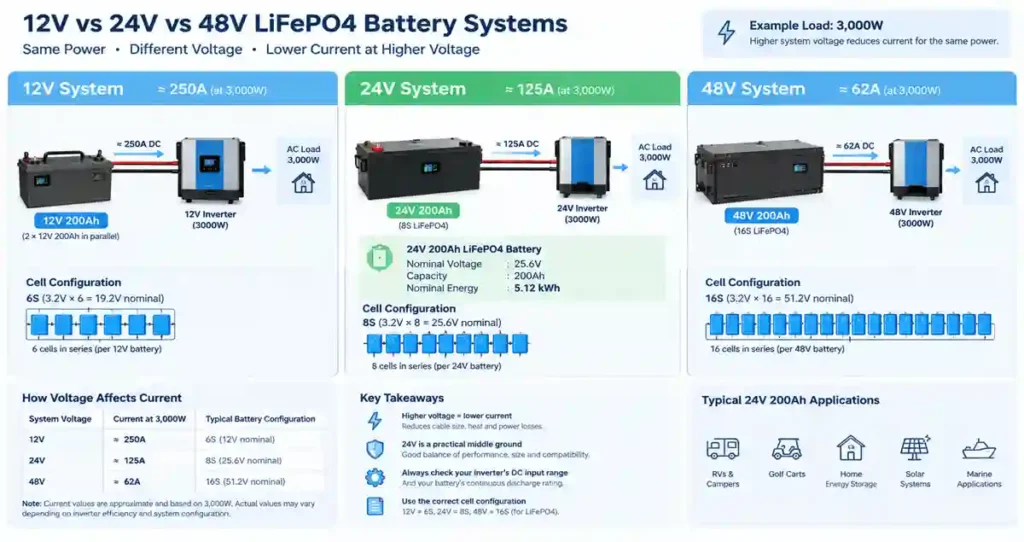
Choosing between voltages comes down to your inverter size and application.
| System voltage | Current at 3,000W | Best for |
| 12 V | About 250 A | Small vans, boats, tent trailers |
| 24 V | About 125 A | Larger RVs, golf carts, small off-grid systems |
| 48 V | About 62 A | Home storage, commercial systems |
Power equals voltage times current, so at the same power draw, 24V carries half the current of 12V, allowing thinner cable, smaller fuses and lower losses. For loads above about 3,000W, 48V becomes the more practical choice.
7. Common Mistakes with 24V 200Ah Batteries
- Assuming all “24V 200Ah” packs are identical. Cell configuration and build quality vary between manufacturers, especially with customized packs.
- Comparing packs by Ah alone. Always check kWh (25.6V x Ah) rather than Ah in isolation.
- Undersizing for EV charging loads. Sustained high-current draw needs a battery and controller both rated for it, not just sized by capacity.
- Ignoring the datasheet’s continuous discharge rating when pairing with a larger inverter or charger.
8. Codes, Standards & Safety Considerations for 24V LiFePO4 Batteries
For a 24V 200Ah LiFePO4 Battery, the applicable codes and standards depend on whether the battery is being used in an RV, golf cart, residential solar system or stationary energy-storage installation.
For stationary energy-storage applications, NEC Article 706 addresses Energy Storage Systems (ESS), while NFPA 855 provides installation requirements for stationary energy-storage systems. NEC documentation also references standards such as UL 1973 for stationary batteries and UL 9540 for energy-storage systems and equipment.
For battery-management systems, IEEE 2686-2024 provides recommendations covering BMS design, configuration, protection functions and interoperability in stationary energy-storage applications.
Important: These standards do not replace the battery manufacturer’s specifications. Always follow the battery datasheet for maximum charging current, discharge current, voltage limits, temperature limits, BMS requirements and approved inverter/charger compatibility. Local electrical codes and the authority having jurisdiction (AHJ) also determine which requirements apply to a specific installation.
Engineer’s Note: A 24V LiFePO4 battery may look like a simple low-voltage battery, but once it becomes part of a larger solar or energy-storage installation, battery protection, DC overcurrent protection, cable sizing, disconnects, grounding, BMS communication and equipment certification all become important. The battery datasheet should be the starting point, while applicable electrical and fire-safety requirements should be checked for the actual installation.
Frequently Asked Questions
What is the energy capacity of a 24V 200Ah LiFePO4 battery?
5.12 kWh (25.6V nominal x 200Ah).
Can I get a custom 24V 200Ah LiFePO4 battery for my RV or golf cart?
Yes. Many manufacturers offer 24V packs in 50Ah, 100Ah, or 200Ah configurations built to order for RV and golf cart applications.
Can a 24V 200Ah battery be charged from solar for EV charging?
Yes, with an MPPT controller set to a 24V lithium profile. Confirm the battery’s continuous discharge rating matches your EV charger’s draw.
What’s the difference between a single-cell and a built-up 24V 200Ah pack?
Most 200Ah packs are assembled from smaller cells, such as 50Ah or 100Ah, wired in parallel. Build quality and BMS balancing matter as much as the underlying cells.
Is 24V or 48V better for a home battery system?
48V is the standard for home storage above about 3,000W, since it halves the current compared to 24V. 24V suits smaller off-grid systems, RVs, and golf carts.
Related guides on SolarVisionAI.com
- Monocrystalline Solar Panels 2026: Still Worth It or Hype
- Polycrystalline Solar Panels: Worth Buying in 2026?
- Thin-film Solar Panels: When They Beat Silicon (2026)
- BIPV Solar Panels: Building-Integrated PV Complete Guide
- Portable Solar Panels: Engineer’s Buyer’s Guide 2026
- CPV Solar Panels: Concentrated Photovoltaic Explained
- Skin Solar Panel: What “Solar Skin” Actually Means
- Solar Fence Post Lights: Cap Sizes, Types & Install Guide
- Bifacial Solar Panels in 2026: How to Boost Energy Output
- Solar Charge Controller: The Complete Guide
- MC4 Connectors: Solar Safety & Installation Guide
- Solar Panel Types, Efficiency & Benefits
- Solar Water Pump Guide
- BESS — Battery Energy Storage System Guide
- Commercial Solar Panel Installation
- Solar Refrigerator & DC Fridge — Complete 2026 Guide
- Bifacial Solar Panel Albedo Effect Guide
- TOPCon: Why TOPCon Solar Panel is a Proven Smart Investment in 2026
- HJT: Why Heterojunction Is the Hot Climate Champion
- PERC: PERC Solar Panel: Still Relevant or Already Outdated?
- Perovskite: Perovskite Solar Panels: The 2026 Reality Check
- N-Type vs P-Type: N-Type vs P-Type Solar Panels: Honest Comparison
- ABC: ABC (all back contact) Solar Panel: Back Contact Technology Explained
- IBC: IBC Solar Panels: Interdigitated Back Contact Guide
- Tandem: Tandem Solar Panels: Are Stacked Cells Ready for Rooftops?