
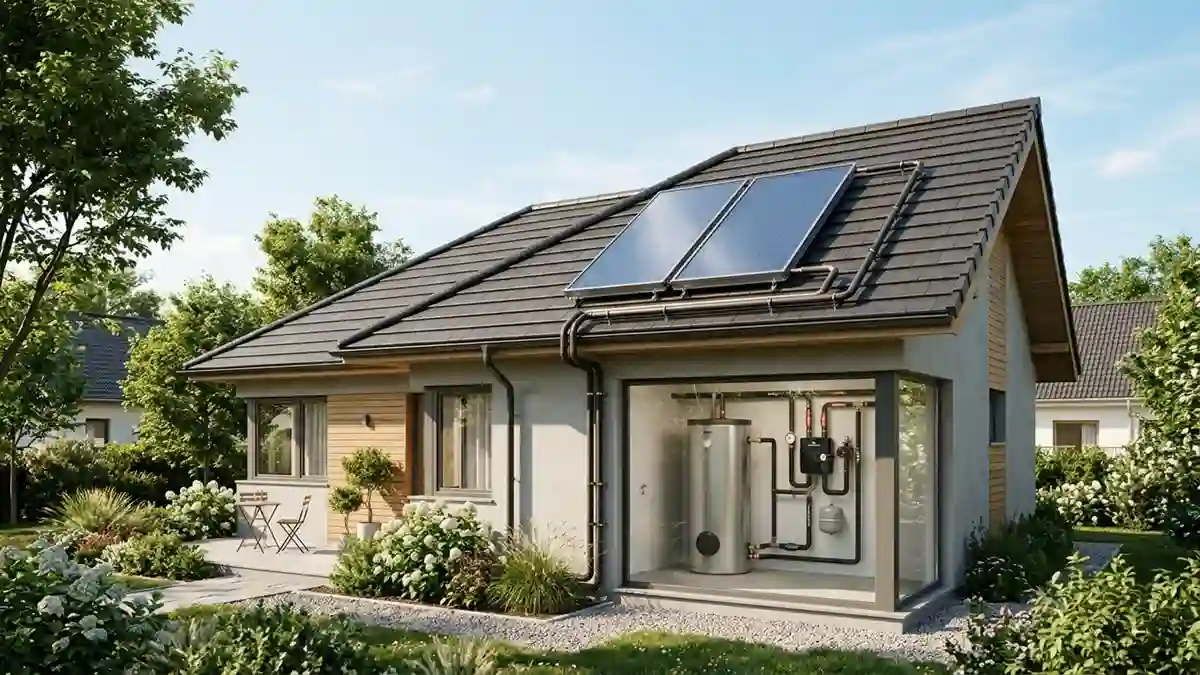
Learn how solar water heaters work, compare system types, estimate energy and dollar savings, understand installation costs, and choose the right solar hot water system.
A solar water heater uses energy from the sun to heat water for showers, washing, kitchens, and other domestic needs. By supplying part of a building’s hot-water demand with solar energy, it can reduce the electricity, natural gas, or propane required by a conventional water heater.
However, not every solar water heating system works the same way. Collector technology, storage capacity, household hot-water consumption, local climate, and the availability of backup heating all affect system performance and payback.
This engineer’s guide explains how a solar water heater works, compares the main system types, estimates energy and financial savings, reviews installation costs, and outlines the factors to consider before choosing a solar hot-water system.
What Is a Solar Water Heater?
A solar water heater, also called a solar hot water system or solar water heating system, captures solar radiation and transfers the resulting heat to water or another heat-transfer fluid.
Unlike a conventional solar photovoltaic (PV) system, which generates electricity, a solar thermal system collects heat directly. The heat is stored in an insulated tank and used when hot water is needed.
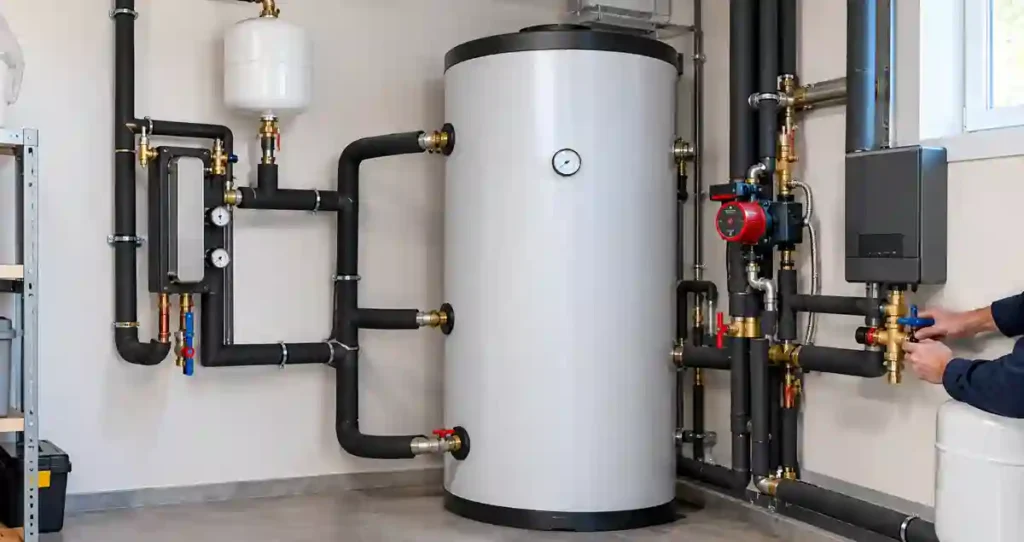
A typical residential system includes:
- Solar collectors: Capture sunlight and convert it into heat.
- Storage tank: Stores heated water for later use.
- Circulation system: Moves water or heat-transfer fluid through the collectors when required.
- Heat exchanger: Transfers heat from one fluid to another in indirect systems.
- Controller and sensors: Operate pumps in active systems.
- Backup heater: Provides additional heat when solar energy is insufficient.
- Pipes, valves, insulation, and safety devices: Connect and protect the system.
The exact components depend on whether the system is active or passive, direct or indirect, and designed for a warm or freezing climate.
How Does a Solar Water Heating System Work?
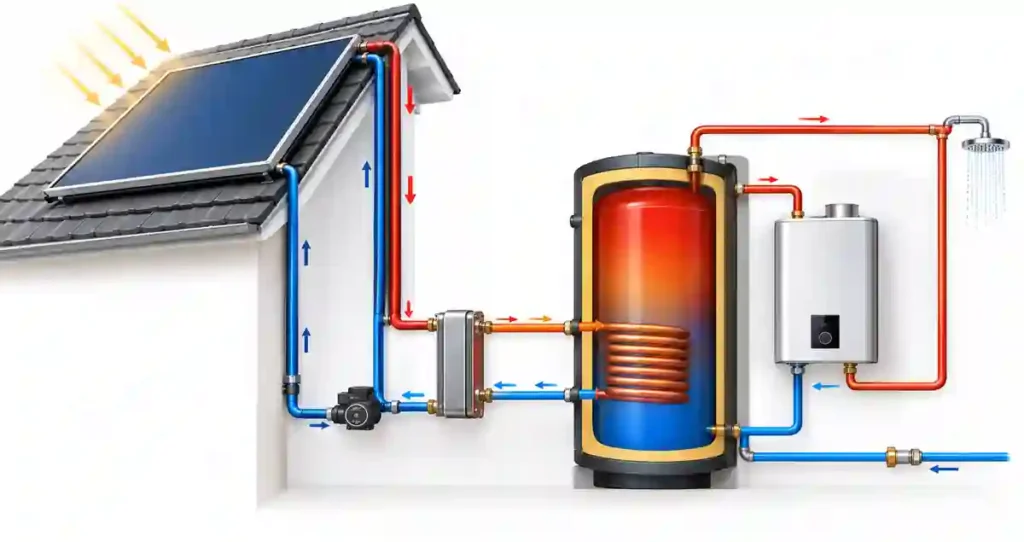
Solar water heating follows a straightforward process: collect heat, transfer it to water, store the heat, and deliver hot water when needed.
- Sunlight reaches the collector. A flat-plate or evacuated-tube collector absorbs solar radiation.
- The collector heats a fluid. Depending on the design, this may be domestic water or a separate heat-transfer fluid.
- Heat moves to the storage tank. A pump or natural circulation transfers the heated fluid. In an indirect system, a heat exchanger transfers heat without mixing the two fluids.
- Hot water is stored. Insulation reduces heat loss while the water waits to be used.
- The building draws hot water. Hot water flows to showers, taps, and appliances as required.
- Backup heating operates when necessary. An electric, gas, or other auxiliary heater raises the water temperature when solar heat is insufficient.
The system can continue supplying hot water after sunset because the storage tank retains heat. Its ability to meet demand overnight depends on tank capacity, insulation, the amount of heat collected during the day, and household consumption.
For a technical overview of collector and system operation, see the ENERGY STAR guide to how solar water heaters work.
Types of Solar Water Heaters
Solar water heaters can be classified by circulation method, heat-transfer arrangement, and collector design. Understanding these differences is essential when selecting a system for a particular building and climate.
1. Active Solar Water Heaters
Active systems use pumps and, typically, electronic controls to circulate water or a heat-transfer fluid.
Advantages
- Controlled circulation can improve heat transfer.
- System operation can respond to collector and tank temperatures.
- Indirect designs can provide freeze protection.
- They offer flexibility for more complex residential installations.
Limitations
- Pumps and controls add cost and complexity.
- Some components require electricity.
- Maintenance is necessary for pumps, sensors, valves, and heat-transfer fluids.
Active systems are useful where controlled circulation or freeze protection is required.
2. Passive Solar Water Heaters
Passive systems rely on natural circulation or the physical arrangement of the collector and tank rather than a circulation pump.
Two common designs are:
Integral collector-storage systems: Water is heated in a collector that also provides storage. These systems are generally more appropriate for mild climates with limited freezing risk.
Thermosyphon systems: Heated water naturally rises while cooler water moves downward. The storage tank is positioned above the collector to support circulation.
Passive systems can be simpler and may have lower equipment costs. However, tank positioning, roof loading, climate, and freeze risk can limit where they are suitable.
3. Direct (Open-Loop) Solar Water Heaters
In a direct system, domestic water circulates through the solar collector and is heated directly by the sun.
This arrangement can be effective in climates where freezing is unlikely. However, the collector and associated plumbing must be protected against freezing where temperatures can fall below 0°C (32°F).
Water quality also matters. Mineral deposits can accumulate in collectors and pipes, particularly where the water has high mineral content.
4. Indirect (Closed-Loop) Solar Water Heaters
An indirect system circulates a separate heat-transfer fluid through the collectors. The fluid transfers its heat to domestic water through a heat exchanger.
The heat-transfer fluid may contain an appropriate antifreeze solution, depending on the system design.
Advantages
- Provides a practical approach to freeze protection.
- Keeps the collector fluid separate from domestic hot water.
- Can be suitable for climates with cold winters.
Limitations
- Heat exchangers add cost.
- Heat-transfer fluid needs inspection and may require replacement.
- Additional components increase maintenance requirements.
An indirect system is often preferable when freezing conditions make direct circulation unsuitable.
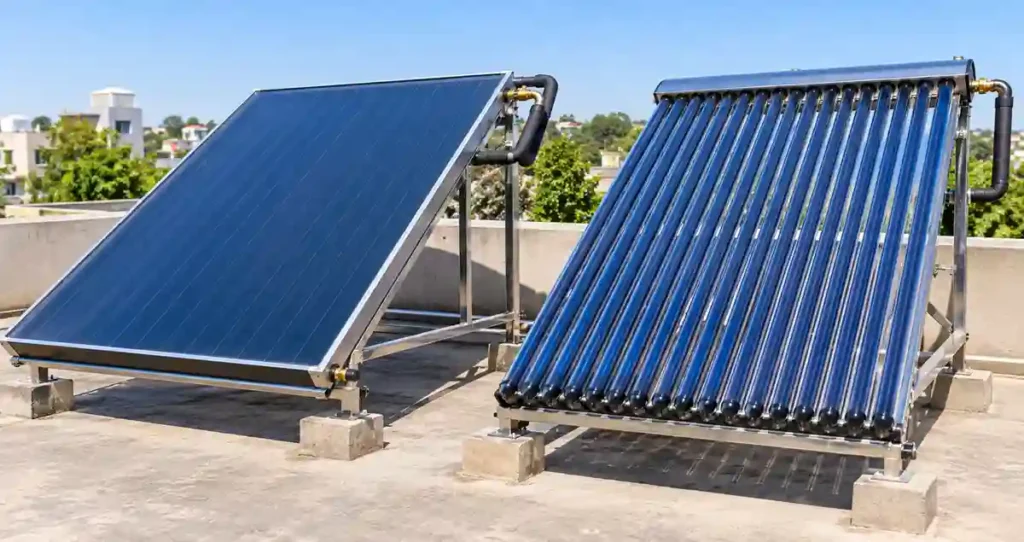
5. Flat-Plate Solar Collectors
<insert image: flat-plate-vs-evacuated-tube-solar-collectors.webp>
Flat-plate collectors generally contain an absorber plate, fluid passages, insulation, and a protective transparent cover.
They are widely used in residential and commercial solar water heating systems.
Their performance depends on solar irradiance, ambient temperature, wind, collector orientation, insulation, and operating temperature. As the temperature difference between the collector and surrounding air increases, heat losses can become more significant.
6. Evacuated-Tube Solar Collectors
Evacuated-tube collectors use absorber components enclosed in glass tubes with a vacuum that reduces heat loss.
They can perform well when the collector operates at elevated temperatures or in cooler conditions. Actual performance depends on the collector design, installation, irradiance, and system operating conditions.
Evacuated-tube collectors may have higher initial costs than some flat-plate alternatives, so their suitability should be evaluated using expected annual heat output rather than collector appearance alone.
7. Unglazed Solar Collectors
Unglazed collectors usually consist of dark polymer or similar absorber material without the insulated glass enclosure used by conventional glazed collectors.
They are commonly used for swimming-pool heating, where the required water temperature is relatively close to ambient temperature.
They are generally less suitable for producing domestic hot water at higher temperatures, especially in cool weather.
For pool-specific applications, see our guide to solar water heaters for pools.
Solar Water Heater vs. Solar PV Water Heating
A solar thermal water heater and a solar PV-powered water heater both use solar energy, but they convert it into useful heat differently.
| Feature | Solar thermal water heater | Solar PV with electric water heating |
|---|---|---|
| Energy conversion | Sunlight directly becomes heat | Sunlight becomes electricity, which powers a heating element or heat pump |
| Main equipment | Thermal collectors, storage tank, plumbing | PV modules, electrical equipment, water heater |
| Electrical generation | Not its primary function | Produces electricity that may serve other loads |
| Water heating method | Transfers collected heat to water | Uses electricity to heat water |
| Potential additional uses | Primarily thermal applications | Electricity can serve other household loads |
| Key design considerations | Collector heat output, storage, heat losses, freeze protection | PV output, electrical load, heater efficiency, controls, and storage |
A conventional resistance water heater converts electricity into heat, but it generally uses more electricity than a heat-pump water heater delivering the same quantity of hot water.
A solar PV system paired with a heat-pump water heater can be an attractive option because the electricity can also serve other household loads. A dedicated solar thermal system may be attractive where the main objective is to supply hot water directly.
Neither option is automatically superior for every home. Compare total installed cost, annual energy performance, available roof area, maintenance, and the value of other possible uses for the energy.
Main Components of a Solar Hot Water System
The components determine how reliably a solar water heater collects, transfers, and stores heat.
Solar collector
The collector captures solar radiation and transfers heat to water or a heat-transfer fluid. Its output depends on collector area, efficiency, solar irradiance, orientation, shading, and operating temperature.
Insulated storage tank
The tank stores heated water until it is required. Its capacity should match household consumption and the expected solar contribution.
A larger tank can store more heat, but an oversized tank may increase standby losses and capital cost. Proper insulation is essential.
Circulation pump
Active systems use a pump to move fluid between the collector and storage tank. Pump selection should account for flow rate, pressure drop, temperature, and control strategy.
Heat exchanger
Indirect systems use a heat exchanger to transfer heat from the collector loop to domestic water. Its capacity and heat-transfer performance affect the system’s ability to deliver useful heat.
Controller and temperature sensors
A differential controller can operate a pump when the collector is sufficiently hotter than the storage tank. This helps prevent unnecessary circulation when the collector cannot add useful heat.
Backup heater
A backup heater supplies additional heat when the stored water does not reach the required temperature. It may be electric, gas-fired, or another compatible type.
Piping, insulation, and safety devices
Pipes must be suitable for the system’s temperature and pressure. Insulation reduces heat loss, while correctly selected pressure-relief, expansion, mixing, and isolation devices help protect the installation.
How to Size a Solar Water Heater
Correct sizing starts with hot-water demand, not simply the number of collectors that fit on the roof.
The main inputs are:
- Number of occupants and daily hot-water consumption
- Incoming cold-water temperature
- Required hot-water delivery temperature
- Local solar resource and seasonal variation
- Collector performance and available installation area
- Storage-tank capacity
- Backup heating capacity
- Climate, freeze risk, and water quality
Step 1: Estimate daily hot-water demand
Estimate the volume of water that must be heated each day. Household usage varies according to shower duration, fixtures, appliances, and occupancy.
Step 2: Calculate the Useful Heat Requirement
To determine how much energy is needed to heat water, use the following formula:
Heat Energy (Q) = Mass of Water (m) × Specific Heat Capacity (cp) × Temperature Rise (ΔT)
Where:
- Q = Heat energy required (kJ)
- m = Mass of water (kg)
- cp = Specific heat capacity of water (4.186 kJ/kg°C)
- ΔT = Temperature rise (°C)
For water, 1 litre is approximately equal to 1 kg.
Worked Example
Suppose you need to heat 200 litres of water from 20°C to 50°C.
1. Calculate the temperature rise:
50°C − 20°C = 30°C
2. Calculate the required heat energy:
Q = 200 × 4.186 × 30
Q = 25,116 kJ
3. Convert kilojoules into kilowatt-hours (kWh):
25,116 ÷ 3,600 = 6.98 kWh
Result: Approximately 6.98 kWh of thermal energy is required to heat 200 litres of water from 20°C to 50°C.
This is the theoretical heat requirement. Actual system energy requirements may be higher because of heat losses from the storage tank, connecting pipes, and other components.
Step 3: Estimate the solar contribution
The collector must supply enough useful heat to meet the intended share of the demand. This depends on the solar resource, collector performance, operating temperatures, and system losses.
Do not size a system using peak sunshine alone. Annual and seasonal performance are more useful for estimating real savings.
Step 4: Select storage and backup capacity
Storage should cover the expected hot-water demand without creating unnecessary heat losses. Backup heating should meet the required service level when solar heat is insufficient.
Step 5: Check installation constraints
Confirm roof orientation, shading, structural capacity, pipe routes, maintenance access, and local plumbing requirements before finalizing the design.
Solar Water Heater Energy Savings: How Much Can You Save?
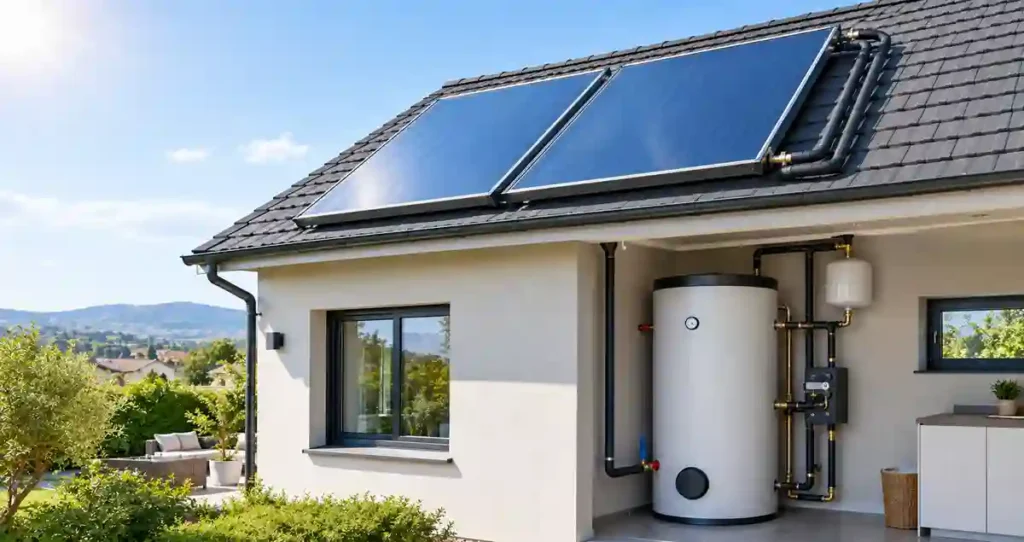
The amount saved depends on how much useful heat the solar system supplies and what energy source it replaces.
For a household using an electric resistance water heater, the electricity savings can be estimated in kilowatt-hours (kWh). If the existing water heater uses natural gas or propane, calculate the amount of fuel saved using its actual consumption, fuel price, and heater efficiency.
Formula: Annual Electricity Savings
Annual Electricity Savings (kWh) = Annual Water-Heating Electricity Consumption (kWh) × Solar Fraction
The solar fraction is the percentage of the total water-heating energy demand supplied by the solar water heating system.
Example:
If a household uses 3,000 kWh of electricity per year for water heating and the solar system supplies 50% of its annual hot-water energy demand:
Annual Electricity Savings = 3,000 × 0.50
Annual Electricity Savings = 1,500 kWh
This represents the estimated electricity avoided through solar water heating, before accounting for any additional system-specific effects or changes in operating conditions.
Worked Example: Annual Savings in kWh and Dollars
Assume a US household has the following water-heating requirements:
- Annual electric water-heating consumption: 3,000 kWh
- Solar fraction: 50%
- Electricity price: $0.1723 per kWh (US average residential electricity price for 2025, reported by the US Energy Information Administration)
1. Calculate annual electricity savings
Annual Electricity Savings = Annual Water-Heating Consumption × Solar Fraction
Annual Electricity Savings = 3,000 × 0.50
Annual Electricity Savings = 1,500 kWh
2. Calculate annual electricity bill savings
Annual Bill Savings = Electricity Savings × Electricity Price
Annual Bill Savings = 1,500 × $0.1723
Annual Bill Savings = $258.45
3. Calculate average monthly savings
Monthly Savings = Annual Bill Savings ÷ 12
Monthly Savings = $258.45 ÷ 12
Average Monthly Savings = $21.54
Estimated Annual Savings
Under these assumptions, the solar water heater saves approximately 1,500 kWh of electricity and $258.45 per year, equivalent to an average of $21.54 per month.
These figures are illustrative calculations, not a guaranteed performance estimate. Actual savings depend on the household’s hot-water consumption, solar fraction, backup-heater operation, electricity tariff, and system heat losses.
Compare different solar fractions
Using the same assumed annual electric water-heating consumption of 3,000 kWh and electricity price of $0.1723/kWh:
| Assumed solar fraction | Electricity saved annually | Estimated annual savings |
|---|---|---|
| 30% | 900 kWh | $155.07 |
| 50% | 1,500 kWh | $258.45 |
| 70% | 2,100 kWh | $361.83 |
These scenarios show how the solar contribution changes the potential savings. They do not predict the performance of a specific collector or installation.
If energy prices remain unchanged, the 50% scenario would produce the following simple cumulative savings:
| Period | Estimated cumulative savings |
|---|---|
| 1 year | $258.45 |
| 5 years | $1,292.25 |
| 10 years | $2,584.50 |
This calculation excludes maintenance, repairs, financing, changes in energy prices, and the initial installation cost. It should not be interpreted as a guaranteed return.
For calculations involving power and energy, use our watts-to-watt-hours calculator.
How to calculate savings for gas or propane water heating
The electricity price above applies only to the electric-water-heating example. It should not be applied to gas or propane savings.
For a gas-fired water heater, estimate the quantity of gas avoided and multiply it by the applicable gas price. For propane, use the quantity of propane avoided and its price per unit.
When comparing systems, account for the efficiency of the existing heater and the backup heater. The value of the saved fuel is the relevant financial benefit—not the price of electricity unless electricity is the energy source being displaced.
Solar Water Heater Efficiency and Performance
Solar water heater performance is influenced by both the solar resource and the way the system is designed and operated.
Solar irradiance
More available sunlight generally provides more opportunity to collect heat. Seasonal variation, cloud cover, and local weather affect annual output.
Collector efficiency
Collectors differ in how effectively they convert incoming solar radiation into useful heat. Performance should be evaluated at the operating temperatures expected for the installation.
Temperature difference
As the collector becomes hotter relative to the surrounding air, heat losses generally increase. This can reduce useful output, particularly in cold or windy conditions.
Orientation and shading
Collectors should be positioned to receive strong sunlight during the useful operating period. Nearby buildings, trees, and rooftop equipment can reduce performance through shading.
Storage and pipe insulation
An insulated tank and properly insulated piping reduce heat loss between collection and use. Poor insulation can reduce the amount of solar heat available when hot water is needed.
Hot-water demand
A household that uses hot water when the tank is warm may use more solar heat directly. Demand timing, tank capacity, and backup controls influence how much collected heat replaces conventional energy.
Seasonal performance
A system may provide a larger share of hot-water demand during sunny months than during winter. Annual savings should therefore be estimated using local conditions rather than a single sunny-day measurement.
Solar Water Heater Installation Cost in 2026
The installed cost of a residential solar water heater depends on collector type, storage capacity, freeze protection, roof access, plumbing modifications, labor, and local permit requirements.
Angi’s 2026 cost guide, updated October 17, 2026, reports that many homeowners pay approximately $1,780–$5,722 for installation, with a broader reported range of $357–$12,000 depending on the project. These are US national estimates, not guaranteed quotations for an individual home.
The final price may be affected by:
- Collector type and total collector area
- Storage tank size and insulation
- Pumps, controllers, and heat exchangers
- Backup heating equipment
- Roof structure, mounting, and access
- Plumbing modifications and pipe insulation
- Permits, inspection, and removal of existing equipment
- Freeze protection and other climate-specific requirements
Before purchasing a system, request an itemized quotation covering equipment, installation labor, plumbing, permits, backup heating, and any required structural work.
Compare the total installed cost with realistic annual energy savings rather than selecting a system based on equipment price alone.
Cost note: These are US installation estimates checked in October 2026. Actual prices vary by location, system design, equipment availability, and site conditions.
Solar Water Heater Payback Period
The payback period estimates how long it takes for the energy-bill savings to recover the initial installation cost of a solar water heating system.
Simple Payback Period Formula
Simple Payback Period (years) = Net Installed Cost ÷ Annual Energy-Bill Savings
Worked Example
Suppose a solar water heating system has an installed cost of $4,000 after confirmed incentives and provides estimated annual energy-bill savings of $500.
Payback Period = $4,000 ÷ $500
Simple Payback Period = 8 years
This means the system would recover its initial cost through energy-bill savings in approximately eight years, assuming the annual savings remain constant.
Payback Based on the Earlier Energy-Savings Example
In the previous example, the estimated annual electricity-bill savings were $258.45, based on a 50% solar fraction.
If the installed system cost is $4,000:
Payback Period = $4,000 ÷ $258.45
Simple Payback Period = Approximately 15.5 years
This calculation shows why the installation cost and expected annual savings must be evaluated together before selecting a solar water heating system.
Important Financial Considerations
Simple payback does not include financing costs, maintenance, component replacement, changes in energy prices, or the time value of money. A more complete financial assessment should consider these factors and compare the solar system with the expected cost of maintaining or replacing the existing conventional water heater.
US Solar Water Heater Tax Credits, Rebates, and Incentives
Federal, state, local, and utility incentives can affect the final cost of a solar water heating system, but eligibility depends on the installation date, location, equipment, and applicable program rules.
For US homeowners, the former federal Residential Clean Energy Credit covered qualifying solar water heating property installed through December 31, 2025. According to current IRS guidance, the credit is not available for property placed in service after December 31, 2025.
Homeowners planning an installation in 2026 should therefore not include the former 30% federal credit in their financial calculations.
Other state, local, or utility programs may be available, but their availability and eligibility requirements vary. Before relying on an incentive, verify its current status, eligible equipment, installation requirements, application deadlines, and documentation rules with the responsible government agency or utility.
Engineering and financial note: Calculate payback using the actual installed price after only those incentives for which the homeowner has confirmed eligibility. Do not assume a rebate or tax credit will be available simply because an older article or product advertisement mentions it.
Solar Water Heater Installation Requirements
A suitable installation involves more than mounting collectors on a roof. The system must be designed around the building, climate, plumbing, and hot-water demand.
Roof orientation and available sunlight
The installation area should receive adequate sunlight and have minimal shading during useful solar hours. The best orientation depends on the site’s location and design objectives.
Structural capacity
Roof-mounted collectors and storage equipment impose loads on the building. A qualified professional should check structural suitability, mounting methods, wind exposure, and any relevant local requirements.
Plumbing layout
Pipe length, pipe diameter, insulation, pressure, and routing affect heat loss and installation cost. Keep pipe runs practical while allowing safe access for maintenance.
Freeze protection
In climates with freezing temperatures, the system must use a suitable freeze-protection strategy. Depending on the design, this may involve an indirect heat-transfer loop, drainback arrangement, or another manufacturer-approved solution.
Water quality
Hard water and mineral deposits can affect collectors, heat exchangers, and pipes. The installer should assess water quality and determine whether flushing, descaling, or other treatment is appropriate.
Backup heating
The system should maintain an acceptable hot-water supply when solar energy is insufficient. Backup equipment must be compatible with the storage arrangement and designed to deliver the required temperature safely.
Codes and permits
Installation should comply with applicable plumbing, electrical, structural, and building requirements. Confirm permit and inspection requirements before work begins.
Advantages of Solar Water Heating
Solar water heating can offer several benefits when the system is properly selected and installed.
- Lower purchased energy use: Solar heat can replace some electricity or fuel otherwise used to heat water.
- Reduced operating costs: Savings depend on the displaced energy source, local tariffs, and system performance.
- Useful energy storage: A well-insulated tank stores hot water for use after the collector stops receiving sunlight.
- Reduced reliance on conventional fuels: The system can reduce exposure to changes in electricity, gas, or propane prices.
- Residential and commercial applications: Solar thermal systems can serve homes, accommodation facilities, and other buildings with suitable hot-water demand.
- Complementary technology: Solar water heating can be considered alongside solar PV, efficient water heaters, and other building energy improvements.
Disadvantages and Limitations
Solar water heating is not the best solution for every building.
- Higher initial cost: Collectors, storage, plumbing, and installation can require a significant upfront investment.
- Weather dependence: Solar heat availability changes with cloud cover and seasons.
- Backup heating may be necessary: The solar system may not meet the entire hot-water demand at all times.
- Roof and space requirements: Collectors need a suitable installation area, and some systems require specific tank positioning.
- Maintenance requirements: Pumps, heat-transfer fluid, valves, controls, and water passages may need periodic inspection or service.
- Freeze and overheating risks: Poorly designed systems may be damaged by freezing or excessive temperatures.
- Variable payback: Financial performance depends on the installed price, energy savings, maintenance, and local utility rates.
A solar water heater should be selected after evaluating both its technical performance and its financial suitability.
Solar Water Heater Maintenance and Troubleshooting
Regular inspection helps maintain performance and identify problems before they cause major damage. Follow the equipment manufacturer’s maintenance schedule and use a qualified professional for work involving pressurized, hot, or electrical components.
Routine maintenance
- Inspect collectors for dirt, shading, physical damage, and mounting problems.
- Check accessible piping and insulation for deterioration or leaks.
- Monitor pump and controller operation in active systems.
- Inspect heat-transfer fluid and replace it when required by the manufacturer.
- Check the storage tank and associated valves for signs of leakage or corrosion.
- Verify backup-heater operation and temperature-control settings.
- Arrange professional servicing at intervals appropriate for the system and local water conditions.
Common problems
Hot water runs out earlier than expected. Possible causes include increased household demand, insufficient storage, reduced collector output, tank heat loss, or a malfunctioning backup heater.
The system provides little solar heat. Check for shading, collector damage, pump or controller faults, air in the circuit, or insufficient sunlight. A qualified technician can assess the cause.
The collector loop appears to be leaking. Shut down the system if required by the manufacturer’s safety instructions and arrange professional inspection. Do not open a hot or pressurized circuit.
Mineral deposits reduce performance. Hard water can cause scale buildup in some systems. Appropriate cleaning and water-treatment procedures depend on the equipment and should follow manufacturer guidance.
The system freezes or shows signs of freeze damage. Stop using affected equipment if there is a risk of leakage or electrical danger. Have the system inspected before restarting it.
Solar Water Heater Applications Beyond Domestic Hot Water
Swimming-pool heating
Solar thermal collectors can heat pool water, often using unglazed collectors. The design should account for pool volume, desired temperature, season of use, wind exposure, and available collector area.
Read our guides to solar water heaters for pools and how a solar water heater connects to a pool.
Off-grid homes
Solar water heating can reduce the amount of electricity or fuel required for hot water in an off-grid home. A thermal system may reduce the electrical load that would otherwise be supplied by batteries and an inverter.
However, the design still needs a reliable backup strategy for periods of low solar availability. For more guidance, explore our Off-Grid Living section.
Commercial buildings
Hotels, guesthouses, gyms, and other facilities may have substantial and predictable hot-water demand. These buildings can be candidates for solar thermal systems, but sizing should reflect actual consumption profiles, storage requirements, available roof area, and backup capacity.
DIY solar water heating
Small experimental systems can help demonstrate solar heat collection, but a domestic installation introduces plumbing pressure, hot-water safety, freeze protection, roof loading, and code-compliance considerations.
For an introductory project, see our guide to a DIY solar water heater. A homemade collector should not be assumed to provide the same reliability, performance, or safety as a professionally designed domestic hot-water system.
Frequently Asked Questions About Solar Water Heaters
What is a solar water heater?
A solar water heater captures heat from sunlight and uses it to warm water for domestic or commercial use. It typically includes solar collectors, an insulated storage tank, connecting pipework, and sometimes pumps, controls, a heat exchanger, and backup heating.
How does a solar water heater work at night?
The collector stops collecting useful solar heat after sunset, but the insulated storage tank can retain heat collected during the day. The available hot water depends on tank insulation, storage capacity, heat loss, and household consumption. Backup heating can provide additional heat when required.
Does a solar water heater work on cloudy days?
Yes, it can still collect some solar energy under cloudy conditions, but its output generally decreases when less solar radiation reaches the collector. The amount of hot water available depends on the weather, system design, stored heat, and backup heater.
Can a solar water heater work in winter?
Yes, if the system is designed for local winter conditions. Collector performance may decline with reduced sunlight and lower ambient temperatures. In freezing climates, the system must include suitable freeze protection.
How much electricity can a solar water heater save?
There is no universal figure. Savings depend on how much electricity the existing water heater uses and what proportion of that demand the solar system supplies. For example, if a conventional electric water heater uses 3,000 kWh per year and solar heating offsets 50%, the estimated electricity savings are 1,500 kWh per year.
How much money can a solar water heater save per year?
Financial savings depend on the amount of energy displaced and the applicable energy price. In the illustrative example using 1,500 kWh of annual electricity savings and a rate of $0.1723/kWh, estimated savings are $258.45 per year. Actual savings may be higher or lower.
Is a solar water heater better than solar PV?
Neither is automatically better. Solar thermal collectors heat water directly, while PV modules generate electricity that can power a conventional or heat-pump water heater and other household loads. Compare total installed cost, annual performance, roof space, maintenance, and the value of electricity for other uses.
How long does a solar water heater last?
Service life depends on equipment quality, installation, water quality, climate, and maintenance. Collectors, tanks, pumps, controls, and valves may have different service lives. Check manufacturer warranties and maintenance requirements rather than assuming every component will last equally long.
Is a solar water heater worth the cost?
It can be worthwhile where hot-water demand is consistent, solar conditions are suitable, and the system replaces relatively expensive conventional energy. The decision should be based on installed cost, realistic annual savings, maintenance, and expected service life.
Can a solar water heater heat a swimming pool?
It can be worthwhile where hot-water demand is consistent, solar conditions are suitable, and the system replaces relatively expensive conventional energy. The decision should be based on installed cost, realistic annual savings, maintenance, and expected service life.
What is the federal solar water heater tax credit in the US for 2026?
Under current IRS guidance, the former Residential Clean Energy Credit is not available for qualifying property placed in service after December 31, 2025. Homeowners considering installations in 2026 should verify any state, local, or utility incentives separately and should not assume the former 30% federal credit applies.
Can a solar water heater heat a swimming pool?
Yes. Solar thermal systems, including unglazed collectors designed for pool heating, can increase pool-water temperature. The correct design depends on pool size, local climate, desired temperature, season, and available collector area.
Final Verdict: Is a Solar Water Heater Right for Your Home?
A solar water heater can reduce conventional energy consumption by using sunlight to supply part of a building’s hot-water demand. The strongest results come from matching collector technology, storage capacity, controls, and backup heating to the building’s actual requirements.
Before making a purchase, estimate daily hot-water demand, calculate the required temperature rise, assess local solar conditions, and obtain a complete installed-cost quotation. Then compare the expected annual energy savings with the total project cost and maintenance requirements.
For homeowners comparing solar thermal with solar PV-powered water heating, evaluate the complete system rather than the collector or equipment price alone. The best option is the one that meets the hot-water requirement safely and reliably while delivering a reasonable long-term financial return.
Engineer’s note: The calculations in this guide are illustrative examples. Actual solar contribution, energy savings, installation costs, and payback depend on site conditions, system specifications, energy prices, and operating practices.
References and Further Reading
- US Energy Information Administration — Annual electricity data
- Internal Revenue Service — Residential Clean Energy Credit
- Angi — Solar Water Heater Installation Costs, 2026
- ENERGY STAR — How Solar Water Heaters Work
- US Department of Energy — Solar Water Heaters
Related guides
- How Is Solar Water Heater Connected to a Pool?
- Solar Livestock Water Heater: Options for Farms
- Solar Water Heater for Horse Troughs: A Livestock Owner’s Guide
- Solar Blanket Reels and Covers: Do They Heat Water?
- Solar Blanket: Types, Uses and How They Work.
- Solar Water Heater for Pool: Types, Sizing and Cost
- Solar Water Heater for Above Ground Pool: Sizing & Setup
- DIY Solar Water Heater: How to Build a Simple System
Related guides on SolarVisionAI.com
- Monocrystalline Solar Panels 2026: Still Worth It or Hype
- Polycrystalline Solar Panels: Worth Buying in 2026?
- Thin-film Solar Panels: When They Beat Silicon (2026)
- BIPV Solar Panels: Building-Integrated PV Complete Guide
- Portable Solar Panels: Engineer’s Buyer’s Guide 2026
- CPV Solar Panels: Concentrated Photovoltaic Explained
- Skin Solar Panel: What “Solar Skin” Actually Means
- Solar Fence Post Lights: Cap Sizes, Types & Install Guide
- Bifacial Solar Panels in 2026: How to Boost Energy Output
- Solar Charge Controller: The Complete Guide
- MC4 Connectors: Solar Safety & Installation Guide
- Solar Panel Types, Efficiency & Benefits
- Solar Water Pump Guide
- Commercial Solar Panel Installation: Engineering Guide
- Solar Fence Post Lights: Cap Sizes, Types & Install Guide
- BESS — Battery Energy Storage System Guide
- Commercial Solar Panel Installation
- Solar Refrigerator & DC Fridge — Complete 2026 Guide
- Bifacial Solar Panel Albedo Effect Guide
- TOPCon: Why TOPCon Solar Panel is a Proven Smart Investment in 2026
- HJT: Why TOPCon Solar Panel is a Proven Smart Investment in 2026
- PERC: PERC Solar Panel: Still Relevant or Already Outdated?
- Perovskite: Perovskite Solar Panels: The 2026 Reality Check
- N-Type vs P-Type: N-Type vs P-Type Solar Panels: Honest Comparison
- ABC: ABC (all back contact) Solar Panel: Back Contact Technology Explained
- IBC: IBC Solar Panels: Interdigitated Back Contact Guide
- Tandem: Tandem Solar Panels: Are Stacked Cells Ready for Rooftops?