
Discover solar EV charging cost, potential electricity savings, installation expenses, and payback. Find out whether charging your electric car with solar is worth it.
Charging an electric vehicle (EV) with solar energy can reduce household electricity expenses, but the financial benefit depends on more than the cost of solar panels. Electricity rates, daily driving distance, solar system size, charging schedules, utility export credits and installation expenses all influence the final savings.
From my experience in solar engineering and system design, I increasingly consider future EV charging requirements when discussing residential solar installations. A homeowner who already has solar panels may be able to use surplus generation for EV charging, while someone planning a new installation needs to consider the additional investment and expected energy demand.
The financial comparison is different in these two situations. Using surplus solar electricity from an existing system may offer attractive savings, but installing an entirely new solar system specifically for EV charging requires a separate payback calculation.
In this guide, I explain how to calculate solar EV charging costs, compare solar and grid electricity, estimate annual savings and evaluate whether the investment makes financial sense.
Quick Answer: Is Solar EV Charging Cheaper?
Solar EV charging can be cheaper than purchasing all charging electricity from the grid, particularly when a homeowner already has a solar system and can use electricity that would otherwise receive a low export credit.
Consider an illustrative example:
- Annual EV driving distance: 12,000 miles
- EV energy consumption: 30 kWh per 100 miles
- Annual electricity requirement: 3,600 kWh
- Grid electricity price: $0.17/kWh
The annual cost of charging entirely from grid electricity would be:
3,600 kWh × $0.17 = $612 per year
If the same 3,600 kWh is supplied by surplus solar electricity, the avoided grid purchase could be worth up to $612 annually at that electricity rate.
However, this is not automatically a $612 saving. If the homeowner could have exported that solar electricity and received compensation, the lost export credit must be included in the calculation.
Solar EV charging is most financially attractive when the value of using solar electricity in the vehicle exceeds the value of exporting it or using another available source of energy.
Solar EV Charging Cost: Savings, Payback and Is It Worth It?
1. What Is the Cost of Solar EV Charging?
The cost of solar EV charging depends on how the solar electricity is produced and how the charging system is installed.
There are three common situations.
Charging with an existing solar system
If a home already has solar panels, the homeowner may be able to charge an EV using surplus electricity.
The additional investment may be limited to:
- A compatible EV charger, if one is required
- Electrical wiring and protection
- Installation labor and permits
- Energy monitoring or smart charging equipment, if needed
- Possible inverter or electrical service upgrades
The solar installation itself is an existing investment. However, solar electricity is not necessarily free to use because it may have an alternative value through utility export compensation.
Adding solar capacity for EV charging
A homeowner with an existing solar system may need additional panels if the current system does not produce enough energy for household consumption and EV driving.
The additional cost depends on:
- Number and rating of additional panels
- Available roof area
- Inverter capacity and compatibility
- Mounting and electrical equipment
- Installation labor
- Permitting and utility requirements
Before expanding a system, compare annual household consumption, existing solar production and the expected EV charging requirement.
Installing a new solar system for home and EV charging
If the homeowner has no solar installation, the project may include a complete PV system, inverter, electrical work, EV charger and possibly battery storage.
This requires a larger initial investment. The financial evaluation should include the value of solar electricity used by the home as well as the energy used by the EV.
It is usually misleading to assign the entire solar system cost to EV charging when the same system also supplies household appliances.
2. How Much Does It Cost to Charge an Electric Car from the Grid?
Before calculating solar savings, establish the cost of charging from the utility.
The basic formula is:
EV Charging Cost = Electricity Used (kWh) × Electricity Rate ($/kWh)
For example, assume an EV consumes 30 kWh per 100 miles and the residential electricity rate is $0.17 per kWh.
| Driving distance | Electricity used | Charging cost at $0.17/kWh |
|---|---|---|
| 100 miles | 30 kWh | $5.10 |
| 500 miles | 150 kWh | $25.50 |
| 1,000 miles | 300 kWh | $51.00 |
| 12,000 miles/year | 3,600 kWh | $612/year |
These figures are illustrative. Actual consumption depends on the vehicle, driving conditions, speed, weather and charging efficiency.
Electricity rates also vary by location and utility. Some customers pay different rates depending on the time of day.
For a more accurate comparison, use the actual electricity rate shown on the homeowner’s utility bill rather than a national average.
3. How Much Can You Save by Charging an EV with Solar Panels?
The savings depend on how much EV charging energy comes from solar generation and what the homeowner would otherwise pay for electricity.
Let’s use the following assumptions:
- Annual EV energy requirement: 3,600 kWh
- Grid electricity rate: $0.17/kWh
- Solar contribution to EV charging: 100%
The annual grid electricity expense avoided would be:
3,600 × $0.17 = $612
If solar supplies only 50% of the EV’s annual electricity requirement, the avoided grid purchase would be:
1,800 × $0.17 = $306
Annual savings at different solar contributions
| Solar contribution to EV charging | Solar energy used | Avoided grid cost |
|---|---|---|
| 25% | 900 kWh | $153 |
| 50% | 1,800 kWh | $306 |
| 75% | 2,700 kWh | $459 |
| 100% | 3,600 kWh | $612 |
These figures represent avoided purchases at the assumed retail rate. They do not subtract the export credit that might have been earned by sending the same solar electricity to the grid.
For an existing solar installation, that distinction is particularly important.
4. Solar EV Charging vs. Grid Charging: Cost Comparison
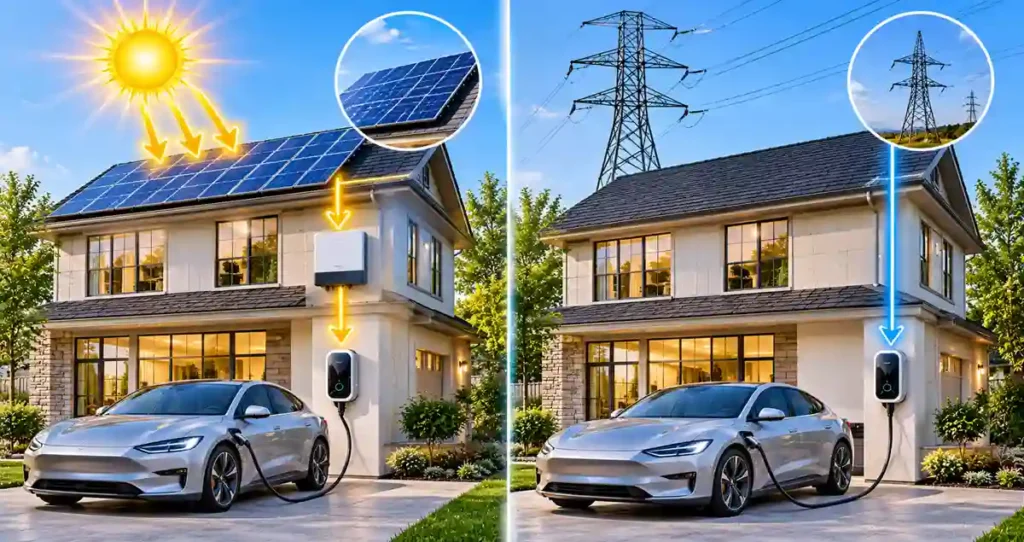
The financial difference between solar and grid charging depends on the value of the solar electricity.
For example, consider a homeowner who receives $0.05/kWh for exported electricity but pays $0.17/kWh to purchase electricity from the grid.
If the homeowner uses one kWh of surplus solar electricity to charge an EV, the approximate financial benefit compared with exporting that electricity is:
$0.17 − $0.05 = $0.12 per kWh
For 3,600 kWh of annual EV charging:
3,600 × $0.12 = $432 per year
This is the incremental benefit of using the solar energy for EV charging instead of exporting it, assuming the export credit and retail rate remain unchanged.
Example: Different solar export credits
Assume the homeowner’s retail electricity rate is $0.17/kWh.
| Export credit | Value of using solar instead of exporting | Annual benefit for 3,600 kWh |
|---|---|---|
| $0.00/kWh | $0.17/kWh | $612 |
| $0.03/kWh | $0.14/kWh | $504 |
| $0.05/kWh | $0.12/kWh | $432 |
| $0.10/kWh | $0.07/kWh | $252 |
| $0.15/kWh | $0.02/kWh | $72 |
This comparison shows why utility compensation rules matter. In a location where exported solar electricity receives a high credit, using every available solar kWh for EV charging may not provide the greatest financial return.
In some situations, charging during off-peak hours and exporting solar generation during the day may be more economical.
5. How Much Does It Cost to Install an EV Charger at Home?
Solar panels do not automatically include an EV charging station. The homeowner may need a separate EVSE (Electric Vehicle Supply Equipment) installation.
The cost depends on charger power, installation distance, electrical panel capacity, wiring requirements and whether upgrades are needed.
Common costs include:
- EV charging equipment
- Circuit breaker and electrical protection
- Conductors, conduit and fittings
- Mounting and installation labor
- Permits and inspection
- Electrical panel or service upgrades, where necessary
The U.S. Department of Energy’s Alternative Fuels Data Center reports that Level 2 charging equipment can vary substantially in price, with published guidance giving a broad equipment cost range of approximately $500–$4,000 before installation and incentives.
Installation costs are separate and depend on the property. A charger installed near an adequately sized electrical panel may require less work than one located in a detached garage or far from the service equipment.
Before purchasing a charger, have an electrician assess the available electrical capacity and installation route.
6. How Much Does It Cost to Add EV Charging to an Existing Solar System?
Adding EV charging to an existing solar installation can be financially attractive because the homeowner does not need to purchase an entirely new PV system.
However, the existing installation must be evaluated first.
Consider these important questions:
- Does the solar system produce enough annual electricity for household consumption and EV driving?
- Is there surplus solar generation during the hours the vehicle is parked at home?
- Can the inverter support the EV charging arrangement?
- Does the main electrical panel have sufficient capacity?
- Is a dedicated Level 2 circuit required?
- Can a smart charger adjust its output based on available solar power?
Example: Existing 10 kW solar system
Assume a home has a 10 kW solar array and an EV that requires 3,600 kWh annually.
The first step is to review actual annual solar generation and household consumption.
For example:
- Annual solar production: 13,000 kWh
- Household electricity consumption: 10,000 kWh
- Additional EV requirement: 3,600 kWh
- Combined annual demand: 13,600 kWh
The solar system produces 600 kWh less than the combined annual energy requirement.
This does not mean that the homeowner must immediately install more panels. The system may still supply a substantial portion of the EV’s energy, with the grid covering the shortfall.
The timing of solar production and electricity consumption must also be considered. Annual energy totals alone do not show whether enough surplus electricity is available when the EV is connected.
7. How Much Does a New Solar System Cost for EV Charging?
If a homeowner wants to install solar specifically to support EV charging, the system should be sized using annual electricity consumption rather than the vehicle battery capacity alone.
The following example uses an EV energy requirement of 3,600 kWh per year.
Assume the proposed solar installation produces 1,400 kWh per kW of installed PV capacity annually. This is an illustrative production assumption, not a universal US value.
Required solar capacity:
3,600 ÷ 1,400 = 2.57 kW
A system of approximately 2.6 kW could theoretically produce the same annual energy as the EV’s assumed consumption.
However, actual system sizing must also account for:
- Solar production at the property
- Seasonal generation differences
- Household energy demand
- System losses
- Roof orientation and shading
- Inverter capacity
- Utility export and net billing arrangements
A homeowner should not automatically install only 2.6 kW of additional solar capacity. The final size depends on the complete household energy profile.
What does a residential solar system cost?
The U.S. Department of Energy’s 2025Q1 residential PV benchmark gives a modeled market price of approximately $2.95/Wdc for an 8 kW PV-only system. This is a national benchmark for a representative system, not a quote for every home or a guaranteed price for a small incremental installation.
At that benchmark:
2,600 W × $2.95/W = $7,670
This calculation is only a simplified illustration of applying a benchmark price per watt to a hypothetical system size. Smaller projects may have a higher cost per watt because fixed permitting, labor, electrical and mobilization costs are spread across fewer panels.
For a site-specific estimate, compare local installer quotations and use the NREL PVWatts Calculator to estimate annual solar production.
8. Does Adding a Home Battery Increase Solar EV Charging Savings?
A home battery can store solar energy for use when the sun is not available. It may be useful when the vehicle is normally parked at home in the evening or overnight.
However, battery storage adds cost and energy losses. It should not be included automatically in every solar EV charging design.
When battery storage can make sense
- The EV is usually parked at home after sunset.
- The homeowner wants to use more solar energy instead of exporting it.
- Export compensation is low.
- Time-of-use electricity prices make stored solar energy valuable.
- The battery also serves household backup requirements.
When a battery may not be economical
- The EV is parked at home during peak solar production.
- The grid provides inexpensive off-peak electricity.
- Export compensation is attractive.
- The battery is being installed only to shift a relatively small amount of EV charging energy.
- The additional battery investment has a long payback period.
Example: Battery energy used for EV charging
Assume a home battery provides 10 kWh of usable energy for EV charging.
At a retail electricity rate of $0.17/kWh, the maximum avoided grid purchase is:
10 × $0.17 = $1.70
But if the 10 kWh could otherwise have been exported for $0.05/kWh, the value of using it for the EV rather than exporting it is:
10 × ($0.17 − $0.05) = $1.20
The battery itself also has an investment cost, conversion losses, operating limits and possible replacement costs. The $1.20 is not the battery’s net daily profit.
A battery should therefore be evaluated across all its uses, including household backup and time-of-use savings, rather than assigning its entire financial value to EV charging.
9. Solar EV Charging vs. Public Charging Costs
Home charging is often less expensive than public DC fast charging, but the actual difference varies by provider, location, subscription and charging speed.
Public charging prices may include:
- Electricity charges
- Charging-network fees
- Session or connection fees
- Idle fees
- Time-based pricing
- Membership discounts
For a simple illustration, assume the same EV consumes 30 kWh per 100 miles.
| Charging source | Illustrative electricity price | Cost per 100 miles |
|---|---|---|
| Home grid electricity | $0.17/kWh | $5.10 |
| Home solar electricity, valued at $0.05/kWh export credit | $0.05/kWh opportunity cost | $1.50 |
| Public charging | $0.35/kWh | $10.50 |
These are comparison assumptions, not published nationwide prices. Public charging prices vary significantly, and the solar row represents the opportunity cost of exported electricity rather than the full installed cost of the solar system.
The table illustrates why home solar charging may reduce running costs, especially for drivers who regularly charge at home.
10. Net Metering, Net Billing and Solar EV Charging Savings
Utility compensation arrangements can substantially affect the economics of solar EV charging.
Net metering
Under a traditional net-metering arrangement, eligible exported electricity may receive a credit that offsets electricity purchased from the grid, according to the utility’s rules.
When retail-rate credits are available, exporting solar electricity may have a similar value to using it at home. The homeowner should compare the specific tariff and billing rules.
Net billing
Under net billing, exported electricity may receive a different compensation rate from the price of electricity purchased from the utility.
For example, if the homeowner pays $0.17/kWh but receives only $0.05/kWh for exports, using surplus solar electricity for EV charging can be more financially attractive.
Time-of-use rates
Some utilities charge different electricity prices depending on the time of day.
A homeowner may be able to charge an EV during off-peak hours at a lower grid rate while exporting solar energy during periods when the export credit is more valuable.
The best strategy depends on the actual utility tariff, not simply the amount of solar electricity generated.
11. How to Calculate the Payback Period for Solar EV Charging
The payback period estimates how long it takes for financial savings to recover the additional investment.
A basic formula is:
Payback Period = Additional Investment ÷ Annual Net Savings
For solar EV charging, use the
additional investment specifically required for the EV charging project. Do not automatically assign the entire cost of an existing household solar system to the vehicle.
Example: Adding an EV charger to an existing solar system
Assume:
- EV charger and installation: $2,000
- Annual EV charging energy: 3,600 kWh
- Grid electricity rate: $0.17/kWh
- Solar export credit: $0.05/kWh
- All annual EV charging supplied by surplus solar
Annual financial benefit compared with exporting the same solar energy:
3,600 × ($0.17 − $0.05) = $432
Simple payback:
$2,000 ÷ $432 = 4.63 years
The illustrative payback period is approximately 4.6 years.
This is a simplified calculation. It excludes maintenance, financing, equipment replacement, changes in electricity tariffs, changes in export credits and any additional electrical upgrades.
If the homeowner must purchase a new solar system, its incremental cost must also be included.
12. Is Solar EV Charging Worth It?
Solar EV charging can be a worthwhile investment, but it is not equally attractive for every homeowner.
Solar EV charging is more attractive when:
- The homeowner already has solar panels.
- The system regularly produces surplus electricity.
- Utility export compensation is relatively low.
- The vehicle is parked at home during daylight hours.
- The homeowner drives enough miles to use a meaningful amount of solar energy.
- A compatible EV charger can be installed without major electrical upgrades.
Solar EV charging may be less attractive when:
- The homeowner needs to install a complete solar system solely for EV charging.
- The vehicle is rarely parked at home during solar production hours.
- The utility provides attractive export credits.
- The household has low annual EV mileage.
- Electrical service or panel upgrades are expensive.
- Battery storage is being added without a clear economic justification.
The best financial decision requires comparing the additional project cost with realistic annual savings, rather than assuming that every kWh of solar electricity is free.
13. Engineer’s Recommendation
When discussing solar installations with homeowners, I recommend considering future EV charging demand as part of the initial electrical and energy assessment.
If the homeowner already has solar panels, first review actual system production, household consumption and surplus energy. Then assess whether the inverter, main electrical panel and wiring arrangement can accommodate an EV charger.
For a new installation, include expected EV energy consumption in the annual load calculation. This helps determine whether additional PV capacity is required and whether a Level 2 charger is suitable.
I would not recommend adding a battery solely because the homeowner plans to purchase an electric vehicle. The complete energy-use pattern, electricity tariff, backup requirements and financial return should justify battery storage.
A well-designed grid-connected solar system with a compatible Level 2 charger and smart energy management can be a practical solution for many residential properties.
NEC, IEEE and Safety Standards for Solar EV Charging
Solar EV charging installations must comply with applicable electrical codes and equipment safety standards. In the United States, the following are particularly relevant:
| Code / Standard | Application |
|---|---|
| NEC Article 625 | EV charging equipment and installation |
| NEC Article 690 | Solar photovoltaic systems |
| NEC Article 705 | Grid-connected solar system interconnection |
| NEC Article 706 | Battery energy storage systems |
| NEC Article 210 | EV charger branch circuits |
| NEC Article 250 | Grounding and bonding |
| IEEE 1547 | Interconnection of solar and storage inverters with the utility grid |
| UL 2594 | AC EV charging equipment safety |
| UL 2202 | DC EV charging equipment safety |
| SAE J1772 / SAE J3400 | EV charging connectors and interfaces |
For international installations, IEC 61851-1 covers general EV charging requirements, while IEC 62196 addresses charging connectors and couplers.
These standards can affect project costs through electrical protection, wiring, panel capacity, equipment certification, permits and inspections.
Note: Always follow the locally adopted NEC edition, applicable standards, manufacturer instructions and authority having jurisdiction (AHJ) requirements.
Frequently Asked Questions
Is it cheaper to charge an electric car with solar panels?
It can be cheaper than purchasing all charging electricity from the grid. The actual saving depends on the solar system’s cost, electricity rates, export compensation and how much solar energy is used by the vehicle.
How much does it cost to charge an EV with solar panels?
The cost depends on the solar electricity’s opportunity cost. If surplus solar electricity could have earned a $0.05/kWh export credit, using 30 kWh for EV charging has an opportunity cost of approximately $1.50.
How much can I save by charging my EV with solar panels?
For an EV using 3,600 kWh annually and a grid electricity price of $0.17/kWh, the avoided grid purchase could be worth $612 per year if all charging energy is supplied by solar. The actual incremental saving must account for any lost export credit.
Do I need a battery to charge my EV with solar panels?
No. A grid-connected solar system can charge an EV without battery storage. A battery is useful when the homeowner wants to store solar electricity for charging after sunset or for other household purposes.
Is it worth installing solar panels just for EV charging?
It depends on annual driving distance, electricity prices, installation cost and solar production. A financial assessment should compare the additional solar investment with the annual value of the electricity produced.
Can I use my existing solar panels to charge an electric car?
Yes, if the existing system and electrical installation are compatible with the EV charger. The available solar generation, inverter output, household load and electrical service capacity must be assessed.
Is solar EV charging cheaper than public fast charging?
It can be significantly cheaper, particularly when the vehicle is charged at home using surplus solar electricity. Public DC fast charging generally has a different pricing structure and may cost more per kWh.
Does a Level 2 EV charger increase solar charging savings?
A Level 2 charger can provide faster charging than Level 1, but faster charging does not automatically increase financial savings. Savings depend on the electricity source, charging schedule and solar energy available.
Does adding a battery improve the payback period?
Not necessarily. A battery adds capital cost and energy losses. It can improve the value of solar electricity in some tariff and usage situations, but its additional investment must be justified by the total household benefits.
How do net metering and net billing affect solar EV charging savings?
They determine the value of solar electricity exported to the grid. If exported electricity receives a lower credit than the retail purchase rate, using surplus solar electricity for EV charging can provide a greater financial benefit.
Related guides
- How Solar EV Charging Works: From Solar Panels to Your EV
- Grid-Connected vs. Off-Grid EV Charging: Key Differences
- Solar Inverter for EV Charging: Capacity, Types and Compatibility
- Direct Solar EV Charging vs. Solar Plus Battery Storage: Which Is Better?
- EV Charger Levels Explained: Level 1 vs. Level 2 vs. Level 3
- Level 1 EV Charger: Speed, Power & Cost
- Level 2 EV Charger: Speed, Installation & Cost
- Level 3 EV Charger: How DC Fast Charging Works
- How Many Solar Panels to Charge an Electric Car? A Practical Guide
- EV Charging Time Using Solar Panels: 7 Essential Charging Factors