
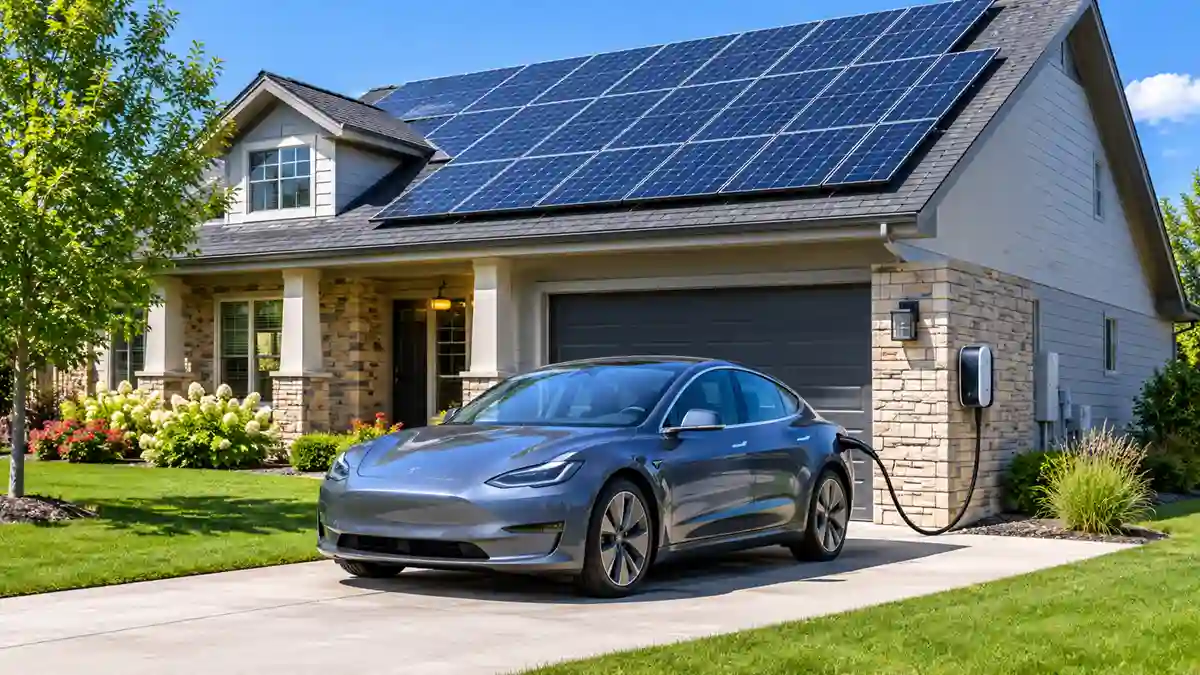
Learn about EV charging time using solar panels. Explore practical calculations based on solar output, EV battery capacity, charger power, and available sunlight.
Charging an electric vehicle (EV) with solar panels can reduce dependence on grid electricity, but the charging time depends on more than the size of the solar system. Actual solar output changes throughout the day, while the EV charger and the vehicle’s onboard charging system also limit how much power can reach the battery.
From my experience in solar engineering and system design, I increasingly consider EV charging requirements when discussing residential solar installations. Even when a homeowner does not currently own an electric vehicle, planning for a future charger can help avoid electrical modifications later. One important part of that planning is understanding how much solar power will be available when the vehicle is parked and connected.
In this guide, I explain how to estimate EV charging time using solar panels, with practical calculations for different solar system capacities. We will also look at direct solar charging, battery-supported charging, grid assistance, and the factors that affect charging speed.
Quick Answer: How Long Does Solar EV Charging Take?
There is no single charging time for every solar installation. It depends on the energy required by the vehicle and the actual solar power available to the charger.
For example, assume an EV needs 30 kWh of additional energy and a solar system can consistently supply 5 kW to the EV charger. The ideal charging time is:
30 kWh ÷ 5 kW = 6 hours
In a real installation, charging may take longer because solar output changes, household loads consume electricity, and conversion losses occur.
A 10 kW solar system does not necessarily provide 10 kW to an EV charger throughout the day. Its actual output may be lower, and some of that power may already be serving the home.
1. What Determines EV Charging Time with Solar Panels?
Several factors determine how quickly an EV can charge from solar energy.
Solar system capacity
Solar system capacity is usually expressed in kilowatts (kW). It represents the rated power of the solar array under standard test conditions, not the amount of power it will produce continuously.
For example, a 10 kW solar array may produce close to its rated output during favorable conditions, but its output will generally be lower during mornings, evenings, cloudy periods and hot operating conditions.
Actual solar generation
The power available from solar panels changes during the day. Solar production typically rises after sunrise, reaches its highest level around solar noon, and decreases toward sunset.
The location, season, panel orientation, tilt, temperature, shading and system condition all affect generation.
EV battery capacity and energy required
The battery capacity of an EV is measured in kilowatt-hours (kWh). However, charging time depends on how much energy must be added, not simply the total battery capacity.
For example, a vehicle with a 75 kWh battery may need only 25 kWh if it is already partially charged.
EV charger power
The EV charger also limits the charging rate. A Level 2 charger rated at 7.2 kW cannot deliver more than its rated output, even if the solar system can produce more power.
The vehicle’s onboard charger may impose another limit. Actual charging power is determined by the available supply, EVSE rating, and vehicle charging capability.
Household electricity consumption
In a grid-connected home, solar generation may be shared among several loads:
- Air conditioning
- Refrigerators and other appliances
- Lighting and electronics
- Water pumps
- Battery charging
- EV charging
If the home consumes 3 kW while the solar system generates 8 kW, approximately 5 kW remains available for the EV before considering other system limitations and losses.
2. Solar System Capacity vs. Actual Power Available for EV Charging
It is important to distinguish between the solar array’s rated capacity and its actual output.
The following examples use an illustrative assumption that the array produces 70% of its rated capacity during a particular sunny period. This is only a planning example, not a guaranteed production factor.
| Solar system capacity | Illustrative solar output at 70% | Home load | Approximate surplus for EV |
|---|---|---|---|
| 5 kW | 3.5 kW | 1.0 kW | 2.5 kW |
| 10 kW | 7.0 kW | 2.0 kW | 5.0 kW |
| 15 kW | 10.5 kW | 3.0 kW | 7.5 kW |
These figures assume that the inverter, wiring and EV charging equipment can support the available power. They also simplify conversion losses and other operating constraints.
The important point is that the power available for EV charging is the solar generation remaining after household consumption, unless the system is deliberately configured to use grid power or battery storage as well.
3. How to Calculate EV Charging Time Using Solar Panels
The basic formula is:
Charging Time (hours) = Energy Required (kWh) ÷ Average Charging Power (kW)
For a solar EV charging system, average charging power should be based on the power actually delivered to the vehicle over the charging period, not the solar array’s nameplate capacity.
Example 1: Charging an EV with 10 kWh of Energy
Assume:
- Energy required by the EV: 10 kWh
- Average power available to the charger: 4 kW
Calculation:
10 kWh ÷ 4 kW = 2.5 hours
The ideal charging time is 2.5 hours. Actual time may be slightly longer because of conversion losses and changes in solar output.
Example 2: Charging an EV with 30 kWh of Energy
Assume:
- Energy required: 30 kWh
- Average power available: 5 kW
Calculation:
30 kWh ÷ 5 kW = 6 hours
This means the EV needs approximately six hours if the charger can receive an average of 5 kW throughout that period.
Example 3: Charging an EV with 50 kWh of Energy
Assume:
- Energy required: 50 kWh
- Average power available: 7 kW
Calculation:
50 kWh ÷ 7 kW = 7.14 hours
The ideal charging time is approximately 7 hours and 9 minutes. In practice, it may take longer if solar output decreases or the vehicle reduces its charging rate.
Quick Charging Time Reference
The following table shows ideal charging times at different average charging powers.
| Energy required | 3 kW average | 5 kW average | 7 kW average |
|---|---|---|---|
| 10 kWh | 3.33 hours | 2 hours | 1.43 hours |
| 20 kWh | 6.67 hours | 4 hours | 2.86 hours |
| 30 kWh | 10 hours | 6 hours | 4.29 hours |
| 40 kWh | 13.33 hours | 8 hours | 5.71 hours |
| 50 kWh | 16.67 hours | 10 hours | 7.14 hours |
These are mathematical estimates assuming constant power. They do not represent guaranteed solar charging durations.
4. EV Charging Time with 5 kW, 10 kW and 15 kW Solar Systems
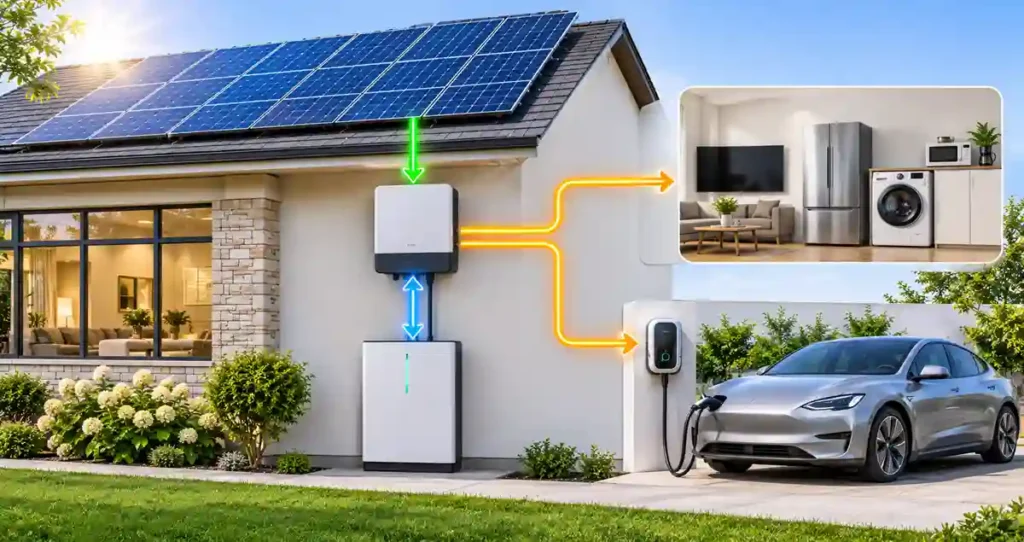
Let’s compare three residential solar installations using a practical example.
Assume that:
- The EV needs 30 kWh of additional energy.
- Solar generation is 70% of the array’s rated capacity during the selected sunny period.
- Household consumption is included in the calculation.
- The EV charger and vehicle can accept the available power.
- The available power remains constant for the simplified calculation.
| Solar system | Illustrative solar output | Home consumption | Power available for EV | Ideal time for 30 kWh |
|---|---|---|---|---|
| 5 kW | 3.5 kW | 1.0 kW | 2.5 kW | 12 hours |
| 10 kW | 7.0 kW | 2.0 kW | 5.0 kW | 6 hours |
| 15 kW | 10.5 kW | 3.0 kW | 7.5 kW | 4 hours |
Important: These examples illustrate the relationship between solar generation, household demand and EV charging time. They do not mean that a 5 kW solar system will always need 12 hours or that a 15 kW system will always charge an EV in four hours. Actual results depend on the solar production profile and the time available for charging.
For a more accurate estimate, use location-specific solar production data and an hourly load profile.
5. How Solar Power Changes Throughout the Day
Solar panels do not produce the same amount of electricity from morning to evening. This variation has a direct impact on EV charging time.
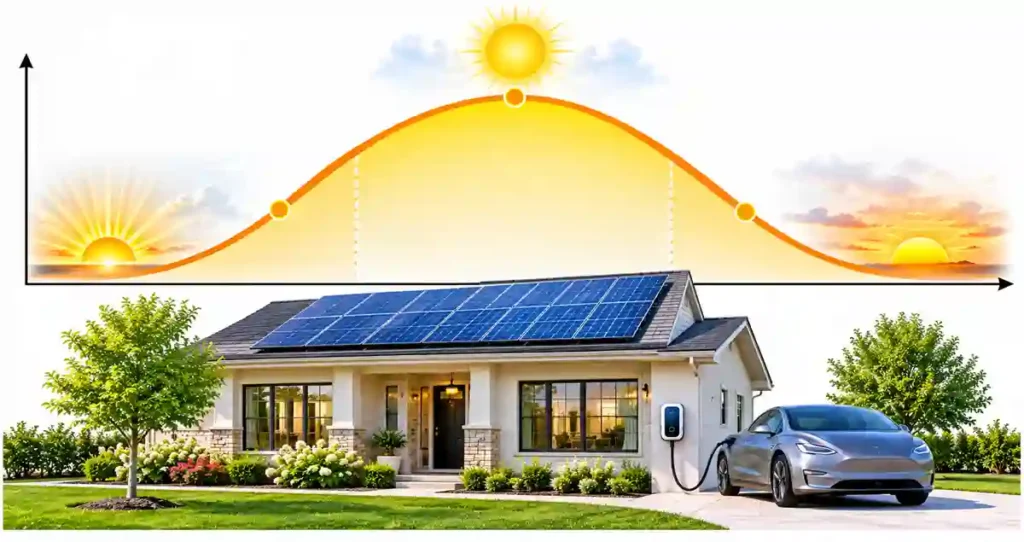
A typical solar production pattern looks like this:
- Morning: Solar output gradually increases after sunrise. The available power may be insufficient for high-power EV charging.
- Midday: Solar production generally reaches its highest level. This is often the best period for charging an EV directly from solar.
- Afternoon: Solar output begins to decline, so charging power may need to be reduced.
- Evening: Solar generation becomes very low or stops after sunset. The system must use stored energy or grid electricity if charging continues.
For example, a 10 kW solar system may generate enough surplus power for a 7 kW EV charger around midday, but it may not support the same charging rate in the early morning or late afternoon.
This is why solar-aware EV charging controls can be useful. They adjust charging power based on available solar generation and household demand.
6. Can You Charge an EV Directly from Solar Panels Without a Battery?
Yes. A grid-connected solar system can charge an EV without a separate home battery.
In this arrangement, solar panels generate electricity, and the solar inverter supplies the home’s electrical system. The EV charger draws available power from that system.
When solar generation is insufficient, the utility grid can supply the difference, provided the system is configured and permitted for grid-connected operation.
For example:
- Solar generation: 6 kW
- Household consumption: 1.5 kW
- Available solar surplus: approximately 4.5 kW
- EV charging demand: 7 kW
In this case, the solar system can contribute approximately 4.5 kW, while the grid supplies the remaining power, subject to system losses and controls.
If the EV charger is configured to use only surplus solar energy, it may reduce its charging rate or pause charging when surplus generation becomes insufficient.
For more detail, read our guide to direct solar EV charging vs. battery storage.
7. How Long Does It Take to Charge an EV with Solar Battery Storage?
A home battery can store excess solar energy during the day and make it available for EV charging later.
This is useful when:
- The vehicle is parked at home in the evening.
- Solar generation is not available during the preferred charging period.
- The homeowner wants to increase solar self-consumption.
- The system is designed to provide backup power as well as EV charging.
Consider an example:
- Home battery usable energy: 10 kWh
- Energy required by the EV: 30 kWh
- Energy supplied by the battery: 10 kWh
- Remaining energy required: 20 kWh
The battery can supply only part of the required energy. The remaining 20 kWh must come from solar generation, the grid or another available source.
A battery’s nominal capacity is not always equal to its usable energy. Depth-of-discharge limits, inverter power ratings, conversion losses and other loads must also be considered.
A home battery is therefore not automatically required for solar EV charging. Its value depends on the homeowner’s charging schedule, electricity tariffs, backup requirements and system economics.
Related reading:
8. How Much Power Does an EV Charger Need?
The charging equipment determines the maximum power that can be delivered to the vehicle, while solar generation determines how much of that demand can be supplied by the solar system.
Typical North American charging arrangements include:
| Charging level | Supply | Typical charging power | Common application |
|---|---|---|---|
| Level 1 AC | 120 V AC | Around 1.2–1.9 kW, depending on equipment | Basic home charging |
| Level 2 AC | 208–240 V AC | Around 3.3–19.2 kW | Residential, workplace and public charging |
| DC fast charging | Typically three-phase AC input to the station; DC output to vehicle | Commonly 50–350 kW, with higher-power equipment available | Public charging and commercial sites |
These are broad equipment ranges, not a recommendation that a residential solar system should supply every listed charging level.
For most residential solar applications, Level 1 or Level 2 charging is more practical. DC fast charging requires substantially more electrical infrastructure and is generally associated with commercial or public charging locations.
The vehicle’s onboard charger limits AC charging power. For DC fast charging, the vehicle’s battery and charging system determine how much power it can accept.
Read our detailed guides:
9. What Happens When Solar Power Is Not Enough for EV Charging?
Solar generation may not always match the EV charger’s power requirement. There are three common ways to handle this situation.
Option 1: Use grid assistance
In a grid-connected installation, the utility supplies the shortfall when solar generation is insufficient.
This allows the EV to charge at a higher, more consistent rate without depending entirely on sunlight.
Option 2: Reduce the EV charging rate
A compatible smart EV charger can adjust its charging power according to the available solar surplus.
For example, if the solar system has only 3 kW available for EV charging, the charger may reduce its output rather than drawing the full 7 kW from the grid.
The minimum operating current and adjustment range depend on the charger, vehicle and applicable charging standard. Some systems may pause charging when available surplus falls below their operating threshold.
Option 3: Use battery storage
A home battery can supplement solar generation when sunlight is insufficient. However, the battery inverter must be capable of supplying the required power, and the battery must have enough usable energy.
For a detailed comparison, see Grid-Connected vs. Off-Grid EV Charging.
10. Factors That Affect Solar EV Charging Time
Even if two homes have the same solar system capacity, their EV charging times may differ.
Weather and cloud cover
Clouds reduce the sunlight reaching solar panels and can cause rapid changes in power output. The EV charger may need to adjust its charging rate accordingly.
Panel orientation and tilt
Panel direction and tilt affect how much sunlight the array receives throughout the day. A system designed to maximize midday generation may produce less power during early morning and late afternoon hours.
Temperature
Solar panels generally operate less efficiently at higher cell temperatures. A hot, sunny day does not necessarily produce the same output as a cooler day with similar sunlight.
Shading and dirt
Shading from trees, buildings or nearby structures can reduce output. Dust and dirt can also affect generation, particularly where panels are not cleaned regularly.
Inverter capacity and efficiency
The inverter converts DC electricity from solar panels into AC electricity for the home and compatible AC EV charging equipment. Its output rating and operating efficiency influence the power available to the charger.
Household load management
Air conditioning, cooking appliances, water heaters and other large loads can reduce the solar surplus available for EV charging.
EV battery temperature and charging limits
The vehicle may reduce charging power when its battery is too cold or too hot. Battery management systems also control charging as the battery approaches a high state of charge.
Charging time is therefore affected by both the solar installation and the vehicle itself.
11. How Smart EV Charging Improves Solar Energy Use
Smart EV charging helps coordinate solar generation, household demand and vehicle charging.
A compatible system can monitor power flow and adjust the EV charger’s output according to the available energy.
For example, if a home solar system produces 8 kW and household loads consume 2 kW, approximately 6 kW may be available for EV charging. If household consumption increases to 4 kW, the charger can reduce its demand to use the remaining surplus.
Depending on the equipment, smart charging can:
- Prioritize available solar energy.
- Reduce grid electricity consumption.
- Adjust charging power as solar output changes.
- Schedule charging during high-production periods.
- Coordinate EV charging with home battery storage.
- Avoid exceeding the home’s electrical service or configured load limits.
Not every EV charger supports solar-surplus charging. The inverter, energy meter, charger and control system must be compatible.
Read our guide to Solar Inverter for EV Charging.
12. Solar EV Charging System Design: What Should Be Checked?
When designing a solar installation that will also support EV charging, the system should be evaluated as a complete electrical arrangement rather than sizing the solar panels alone.
Important design considerations include:
- Daily EV energy requirement: Estimate driving distance and the vehicle’s energy consumption to determine how much electricity it needs.
- Solar generation profile: Estimate hourly and seasonal production using the installation location, array orientation and system specifications.
- Inverter capacity: Check whether the inverter can supply household loads and the EV charger simultaneously.
- Electrical service capacity: Assess the main panel, service rating, available breaker space and total electrical demand.
- EV charger rating: Select a charger compatible with the vehicle and the home’s electrical supply.
- Battery storage: Decide whether storage is necessary based on charging hours, backup requirements and electricity tariffs.
- Energy management: Consider smart charging and dynamic load management where appropriate.
- Protection and wiring: Size conductors and overcurrent protection according to the applicable electrical code, equipment instructions and installation conditions.
For example, a home with a 10 kW solar array and a 7.2 kW Level 2 charger may still require grid assistance if household loads are high or solar production is low. The inverter’s rated output, electrical service and load-management arrangement must all be checked.
For further system planning, see our Solar Array Guide, Solar Inverter Guide and Residential Solar Panel Installation Guide.
13. NEC Codes and Safety Standards for Solar EV Charging
Solar EV charging combines photovoltaic generation, building electrical distribution and EV charging equipment. The installation must comply with the electrical codes adopted by the local authority having jurisdiction (AHJ).
For US installations, the following NEC provisions may be relevant, depending on the system configuration and adopted edition:
- NEC Article 625: Electric Vehicle Power Transfer System — the primary article for EV charging equipment and installations.
- NEC Article 690: Solar Photovoltaic Systems — covers PV system requirements.
- NEC Article 705: Interconnected Electric Power Production Sources — relevant to qualifying interconnected solar systems.
- NEC Article 706: Energy Storage Systems — applies when battery storage is included.
- NEC Article 210: Branch Circuits — relevant to the EV charging circuit.
- NEC Article 220: Branch-Circuit, Feeder and Service Load Calculations — used when evaluating electrical demand.
- NEC Article 250: Grounding and Bonding.
- NEC Article 310: Conductors for General Wiring.
For continuous EV charging loads, circuit sizing generally follows the applicable continuous-load requirements. For example, a 32 A charging load commonly requires a 40 A branch circuit, subject to the applicable code, equipment listing and installation conditions.
The PV inverter, battery inverter and EV charger must also be installed according to their manufacturer instructions and applicable product certifications.
Relevant product and industry standards include:
- UL 2594 for AC EV supply equipment.
- UL 2202 for DC charging equipment.
- UL 2231 for personnel protection systems for EV supply circuits.
- SAE J1772 and SAE J3400 for relevant North American charging interfaces.
Important: NEC requirements depend on the edition adopted by the state or local jurisdiction. Always verify the applicable code, equipment listing, utility requirements and AHJ instructions before installation.
14. Is Solar EV Charging Practical for Everyday Driving?
Yes. For many homeowners, solar EV charging can cover a meaningful portion of daily driving energy requirements, especially when the vehicle is parked at home during daylight hours.
However, the practical benefit depends on the match between three things:
- When the vehicle is parked and available for charging.
- When the solar system produces electricity.
- How much energy the vehicle needs each day.
A homeowner who works away from home during daylight hours may have limited opportunity for direct solar charging. A home battery, grid-connected charging or scheduled charging may help bridge this gap.
By contrast, a homeowner who works from home or has daytime vehicle parking may be able to use more of the solar generation directly.
The best arrangement is not necessarily the one with the largest solar array. It is the one that matches the home’s energy demand, EV usage, electrical infrastructure and charging schedule.
Engineer’s Recommendation: When planning a residential solar system, I recommend considering future EV charging even if the homeowner does not currently own an electric vehicle.
The first step is to estimate the vehicle’s daily energy requirement. Then assess the solar generation profile, inverter capacity, household load, electrical panel and possible charger rating.
A larger solar array alone does not guarantee faster EV charging. The available power at the time of charging is what matters.
For most grid-connected homes, a compatible Level 2 charger combined with solar generation and smart energy management can provide a practical arrangement. Battery storage can be added when evening charging, backup power or greater solar self-consumption justifies the additional investment.
Frequently Asked Questions
How long does it take to charge an electric car using solar panels?
It depends on the energy required by the EV and the average power available from the solar system. For example, supplying 30 kWh at an average of 5 kW takes approximately six hours under ideal constant-power conditions.
Can solar panels charge an EV in one day?
Yes. A suitably sized solar system can provide enough energy for many daily driving requirements in one day. However, the result depends on sunlight, solar capacity, household consumption, vehicle efficiency and the time available for charging.
Can I charge my EV directly from solar panels without a battery?
Yes. A grid-connected solar system can charge an EV without home battery storage. The grid can supply additional electricity when solar generation is insufficient, or a compatible smart charger can limit charging to available solar surplus.
Does a 10 kW solar system charge an EV faster than a 5 kW system?
It can, provided that the larger system produces more usable surplus power and the charger and vehicle can accept it. Household consumption, inverter capacity and solar conditions also affect the result.
Can I use a Level 2 EV charger with solar panels?
Yes. A Level 2 charger can operate with a compatible solar installation. The system must have sufficient electrical capacity, suitable protection and appropriate load management. Solar generation can supply part or all of the charging energy depending on available output.
Do I need a battery for solar EV charging at night?
If you want to use stored solar electricity at night, you need battery storage or another energy source. In a grid-connected system, the utility can supply electricity when solar generation is unavailable.
Does cloudy weather increase EV charging time?
It can. Cloud cover reduces solar generation, which may lower the power available to the EV charger. A grid-connected system can compensate for the shortfall if configured to do so.
What is the best time of day to charge an EV using solar panels?
Midday is often the best period because solar generation is usually higher. However, the actual optimum period depends on the solar array’s orientation, location, season and household electricity demand.
Can a solar inverter supply an EV charger directly?
A compatible grid-connected or hybrid inverter can supply an EV charger through the home’s electrical distribution system. The inverter must have sufficient output capacity, and the electrical installation must be designed for the combined loads.
Is solar EV charging cheaper than grid charging?
Solar EV charging can reduce the amount of electricity purchased from the utility. Actual savings depend on the cost of the solar installation, electricity tariffs, export compensation, charging schedule and system performance.
Conclusion
EV charging time using solar panels depends on the amount of energy the vehicle needs and the solar power available during the charging period. Solar system capacity is only one part of the calculation.
For a reliable design, consider the solar production profile, household demand, inverter capacity, EV charger rating, vehicle charging limits, and whether battery storage or grid assistance is required.
With suitable system design and smart charging, homeowners can make better use of solar generation while reducing their dependence on grid electricity for everyday EV charging.
Related guides
- How Solar EV Charging Works: From Solar Panels to Your EV
- Grid-Connected vs. Off-Grid EV Charging: Key Differences
- Solar Inverter for EV Charging: Capacity, Types and Compatibility
- Direct Solar EV Charging vs. Solar Plus Battery Storage: Which Is Better?
- EV Charger Levels Explained: Level 1 vs. Level 2 vs. Level 3
- Level 1 EV Charger: Speed, Power & Cost
- Level 2 EV Charger: Speed, Installation & Cost
- Level 3 EV Charger: How DC Fast Charging Works
- How Many Solar Panels to Charge an Electric Car? A Practical Guide