
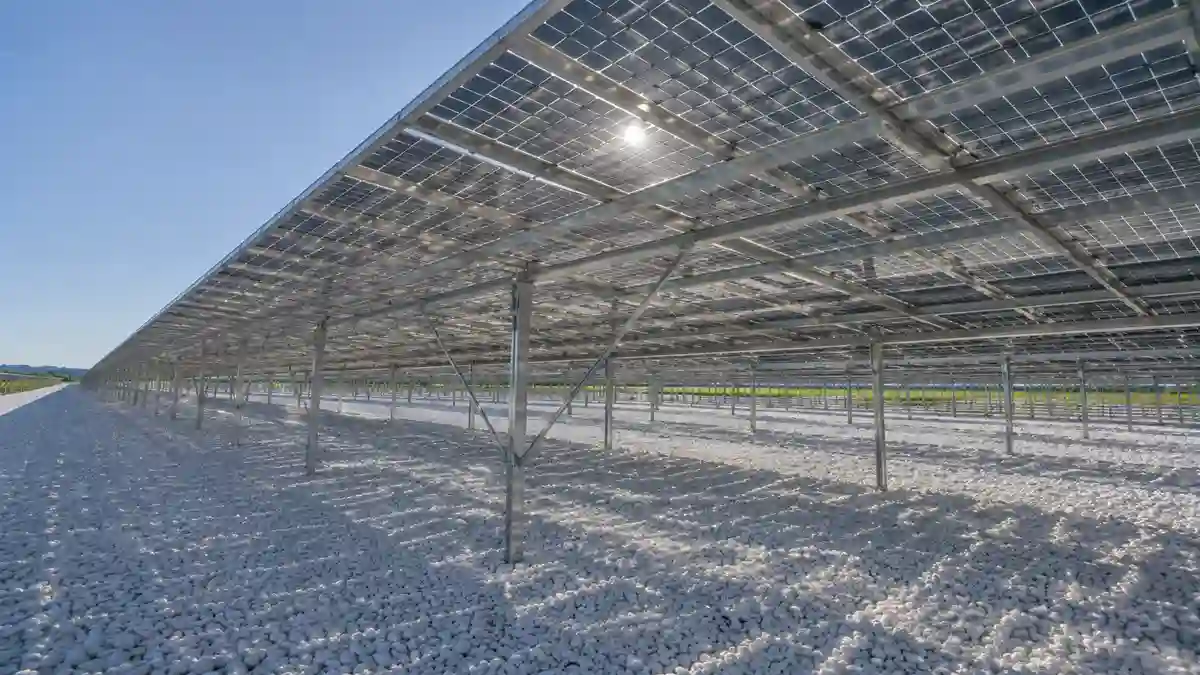
Bifacial solar panel albedo effect explained by a registered engineer. Learn how ground reflectivity affects energy output and system performance.
Albedo is the single number that determines whether a bifacial solar panel purchase was money well spent or a premium paid for very little real benefit, and it’s also the number most sales conversations skip entirely. Understanding it properly turns a vague marketing promise (“bifacial panels generate more power”) into an actual, site-specific calculation you can hold an installer accountable to.
This guide is part of our Types of Solar Panels hub, and is a technical companion to our Monofacial vs Bifacial comparison — read that one for the buying decision, this one for the physics behind why the decision varies so much by site.
What Albedo Actually Measures
Albedo is a measure of how much light a surface reflects, expressed as a value between 0 (perfectly absorptive, reflects nothing) and 1 (perfectly reflective, reflects everything). Fresh snow sits around 0.8-0.9. White reflective membrane roofing can reach 0.6-0.7. Light-colored gravel or concrete typically falls in the 0.2-0.4 range. Grass sits around 0.2-0.25. Dark asphalt or dark shingle roofing is often as low as 0.05-0.1 — meaning it absorbs the overwhelming majority of light that hits it, leaving almost nothing for a bifacial panel’s rear cells to capture.
Engineer’s Note: The relationship between albedo and bifacial gain isn’t linear in a way most people expect — doubling the albedo doesn’t simply double the rear-side gain, because mounting height, panel spacing, and the angle of incident light all interact with ground reflectivity in the actual calculation. Manufacturer bifacial gain claims almost always assume a baseline albedo in the 0.2-0.3 range; if your actual site is meaningfully darker than that, expect a real-world gain below the advertised figure.
Bifacial solar panel albedo effect Values by Surface
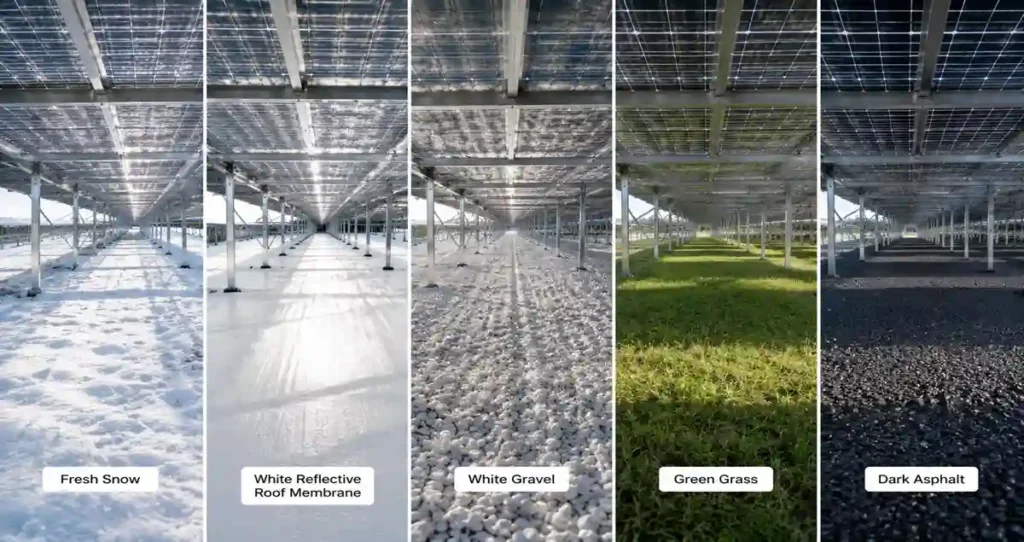
| Surface Type | Typical Albedo | Practical Impact on Bifacial Gain | Industry Reference |
| Fresh snow | 0.80 – 0.90 | Highest realistic gain — strong case for bifacial | NREL |
| White reflective roofing membrane | 0.60 – 0.70 | Strong gain, common on commercial flat roofs | Fraunhofer ISE |
| Light gravel or white stone | 0.20 – 0.40 | Moderate, solid gain — common ground-mount choice | NREL |
| Grass/vegetation | 0.20 – 0.25 | Modest gain, still meaningfully better than dark surfaces | NREL |
| Concrete (aged/weathered) | 0.15 – 0.35 | Variable — depends heavily on condition and cleanliness | Fraunhofer ISE |
| Dark asphalt / dark shingle roofing | 0.05 – 0.10 | Minimal gain — bifacial premium hard to justify here | NREL |
Advantages and Disadvantages of Optimizing for Albedo
| Advantages | Disadvantages |
| Deliberately choosing a light ground cover can meaningfully boost bifacial output | Adding reflective ground cover (white gravel, membrane) is an extra project cost |
| Albedo calculations let you model real gain before committing to bifacial | Albedo-optimized surfaces may require ongoing maintenance to stay reflective |
| Snow-prone regions get a genuine seasonal bifacial performance boost for free | Albedo degrades over time from dirt, dust, and weathering unless maintained |
| Ground-mount projects can be designed around albedo from the start | Rooftop installations rarely have practical control over albedo at all |
Real-World Applications of bifacial solar panel albedo effect
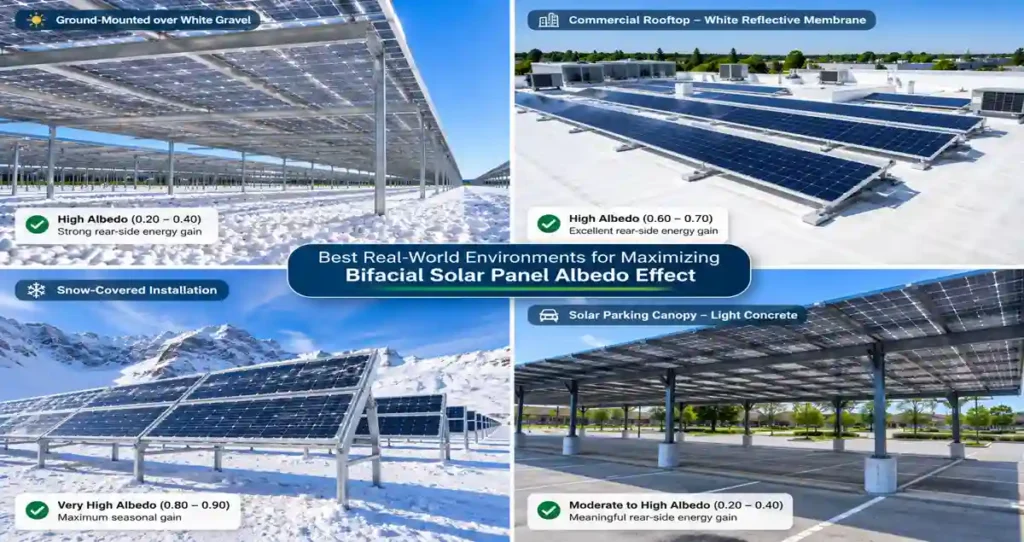
On ground-mount projects where the budget allows, I’ve recommended deliberately specifying a light-colored gravel or crushed stone ground cover underneath and around a bifacial array to raise the albedo from bare soil’s fairly low reflectivity into a range that noticeably improves rear-side gain. The incremental cost of the right ground cover is usually modest compared to the bifacial panel premium itself, and skipping that detail means leaving part of the bifacial investment’s return on the table.
I’ve also had genuinely productive conversations with clients in snow-prone regions about seasonal bifacial performance — a system that looks like a modest bifacial gain on an annual average basis can show a dramatically higher gain during winter months specifically, when snow cover pushes albedo toward its highest realistic values. For clients weighing bifacial primarily against winter output reliability, that seasonal pattern is worth modeling explicitly rather than looking at an annual average number alone.
Field Note: I once reviewed a bifacial ground-mount design where the racking was specified at a mounting height too low to give reflected light a meaningful angle of incidence onto the rear cells, even though the ground cover itself was excellent white gravel. Albedo is necessary but not sufficient — mounting geometry has to cooperate with it, or a great ground surface still delivers a disappointing real-world gain.
Where This Matters Most
- Ground-mount systems where you control the surface beneath the array
- Snow-prone regions where seasonal albedo swings are significant and predictable
- Utility-scale projects where even a small percentage gain compounds into meaningful total energy across thousands of panels
- Any site evaluation where a bifacial quote is being compared against a monofacial alternative
How Albedo Interacts With Seasonal and Regional Conditions
Albedo isn’t a fixed, permanent property of a site — it changes with seasons, weather, and even time of day in some cases. A gravel ground cover that provides solid reflectivity in dry conditions can perform differently after rain darkens the surface, and vegetation-covered ground shifts reflectivity across growing seasons as plant cover changes. I always encourage clients modeling bifacial gain to think in terms of a realistic annual average rather than a single best-case snapshot, since real installations experience the full range of conditions across a year, not just the ideal ones.
Regional climate patterns matter too, independent of the specific ground surface chosen. A site with regular rainfall and cloud cover will have fewer days where any albedo advantage even gets a chance to matter, since diffuse light under overcast conditions behaves differently than direct sunlight when it comes to ground reflection and rear-cell capture. This is a genuinely underappreciated variable in most bifacial gain conversations, and it’s worth discussing explicitly with an installer who understands the distinction rather than accepting a single generic gain percentage.
Common Misconceptions Worth Clearing Up
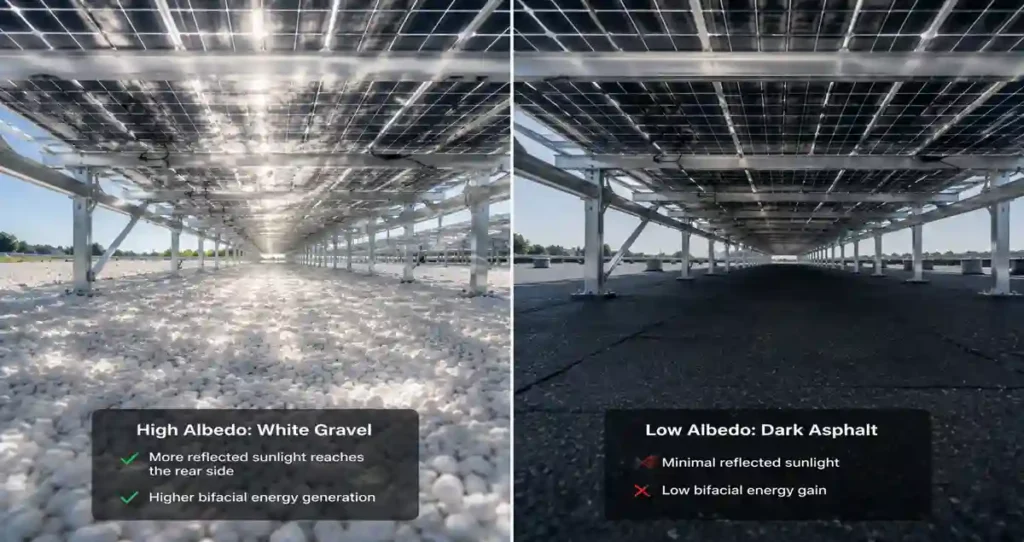
People sometimes assume any bifacial panel automatically captures meaningful rear-side energy regardless of what’s underneath it. The panel’s rear-side capability is necessary but not sufficient — without adequate albedo and mounting clearance, a bifacial panel behaves almost identically to a monofacial one in practice, while still carrying the bifacial price premium.
For the buying decision this feeds into, see our Monofacial vs Bifacial comparison. For ground-mount installation specifics where albedo optimization matters most, see Bifacial Solar Panels Ground Mount.
If there’s one habit I’d want every reader to take from this guide, it’s asking for the actual albedo assumption behind any bifacial gain figure quoted to you. That single number does more to separate a realistic quote from an inflated one than almost anything else in the conversation, and most installers who’ve done the modeling properly will have that number ready to share without hesitation.
Engineering Assessment
| Feature | Rating |
|---|---|
| Engineering Accuracy | ★★★★★ |
| Practical Value | ★★★★★ |
| Commercial Relevance | ★★★★★ |
| Installation Importance | ★★★★★ |
| Real World Applicability | ★★★★★ |
| Overall Recommendation | ★★★★★ |
Frequently Asked Questions
What is a good albedo value for bifacial solar panels?
Manufacturer gain claims typically assume an albedo around 0.2-0.3. Values above that (light gravel, white membrane, snow) improve realistic gain; values well below it (dark asphalt, dark shingles) usually mean minimal real-world benefit from the bifacial premium.
Can I improve albedo on an existing installation?
On ground-mount systems, yes — adding light-colored gravel, crushed stone, or reflective ground cover beneath and around the array can meaningfully improve albedo after the fact. On rooftop installations, there’s rarely a practical way to change the roof surface’s reflectivity.
Does snow actually help bifacial panel performance?
Yes, genuinely. Fresh snow has one of the highest realistic albedo values of any common ground surface, and bifacial systems in snow-prone regions often see a real, measurable seasonal performance boost during winter months as a result.
Can bifacial solar panels be used with lithium batteries?
Yes. Albedo affects how much energy a bifacial panel produces, but it has no impact on battery compatibility. Bifacial solar panels work with lithium batteries just like monofacial systems when paired with a compatible charge controller or hybrid inverter.
Are bifacial solar panels compatible with net metering?
Yes. Electricity generated from bifacial solar panels can be exported through approved grid-connected systems under local net metering regulations, just like conventional solar panels.
Does rain affect the albedo effect?
Rain can temporarily darken some ground surfaces, reducing reflectivity and slightly lowering rear-side energy generation. However, rain also helps clean solar panels, which can improve overall system performance.
Which ground surface provides the highest albedo?
Fresh snow provides the highest natural albedo, followed by white reflective roofing membranes, bright white gravel, and light-colored concrete. Dark asphalt and black roofing materials provide the lowest reflected light.
Can I improve albedo after installation?
Yes. Ground-mounted systems can often improve rear-side energy generation by replacing dark soil with white gravel, crushed stone, or other highly reflective ground coverings.
References
Albedo values by surface type and their relationship to bifacial gain are drawn from NREL’s bifacial performance research and Fraunhofer ISE’s Photovoltaics Report.
Related guides on SolarVisionAI.com
- Monocrystalline Solar Panels 2026: Still Worth It or Hype
- Polycrystalline Solar Panels: Worth Buying in 2026?
- Thin-film Solar Panels: When They Beat Silicon (2026)
- BIPV Solar Panels: Building-Integrated PV Complete Guide
- Portable Solar Panels: Engineer’s Buyer’s Guide 2026
- CPV Solar Panels: Concentrated Photovoltaic Explained
- Skin Solar Panel: What “Solar Skin” Actually Means
- Solar Fence Post Lights: Cap Sizes, Types & Install Guide
- Bifacial Solar Panels in 2026: How to Boost Energy Output
- Solar Charge Controller: The Complete Guide
- MC4 Connectors: Solar Safety & Installation Guide
- Solar Panel Types, Efficiency & Benefits
- Solar Water Pump Guide
- Commercial Solar Panel Installation: Engineering Guide
- Solar Fence Post Lights: Cap Sizes, Types & Install Guide
- BESS — Battery Energy Storage System Guide
- Commercial Solar Panel Installation
- Solar Refrigerator & DC Fridge — Complete 2026 Guide
- Monofacial Solar Panels: Are They Still Worth Buying in 2026?
- Bifacial Solar Panels Ground Mount
- TOPCon: Why TOPCon Solar Panel is a Proven Smart Investment in 2026
- HJT: Why TOPCon Solar Panel is a Proven Smart Investment in 2026
- PERC: PERC Solar Panel: Still Relevant or Already Outdated?
- Perovskite: Perovskite Solar Panels: The 2026 Reality Check
- N-Type vs P-Type: N-Type vs P-Type Solar Panels: Honest Comparison
- ABC: ABC (all back contact) Solar Panel: Back Contact Technology Explained
- IBC: IBC Solar Panels: Interdigitated Back Contact Guide
- Tandem: Tandem Solar Panels: Are Stacked Cells Ready for Rooftops?