
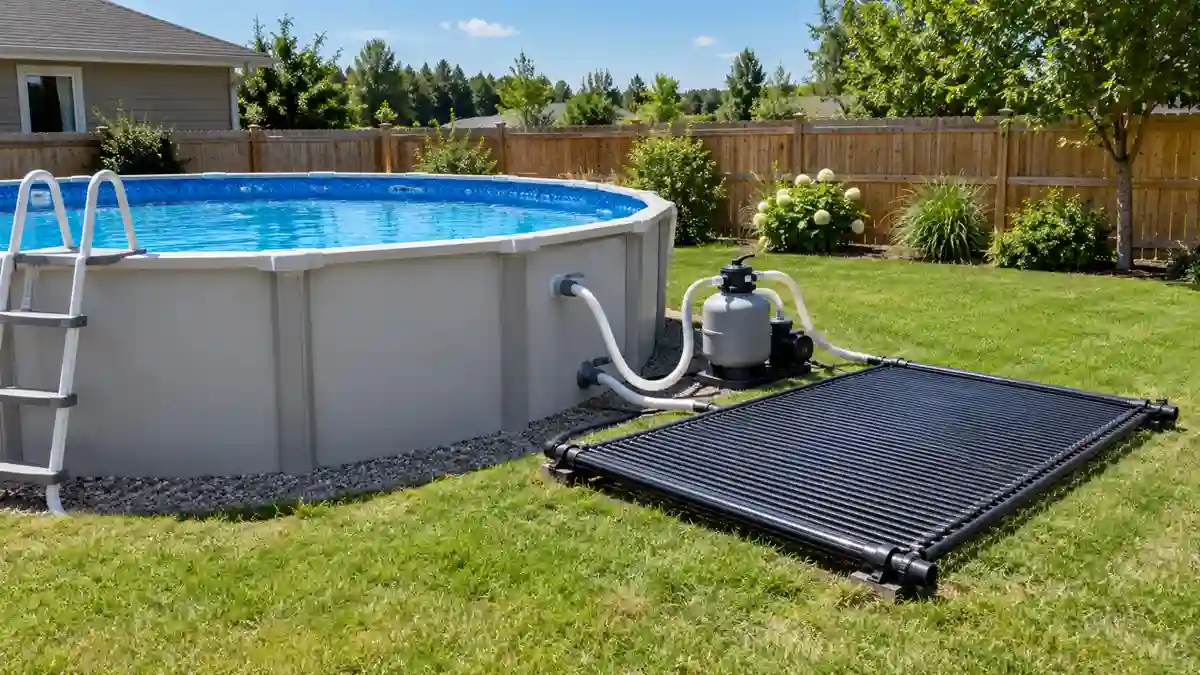
Learn how to choose a solar water heater for above ground pool, estimate collector size, check pump compatibility, install the system and reduce heat loss.
A solar water heater for an above ground pool can extend the swimming season by using sunlight to raise the water temperature. These systems are often attractive to homeowners because above-ground pools may have accessible plumbing, relatively small water volumes and enough nearby ground or roof space for solar collectors.
However, a successful installation depends on more than connecting a solar collector to the pool hoses. The circulation pump must provide the required flow, the collector must be compatible with the pool equipment, and the system must collect enough useful heat to offset the pool’s ongoing heat losses.
This guide explains how solar pool heaters work, how to estimate collector size, how to assess pump compatibility, what affects installation cost, and which mistakes to avoid.
Editor’s Note: This article focuses on above-ground pools using solar thermal collectors that transfer heat directly to circulating pool water. Photovoltaic (PV) panels generate electricity and require a different arrangement if they are used to power a pool pump or heat pump.
How Does a Solar Water Heater for Above Ground Pool Work?
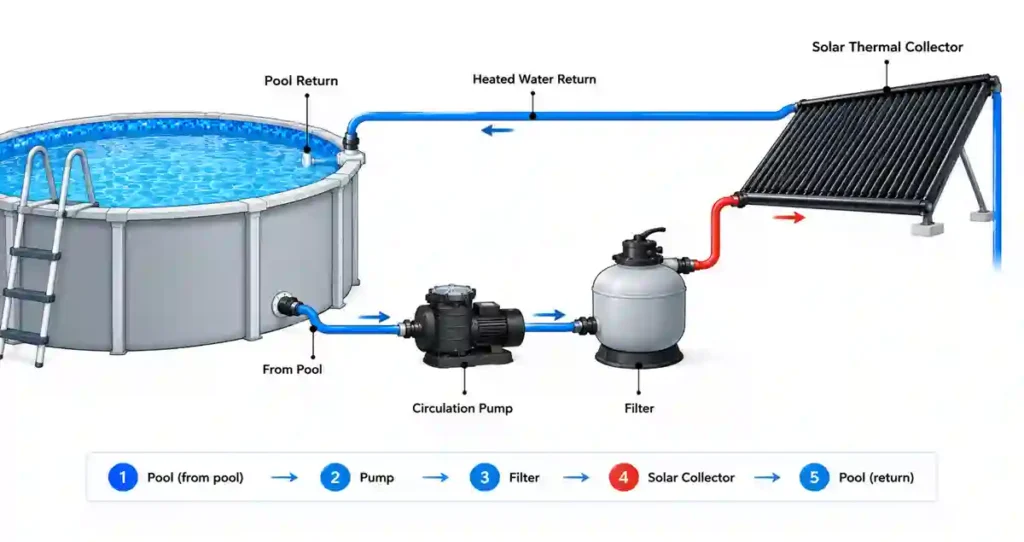
A typical solar thermal pool heater circulates pool water through a collector exposed to sunlight. The collector absorbs solar energy and transfers heat to the water before it returns to the pool.
A common flow sequence is:
Pool → Circulation pump → Filter → Solar collector → Pool return
The exact arrangement depends on the collector design and the pool’s existing circulation equipment. Some systems use a dedicated solar heater with its own bypass arrangement, while others use a collector designed to connect directly to compatible pool hoses.
When sunlight is available and the collector can provide useful heat, water passes through the heating circuit. When heating is unnecessary, the system may bypass the collector or stop circulation through it, depending on the manufacturer’s instructions.
For a more detailed explanation of pump, filter, collector and bypass connections, read our guide to how a solar water heater is connected to a pool.
Engineer’s Note
A solar collector can be connected correctly and still deliver disappointing results. Poor heating may result from inadequate sunlight, insufficient collector area, restricted flow, incorrect valve positioning or excessive heat loss from the pool.
The installation should therefore be assessed as a complete thermal and hydraulic system rather than as an isolated collector.
Types of Solar Water Heater for Above Ground Pool
Several technologies can heat an above-ground pool, but they operate differently.
1. Solar thermal pool collectors
Solar thermal collectors absorb sunlight and transfer heat directly to circulating pool water. Many residential above-ground pool heaters use compact polymer collectors, mats or panels designed for relatively low-temperature pool heating.
Advantages
- Direct transfer of solar heat to pool water.
- Relatively simple operation.
- Potentially low heating-energy costs during suitable weather.
- No separate hot-water storage tank is normally required.
Limitations
- Heating output varies with sunlight and weather.
- Collector space is required.
- The existing pump may have limited capacity for additional hydraulic resistance.
- Heating may be insufficient during cold, cloudy or windy conditions.
2. Photovoltaic panels powering a pool heat pump
PV panels generate electricity rather than directly heating the water. That electricity can power a compatible heat pump, which extracts heat from the surrounding air and transfers it to the pool.
This arrangement requires electrical equipment, compatible controls and an assessment of the pool’s heating demand.
If you are comparing PV technology with direct solar thermal heating, our solar blanket guide explains an important distinction between products that manage pool heat and equipment that actively heats circulating water.
3. Solar pool covers
A solar pool cover is not the same as a solar thermal collector. A cover can help retain heat and reduce evaporation, but it does not circulate water through a heating collector.
For many above-ground pools, a cover is a useful companion to an active solar heater because it reduces the heat lost after the water has warmed.
Our guide to solar blankets and how they work explains the heat-retention role of pool covers. If handling and storage are concerns, see our article on solar blanket reels and covers.
Engineer’s Note: Choose the Right Technology
For a straightforward outdoor above-ground pool, a purpose-designed solar thermal collector may be the simplest option. A PV-powered heat pump can make sense when greater temperature control or broader use of solar electricity is important.
Compare both options using the pool’s heating requirement, local climate, installation space, equipment cost and expected operating expenses.
How to Size a Solar Water Heater for an Above Ground Pool
Collector sizing should start with the pool’s dimensions and operating conditions. Avoid choosing a heater based only on the product’s advertised pool capacity.
Step 1: Calculate the pool surface area
For a rectangular pool:
Surface area = Length × Width
For a circular pool:
Surface area = π × Radius²
For example, consider a circular above-ground pool with a diameter of 4.5 m.
Radius = 4.5 ÷ 2 = 2.25 m
Surface area = 3.1416 × 2.25²
Surface area ≈ 15.9 m²
This surface area helps establish a preliminary collector-sizing basis because evaporation and several other heat-loss processes occur at the water surface.
Step 2: Estimate the initial collector area
For some outdoor solar thermal pool-heating systems, a preliminary collector-area estimate may start around 50–100% of the pool’s surface area. This is a planning guideline, not a universal requirement or a guarantee of heating performance.
For the example pool:
- Pool surface area: approximately 15.9 m².
- Preliminary collector area at 50%: approximately 8.0 m².
- Preliminary collector area at 100%: approximately 15.9 m².
The appropriate collector area may be lower or higher depending on local solar conditions, target water temperature, collector performance, pool-cover use, wind exposure and the desired swimming season.
For a more detailed explanation of collector sizing, energy requirements and operating costs, see our solar water heater for pool sizing guide.
Step 3: Calculate the pool’s water volume
For a pool with a reasonably uniform water depth:
Water volume (m³) = Surface area (m²) × Average water depth (m)
For the example pool, assume an average water depth of 1.0 m.
Water volume = 15.9 × 1.0
Water volume ≈ 15.9 m³, or approximately 15,900 litres.
Use the actual average water depth rather than the maximum wall height when estimating the pool’s water volume.
Step 4: Estimate the energy needed to raise the water temperature
A useful estimate of the heat needed to raise pool water temperature is:
Thermal energy (kWh) = Water volume (m³) × Temperature rise (°C) × 1.163
For a pool containing 15.9 m³ of water, a temperature increase of 5°C requires approximately:
15.9 × 5 × 1.163 = 92.5 kWh of thermal energy
This estimate represents the energy stored in the water. It does not include ongoing heat losses, and it does not mean that the collector will deliver this energy in a single day.
Actual heating time depends on the useful heat output of the collector, available sunlight, water circulation and heat loss from the pool.
Step 5: Check the available installation area
The collector needs an appropriate location with useful solar exposure. Options may include a suitable ground-mounted area or a roof that can safely support the installation.
Check for:
- Shading from trees, buildings and fences.
- Collector orientation and seasonal sunlight.
- Pipe distance between the pool equipment and collector.
- Safe access for inspection and maintenance.
- Structural support and wind exposure.
- The manufacturer’s installation and mounting requirements.
Engineer’s Field Notes
Before recommending a collector, record the pool’s diameter or dimensions, average water depth, target temperature, typical swimming hours, local weather, available mounting area and whether a cover will be used.
These measurements provide a better starting point than selecting a product based solely on a marketing claim such as “heats pools up to a certain size.”
Can the Existing Above Ground Pool Pump Run a Solar Heater?
Often, yes. Many solar thermal pool heaters are designed to work with an existing pool circulation pump.
However, above-ground pool pumps may be smaller than the pumps used in some in-ground installations. Adding a collector and extra piping changes the hydraulic resistance of the system.
The pump must provide the collector’s required flow at the actual operating head. If flow becomes too low, heat transfer may suffer. If the collector is incompatible with the pump or plumbing, the system may not operate as intended.
Before connecting the collector, check:
- The pump manufacturer’s flow and operating limits.
- The collector’s required flow rate and pressure limits.
- The condition of the pool filter.
- The hose diameter and total pipe length.
- The elevation between the pump and collector.
- The collector manufacturer’s connection diagram.
Our solar water pump selection guide provides additional background on pump types, flow and head. The pump requirements for a closed pool-circulation circuit are different from those for lifting water from a well, but the underlying hydraulic principles remain relevant.
Engineer’s Note: Do Not Upgrade the Pump Without Checking the System
A larger pump is not automatically the solution to poor collector performance. The real issue may be a clogged filter, a restricted hose, an unsuitable valve arrangement or an incorrect connection.
Check the system’s operating point before replacing the pump. The objective is to achieve the required flow without exceeding the ratings of the collector, filter, hoses or fittings.
How to Connect a Solar Heater to an Above Ground Pool
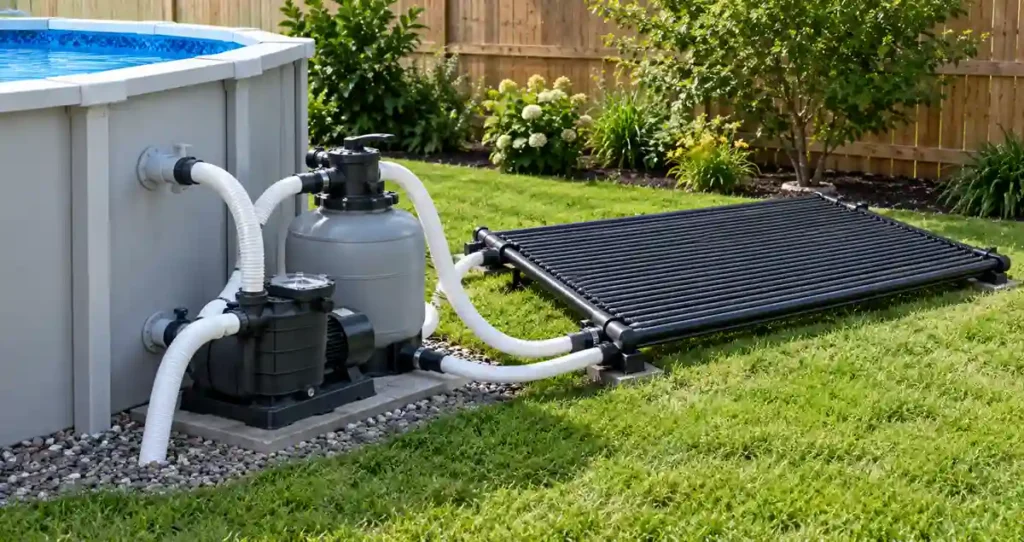
Many compact pool heaters use hose connections, but the correct arrangement depends on the particular pool and collector.
A common installation places the collector in the filtered-water circulation path. The pump sends water through the filter and then through the solar heater before the warmed water returns to the pool.
Some products use an integrated bypass; others require a separate valve arrangement. Follow the manufacturer’s instructions rather than copying a generic diagram.
Basic installation checks
1. Confirm compatibility. Check hose diameter, fitting type, pressure rating, required flow and the manufacturer’s approved pool capacity.
2. Select the collector location. Use an unshaded location with suitable sunlight and safe support. Avoid placing a collector where people may trip over the hoses or where the equipment can be damaged.
3. Check the pump and filter. Clean the filter as required and confirm that the circulation pump can support the additional resistance.
4. Follow the approved plumbing layout. Connect the supply and return according to the collector’s marked ports and installation manual.
5. Check for leaks. Start the circulation system according to the manufacturer’s procedure and inspect connections, hoses and fittings.
6. Confirm normal operation. Verify that flow is adequate and that the collector is not operating beyond its specified limits.
For a deeper explanation of the plumbing sequence and bypass concept, use our pool-heater connection and plumbing guide.
Engineer’s Field Notes
On a compact above-ground pool, a small hose restriction can have a noticeable effect on circulation. Check for kinks, partially closed valves, trapped air where relevant and filter restrictions before assuming the collector itself is defective.
Do not modify a pressurised system beyond the manufacturer’s approved configuration. Isolate the equipment safely before making plumbing changes.
How Much Does a Solar Heater for an Above Ground Pool Cost?
The total cost depends on the collector type, collector area, pump compatibility, mounting method, hose or pipe requirements and installation labor.
A compact collector connected close to the pool equipment may be relatively straightforward to install. A larger array mounted on a roof may require additional supports, longer pipe runs, structural assessment and more complex controls.
Compare products and quotations using the same criteria.
| Cost factor | What to check |
|---|---|
| Collector | Type, surface area, rated performance and warranty |
| Pump compatibility | Whether the existing pump can provide the required flow |
| Plumbing | Hose diameter, pipe length, valves, fittings and leak protection |
| Mounting | Ground support, roof suitability and wind loading |
| Controls | Manual or automatic flow control and temperature sensing |
| Installation | Labor, access, commissioning and any required permits |
| Operating cost | Pump electricity and any auxiliary heating energy |
| Maintenance | Filter cleaning, inspection, seasonal shutdown and repairs |
Avoid comparing a low-cost collector mat with a complete professionally installed system as though they provide the same scope of work.
Engineer’s Note: Calculate Cost Against Useful Heat
A low initial price does not necessarily mean the lowest operating cost. The collector must provide enough useful heat under the conditions in which the pool is used.
Compare the expected swimming season, energy consumption, maintenance, equipment life and the amount of conventional heating that the system is likely to displace.
How to Improve Solar Heating Performance
A solar collector cannot compensate for every source of heat loss. Good operating practices can help make the most of the energy it captures.
Use a suitable pool cover
A pool cover can reduce evaporation and help retain heat when the pool is not in use. This is particularly important overnight or during cooler, windy conditions.
Read our guide to solar blankets and pool heat retention for more information.
Keep the filter clean
A restricted filter can reduce water circulation and affect the heating circuit. Follow the filter manufacturer’s cleaning and maintenance schedule.
Avoid unnecessary shading
Trees, fences and buildings can reduce the solar energy reaching the collector. Assess shading during the hours when the system is intended to operate.
Operate the system when useful heat is available
Solar thermal collectors generally provide the most useful heating when solar radiation is available and the collector can transfer heat to the water. Follow the manufacturer’s control and circulation recommendations.
Maintain the collector and hoses
Inspect the collector, supports, hoses and fittings for leaks, cracks, deterioration or damage. Follow the manufacturer’s recommendations for seasonal storage and shutdown.
Engineer’s Note
A pool cover and a solar thermal collector perform different functions. The collector adds heat when solar energy is available; the cover helps retain heat already gained. For some pools, improving heat retention may deliver a better overall result than simply installing a larger collector array.
Solar Thermal vs. PV for an Above Ground Pool
The right choice depends on whether the objective is direct water heating or electricity generation.
| Feature | Solar thermal collector | PV-powered heating |
|---|---|---|
| Main output | Heat transferred to water | Electricity |
| Typical arrangement | Collector connected to pool circulation | PV panels powering compatible equipment |
| Main equipment | Collector, plumbing and circulation system | PV panels, electrical controls and heating equipment |
| Electrical needs | Existing circulation pump uses electricity | Depends on pump or heat-pump arrangement |
| Heating performance | Depends on solar heat collection and pool losses | Depends on PV output and the performance of the heating equipment |
PV-powered heating should be assessed as an electrical system, including load demand, motor starting, controls and the heat pump’s performance. A PV module should not be connected directly to an ordinary pool pump unless the equipment is specifically designed for that electrical arrangement.
For readers considering a wider PV system, our Solar ROI Calculator can help evaluate solar-electricity economics. Its results should not be interpreted as a dedicated solar thermal pool-heating payback calculation.
Common Problems and Troubleshooting
| Symptom | Possible cause | What to check |
|---|---|---|
| Water is not noticeably warmer | Low sunlight, insufficient collector area or high heat loss | Check weather, collector exposure, sizing and pool cover |
| Weak water flow | Dirty filter, kinked hose or excessive hydraulic resistance | Inspect filter, hose routing, valves and pump operation |
| Collector leaks | Damaged hose, fitting or collector | Isolate the circuit and follow the manufacturer’s repair procedure |
| Heating is inconsistent | Variable weather, incorrect controls or changing circulation | Check operating schedule, flow and control settings |
| Pump sounds unusual | Air ingress, restriction or unsuitable operating conditions | Inspect the suction side, filter and plumbing |
| Water temperature falls overnight | Evaporation and environmental heat loss | Use a suitable cover and assess nighttime conditions |
These are possible causes rather than definitive diagnoses. Use the manufacturer’s troubleshooting procedure and obtain qualified assistance where required.
Engineer’s Field Notes
When a pool fails to warm up, record the pool temperature at the start and end of the heating period, the weather conditions, circulation duration and whether the cover was used.
These observations help distinguish poor solar input from hydraulic problems or excessive heat loss. Avoid concluding that the collector is faulty based on one cool day.
Maintenance and Seasonal Shutdown
Inspect the collector, hoses, fittings, mounting and visible plumbing regularly. Keep the filter maintained and confirm that valves and connections remain in good condition.
Where freezing weather is possible, follow the manufacturer’s specific draining, storage and freeze-protection instructions. Water left in exposed components may freeze and damage them.
Before restarting a system after seasonal storage, inspect the hoses and collector for damage, reconnect the equipment according to the approved layout, and check for leaks before normal operation.
Do not exceed the collector’s rated temperature, pressure or flow. Never bypass safety devices or modify electrical equipment without suitable qualifications.
Applicable Codes and Engineering Standards
For installations in the United States, the following codes and standards may apply to solar pool-heating systems, depending on the installation type and locally adopted code editions.
- ICC 902/PHTA 902/SRCC 400-2020: Solar Pool and Spa Heating System Standard.
- ICC 901/SRCC 100-2020: Solar Thermal Collector Standard.
- 2024 International Swimming Pool and Spa Code (ISPSC), Sections 302.1, 302.2, 302.3 and 317.2–317.6: Electrical, plumbing, equipment and solar-heating requirements.
- International Plumbing Code (IPC), Section 302.2: Water-service, makeup-water and drainage piping requirements for pools and spas, where applicable.
- NFPA 70 (National Electrical Code), Article 680: Electrical installations associated with swimming pools and similar aquatic facilities.
- NFPA 70 (National Electrical Code), Article 690: Photovoltaic system requirements where a PV-powered heating arrangement is installed.
- NSF/ANSI/CAN 50: Swimming pool and spa equipment requirements, where applicable.
- International Building Code (IBC) or International Residential Code (IRC): Applicable structural requirements for buildings and roof-mounted collectors.
Engineer’s Code-Compliance Note: Confirm the code editions adopted by the local authority, the equipment listing and certification requirements, the manufacturer’s installation instructions, and any permit obligations. Applicability varies by jurisdiction and installation type. These US references are not automatically applicable outside the United States.
Frequently Asked Questions
Is a solar water heater suitable for an above ground pool?
Yes. A purpose-designed solar thermal collector can heat an above-ground pool when it is compatible with the circulation pump, filter and plumbing. Actual performance depends on sunlight, collector size, water flow and heat loss.
How many solar panels do I need for an above ground pool?
The number depends on the technology. Solar thermal systems are sized using collector area and the pool’s heating requirements. PV systems require a separate electrical calculation based on the heating equipment’s consumption and expected solar generation.
Can I connect a solar heater to my existing pool pump?
Often, yes. Check that the pump can deliver the required flow at the additional system head and that the collector is compatible with the pump and filter.
Does a solar pool heater work on cloudy days?
It may still collect some heat, but useful output is generally reduced when solar radiation is lower. Whether the pool temperature rises depends on the remaining heat input and the pool’s heat losses.
Should I turn off the solar heater at night?
Follow the collector and controller manufacturer’s instructions. When the collectors are cooler than the pool water, circulating water through them may increase heat loss. A suitable bypass or control strategy can help prevent unwanted cooling.
Does a pool cover make solar heating more effective?
A suitable cover can reduce evaporation and help retain heat when the pool is not in use. It complements a solar thermal heater but does not replace the collector.
Can I use a solar heater without a pool pump?
Only if the specific product is designed for a different circulation arrangement. Most conventional solar thermal pool-heating systems need adequate water circulation. Do not assume that a collector can operate safely or effectively without the flow specified by its manufacturer.
How long does it take to warm an above ground pool?
There is no universal heating time. Pool volume, target temperature, collector area, sunlight, wind, ambient temperature, water flow and ongoing heat loss all influence the result.
Final Engineering Recommendation
A solar water heater can be a practical way to extend the swimming season of an above-ground pool, but the system must be selected and installed according to the pool’s actual requirements.
Start by calculating the pool’s surface area and water volume. Estimate the energy required for the desired temperature increase, then assess collector area, solar exposure, pump compatibility and expected heat loss. Confirm the approved plumbing arrangement before connecting the equipment.
A suitable pool cover can further improve heat retention, while routine inspection helps maintain circulation and identify leaks or restrictions.
Engineer’s Note: The best system is not necessarily the largest or cheapest collector. It is the system that matches the pool’s heating demand, operates within the equipment limits and delivers useful heat under the conditions in which the pool is used.
Related guides
- How Is Solar Water Heater Connected to a Pool?
- Solar Livestock Water Heater: Options for Farms
- Solar Water Heater for Horse Troughs: A Livestock Owner’s Guide
- Solar Blanket Reels and Covers: Do They Heat Water?
- Solar Blanket: Types, Uses and How They Work.
- Solar Water Heater for Pool: Types, Sizing and Cost
Related guides on SolarVisionAI.com
- Monocrystalline Solar Panels 2026: Still Worth It or Hype
- Polycrystalline Solar Panels: Worth Buying in 2026?
- Thin-film Solar Panels: When They Beat Silicon (2026)
- BIPV Solar Panels: Building-Integrated PV Complete Guide
- Portable Solar Panels: Engineer’s Buyer’s Guide 2026
- CPV Solar Panels: Concentrated Photovoltaic Explained
- Skin Solar Panel: What “Solar Skin” Actually Means
- Solar Fence Post Lights: Cap Sizes, Types & Install Guide
- Bifacial Solar Panels in 2026: How to Boost Energy Output
- Solar Charge Controller: The Complete Guide
- MC4 Connectors: Solar Safety & Installation Guide
- Solar Panel Types, Efficiency & Benefits
- Solar Water Pump Guide
- Commercial Solar Panel Installation: Engineering Guide
- Solar Fence Post Lights: Cap Sizes, Types & Install Guide
- BESS — Battery Energy Storage System Guide
- Commercial Solar Panel Installation
- Solar Refrigerator & DC Fridge — Complete 2026 Guide
- Bifacial Solar Panel Albedo Effect Guide
- TOPCon: Why TOPCon Solar Panel is a Proven Smart Investment in 2026
- HJT: Why TOPCon Solar Panel is a Proven Smart Investment in 2026
- PERC: PERC Solar Panel: Still Relevant or Already Outdated?
- Perovskite: Perovskite Solar Panels: The 2026 Reality Check
- N-Type vs P-Type: N-Type vs P-Type Solar Panels: Honest Comparison
- ABC: ABC (all back contact) Solar Panel: Back Contact Technology Explained
- IBC: IBC Solar Panels: Interdigitated Back Contact Guide
- Tandem: Tandem Solar Panels: Are Stacked Cells Ready for Rooftops?