
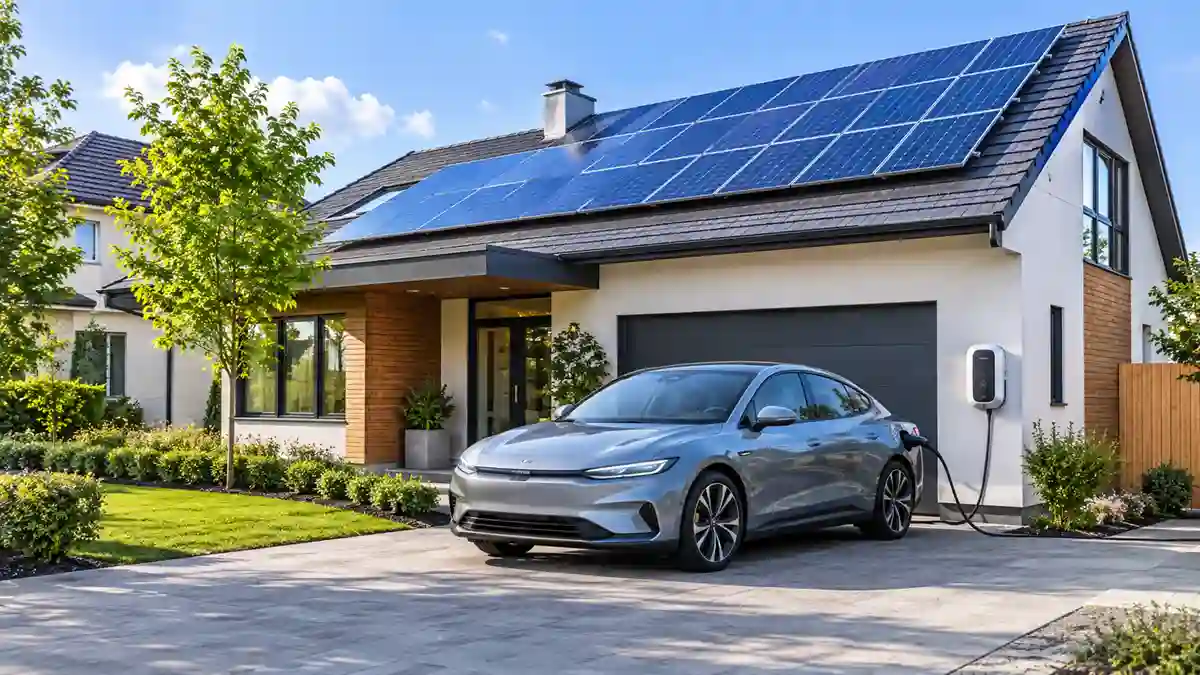
Learn how solar EV charging works, from solar panels and inverters to home EV chargers. Explore costs, system setup, US permits, electrical codes, and installation requirements.
Solar energy and electric vehicles (EVs) are two important technologies shaping the future of clean transportation. By combining rooftop solar panels with an electric vehicle charging system, homeowners can generate electricity for their vehicles, reduce their dependence on grid power, and make better use of renewable energy.
A solar EV charging system uses photovoltaic (PV) panels to convert sunlight into electricity. An inverter, electrical distribution equipment, and an EV charging station then work together to deliver usable power to the vehicle. Depending on the installation, the system can also use grid electricity or battery storage when solar generation is insufficient.
However, charging an electric car with solar energy involves more than connecting solar panels to a vehicle. Solar generation, inverter capacity, household electricity demand, charging equipment, and the vehicle’s onboard charging system all influence the process.
This guide explains the complete energy flow, the main components of a solar EV charging system, how solar electricity reaches the vehicle’s battery, and how grid power and battery storage can support charging when sunlight is limited.
How Does Solar EV Charging Work?
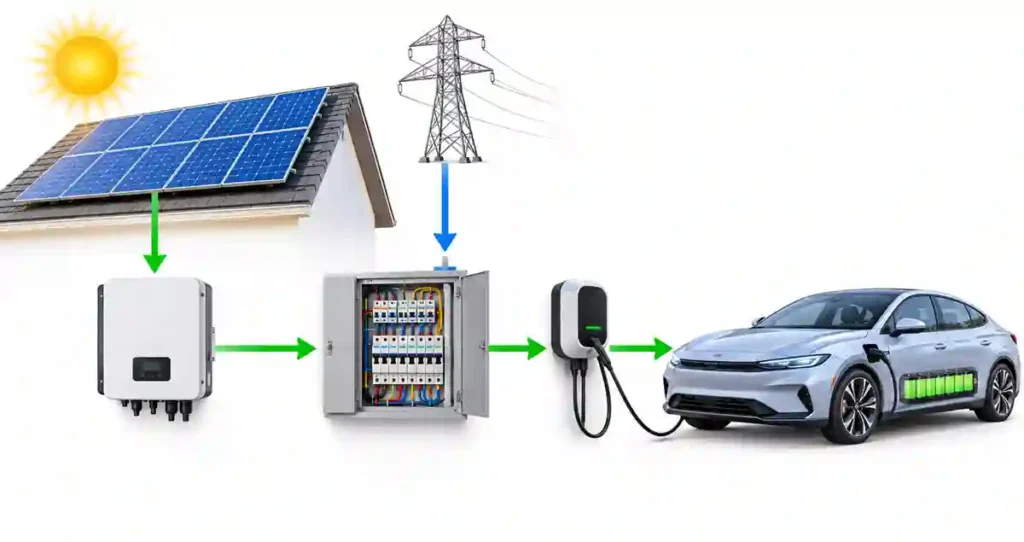
Solar EV charging works by converting sunlight into electricity and supplying that electricity to an electric vehicle through compatible charging equipment.
In a typical grid-connected residential installation, the process follows five main stages:
- Solar generation: Photovoltaic panels absorb sunlight and produce direct current (DC) electricity.
- Power conversion: A solar inverter converts the generated DC electricity into alternating current (AC) for household electrical use.
- Electricity distribution: The electrical distribution system supplies available solar power to household appliances and the EV charging circuit.
- Vehicle charging: The EV charging equipment provides a controlled electrical connection between the power supply and the vehicle.
- Battery charging: The vehicle’s onboard charger converts incoming AC electricity into DC electricity for storage in its traction battery.
When solar generation is insufficient, a grid-connected system can draw additional electricity from the utility supply. If battery storage is installed, stored energy can also contribute to EV charging.
The actual solar contribution depends on available generation, household consumption, charging power, and the system’s energy-management settings.
Main Components of a Solar EV Charging System
A residential solar EV charging installation combines several electrical components. Each has a specific role in generating, converting, distributing, or controlling electricity.
1. Solar Panels
Solar panels are the primary electricity-generating components. They use photovoltaic cells to convert sunlight directly into DC electricity.
When sunlight reaches the semiconductor material in a PV cell, it generates an electric current via the photovoltaic effect.
The amount of electricity generated depends on several factors:
- Solar panel rated capacity and efficiency.
- Available sunlight and local weather conditions.
- Panel orientation and tilt angle.
- Shading from nearby buildings, trees, or other obstructions.
- Module temperature and electrical system losses.
Multiple solar panels are connected to form a PV array that supplies electricity to the inverter.
For a deeper technical explanation, see our guide to how solar panels work.
2. Solar Inverter
Solar panels generate DC electricity, while conventional residential electrical systems use AC electricity.
A solar inverter performs the DC-to-AC conversion required to supply household electrical loads and compatible EV charging equipment.
Depending on the installation, the inverter may also:
- Monitor solar generation.
- Synchronize with the utility grid.
- Manage power distribution.
- Communicate with battery storage.
- Support export and import monitoring.
String inverters, microinverters, and hybrid inverters are among the available configurations.
A grid-connected solar inverter must meet the applicable electrical and utility-interconnection requirements.
Explore our solar inverter guide and hybrid inverter guide for more information.
3. EV Charging Equipment (EVSE)
Electric vehicle supply equipment (EVSE), commonly called an EV charger, provides the electrical connection and safety controls needed to charge an electric vehicle.
Residential AC charging commonly uses Level 1 or Level 2 equipment.
The EVSE communicates with the vehicle, controls the permitted charging current, and provides the necessary electrical safety functions.
An important technical distinction is that conventional AC EVSE does not normally perform the main AC-to-DC battery conversion. That function is handled by the vehicle’s onboard charger.
The charging rate depends on:
- EVSE output rating.
- Vehicle onboard charger capacity.
- Available electrical supply.
- Circuit and wiring capacity.
- Vehicle charging settings.
The U.S. Department of Energy’s Alternative Fuels Data Center provides an overview of EV charging equipment and charging levels.
4. Electrical Distribution and Protection
The electrical distribution system connects the solar inverter, utility supply, household loads, and EV charging equipment.
Depending on the installation, it may include:
- Main distribution board and circuit breakers.
- Dedicated EV charging circuit.
- Appropriately sized electrical cables.
- Grounding and earthing arrangements.
- Residual-current protection.
- Overcurrent protection.
- Surge protection where required.
- Disconnecting and isolation equipment.
A dedicated charging circuit is generally required for a residential Level 2 installation.
The electrical design must account for the EVSE rating, continuous charging load, conductor ampacity, protective-device coordination, and local electrical codes.
For installation planning, see our solar panel installation guide.
5. Battery Storage (Optional)
A stationary battery can store surplus solar electricity for later use.
For example, a residential solar system may generate more electricity than the home needs during the afternoon. Instead of exporting all the surplus electricity, a compatible battery system can store some of it for evening consumption or EV charging.
Battery storage can offer:
- Greater flexibility in charging schedules.
- Better use of surplus solar generation.
- Reduced dependence on grid electricity during selected periods.
- Backup power for compatible household loads during outages.
However, a battery is not essential for every grid-connected solar EV charging system.
Explore our lithium-ion battery guide, LiFePO4 battery guide, and home battery backup guide for more information.
Solar EV Charging: Complete Energy Flow
Understanding the energy pathway helps explain how the different components work together.
In a typical grid-connected residential AC charging installation, the energy flow is:
Sunlight → Solar panels → DC electricity → Solar inverter → AC electrical distribution → EVSE → EV onboard charger → EV battery
The utility grid can supply additional electricity through the home’s electrical distribution system whenever solar generation is insufficient.
A battery-supported installation adds another energy pathway:
Solar panels → Inverter or battery charging system → Battery storage → Compatible inverter output → Electrical distribution → EVSE → EV battery
The exact arrangement depends on the inverter architecture and battery integration.
The U.S. Department of Energy explains the role of PV modules, inverters, and storage in its Solar Photovoltaic System Design Basics.
What Happens When Solar Generation Is Higher or Lower Than EV Demand?
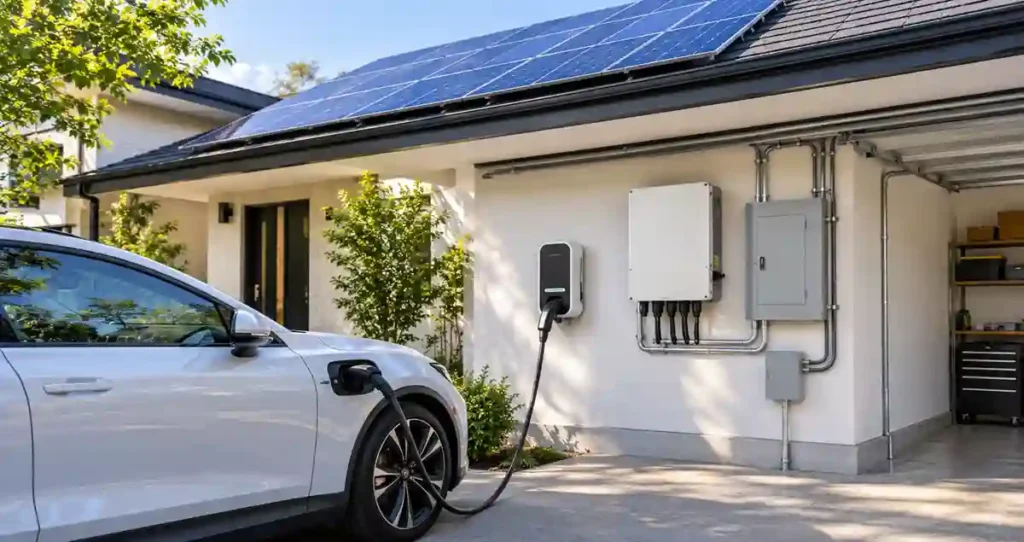
Solar electricity generation changes throughout the day, while an EV may require a relatively consistent charging power.
A smart energy-management system can help coordinate these differences.
When Solar Generation Exceeds EV Demand
If the solar system generates more electricity than the combined household and EV loads require:
- The EV can use available charging power.
- Other household appliances can consume the surplus.
- Excess electricity can charge a compatible stationary battery.
- Remaining electricity may be exported to the utility grid, subject to local interconnection and compensation arrangements.
When Solar Generation Is Lower Than EV Demand
If the vehicle requires more power than the solar system currently generates:
- The utility grid can supply the difference in a grid-connected installation.
- A compatible battery can contribute stored electricity.
- Smart charging controls can reduce the EV charging rate to match available solar power.
This flexibility allows solar generation, household consumption, and vehicle charging to operate together without requiring the PV array to produce the EV charger’s full rated output at every moment.
Practical Example: How Solar Power Supplies an EV Charger
Consider a residential property with the following operating conditions:
| Parameter | Value |
|---|---|
| Solar PV system rated capacity | 6 kW |
| Solar inverter AC output at the time | 5 kW |
| Household electricity demand | 1 kW |
| EV charging power demand | 7 kW |
| Stationary battery | Not installed |
The solar inverter is currently supplying 5 kW of AC power.
The household uses 1 kW, leaving approximately 4 kW available for EV charging.
The remaining 3 kW needed by the vehicle can come from the utility grid.
Power balance:
| Energy flow | Power |
|---|---|
| Solar inverter output | 5 kW |
| Household consumption | 1 kW |
| Solar contribution to EV | 4 kW |
| Grid contribution to EV | 3 kW |
| Total EV charging power | 7 kW |
This example assumes sufficient grid and circuit capacity, compatible equipment, and negligible distribution losses for simplicity.
It demonstrates an important principle: a solar EV charging system does not necessarily need to generate the full EV charger rating from solar panels. A grid-connected system can combine solar and utility electricity to meet charging demand.
Can an Electric Car Charge Directly from Solar Panels?
In a typical residential installation, solar panels are not connected directly to the vehicle’s charging port.
The system requires appropriate power conversion, electrical protection, and charging control equipment.
For conventional AC charging:
- Solar panels generate DC electricity.
- The solar inverter converts it into AC electricity.
- The EVSE provides a controlled charging connection.
- The vehicle’s onboard charger converts incoming AC electricity into DC.
- The DC electricity charges the vehicle’s battery.
Specialized DC charging systems can use different power-conversion architectures, including DC-coupled configurations. However, these require dedicated equipment and compatible charging interfaces.
Simply connecting conventional solar panels to an EV charging port is not a standard or safe charging method.
What Determines the Performance of Solar EV Charging?
Several technical and operating factors influence how much solar electricity an electric vehicle can use.
Solar array capacity: A larger PV array can generally generate more electricity, although actual output depends on operating conditions.
Solar conditions: Sunlight intensity, cloud cover, shading, panel orientation, and temperature influence solar generation.
Vehicle energy demand: Daily driving distance and vehicle efficiency determine the energy needed for charging.
EV charging capacity: The EVSE and onboard charger determine the maximum AC charging power.
Household electricity consumption: Other electrical loads compete for available solar generation.
Inverter capacity: The inverter must support the electrical demand and operate within its rated output.
Energy management: Smart charging controls can adjust charging power according to available solar generation and household demand.
These factors should be considered together when planning a residential solar EV charging installation.
Solar EV Charging in the United States: Permits, Electrical Codes and Installation Requirements
If you are planning to install solar panels and a home EV charger in the United States, the project involves more than selecting panels and a charging unit. You may also need local building and electrical permits, utility approval and a final inspection.
Requirements differ between states, cities and counties. The local building or electrical department—often called the Authority Having Jurisdiction (AHJ)—determines which codes and permit requirements apply to your property.
1. Solar panel permits and inspections
Most local jurisdictions require permits before installing a residential rooftop solar system. Depending on the project and location, the application may require:
- A rooftop layout showing the proposed solar panel locations.
- Electrical drawings showing the panels, inverter, disconnects and connection to the home’s electrical system.
- Equipment specifications and installation details.
- Structural information confirming that the roof can support the solar equipment, where required.
- Applicable fire-safety and roof-access details.
After installation, the local authority may inspect the system before it can be approved for operation. The U.S. Department of Energy explains the general permitting and inspection process in its guide to permitting and inspection for rooftop solar. Department of Energy+1
2. EV charger installation permits
Installing a Level 2 home EV charger commonly involves electrical work, particularly when the charger is hardwired or requires a new circuit.
Before installation, check whether your local authority requires an electrical permit. A qualified electrician should assess:
- The existing electrical service and main panel capacity.
- The charger’s voltage and rated current.
- The dedicated branch circuit and appropriate overcurrent protection.
- Conductor sizing, grounding and required protective devices.
- Indoor or outdoor installation conditions.
- Whether an electrical panel upgrade or load-management system is necessary.
The National Electrical Code (NEC) includes Article 625, which addresses electric vehicle power transfer systems. Other electrical-code provisions may also apply to the circuit, wiring, grounding and equipment. The adopted NEC edition and local amendments depend on the jurisdiction. Building America Solution Center+1
3. Electrical codes for solar and battery systems
A solar EV charging installation may involve several parts of the electrical code, rather than one single rule:
| Code reference | General subject |
|---|---|
| NEC Article 625 | Electric vehicle charging equipment |
| NEC Article 690 | Solar photovoltaic systems |
| NEC Article 705 | Interconnected electric power production sources |
| NEC Article 706 | Energy storage systems |
These references are useful starting points for understanding the electrical design. They are not a substitute for checking the locally adopted code edition, amendments and project-specific requirements.
For example, a home adding solar panels, a battery and an EV charger may need an electrical design that accounts for inverter output, service-panel capacity, circuit ratings, energy storage equipment and the connection to the utility supply.
4. Utility approval and grid interconnection
If your solar system is connected to the utility grid, you may need an interconnection application and approval from your electric utility.
The process commonly involves:
- Submitting the solar system’s technical details to the utility.
- Receiving approval to connect the proposed system.
- Installing the equipment after the required permits and approvals.
- Completing the local electrical inspection.
- Submitting final documentation to the utility.
- Receiving permission to operate (PTO), where required.
Important: Passing a local electrical inspection does not automatically mean that your utility has authorized the solar system to export electricity to the grid. Check the utility’s interconnection requirements before commissioning the system. The Department of Energy’s Energy.gov+1
5. What should homeowners check before installation?
Before choosing an installer, use this checklist:
- Confirm solar permit requirements with your local building department.
- Check whether a separate electrical permit is required for the EV charger.
- Confirm that the roof is suitable for the proposed solar array.
- Have an electrician assess the existing electrical service and panel capacity.
- Confirm that the solar inverter and EV charger are compatible with the proposed system design.
- Check utility interconnection and net-metering or export rules.
- Ask who will arrange inspections and utility approval.
- Keep copies of permits, inspection records, equipment documentation and final approvals.
Homeowners can also consult the U.S. Department of Energy’s Homeowner’s Guide to Going Solar and the DOE rooftop solar permitting guide for additional guidance.
6. Where can you check local requirements?
Start with the building or electrical department for your city or county. These examples illustrate why checking locally matters:
- California: California Energy Commission and the relevant city or county building department.
- New York: NYSERDA – Doing Solar Business in New York.
- New York City: NYC Department of Buildings – Solar Energy Requirements.
- Other states: Contact your local building department, electrical inspector and electricity provider.
For example, New York municipalities can have different permitting and code requirements, while New York City has its own construction-code and contractor requirements. NYSERDA+1
Engineering note: A solar EV charging system should be designed as one coordinated electrical installation. Adding an EV charger to an existing solar system is not simply a matter of connecting another appliance. The available electrical capacity, inverter configuration, circuit protection, utility connection and local requirements all need to be considered.
Frequently Asked Questions
Does solar EV charging work on cloudy days?
Yes. Solar panels can generate electricity under cloudy conditions, although output is generally lower than during clear, sunny weather. A grid-connected system can supplement reduced solar generation with utility electricity.
Can I charge my electric car using rooftop solar panels?
Yes. A properly designed rooftop solar installation can supply electricity to compatible EV charging equipment. The system must have suitable inverter capacity, electrical protection, and charging infrastructure.
Do I need a battery to charge an EV with solar panels?
No. A grid-connected solar system can charge an EV without stationary battery storage. A battery is useful when surplus solar electricity needs to be stored for charging later, particularly outside daylight hours.
Can solar panels power a Level 2 EV charger?
Yes. A sufficiently sized solar system and compatible inverter can supply a Level 2 EV charging installation. The actual solar contribution depends on PV generation, household demand, inverter capacity, and the charger’s operating power.
Can I charge my EV using only solar electricity?
Yes, under suitable conditions. The solar system must provide enough usable power and energy for the vehicle’s charging requirements. Smart charging controls can help match charging demand to solar availability. Without sufficient solar generation or storage, charging may need to pause or use another power source.
Is solar EV charging independent of the electricity grid?
Not necessarily. Most residential installations are grid-connected and use utility electricity when solar generation is insufficient. Complete off-grid operation requires a properly designed standalone system with sufficient solar generation, energy storage, inverter capacity, and backup provisions.
Does a solar inverter charge an EV battery directly?
In a conventional AC residential installation, the solar inverter supplies AC electricity to the electrical distribution system. The EVSE then provides the controlled charging connection, and the vehicle’s onboard charger converts AC electricity into DC for its battery.
Final Thoughts
Solar EV charging combines photovoltaic electricity generation with electric vehicle charging equipment to make renewable electricity available for transportation.
Solar panels generate DC electricity, the inverter converts it into usable AC power, and the EV charging equipment supplies electricity to the vehicle. The onboard charger then converts AC electricity into DC for storage in the traction battery.
A grid-connected system can combine solar and utility electricity, while optional battery storage provides additional flexibility when solar panel generation and vehicle charging schedules do not match.
For homeowners considering this combination, understanding the complete energy pathway is the first step toward selecting suitable equipment and planning an effective installation.
Related guides
Related guides on SolarVisionAI.com
- Monocrystalline Solar Panels 2026: Still Worth It or Hype
- Polycrystalline Solar Panels: Worth Buying in 2026?
- Thin-film Solar Panels: When They Beat Silicon (2026)
- BIPV Solar Panels: Building-Integrated PV Complete Guide
- Portable Solar Panels: Engineer’s Buyer’s Guide 2026
- CPV Solar Panels: Concentrated Photovoltaic Explained
- Skin Solar Panel: What “Solar Skin” Actually Means
- Solar Fence Post Lights: Cap Sizes, Types & Install Guide
- Bifacial Solar Panels in 2026: How to Boost Energy Output
- Solar Charge Controller: The Complete Guide
- MC4 Connectors: Solar Safety & Installation Guide
- Solar Panel Types, Efficiency & Benefits
- Solar Water Pump Guide
- Commercial Solar Panel Installation: Engineering Guide
- Solar Fence Post Lights: Cap Sizes, Types & Install Guide
- BESS — Battery Energy Storage System Guide
- Commercial Solar Panel Installation
- Solar Refrigerator & DC Fridge — Complete 2026 Guide
- Bifacial Solar Panel Albedo Effect Guide
- TOPCon: Why TOPCon Solar Panel is a Proven Smart Investment in 2026
- HJT: HJT Solar Panels: Why Heterojunction Is the Hot Climate Champion
- PERC: PERC Solar Panel: Still Relevant or Already Outdated?
- Perovskite: Perovskite Solar Panels: The 2026 Reality Check
- N-Type vs P-Type: N-Type vs P-Type Solar Panels: Honest Comparison
- ABC: ABC (all back contact) Solar Panel: Back Contact Technology Explained
- IBC: IBC Solar Panels: Interdigitated Back Contact Guide
- Tandem: Tandem Solar Panels: Are Stacked Cells Ready for Rooftops?