
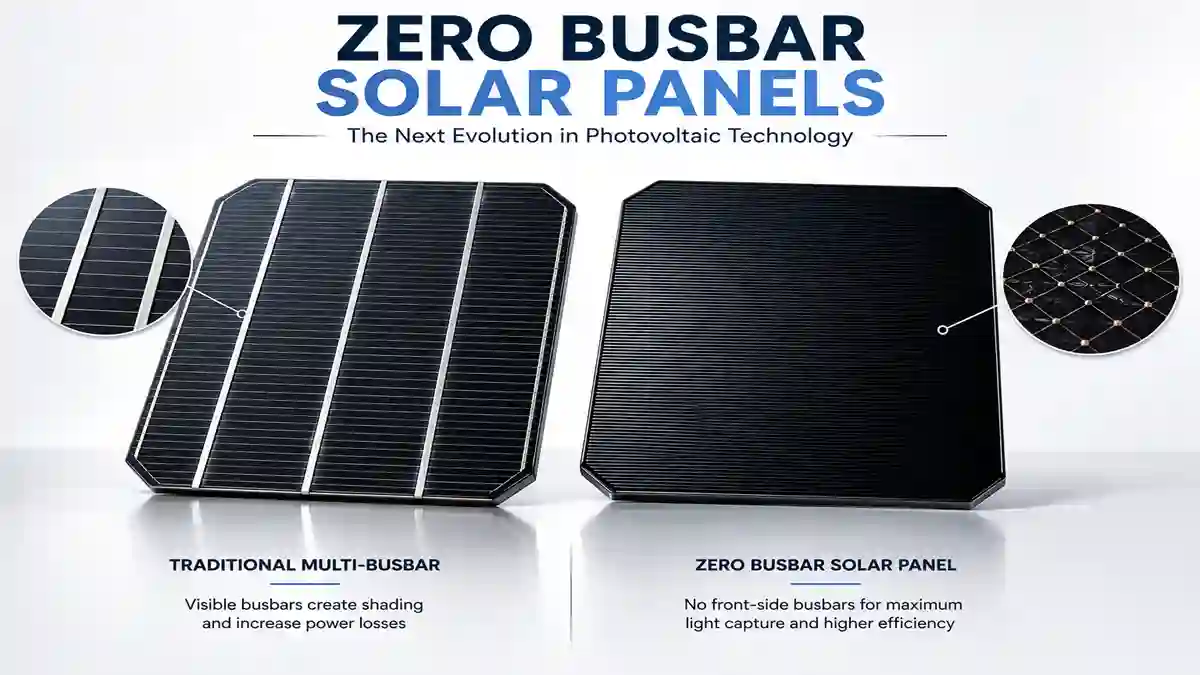
Before paying a premium for SmartWire or zero busbar solar panels, learn how eliminating front busbars affects real-world efficiency, reliability, and long-term panel lifespan.
If the busbar story so far has been “more is better,” zero busbar technology is the plot twist — the logical endpoint of that trend turns out to be removing front-surface busbars altogether. It’s a genuinely different engineering approach from simply adding more busbars, and understanding it explains where cell wiring technology is actually headed beyond the 16BB and 20BB designs covered in our other Busbar cluster guides.
This guide is part of our Types of Solar Panels hub, and builds on our Solar Panel Busbars guide — read that one first for the full busbar-count trajectory, this one for what comes after it.
How Zero Busbar Actually Works
Rather than printing wide metal busbars onto the cell surface, zero busbar (0BB) designs use a fine mesh of thin wires — often marketed under trade names like SmartWire — embedded in a conductive foil or film that’s laminated directly onto the cell during panel assembly, rather than soldered onto busbars printed on the cell itself. This eliminates the traditional front-surface busbar, meaning there’s no wide metal strip blocking light from reaching the cell at that location.
Engineer’s Note: The genuine advantage here isn’t just marginally less shading from thinner wires — it’s a fundamentally different current-collection approach. Traditional busbars require soldering, which introduces thermal stress and a real point of potential failure at each solder joint. Zero Busbar’s wire-mesh lamination process typically avoids that soldering stress entirely, which is part of why it’s frequently paired with more delicate cell architectures like HJT and back-contact designs that benefit from reduced manufacturing stress.
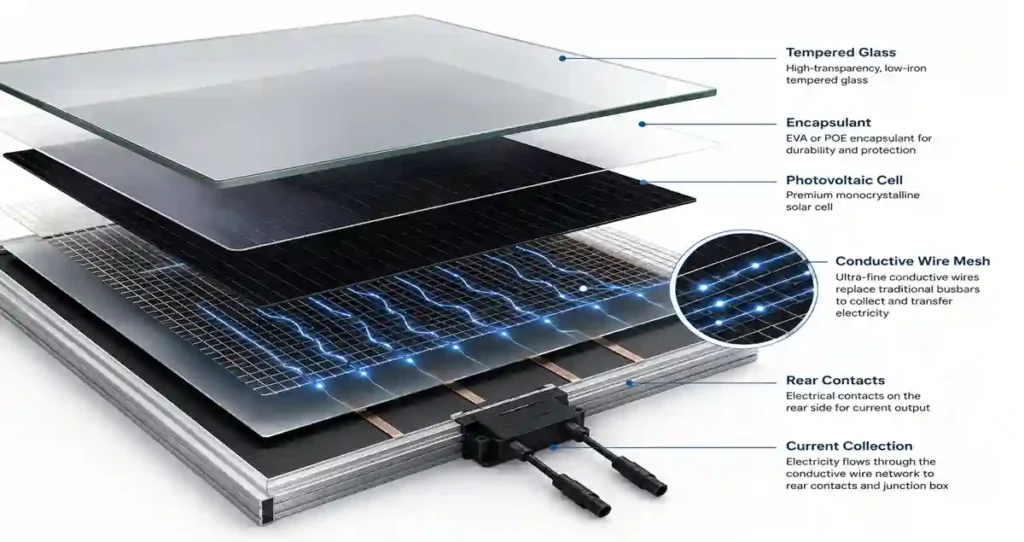
Zero Busbar vs Traditional Busbar Construction
| Feature | Traditional Multi-Busbar | Zero Busbar Solar Panel |
|---|---|---|
| Front busbars | Visible silver busbars | No visible front busbars |
| Current collection | Metallic busbars | Conductive wire mesh / SmartWire |
| Front-side shading | Slightly higher | Lower |
| Cell appearance | Visible busbars | Clean black surface |
| Manufacturing | Mature, mass production | Emerging premium technology |
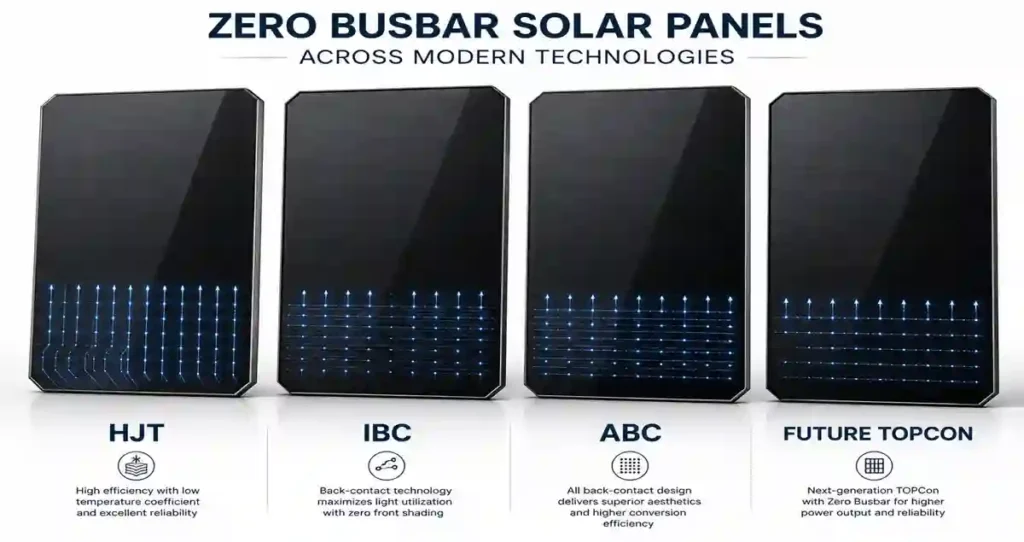
| Typical cell technologies | PERC, TOPCon, HJT | Mainly HJT, IBC, ABC |
Zero Busbar Integration Across Solar Panel Technologies
- Monocrystalline Solar Panels – Expected to become the primary platform for Zero Busbar technology because of their high efficiency and premium market positioning.
- TOPCon Solar Panels – Currently dominated by mature 16BB and 20+ BB designs, with Zero Busbar versions likely to emerge as manufacturing technology advances.
- HJT (Heterojunction) Solar Panels – One of the most suitable technologies for Zero Busbar integration due to lower mechanical stress, reduced shading, and higher overall efficiency.
- IBC (Interdigitated Back Contact) Solar Panels – A natural fit, as both technologies aim to maximize the active cell area by minimizing or eliminating front-side metalization.
- ABC (All Back Contact) Solar Panels – Complements the back-contact architecture by further improving aesthetics and electrical performance without visible front conductors.
- Half-Cut Solar Panels – Zero Busbar can be combined with half-cut cells to reduce both electrical resistance and power losses through shorter current paths.
- Monofacial Solar Panels – Can adopt Zero Busbar technology to improve front-side light absorption and enhance module efficiency.
- Bifacial Solar Panels – Zero Busbar reduces front-side shading while maintaining rear-side energy generation, making it well suited for premium bifacial modules.
- Future Outlook – Zero Busbar is not a new type of solar panel, but an advanced current-collection technology that can be integrated into nearly every premium photovoltaic architecture, making it one of the next major evolutionary steps in solar module design.
Efficiency and Reliability Reality
| Metric | Zero Busbar (0BB) | Traditional High Busbar Count (16BB) | Industry Reference |
| Front-surface shading | Minimal — fine wire mesh vs printed busbars | Low, but busbars still present and visible | PV Magazine |
| Manufacturing stress | Lower — no soldering onto the cell surface | Higher — requires soldered connections at each busbar | Fraunhofer ISE |
| Common pairing with cell technology | Frequently paired with HJT, back-contact designs | Used across PERC, TOPCon, and most mainstream cells | NREL |
| Market maturity | Growing, increasingly common on premium lines | Fully mainstream standard as of 2026 | PV Magazine |
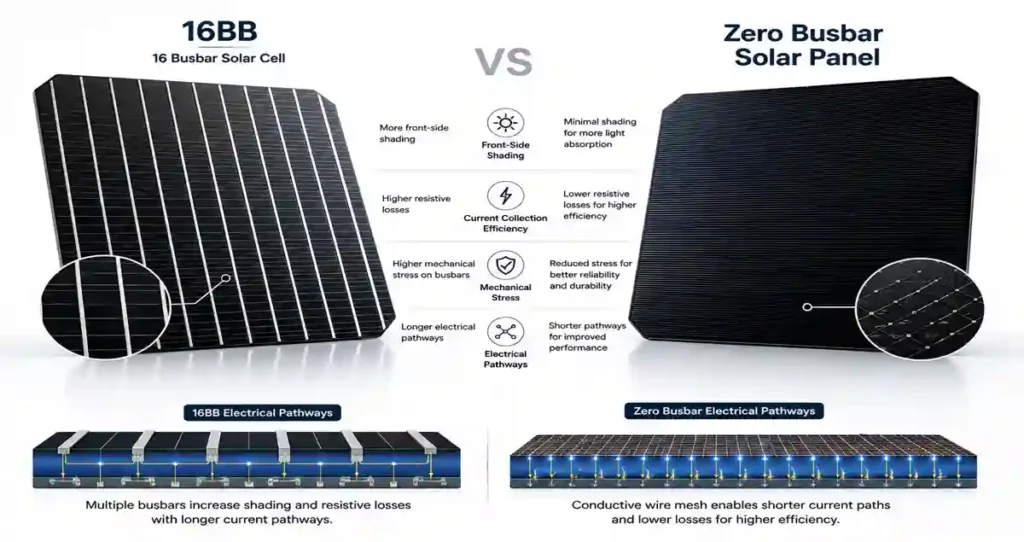
Zero Busbar Solar Panel Performance Overview
| Characteristic | Multi-Busbar (16BB–20+ BB) | Zero Busbar |
|---|---|---|
| Commercial maturity | Excellent | Emerging |
| Electrical resistance | Very low | Very low |
| Front shading | Low | Lowest |
| Mechanical stress | Low | Lower |
| Manufacturing complexity | Moderate | High |
| Cost | Lower | Higher |
| Availability | Widely available | Limited |
| Best suited for | Residential, commercial, utility | Premium high-efficiency modules |
Advantages and Disadvantages
| Advantages | Disadvantages |
| Reduced manufacturing stress from eliminating soldered busbar joints | Newer technology with a shorter field-proven track record than high-BB designs |
| Minimal front-surface shading compared to even high busbar count designs | Fewer manufacturers currently offer it compared to standard busbar options |
| Well-suited pairing with delicate cell architectures like HJT | Marketing under various trade names can make direct comparison confusing |
| Represents the clear direction of near-term cell wiring innovation | Premium positioning means it’s not yet the cost-effective default choice |
Real-World Applications
Zero busbar technology comes up most often in my consulting work on premium projects where the client has already selected HJT or a similar advanced cell architecture, since the two technologies are frequently paired together by manufacturers specifically because the reduced manufacturing stress of zero busbar suits HJT’s more delicate cell structure well. I haven’t yet recommended it as a default choice for straightforward budget-driven residential projects, simply because standard high busbar count designs remain the more cost-effective, equally reliable option for that segment today.
Field Note: I reviewed a premium HJT panel datasheet recently that paired the cell technology with zero busbar wiring, and the combination’s stated reliability data looked genuinely strong — fewer manufacturing defects attributed to soldering stress specifically. That’s a promising signal, though I’d still want to see a few more years of field data accumulate before treating it as thoroughly proven the way 16BB traditional busbar designs now are.
Where It Doesn’t Make Sense Yet
Purely cost-driven projects where a standard 16BB traditional busbar design already delivers excellent, well-proven performance at a lower price point. Zero busbar’s genuine advantages matter most when paired with premium cell architectures that specifically benefit from reduced manufacturing stress — it’s not yet the more cost-effective default for straightforward budget or mid-tier projects.
Where Zero Busbar Makes Sense
| Application | Recommendation | Reason |
|---|---|---|
| Residential rooftop | ★★★★★ | Premium appearance and maximum efficiency |
| Commercial rooftop | ★★★★☆ | Excellent, but higher cost |
| Utility-scale solar farms | ★★★☆☆ | Depends on project economics |
| Budget residential systems | ★★☆☆☆ | 16BB TOPCon usually offers better value |
| High-end HJT systems | ★★★★★ | One of the best combinations available |
What to Ask Your Installer About Zero Busbar Products
If a quote includes zero busbar technology, I’d recommend asking specifically which cell architecture it’s paired with, since that combination matters more than the wiring approach in isolation. Zero busbar paired with HJT or premium back-contact cells represents a coherent, well-reasoned premium product. Zero busbar marketed on its own as a headline feature without clarity on the underlying cell technology is worth a more skeptical look, since the wiring approach alone doesn’t guarantee premium overall performance.
It’s also worth asking directly about available field performance data and warranty terms specific to the zero busbar construction, rather than assuming standard warranty language automatically covers this newer wiring approach identically to traditional busbar designs. A manufacturer confident in the technology should have no difficulty answering these questions directly.
Common Misconceptions Worth Clearing Up
People sometimes assume “zero busbar” means the cell has no current-collection mechanism at all, which obviously can’t be true — the cell still needs some way to gather current. What’s actually eliminated is the traditional wide, soldered busbar; current collection still happens, just through a finer wire-mesh lamination approach instead.
Buying Checklist
- Confirm which cell technology zero busbar is paired with, since that combination affects overall performance more than the wiring approach alone
- Ask for the specific trade name or technical description, since “zero busbar” and “SmartWire” are used somewhat interchangeably by different manufacturers
- Weigh the premium against standard 16BB traditional busbar designs, since the cost-effectiveness case isn’t as clear-cut yet as it is for high busbar count adoption
- Request available field performance data specifically, given the shorter track record compared to traditional busbar designs
For the full trajectory of traditional busbar count increases leading up to this technology, see our Solar Panel Busbars guide. For the specific busbar-count comparison across mainstream options, see 5BB vs 9BB vs 16BB Solar Panels.
My honest expectation for where this technology heads next: as more manufacturers gain experience with the wire-mesh lamination process and field data accumulates to match the confidence level the industry already has in traditional high busbar count designs, I’d expect zero busbar to gradually work its way down from premium HJT-paired product lines into more mainstream, cost-competitive offerings. That’s roughly the same adoption curve busbar count increases themselves followed a decade ago — premium first, mainstream once manufacturing scale and field confidence catch up.
Technology Evolution
3BB
   ↓
5BB
   ↓
9BB
   ↓
16BB
   ↓
20+ BB
   ↓
Zero Busbar (0BB)
Rather than continuing to increase the number of front-side busbars, Zero Busbar Solar Panels represent the next major evolution in photovoltaic engineering by eliminating visible busbars and replacing them with advanced conductive wire technology.
Frequently Asked Questions
What does zero busbar mean in solar panels?
Zero busbar (0BB) refers to cell designs that eliminate traditional soldered front-surface busbars in favor of a fine wire-mesh lamination approach, often marketed under trade names like SmartWire, reducing manufacturing stress and front-surface shading.
Is zero busbar technology better than 16BB traditional busbar designs?
It offers genuine advantages in manufacturing stress reduction and shading, particularly when paired with premium cell architectures like HJT, but 16BB traditional busbar designs remain the more cost-effective, longer field-proven choice for most standard projects today.
Is SmartWire the same as zero busbar technology?
SmartWire is a specific trade name used for one implementation of zero busbar technology. Different manufacturers may use different trade names for similar wire-mesh lamination approaches, so it’s worth asking for the specific technical description rather than assuming all zero busbar products are identical in construction or performance.
Does a Zero Busbar Solar Panel produce more electricity than a 16BB panel?
Not necessarily. Zero Busbar technology reduces front-side shading and improves current collection, but the final energy output still depends on the underlying cell technology, such as TOPCon, HJT, IBC, or ABC, as well as the panel’s overall design.
Why don’t all manufacturers use Zero Busbar technology yet?
Zero Busbar manufacturing requires advanced production equipment, precise conductive wire placement, and tighter quality control. These factors increase manufacturing complexity and cost, which is why most mainstream panels still rely on mature multi-busbar designs.
Which solar panel technologies currently use Zero Busbar?
Zero Busbar is most commonly found on premium HJT, IBC (Interdigitated Back Contact), and ABC (All Back Contact) solar panels. Most TOPCon panels continue to use advanced multi-busbar designs such as 16BB or 20+ BB.
Is Zero Busbar technology the future of solar panels?
Many industry experts consider Zero Busbar one of the next major developments in photovoltaic engineering because it reduces front-side shading and mechanical stress. However, widespread adoption will depend on manufacturing costs and large-scale commercial production.
Should homeowners wait for Zero Busbar Solar Panels?
For most homeowners in 2026, there is little reason to delay a solar installation. Modern 16BB and 20+ BB TOPCon and HJT solar panels already deliver excellent efficiency and long-term reliability. Zero Busbar is a promising technology, but its availability and pricing are still evolving.
References
Manufacturing and reliability data for zero busbar technology reference Fraunhofer ISE’s Photovoltaics Report, NREL’s cell technology research, and ongoing coverage from PV Magazine.
Related guides on SolarVisionAI.com
- Monocrystalline Solar Panels 2026: Still Worth It or Hype
- Polycrystalline Solar Panels: Worth Buying in 2026?
- Thin-film Solar Panels: When They Beat Silicon (2026)
- BIPV Solar Panels: Building-Integrated PV Complete Guide
- Portable Solar Panels: Engineer’s Buyer’s Guide 2026
- CPV Solar Panels: Concentrated Photovoltaic Explained
- Skin Solar Panel: What “Solar Skin” Actually Means
- Solar Fence Post Lights: Cap Sizes, Types & Install Guide
- Bifacial Solar Panels in 2026: How to Boost Energy Output
- Solar Charge Controller: The Complete Guide
- MC4 Connectors: Solar Safety & Installation Guide
- Solar Panel Types, Efficiency & Benefits
- Solar Water Pump Guide
- Commercial Solar Panel Installation: Engineering Guide
- Solar Fence Post Lights: Cap Sizes, Types & Install Guide
- BESS — Battery Energy Storage System Guide
- Commercial Solar Panel Installation
- Solar Refrigerator & DC Fridge — Complete 2026 Guide
- Bifacial Solar Panel Albedo Effect Guide
- TOPCon: Why TOPCon Solar Panel is a Proven Smart Investment in 2026
- HJT: Why TOPCon Solar Panel is a Proven Smart Investment in 2026
- PERC: PERC Solar Panel: Still Relevant or Already Outdated?
- Perovskite: Perovskite Solar Panels: The 2026 Reality Check
- N-Type vs P-Type: N-Type vs P-Type Solar Panels: Honest Comparison
- ABC: ABC (all back contact) Solar Panel: Back Contact Technology Explained
- IBC: IBC Solar Panels: Interdigitated Back Contact Guide
- Tandem: Tandem Solar Panels: Are Stacked Cells Ready for Rooftops?