
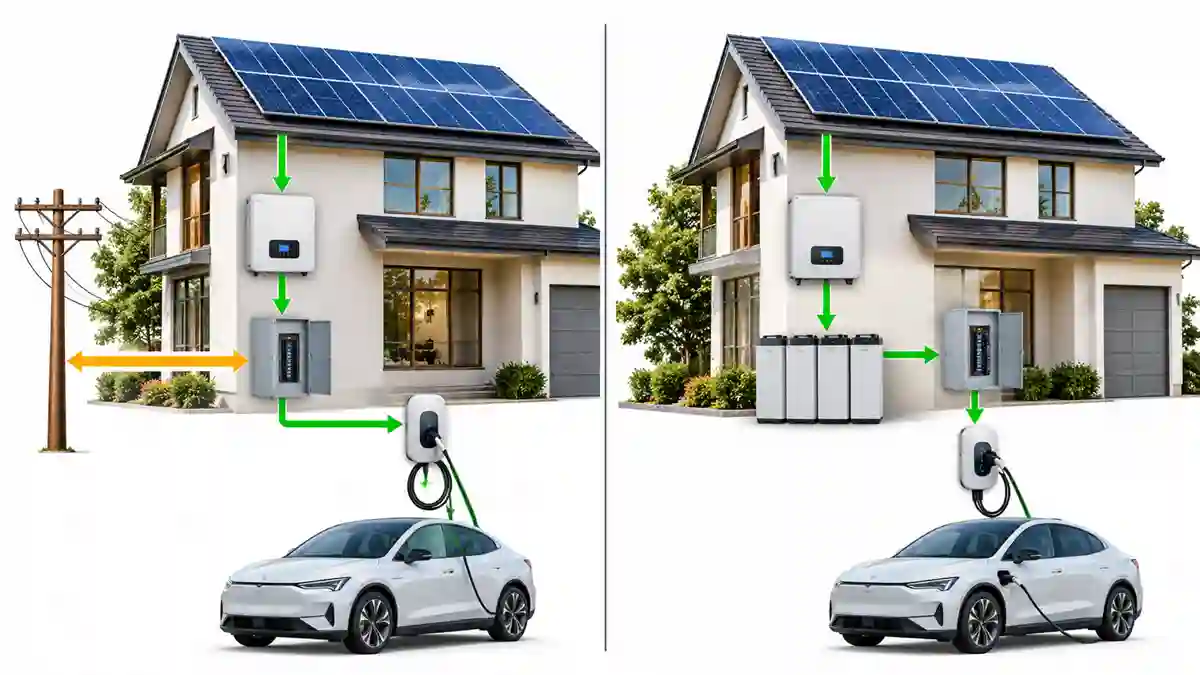
Compare grid-connected vs. off-grid EV charging, including solar panels, battery storage, costs, power outages and system requirements for US homeowners.
Charging an electric vehicle (EV) with solar energy can be done through a grid-connected solar system or a standalone off-grid installation. Both configurations can use solar panels to supply electricity to an EV, but they differ in how they manage power, handle changing solar production, and maintain charging when sunlight is unavailable.
A grid-connected solar EV charging system works alongside the utility electricity supply. When solar generation is insufficient, electricity can come from the grid. An off-grid EV charging system operates independently of the utility network and must manage its own electricity generation, storage and backup supply.
The right configuration depends on your location, daily driving requirements, electricity availability, charging schedule and budget. This guide compares both options, explains their electrical arrangements and examines the practical considerations for residential and remote EV charging.
1. What Is Grid-Connected Solar EV Charging?
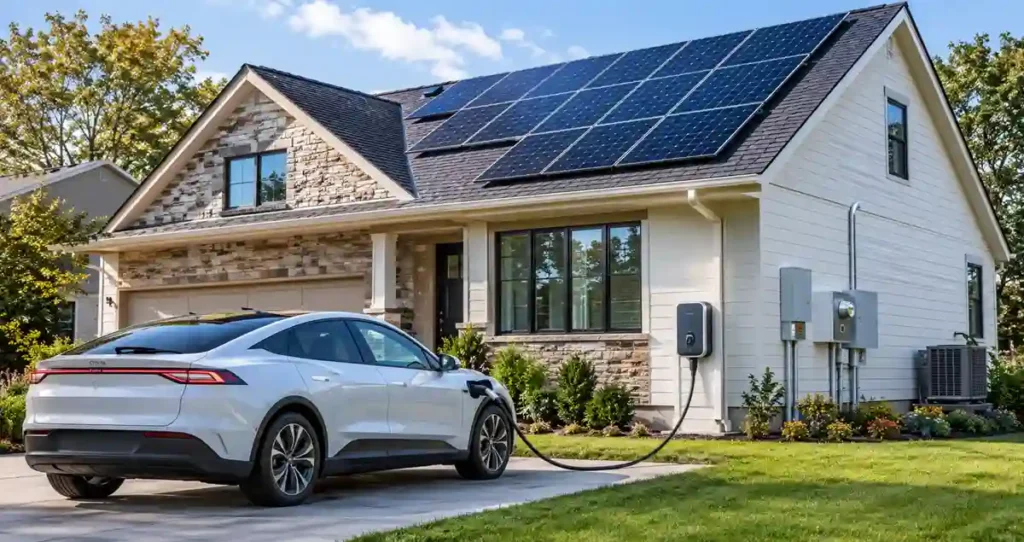
A grid-connected solar EV charging system combines rooftop solar panels with the local electricity network. The solar installation supplies electricity to household loads and the EV charger, while the utility grid provides additional electricity whenever solar generation cannot meet demand.
This arrangement is common for homeowners who already have rooftop solar or plan to install solar panels alongside a home EV charger.
If you are new to solar EV charging, start with our guide on How Solar EV Charging Works, which explains the complete process from solar panels and inverters to EV chargers and vehicle batteries.
How does a grid-connected system work?
During daylight hours, solar panels generate DC electricity. A grid-connected inverter converts this electricity into AC power for household circuits and the EV charging equipment.
An energy management system can prioritize available solar electricity for EV charging. If the vehicle requires more power than the solar system currently produces, the remaining demand can be supplied by the utility grid.
For example:
- Solar panels generate 5 kW.
- Household appliances consume 1 kW.
- Approximately 4 kW remains available for EV charging.
- The EV charger requests 7.2 kW.
- The utility grid supplies the remaining 3.2 kW.
This is a simplified power balance, assuming sufficient electrical service capacity and compatible equipment.
The important advantage is that the vehicle does not have to wait for the solar system to generate its full charging power. Solar and grid electricity can work together to meet the charging demand.
Main components
A typical grid-connected solar EV charging installation includes:
- Solar photovoltaic panels.
- Grid-connected solar inverter.
- Electrical distribution panel.
- Utility electricity connection and meter.
- EV charging equipment (EVSE).
- Energy monitoring or smart charging controls.
Battery storage is optional. A homeowner can charge an EV using solar electricity and grid power without installing a stationary battery.
For more information about inverter selection and operation, see our Solar Inverter Guide.
2. What Is Off-Grid Solar EV Charging?
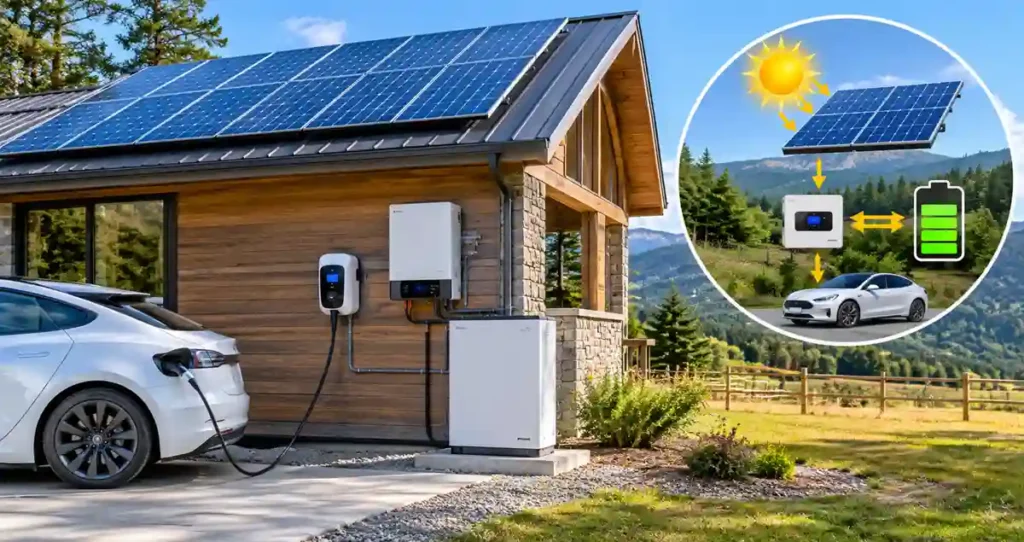
An off-grid solar EV charging system operates without a connection to the utility electricity network. It generates and manages its own electricity to supply the EV charger and any other connected loads.
This configuration can be useful for remote homes, rural properties, isolated facilities and locations where extending the utility grid is difficult or expensive.
Unlike a grid-connected system, an off-grid installation cannot depend on the utility to supply electricity when solar production falls.
It must therefore be designed around the actual charging demand, available solar energy, energy storage capacity and backup arrangements.
How does an off-grid EV charging system work?
Solar panels generate electricity during daylight hours. The system’s power electronics manage the generated energy and direct it toward the connected loads or battery storage.
When solar generation exceeds the immediate demand, surplus electricity can charge the stationary battery bank.
When sunlight decreases or the vehicle needs to charge after sunset, the battery supplies electricity through a suitably rated inverter or an appropriately designed DC charging architecture.
A generator may also be included as backup where extended cloudy periods or high charging demand could exceed the available solar and battery capacity.
Main components
A typical off-grid solar EV charging system includes:
- Solar photovoltaic array.
- MPPT charge controller or suitable solar inverter architecture.
- Battery energy storage system.
- Off-grid or grid-forming inverter, where required by the design.
- EV charging equipment compatible with the electrical system.
- Energy management system.
- Electrical protection and distribution equipment.
- Optional backup generator.
The battery is particularly important in conventional residential off-grid systems because EV charging demand does not always match solar production.
For a deeper explanation of standalone solar configurations, read our Off-Grid Solar System Guide.
3. Grid-Connected vs. Off-Grid EV Charging: Key Differences
Although both configurations can use solar panels to charge an electric vehicle, their operating principles and design requirements are different.
| Comparison | Grid-connected system | Off-grid system |
|---|---|---|
| Utility connection | Connected to the electricity grid | Independent of the utility grid |
| Main energy source | Solar and utility electricity | On-site generation and stored energy |
| Battery requirement | Optional | Normally required for dependable residential operation |
| Nighttime charging | Grid electricity or battery storage | Battery or another on-site power source |
| Cloudy weather | Grid can supplement solar generation | Stored energy or backup generation is needed |
| Power outages | Standard grid-tied solar usually shuts down | Can continue if the system has sufficient available energy |
| Installation complexity | Generally simpler | More complex system design |
| Initial investment | Usually lower without battery storage | Usually higher because of storage and additional equipment |
| Energy independence | Partial | Greater independence from the utility |
| Best suited for | Homes with reliable utility access | Remote properties and locations without practical grid access |
One important point: a grid-connected system can also include batteries and backup capability. The distinction is not simply whether a battery is installed. It is whether the system depends on the utility grid or can operate independently from it.
4. What Happens During a Power Outage?
This is one of the most important differences homeowners should understand before installing solar EV charging equipment.
Grid-connected solar EV charging during an outage
Many homeowners assume that rooftop solar panels will continue supplying electricity when the utility grid fails. However, a conventional grid-tied solar inverter normally disconnects during an outage because of anti-islanding protection.
This safety function prevents the solar installation from unintentionally energizing utility lines while utility personnel may be working to restore power.
As a result, a standard grid-connected solar system may stop supplying the home and EV charger even when sunlight is available.
A solar-plus-battery system with suitable backup functionality can operate differently. Its inverter and transfer equipment can isolate the property from the utility grid and supply selected loads using available solar generation and stored energy.
However, backup operation depends on the inverter’s design, battery capacity, available PV power and the loads connected to the backup circuits.
Read the U.S. Department of Energy’s Solar and Resilience Basics for an explanation of how solar and battery systems can support electricity during outages.
Off-grid solar EV charging during an outage
An off-grid system does not depend on the utility grid, so a utility outage does not directly interrupt its operation.
However, that does not mean it can charge an EV under every condition.
Charging may be limited if:
- Battery state of charge is low.
- Solar generation is reduced by clouds or poor weather.
- The inverter cannot supply the required charging power.
- Household loads consume most of the available energy.
- The battery management system limits discharge.
- The system has insufficient stored energy for nighttime charging.
An off-grid system must be designed with enough power capacity and stored energy to handle these conditions.
5. Do You Need Battery Storage for EV Charging?
The answer depends on the system architecture and when you plan to charge your vehicle.
Grid-connected system without a battery
A grid-connected solar EV charging system can operate without stationary battery storage.
During daylight hours, the EV can use available solar electricity. If solar production decreases, the utility grid supplies the shortfall.
At night, the vehicle can charge using grid electricity.
This arrangement can be practical for homeowners who have reliable utility service and can charge their vehicles during the day or overnight.
Grid-connected system with battery storage
Adding a battery allows homeowners to store surplus solar electricity for use later.
For example, solar panels can charge the stationary battery during the day while the vehicle is away. The stored electricity can then support EV charging in the evening.
A battery can also provide backup power during an outage when the system is designed for islanded operation.
However, battery storage adds equipment cost, conversion losses, maintenance considerations and replacement costs over the system’s operating life.
Learn more about solar batteries, their types and energy storage characteristics.
Off-grid system with battery storage
For a conventional residential off-grid EV charging system, battery storage is generally a central design requirement.
Solar production changes throughout the day and can be reduced by weather, shading and seasonal conditions. EV charging demand, meanwhile, can occur at any time.
The battery provides an energy buffer between solar generation and vehicle charging demand.
A properly designed system must consider both battery energy capacity (kWh) and battery discharge power (kW). Having enough stored energy does not automatically mean that the battery can deliver the required charging power.
Our Home Battery Backup Guide explains how stationary storage supports household electricity requirements.
6. Practical Example: Charging an EV with a 7.2 kW Charger
Consider a residential EV owner who wants to charge a vehicle using a Level 2 AC charger rated at 7.2 kW.
Assume the vehicle needs 30 kWh of energy delivered to its battery.
Grid-connected configuration
Suppose the solar system is generating 5 kW, while the household is consuming 1 kW.
The remaining solar power is:
Available solar power = 5 kW − 1 kW
Available solar power = 4 kW
The EV charger requires 7.2 kW.
Therefore:
Grid contribution = 7.2 kW − 4 kW
Grid contribution = 3.2 kW
The solar system supplies approximately 4 kW, and the utility grid supplies approximately 3.2 kW.
The EV can continue charging at the requested power, provided the electrical installation and charger controls permit this operating condition.
Off-grid configuration
Now consider the same EV charger in an off-grid installation.
There is no utility grid available to supply the additional 3.2 kW.
The system must provide the entire 7.2 kW charging demand, along with any simultaneous household loads.
This means the inverter must have sufficient continuous AC output capacity, while the battery and power electronics must support the required discharge power.
For a simplified battery-sizing illustration, assume:
- Energy required by the EV: 30 kWh.
- Overall battery-to-EV energy delivery efficiency: 90%.
- Maximum planned battery depth of discharge: 80%.
The estimated nominal battery capacity is:
Battery capacity = 30 ÷ (0.90 × 0.80)
Battery capacity ≈ 41.7 kWh
This is an illustrative calculation, not a complete off-grid system design. Actual sizing must account for the manufacturer’s battery limits, inverter efficiency, temperature, reserve capacity, degradation, household loads and operating conditions.
The example shows why off-grid EV charging can require substantial battery storage even when the vehicle’s daily energy requirement appears manageable.
7. Which System Is More Cost-Effective?
The more economical option depends on the location, electricity tariff, solar resource, charging schedule and equipment requirements.
Grid-connected system costs
A grid-connected solar EV charging installation generally has fewer components when battery storage is not included.
Its main cost considerations include:
- Solar panels and mounting structure.
- Grid-connected inverter.
- EV charger.
- Electrical protection and installation.
- Utility interconnection requirements.
- Any necessary electrical service upgrades.
The utility grid reduces the need to size stationary batteries for every nighttime or cloudy-day charging requirement.
However, the homeowner remains exposed to electricity tariffs, utility charges and applicable export compensation rules.
For US homeowners, the value of exported solar electricity varies by utility and state. Net metering and net billing arrangements are not identical.
Read our guides to Net Metering Explained and Net Metering vs. Net Billing.
Off-grid system costs
An off-grid system usually requires more equipment and a more detailed engineering assessment.
Its cost can include:
- Larger solar PV capacity.
- Battery energy storage.
- Off-grid inverter and power conversion equipment.
- Battery management and protection.
- Energy management controls.
- Backup generator, where required.
- Additional electrical installation and commissioning.
The battery bank can be a significant part of the initial investment. Its capacity must be selected according to the expected charging demand and the required period of autonomy.
An off-grid system may avoid utility electricity purchases, but this does not automatically make it cheaper over its lifetime. Battery replacement, system maintenance and backup generation must also be considered.
Use our Solar ROI Calculator as a starting point for evaluating solar investment economics. An off-grid EV charging project will need additional battery and charging-specific cost inputs.
8. Which System Is Better for Different Locations?
The best configuration depends on the property’s electricity access and the way the EV is used.
Residential homes in cities and suburbs
Grid-connected solar EV charging is generally the practical choice for homes with an available utility connection.
Homeowners can use solar electricity during the day and grid electricity when solar generation is insufficient.
A battery can be added if evening solar charging, backup power or greater energy independence is a priority.
Rural properties
Rural properties may have limited grid capacity or unreliable electricity supply.
A grid-connected solar system can still be suitable where a utility connection exists. However, the project should be evaluated for service capacity, utility interconnection and potential electrical upgrades.
Where utility access is available but limited, a hybrid solar-and-battery configuration may help manage EV charging demand.
Remote homes and off-grid properties
An off-grid system can be suitable where utility grid extension is unavailable or prohibitively expensive.
The design must consider the property’s complete electrical demand, not just the EV charger.
A system that can charge a vehicle during sunny afternoons may not have enough stored energy for nighttime charging or several cloudy days.
Commercial and public EV charging locations
Commercial charging facilities may use grid-connected solar, battery storage or a combination of both.
For example, a charging site with limited grid capacity may use a battery energy storage system to reduce peak demand or support short periods of high charging power.
Some remote charging facilities can operate as standalone renewable-energy microgrids.
The U.S. Department of Transportation discusses these options in its EV Infrastructure Project Planning Checklist.
9. Important Design Considerations Before Choosing a System
Before selecting grid-connected or off-grid EV charging, consider the following engineering requirements.
1. Daily EV energy demand
Estimate how much electricity the vehicle needs each day.
Use the vehicle’s energy consumption and expected daily driving distance rather than selecting the solar system based only on the EV battery’s total capacity.
2. Solar energy availability
Evaluate the site’s solar resource, shading, roof orientation and seasonal production.
The system must be designed around realistic energy generation rather than the solar panels’ rated capacity alone.
3. Inverter power capacity
Check whether the inverter can supply the EV charger’s required power while supporting other household loads.
For off-grid systems, continuous inverter output and surge capability must be assessed against the actual load profile.
4. Battery power and energy capacity
If battery storage is included, check both:
- Energy capacity in kWh.
- Continuous charge and discharge power in kW.
These are different specifications and both affect EV charging performance.
5. EV charger compatibility
Confirm that the EV charger is compatible with the electrical supply, inverter arrangement and energy management system.
Some smart EV chargers can adjust their charging power according to available solar surplus. Not every charger or inverter combination supports this feature.
6. Electrical protection and installation
The system requires appropriate circuit protection, grounding, disconnects, wiring and installation practices.
In the United States, the locally adopted electrical codes and permitting requirements must be checked before installation.
For residential solar installation guidance, see our Residential Solar Panel Installation Guide.
10. Frequently Asked Questions
Can I charge an EV using solar panels without connecting to the grid?
Yes. An off-grid solar EV charging system can charge an electric vehicle without utility electricity. It needs suitable solar generation, power conversion and, for dependable conventional residential charging, normally battery storage.
Is grid-connected solar EV charging better than off-grid charging?
For most homes with reliable utility access, grid-connected solar EV charging is generally more practical because the utility can supply electricity when solar generation is insufficient. Off-grid systems are more appropriate for remote properties or locations without a practical grid connection.
Can an off-grid solar system charge an EV at night?
Yes, provided the system has sufficient stored energy and inverter power. Solar electricity generated during the day can be stored in batteries and used for EV charging after sunset.
Does a grid-connected solar system work during a power outage?
A standard grid-tied solar system normally shuts down during a utility outage because of anti-islanding protection. A properly designed solar-plus-battery system with backup capability can continue supplying selected loads while isolated from the utility grid.
Can I use solar panels and grid electricity together to charge my EV?
Yes. A grid-connected solar EV charging system can use available solar electricity and draw additional power from the utility grid when required. Smart energy management can help prioritize solar generation.
Is battery storage compulsory for solar EV charging?
No. A grid-connected system can charge an EV without a stationary battery. Off-grid systems generally require battery storage for dependable charging when solar generation is unavailable, although specialized direct-PV charging architectures can operate without stationary batteries under intermittent charging conditions.
Can an off-grid solar system support a Level 2 EV charger?
Yes, if the system is designed to provide the charger’s required voltage, continuous power and energy. The inverter, battery and electrical protection must all be appropriately rated.
Is off-grid EV charging suitable for commercial charging stations?
It can be suitable for remote sites, fleet depots and locations where utility access is limited. However, commercial charging demand can be substantial, so solar generation, battery storage, charging power and backup requirements must be carefully evaluated.
Conclusion
Grid-connected and off-grid solar EV charging systems both allow electric vehicles to use solar electricity, but they serve different requirements.
A grid-connected system is generally more practical for residential properties with utility access because the grid can supplement solar generation and support charging when sunlight is unavailable. An off-grid system offers greater independence but requires careful planning of solar generation, battery storage, inverter capacity and energy management.
Before choosing either configuration, calculate the vehicle’s daily energy demand and evaluate the property’s electrical supply. The best solution is not necessarily the one with the largest solar array or battery bank, but the one that reliably meets the charging requirement without unnecessary system cost.
Related guides
Related guides on SolarVisionAI.com
- Monocrystalline Solar Panels 2026: Still Worth It or Hype
- Polycrystalline Solar Panels: Worth Buying in 2026?
- Thin-film Solar Panels: When They Beat Silicon (2026)
- BIPV Solar Panels: Building-Integrated PV Complete Guide
- Portable Solar Panels: Engineer’s Buyer’s Guide 2026
- CPV Solar Panels: Concentrated Photovoltaic Explained
- Skin Solar Panel: What “Solar Skin” Actually Means
- Solar Fence Post Lights: Cap Sizes, Types & Install Guide
- Bifacial Solar Panels in 2026: How to Boost Energy Output
- Solar Charge Controller: The Complete Guide
- MC4 Connectors: Solar Safety & Installation Guide
- Solar Panel Types, Efficiency & Benefits
- Solar Water Pump Guide
- Commercial Solar Panel Installation: Engineering Guide
- Solar Fence Post Lights: Cap Sizes, Types & Install Guide
- BESS — Battery Energy Storage System Guide
- Commercial Solar Panel Installation
- Solar Refrigerator & DC Fridge — Complete 2026 Guide
- Bifacial Solar Panel Albedo Effect Guide
- TOPCon: Why TOPCon Solar Panel is a Proven Smart Investment in 2026
- HJT: HJT Solar Panels: Why Heterojunction Is the Hot Climate Champion
- PERC: PERC Solar Panel: Still Relevant or Already Outdated?
- Perovskite: Perovskite Solar Panels: The 2026 Reality Check
- N-Type vs P-Type: N-Type vs P-Type Solar Panels: Honest Comparison
- ABC: ABC (all back contact) Solar Panel: Back Contact Technology Explained
- IBC: IBC Solar Panels: Interdigitated Back Contact Guide
- Tandem: Tandem Solar Panels: Are Stacked Cells Ready for Rooftops?