
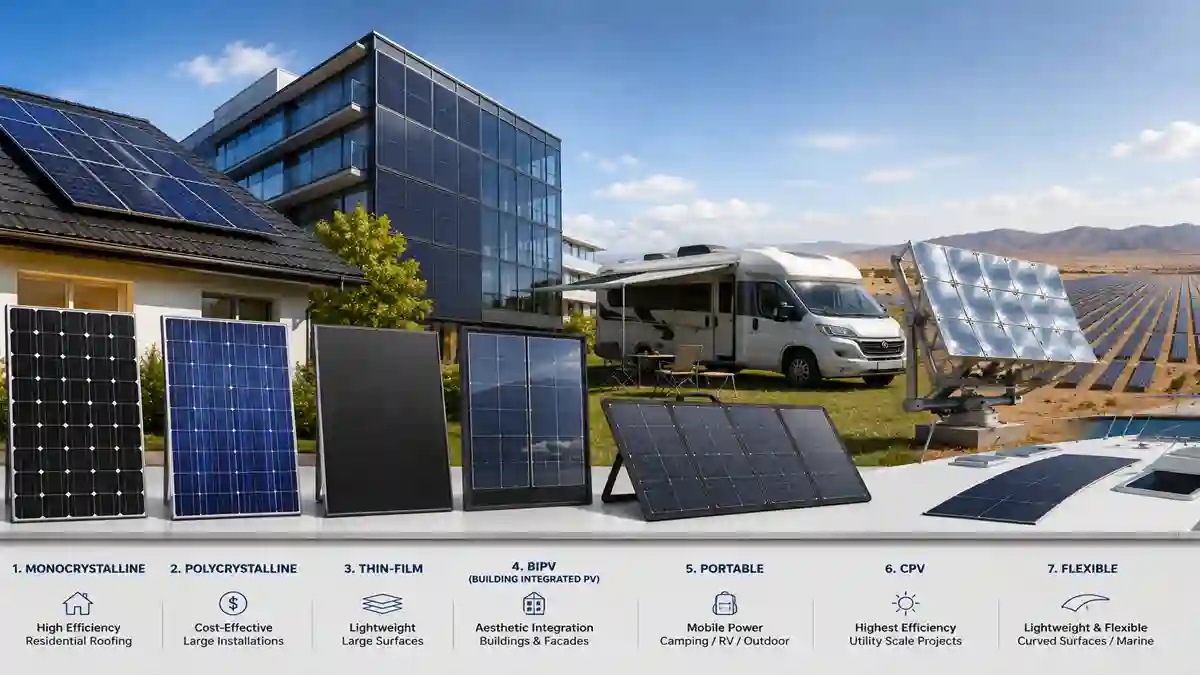
The types of solar panels are explained by a registered engineer — monocrystalline, polycrystalline, thin-film, BIPV, portable, CPV, and flexible.
Every client meeting I’ve ever had starts with some version of the same sentence: “Just tell me which solar panel to buy.” I understand the instinct — solar feels like it should be a commodity decision, the way choosing a light bulb is. It isn’t. “Solar panel” is an umbrella term covering at least seven genuinely different products, built with different materials, aimed at different jobs, and priced on different logic. Get the category wrong, and no amount of careful installation saves the project.
I wrote this guide as the front door to everything else on this site about panel hardware. It’s the page I’d hand a client on day one, before we’ve even talked about their roof. Read it top to bottom, and you’ll know enough to have an intelligent conversation with any installer — and to catch it if someone tries to sell you the wrong type for your situation, which happens more often than the industry likes to admit.
Engineer’s Note: If you read nothing else on this page, read this: there is no single “best” panel type. Every recommendation below is contingent on your roof, budget, and application. The most expensive mistake I see isn’t picking a bad panel — it’s picking a good panel for the wrong situation. A premium monocrystalline panel on an oversized rural roof is just as much of a mismatch as a budget polycrystalline panel on a cramped urban rooftop.
Monocrystalline Solar Panels
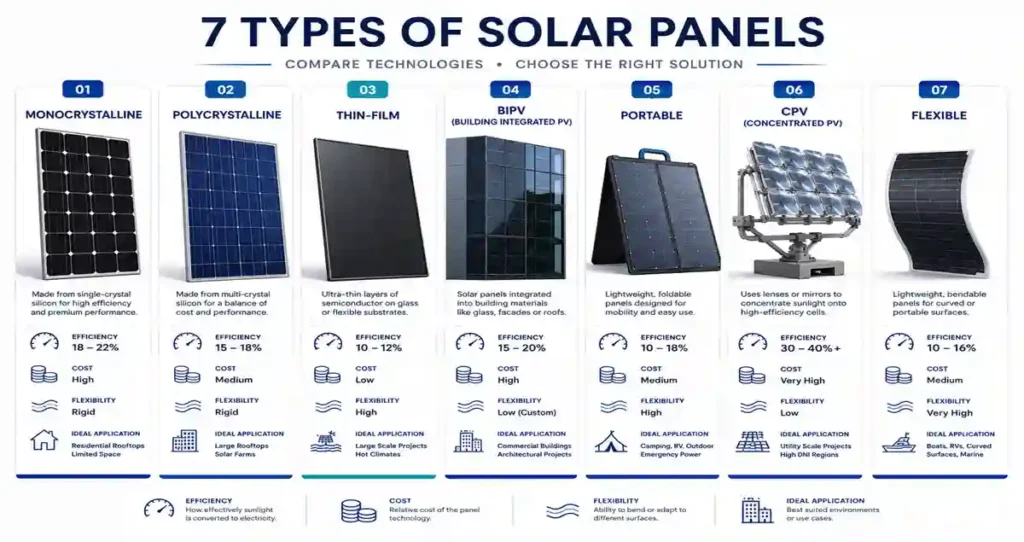
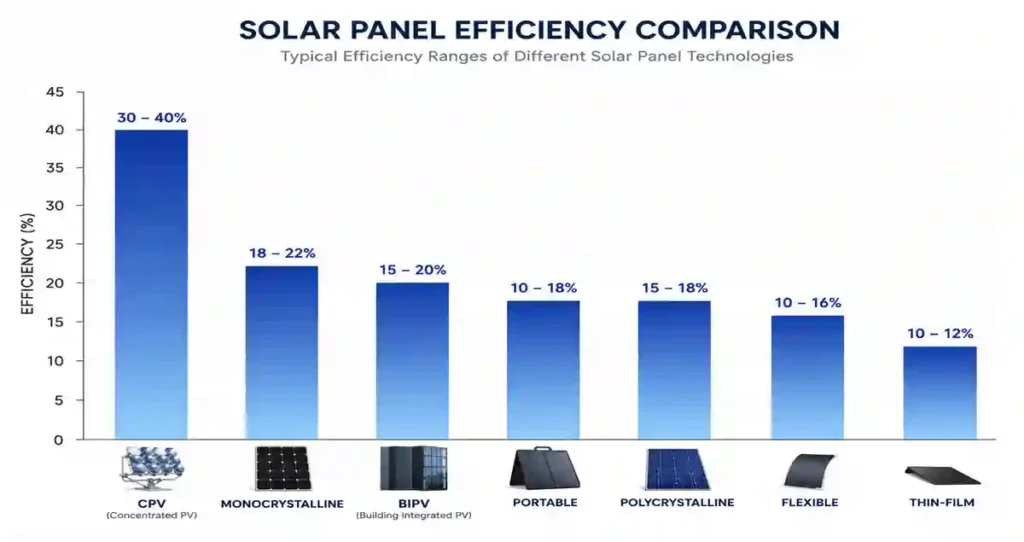
Cut from a single continuous silicon crystal, monocrystalline panels are the ones most people picture when they imagine “solar panels” — uniform black cells, rounded corners where the circular ingot was squared off. It’s also the efficiency leader among mainstream panels, typically 18–22%, with the best low-light and hot-weather performance of the standard silicon types.
I specify monocrystalline on the majority of residential rooftops I work on, simply because most residential roofs have a hard space ceiling — a certain number of square meters and no more — and monocrystalline extracts the most watts out of that fixed area. The trade-off is cost: you’re paying a premium for that efficiency, and on a large enough roof, the premium doesn’t always earn its keep.
| Advantages | Disadvantages |
| Highest efficiency of any mainstream panel type | Highest cost per watt among standard silicon options |
| Best performance in limited-space installations | Marginal cost increase in low-space-constraint projects |
| Strong low-light and hot-climate performance | Manufacturing waste higher than polycrystalline |
| Long track record — 25+ year warranties standard | Efficiency gains over TOPCon/PERC are narrowing |
Polycrystalline Solar Panels
Polycrystalline panels are cast from multiple silicon fragments rather than grown as one crystal — you can spot them by the fractured, glassy-blue cell surface instead of a monocrystalline’s uniform black. That casting process is cheaper and generates less waste, which is exactly why polycrystalline sits at the budget end of the silicon panel market, typically 15–18% efficient.
I still see this panel win bids on large ground-mount projects where land isn’t the constraint — a 2-acre solar farm doesn’t care that polycrystalline needs slightly more space per kilowatt, but it very much cares about total procurement cost across a few thousand panels.
| Advantages | Disadvantages |
| 10–15% lower cost per watt than monocrystalline | Lower efficiency means larger footprint needed |
| Lower manufacturing energy and material waste | Slightly worse temperature coefficient in hot climates |
| Proven, mature manufacturing process | TOPCon has closed much of its historical price advantage |
| Good fit for large, space-abundant installations | Less common on new premium residential product lines |
Thin-Film Solar Panels
Thin-film abandons the silicon wafer altogether. Instead, a semiconductor layer — cadmium telluride, amorphous silicon, or CIGS — is deposited directly onto glass, plastic, or metal. The result is lightweight, sometimes genuinely flexible, and tolerant of heat in a way crystalline silicon isn’t, but efficiency drops to 10–12%.
I’ve specified thin-film exactly twice in the past two years, both times on utility-scale farms in very hot, land-abundant regions where its better temperature coefficient partly offsets the raw efficiency deficit. I would not put it on a residential roof in 2026 — the footprint penalty is too large for how little space most homes have to give.
| Advantages | Disadvantages |
| Lightweight — usable on roofs that can’t bear rigid panel load | Lowest efficiency of any panel category on this list |
| Better heat tolerance than crystalline silicon | Requires roughly double the space for equal output |
| Some variants are genuinely flexible | Historically faster early-year degradation |
| Lower manufacturing material intensity | Limited manufacturer/warranty options for residential |
BIPV (Building-Integrated PV) Solar Panels
BIPV panels don’t sit on your roof — they are your roof, or your facade, or your window glazing. Roof tiles, cladding, and glazing manufactured with embedded PV cells replace the conventional building material rather than mounting on top of it, which is exactly what a client wants when the honest answer to “will it look like solar panels?” needs to be no.
Every successful BIPV project I’ve reviewed was specified during new construction, not retrofitted onto an existing building — that timing is what makes the economics work, because you’re not paying for both the standard building material and the panel separately. For the mounting side of BIPV installation, see Wall Mounted Solar Panels and Wall Facade Solar Mounting System.
| Advantages | Disadvantages |
| Architectural integration — no visible “panel” aesthetic | 30–60% higher cost per watt than standard panels |
| Offsets cost when replacing planned building material | Lower efficiency, especially for tile/glazing formats |
| Ideal for heritage or aesthetic-restricted properties | Fewer qualified installers with BIPV experience |
| Enables solar on facades and balconies, not just roofs | Installation errors risk building weatherproofing |
Portable Solar Panels
Portable panels are built to travel — foldable, lightweight, quick to deploy for camping, RVs, boats, and off-grid emergency power. They prioritize weight and pack size over maximum efficiency, typically running 10–18% depending on the cell technology used underneath the flexible housing.
The marketing in this category is some of the most inflated I’ve seen anywhere in solar — “200W” panels that deliver 120–150W in real field conditions are common. If you’re buying for actual off-grid dependency rather than casual weekend charging, budget around tested field output, not the number printed on the box. For vehicle mounting specifically, see Solar Panel Mount Brackets for RV, Polo & Motorhome.
| Advantages | Disadvantages |
| Lightweight and foldable for travel and off-grid use | Real-world wattage often well below rated STC number |
| Fast setup — no permanent mounting required | Hinges and connectors are common failure points |
| Good fit for camping, RV, marine, and emergency power | Shorter lifespan than fixed rooftop installations |
| Wide range of price points and form factors | Lower efficiency than standard rigid panels |
CPV (Concentrated Photovoltaic) Solar Panels
CPV holds the efficiency record of anything on this list — 30–40%+ — achieved by using lenses or mirrors to concentrate sunlight onto small, extremely high-efficiency multi-junction cells derived from aerospace semiconductor technology. It’s also the panel type I recommend least often, because that efficiency only shows up under specific conditions almost no residential buyer has.
CPV requires continuous sun-tracking to keep concentrated light on the focal point, and it performs poorly under cloud cover or diffuse light. I’ve never specified it on a residential or commercial rooftop — it only comes up in utility-scale conversations, and even there, standard bifacial flat-panel arrays have closed enough of the cost gap that CPV is a shrinking niche.
| Advantages | Disadvantages |
| Highest efficiency of any panel technology, by a wide margin | Requires mechanical tracking — added cost, maintenance, failure points |
| Best energy density per unit land area in ideal-sun climates | Performs poorly under cloud cover or diffuse light |
| Well suited to utility-scale desert/high-DNI installations | No viable residential or small-commercial product |
| Leverages proven aerospace-grade cell technology | High upfront system complexity and cost |
Skin-Type Flexible Solar Panels
This is the category people mean when they picture a solar panel thin enough to laminate onto a curved surface like a decal — a vehicle roof, a backpack, a curved architectural element. It’s built from thin-film cells on a flexible polymer substrate with no rigid glass or aluminum frame, which is exactly what gives it the bend but also exactly what makes it more fragile.
I’ve inspected skin-type panels after 3+ years of outdoor exposure more than once, and every single one showed measurable output decline. I only recommend this category when the curved form factor is a genuine hard requirement, not a nice-to-have — for anything else, a standard portable panel will outlast it by years.
| Advantages | Disadvantages |
| True curved-surface conformity — no other type bends this far | Lower durability, no glass protection layer |
| Very lightweight, ideal for gear and vehicle applications | Shorter lifespan (5–10 years vs 25+ for rigid panels) |
| Enables solar on boats, backpacks, and unconventional shapes | Lower efficiency than rigid or semi-rigid portable panels |
| Growing product range for specialty/expedition use | More vulnerable to punctures and UV degradation |
Efficiency Compared Across Every Panel Type
Which Type Should You Actually Choose?
Tap a box to read the full guide for that panel type
| Your Priority | Best Panel Type | Why It’s the Best Choice | Industry Reference |
|---|---|---|---|
| Maximum efficiency with limited roof space | Monocrystalline | Delivers the highest power output per square meter among mainstream silicon technologies, making it ideal for space-constrained rooftops. | NREL, Fraunhofer ISE |
| Lowest upfront cost with ample installation space | Polycrystalline | Lower manufacturing costs make it a budget-friendly option for large roofs and ground-mounted systems where space isn’t a limitation. | IEA, IRENA |
| Lightweight panels or large utility-scale applications | Thin-Film | Lightweight construction, excellent temperature tolerance, and compatibility with large or unconventional surfaces. | NREL, PV Magazine |
| Seamless architectural integration | BIPV | Functions as both a building material and a solar generator, replacing traditional roofs, façades, or glazing. | IEA PVPS, Fraunhofer ISE |
| Camping, RVs, boats, and portable power | Portable Solar Panels | Foldable, lightweight, and easy to transport, providing convenient off-grid electricity wherever needed. | Industry Best Practice |
| Maximum efficiency for utility-scale projects in high-DNI regions | CPV (Concentrated Photovoltaics) | Achieves the highest photovoltaic efficiencies but requires dual-axis solar tracking and direct sunlight. | NREL, Fraunhofer ISE |
| Curved, lightweight, or unconventional mounting surfaces | Flexible (Skin-Type) Solar Panels | Thin, bendable modules conform to curved roofs, marine applications, and irregular surfaces where rigid panels cannot be installed. | PV Magazine, Industry Applications |
Note: The recommendations above are based on current industry practices and performance data published by the National Renewable Energy Laboratory (NREL), Fraunhofer Institute for Solar Energy Systems (Fraunhofer ISE), the International Energy Agency (IEA), the International Renewable Energy Agency (IRENA), and technical insights from PV Magazine. Product performance may vary depending on manufacturer, cell technology (PERC, TOPCon, HJT), installation quality, and local environmental conditions. Compliance with IEC 61215 and IEC 61730 remains essential when selecting certified solar modules.
For the full side-by-side technical comparison between the three core silicon/thin-film categories, see Monocrystalline vs Polycrystalline vs Thin-Film: Full Comparison.
What’s Inside Every Panel, Regardless of Type
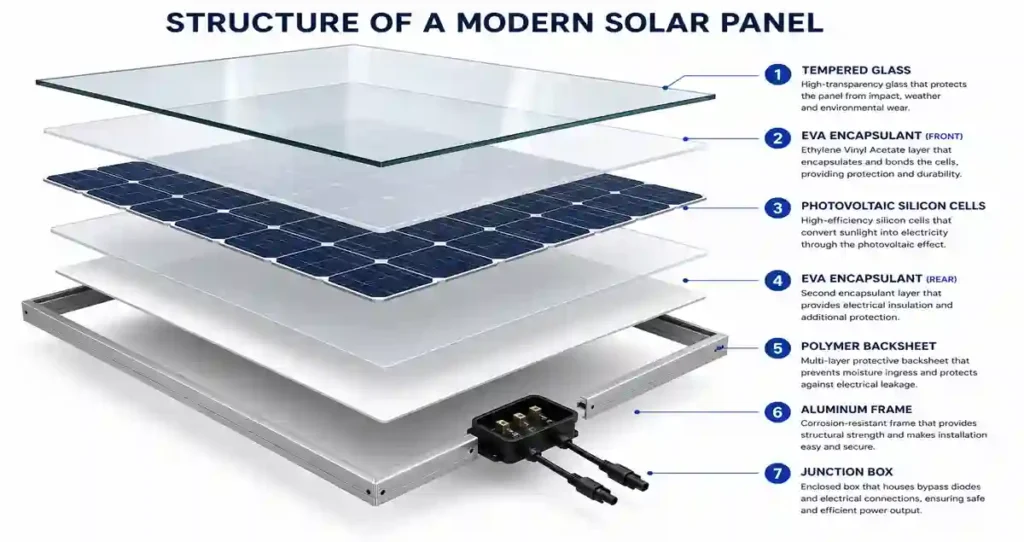
Every panel above, whatever the cell chemistry, shares the same six-layer construction underneath: glass, encapsulant, cells, backsheet, frame, and junction box. What changes between types is the cell chemistry and the form factor — not the fundamental architecture.
Frequently Asked Questions (FAQs)
Which type of solar panel is best for homes?
Monocrystalline solar panels are generally the best choice for residential installations because they offer the highest efficiency, excellent durability, and superior performance when roof space is limited.
Are polycrystalline panels still worth buying?
Yes. Polycrystalline panels remain a cost-effective option for projects with ample installation space. Although their efficiency is slightly lower than monocrystalline panels, they provide excellent value for budget-conscious solar installations.
What is the lifespan of different solar panel types?
Most crystalline silicon solar panels, including monocrystalline and polycrystalline, have a lifespan of 25–30 years. Thin-film and flexible solar panels typically last between 10 and 20 years, depending on the technology, installation quality, and environmental conditions.
Which solar panel performs best in hot climates?
Thin-film solar panels generally have better temperature tolerance, making them perform well in very hot conditions. However, modern TOPCon monocrystalline panels also maintain excellent efficiency and reliable performance in high-temperature environments.
Are flexible solar panels waterproof?
Most high-quality flexible solar panels are weather-resistant and waterproof, making them suitable for outdoor use. However, they generally have a shorter lifespan than traditional glass-covered solar panels.
Can different types of solar panels be mixed?
Yes, different types of solar panels can be combined in the same system. However, their voltage and current characteristics must be carefully matched. Without proper system design, mixing panel types can reduce overall efficiency and energy production.
Which solar panel offers the highest efficiency?
Concentrated Photovoltaic (CPV) systems can achieve efficiencies exceeding 40%. However, they require dual-axis solar tracking systems and are primarily used in utility-scale power plants rather than residential installations.
What is Building Integrated Photovoltaics (BIPV)?
Building-integrated photovoltaics (BIPV) is a solar technology that replaces conventional building materials—such as roofs, facades, skylights, or windows—while simultaneously generating clean electricity. It combines energy production with modern architectural design.
The Full Cluster — Navigation
- Monocrystalline Solar Panels 2026: Still Worth It or Hype
- Polycrystalline Solar Panels: Worth Buying in 2026?
- Thin-film Solar Panels: When They Beat Silicon (2026)
- BIPV Solar Panels: Building-Integrated PV Complete Guide
- Portable Solar Panels: Engineer’s Buyer’s Guide 2026
- CPV Solar Panels: Concentrated Photovoltaic Explained
- Skin Solar Panel: What “Solar Skin” Actually Means
The Complete Solar Panel Technology Cluster
- TOPCon: Why TOPCon Solar Panel is a Proven Smart Investment in 2026
- HJT: Why TOPCon Solar Panel is a Proven Smart Investment in 2026
- PERC: PERC Solar Panel: Still Relevant or Already Outdated?
- Perovskite: Perovskite Solar Panels: The 2026 Reality Check
- N-Type vs P-Type: N-Type vs P-Type Solar Panels: Honest Comparison
- ABC: ABC (all back contact) Solar Panel: Back Contact Technology Explained
- IBC: IBC Solar Panels: Interdigitated Back Contact Guide
- Tandem: Tandem Solar Panels: Are Stacked Cells Ready for Rooftops?
Related guides on SolarVisionAI.com
- Solar Fence Post Lights: Cap Sizes, Types & Install Guide
- Solar Charge Controller: The Complete Guide
- MC4 Connectors: Solar Safety & Installation Guide
- Solar Panel Types, Efficiency & Benefits
- Solar Water Pump Guide
- Commercial Solar Panel Installation: Engineering Guide
- Solar Fence Post Lights: Cap Sizes, Types & Install Guide
- BESS — Battery Energy Storage System Guide
- Commercial Solar Panel Installation