
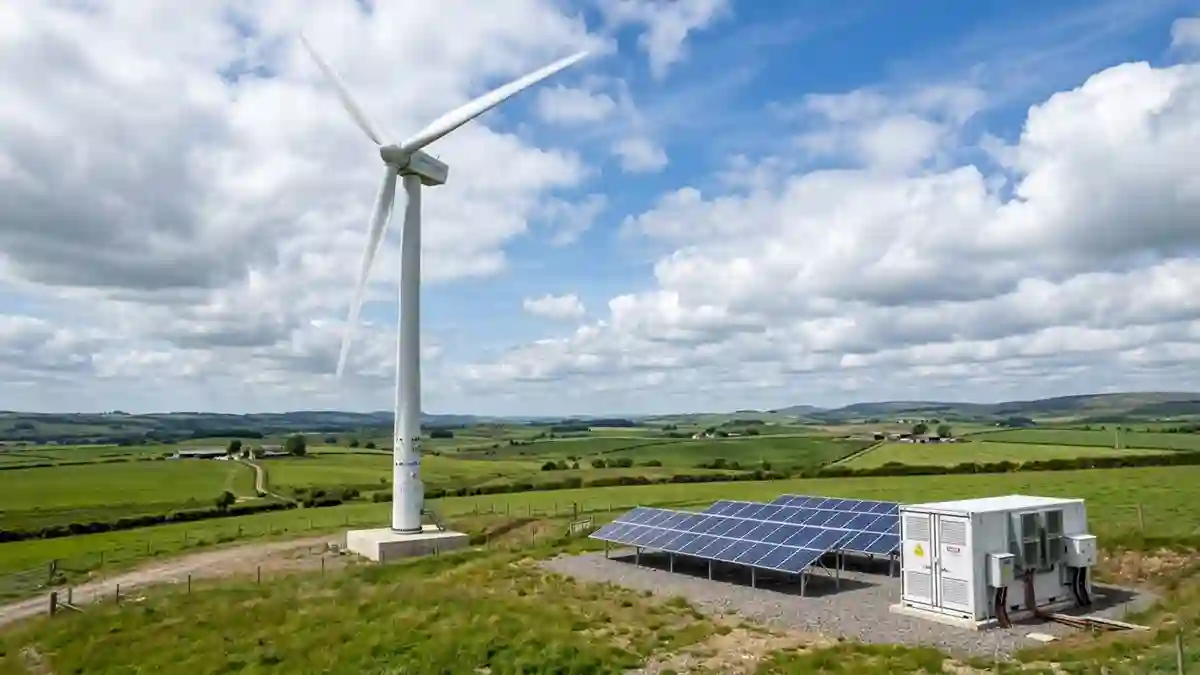
Learn about wind turbine parts and their functions, including blades, generators, nacelles, controllers, towers, batteries, solar panels, and inverters.
Wind turbines are designed to capture energy from moving air and convert it into electricity. However, a wind turbine does not always work alone. In many residential and off-grid installations, it operates alongside solar panels, battery storage, charge controllers, and inverters to provide a more complete renewable energy system.
The two main types of wind turbines are horizontal-axis wind turbines (HAWT) and vertical-axis wind turbines (VAWT).
Horizontal-axis wind turbines are the familiar design seen on wind farms and many small residential installations. Their blades rotate around a horizontal shaft, and the rotor is usually positioned on top of a tower. Many of these turbines have a nacelle containing the generator, gearbox (if used), shaft, and other important equipment. A tail vane or yaw system helps the turbine face the wind, depending on its design.
Vertical-axis wind turbines use a different arrangement. Their rotor turns around a vertical shaft, with blades or curved surfaces arranged around that shaft. They generally do not need the same wind-direction alignment system as conventional horizontal-axis turbines.
In a complete renewable energy installation, the turbine’s generator produces electricity, while a suitable controller manages its electrical output. A rectifier may be needed to convert variable AC output into DC. The electricity can then be used to charge a compatible battery bank or supply a suitable inverter system. Solar panels can provide additional daytime generation, while batteries store energy for use when solar or wind production is low.
If you are planning a complete system, our guides to solar panels and how they work, solar battery storage, LiFePO4 batteries, solar charge controllers, and power inverters explain the other important equipment used in renewable energy systems.
Understanding these connections is important when selecting equipment for a home, an off-grid property or a larger renewable energy installation. A wind turbine’s advertised power rating alone does not tell you whether it will work properly with your batteries, inverter or existing solar system.
In this guide, I will explain the main parts of a wind turbine, using the horizontal-axis design as the primary example. I will also compare its components with those of a vertical-axis turbine, so you can understand how both designs work, how their arrangements differ, and how they connect to a complete renewable energy system.
Horizontal-Axis vs Vertical-Axis Wind Turbine Components
Horizontal-axis and vertical-axis wind turbines perform the same basic job: they capture energy from the wind and convert it into electricity. However, their mechanical arrangements are different.
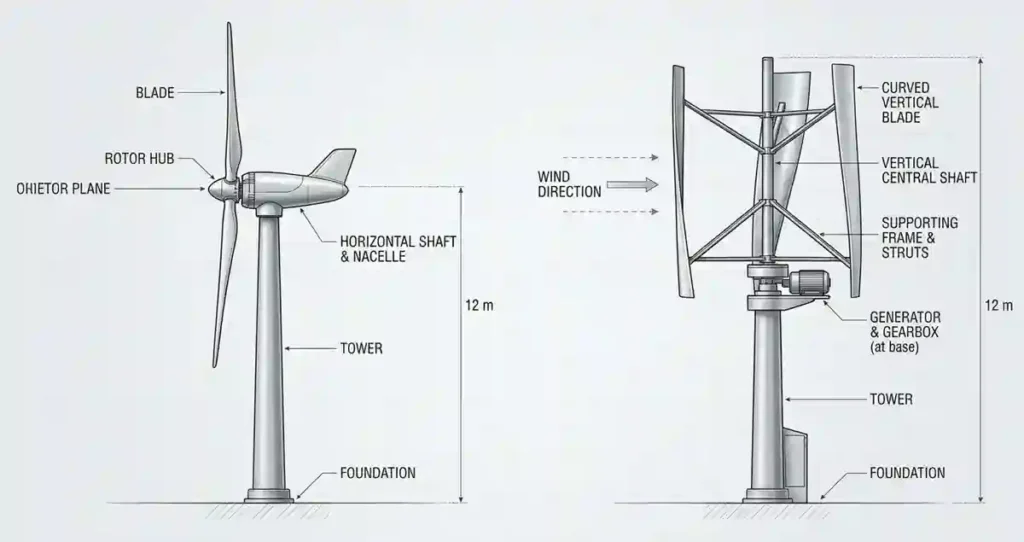
A horizontal-axis wind turbine has a rotor that turns around a horizontal shaft. In a conventional upwind design, the rotor faces the wind, while the nacelle is positioned behind it on top of the tower. The nacelle commonly houses the generator, main shaft, bearings, and, in geared models, the gearbox. A tail vane is often used on small turbines, while larger machines generally use a yaw system to turn the nacelle towards the wind.
A vertical-axis wind turbine has a rotor that turns around a vertical shaft. Its blades or curved rotor elements are arranged around the shaft rather than extending forward from a nacelle. Depending on the design, it may use support arms, upper and lower bearings, a central shaft, and a generator positioned near the base or integrated into another part of the assembly.
The most important difference is the direction of the rotating shaft and the way the turbine responds to changing wind direction. A conventional horizontal-axis turbine usually needs a tail vane or yaw arrangement to face the wind. A vertical-axis turbine generally does not need this type of wind-direction alignment system because its rotor can receive wind from different horizontal directions.
| Component or feature | Horizontal-axis turbine (HAWT) | Vertical-axis turbine (VAWT) |
|---|---|---|
| Rotor shaft | Horizontal | Vertical |
| Blade arrangement | Blades extend from a central hub | Rotor elements arranged around a vertical shaft |
| Nacelle | Commonly used to house drivetrain equipment | Often has a different or simpler equipment arrangement |
| Generator position | Commonly inside the nacelle | May be near the base or integrated into the structure |
| Gearbox | Used in some designs; direct-drive options also exist | Depends on generator and drivetrain design |
| Wind-direction alignment | Usually uses a tail vane or yaw system | Generally does not require a yaw system |
| Main support | Tower and rotor support structure | Tower, frame or other supporting structure |
| Maintenance access | Often involves equipment at height | Some designs allow easier access to ground-level components, but this is not guaranteed |
Which design has simpler components?
A vertical-axis turbine can offer a different maintenance arrangement because some designs place the generator and other equipment closer to the ground. This may make certain inspections or repairs easier. However, the result depends on the actual model, bearing arrangement, foundation and access requirements.
Horizontal-axis turbines are a more established design for many wind-power applications and commonly use well-developed rotor, nacelle and tower arrangements. Their performance and maintenance requirements depend on turbine size, construction quality and site conditions.
Neither design is automatically more efficient, cheaper or easier to maintain. The complete turbine design and the available wind resource matter more than the axis direction alone.
If you are specifically considering a vertical-axis turbine for a residential property, see our dedicated guide: Vertical Wind Turbine for Home: Output, Pros, Cons and Limits.
1. Wind Turbine Blades
The blades are the parts that capture energy from the wind. As air flows around their shaped surfaces, it creates a force that makes them rotate. This rotation is transferred to the hub and then to the turbine’s drivetrain.
Most conventional horizontal-axis wind turbines have two or three blades. Three-blade designs are widely used because they offer a practical balance of performance, stability, and operating smoothness. Blade length and rotor diameter are important because a larger rotor can capture wind from a larger area, although the actual electricity produced still depends on wind speed, turbine design, and site conditions.
Blades are commonly made from reinforced composite materials such as fiberglass. Their condition matters. Cracks, loose fittings, surface damage, or imbalance can affect performance and may create safety risks.
When comparing turbines, do not judge them by blade count alone. Check the manufacturer’s power curve, rotor diameter, rated wind speed, operating wind-speed range, and safety information. For a homeowner, these details are more useful than a headline wattage figure.
2. Rotor and Hub
The rotor is the rotating assembly made up of the blades and the hub. The hub holds the blades in position and transfers their turning force to the main shaft.
Think of the rotor as the part that collects energy from the wind and turns it into mechanical movement. The hub must be strong enough to handle the forces created by the rotating blades, including changing wind conditions and vibration.
Some larger turbines also have a pitch system connected to the rotor. This system changes the angle of the blades to control how much energy they capture. Small turbines may use simpler methods of controlling speed and reducing exposure to strong winds.
3. Main Shaft and Bearings
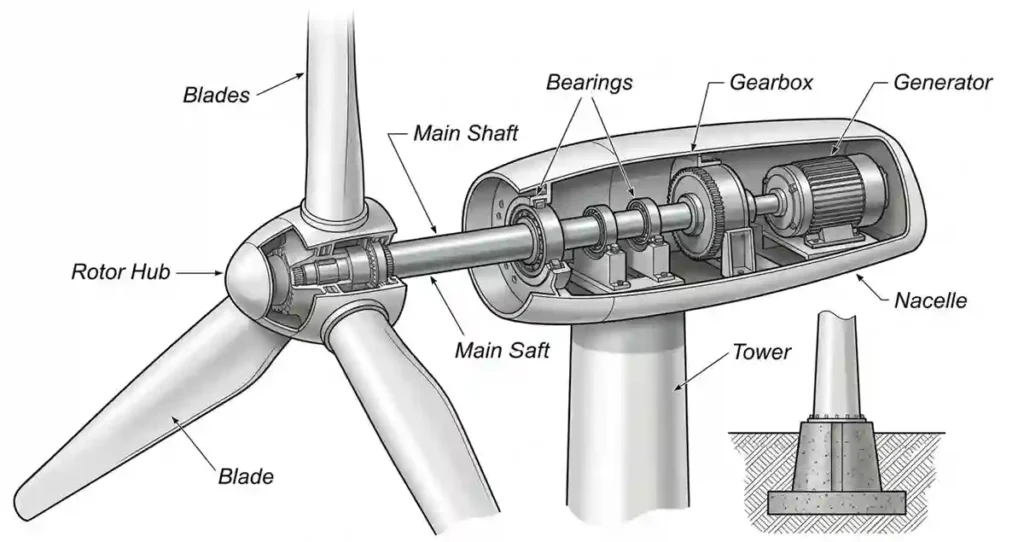
The main shaft connects the rotor to the drivetrain. As the blades and hub rotate, the shaft transfers that movement towards the generator.
Bearings support the shaft and allow it to rotate smoothly. They also help manage the loads created by the rotor. If bearings wear out, become damaged, or are not properly maintained, the turbine may develop noise, vibration, heat, or mechanical problems.
For maintenance planning, bearings should not be treated as minor parts. Their condition can affect the reliability of the entire rotating assembly.
4. Gearbox
A gearbox is used in some wind turbines to increase the rotational speed between the rotor and the generator. The blades usually rotate much more slowly than the speed required by certain generator designs. The gearbox changes that speed so the generator can operate as intended.
However, not every wind turbine has a gearbox. A direct-drive turbine connects the rotor to a generator designed to operate at lower rotational speeds. This removes the gearbox and reduces the number of moving drivetrain parts.
Neither design should automatically be considered the best in every situation. A geared turbine has additional mechanical components that need inspection and maintenance. A direct-drive design avoids the gearbox but may use a larger or more specialised generator. The correct choice depends on the turbine design, operating conditions, service support, and manufacturer’s specifications.
5. Generator or Alternator
The generator converts the mechanical rotation of the turbine into electrical energy. As its internal magnetic field and electrical windings interact, electricity is produced.
Small wind turbines may use permanent-magnet alternators or other generator designs. Their output can vary with rotor speed and wind conditions. This means the electricity coming directly from a wind generator may not have the stable voltage and frequency required by household appliances or the utility grid.
That is why the generator must be matched with the correct rectifier, controller, inverter, and battery or grid connection arrangement.
When selecting a turbine, check the generator’s rated voltage, maximum current, output characteristics, and compatibility with the controller. Do not assume that a generator advertised as 48 V will always produce a constant 48 V under every wind condition.
6. Nacelle
The nacelle is the protective housing located behind the rotor on many horizontal-axis wind turbines. It contains important mechanical and electrical components.
Depending on the turbine design, the nacelle may contain the main shaft, bearings, gearbox, generator, brake, cooling equipment, and control components. It protects these parts from weather and provides the structure that connects the rotor and drivetrain to the tower.
A small residential turbine may have a much simpler housing than a large commercial turbine. Some compact designs combine components in a small generator housing rather than using a large, serviceable nacelle.
The nacelle is important during inspection because unusual noise, excessive vibration, overheating, or visible damage may indicate a problem inside the housing. Maintenance should follow the manufacturer’s procedures. Do not open or work on a turbine at height without the required training, isolation, and safety equipment.
7. Tail Vane and Yaw System
A horizontal-axis turbine needs to face the wind to operate as designed. Small turbines often use a tail vane to help keep the rotor pointed towards the wind.
Larger upwind turbines commonly use a yaw system. It turns the nacelle so the rotor faces the changing wind direction. The system may include a yaw bearing, motors, drives, and control equipment.
Not every turbine uses the same arrangement. Some downwind designs and many vertical-axis turbines do not need the same active yaw arrangement as a conventional upwind horizontal-axis turbine.
When comparing residential turbines, check how the machine responds when wind direction changes. Also check whether the tail or yaw mechanism has inspection and maintenance requirements.
8. Brake and Overspeed Protection
A wind turbine must be able to control its speed and respond safely when wind conditions become too strong or an electrical or mechanical fault occurs.
Depending on its design, a turbine may use mechanical brakes, electrical braking, blade pitch control, furling, or a combination of methods. Furling is a common approach in some small horizontal-axis turbines: the turbine changes its position relative to the wind to reduce the force acting on the rotor.
A brake is not simply an everyday on-and-off switch. It is part of a safety and stopping arrangement, and its operation must follow the manufacturer’s instructions.
Never assume that disconnecting the electrical output will safely stop a wind turbine. The correct shutdown method depends on the turbine and controller design. An unsuitable disconnection can create dangerous operating conditions or damage equipment.
9. Wind Sensors and Controller
Wind sensors help the turbine monitor operating conditions. An anemometer measures wind speed, while a wind vane measures wind direction. Some turbines use additional sensors to monitor temperature, vibration, rotational speed, or electrical conditions.
The controller receives information from the turbine and manages its operation. Depending on the model, it may control starting, stopping, braking, furling or pitch functions, and electrical output.
For a small wind power system, the controller may also manage charging and coordinate with a battery system. However, the turbine’s own control system and the battery charge controller are not necessarily the same device. Some products combine these functions, while others use separate equipment.
Always confirm the controller’s input voltage range, maximum current, turbine compatibility, battery voltage, braking method, and diversion-load requirements. A controller should be selected for the actual turbine, not simply because its advertised voltage matches the battery bank.
For more detail on the electrical side, see the guide to wind and solar hybrid controllers.
10. Rectifier and Diversion Load
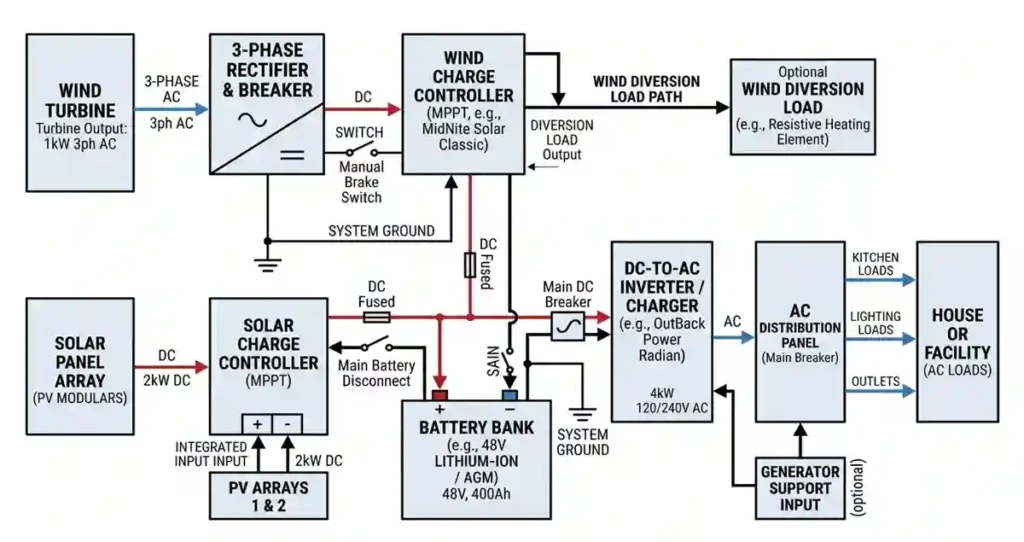
Some small wind turbines produce variable-frequency AC electricity. A rectifier converts this output into DC electricity so it can be managed by a suitable charging or control system.
A diversion load is a controlled electrical load that can absorb excess energy when the battery cannot accept more charging power. In some small wind systems, the controller directs energy to a diversion load to help manage turbine operation and prevent an unsafe charging condition.
The diversion load must be correctly rated and compatible with the controller. It is not a substitute for the turbine’s mechanical safety system, and it should never be selected by guesswork.
This is particularly important in battery-based systems. The controller, battery, braking arrangement, and diversion load must be designed to work together.
11. Tower and Foundation
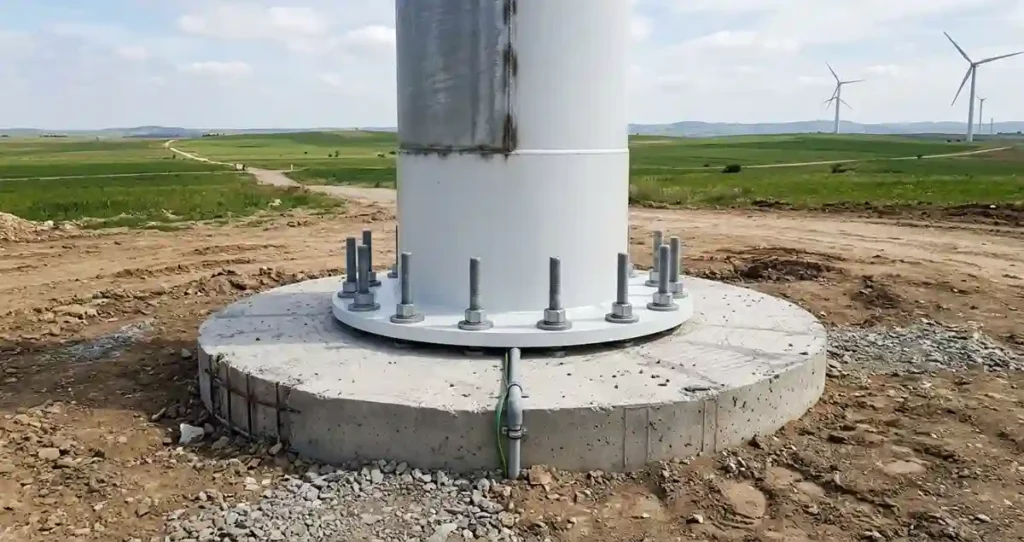
The tower supports the turbine and raises the rotor into the wind. Wind conditions can be very different close to the ground compared with higher elevations, especially near trees, buildings, and other obstacles.
Tower height therefore affects the wind resource available to the turbine. But a taller tower also brings additional structural, installation, access, and cost requirements.
The foundation transfers the tower and turbine loads safely into the ground. Its design depends on the turbine, tower height, soil conditions, local wind conditions, and the manufacturer’s structural requirements.
Do not select a tower based only on price or appearance. Check the manufacturer’s approved tower arrangement, foundation details, structural loading, access for maintenance, and local permitting requirements.
For more on residential turbine selection and site considerations, read Home Wind Turbine: Cost, Output, Sizing and Is It Worth It?.
12. Electrical Cables, Protection and Earthing
The turbine’s electrical output must travel safely from the generator and control equipment to the inverter, battery, or grid connection. Cable size and insulation must suit the system voltage, current, cable length, installation environment, and manufacturer’s requirements.
The electrical installation may require suitable isolators, overcurrent protection, surge protection, grounding and bonding, and other protective equipment. The exact arrangement depends on the turbine design and whether the system is grid-connected or off-grid.
A wind turbine installed on a tower is exposed to weather and may be vulnerable to lightning-related surges. The protection design should consider the tower, electrical wiring, grounding arrangement, and the building or equipment it supplies.
For an off-grid installation, the turbine’s output must also be compatible with the battery charging equipment. You can learn more about battery selection in the LiFePO4 battery guide and home battery backup guide.
13. Inverter and Battery Storage
The inverter and battery are not necessarily parts of the wind turbine itself, but they are important parts of many complete wind power systems.
A battery stores electricity so it can be used when the wind is weak or the turbine is not producing enough power. The battery bank must be compatible with the charging equipment and designed for the expected energy use.
An inverter converts DC electricity from a battery or DC system into AC electricity for compatible household loads. In a grid-connected system, the inverter must also meet the relevant grid-interconnection requirements.
Do not connect a wind turbine directly to an ordinary solar inverter unless the manufacturer specifically approves that arrangement. Wind turbines can have different electrical output and braking requirements from solar panels. A compatible wind controller or approved hybrid system is essential.
For more information, see the power inverter technical guide, hybrid inverter guide, and off-grid solar system guide.
14. How Wind Turbine Parts Work Together
The process begins when wind flows across the blades. The blades rotate the hub, and the rotor transfers mechanical movement to the main shaft. Depending on the turbine design, the shaft drives a gearbox or connects directly to the generator.
The generator produces electricity. The controller and associated electrical equipment manage the output and help protect the turbine. In a small battery-based system, a rectifier and wind charge controller may regulate the electrical supply before it reaches the battery. An inverter then supplies suitable AC power to household loads.
The tower and foundation support the entire machine, while the braking and overspeed protection systems help it respond to operating limits and faults.
The complete arrangement varies by turbine model. Always use the manufacturer’s wiring diagram and installation manual rather than assuming that every turbine follows the same electrical layout.
15. Main Wind Turbine Parts: Quick Comparison
| Component | Main function |
|---|---|
| Blades | Capture energy from the wind |
| Hub | Holds the blades and transfers rotation |
| Rotor | Rotating assembly of blades and hub |
| Main shaft | Transfers mechanical rotation |
| Bearings | Support rotating parts |
| Gearbox | Increases rotational speed where required |
| Generator | Converts mechanical energy into electricity |
| Nacelle | Houses and protects key turbine components |
| Tail vane or yaw system | Helps the rotor face the wind |
| Brake and overspeed controls | Help control or stop the turbine safely |
| Controller | Manages operation and electrical output |
| Rectifier | Converts AC output to DC where required |
| Diversion load | Absorbs controlled excess electrical energy |
| Tower | Raises and supports the turbine |
| Foundation | Transfers structural loads into the ground |
| Inverter | Converts DC electricity into usable AC power |
| Battery | Stores energy for later use |
16. Engineering Standards and Safety Requirements for Wind Turbine Parts
Wind turbine components should be selected and installed according to the manufacturer’s design and the standards adopted in the installation location. The following references are useful starting points.
IEC 61400-2 – Small Wind Turbines: This international standard addresses the safety, design, installation, maintenance, and operation of small wind turbines. Its scope includes mechanical and electrical subsystems, protection mechanisms, support structures, foundations, and electrical connection to the load. See the IEC 61400-2 publication.
NFPA 70 – National Electrical Code (NEC): In the United States, the NEC provides requirements for electrical installations. Article 694 addresses small wind electric systems. The locally adopted edition and authority having jurisdiction determine which requirements apply. See the NFPA 70 information page.
IEEE 1547 – Interconnection of Distributed Energy Resources: This standard is relevant when a wind power system is connected to an electric power system. It addresses the interconnection and interoperability requirements for distributed energy resources. It is not a general mechanical design standard for turbine blades, towers, or gearboxes. See the IEEE 1547 series information.
Standards are not a substitute for the turbine manufacturer’s installation manual, local electrical rules, structural requirements, or required approvals. The correct standards depend on the system type and location.
Engineer’s Note
When I evaluate a wind turbine, I do not look at the generator rating alone. I consider the complete system: rotor size, expected wind conditions, tower arrangement, generator characteristics, controller compatibility, braking method, and the electrical equipment needed to use the energy safely.
A turbine is only as useful as the system around it. A good generator connected to an unsuitable controller or an incorrectly designed battery system can lead to poor performance and equipment problems. Component compatibility should be checked before purchasing or installing the turbine.
Engineer’s Field Notes
Before selecting a small wind turbine, ask the supplier for the technical datasheet, power curve, rated and maximum operating wind speeds, rotor diameter, generator type, controller specifications, approved tower arrangement, and maintenance schedule.
Also confirm whether the package includes the rectifier, diversion load, braking equipment, cables, inverter, and battery interface. Some products advertised as complete wind turbine kits include only the turbine and basic controller. Other equipment may need to be purchased separately.
For an off-grid project, calculate the expected energy use and check the battery charging limits before choosing the turbine. For a grid-connected project, confirm inverter certification and utility interconnection requirements before installation.
Frequently Asked Questions
What are the main parts of a wind turbine?
The main parts are the blades, hub, rotor, shaft, generator, controller, tower, and foundation. Larger turbines may also have a gearbox, nacelle, yaw system, pitch system, and additional sensors. A complete electrical system may include a rectifier, diversion load, inverter, and battery.
What is the function of a wind turbine nacelle?
The nacelle is the housing that protects important turbine equipment. Depending on the design, it may contain the generator, gearbox, shaft, bearings, brake, and control equipment.
Does every wind turbine have a gearbox?
No. Some turbines use a gearbox to increase the rotational speed before the generator. Direct-drive turbines connect the rotor to a generator designed to operate without a gearbox.
What does a wind turbine controller do?
A controller manages the turbine’s operation and electrical output. Depending on the model, it may regulate battery charging, monitor operating conditions, control braking, and manage a diversion load.
What is the difference between a wind turbine generator and an inverter?
The generator converts the turbine’s mechanical rotation into electricity. The inverter converts DC electricity into AC electricity suitable for compatible loads or, when designed and approved for it, grid connection.
What parts are needed for a small off-grid wind power system?
A typical system may include a turbine, approved tower and foundation, controller, rectifier if required, diversion load where specified, battery bank, inverter, cables, isolators, and protective equipment. The exact equipment depends on the turbine and system design.
Which wind turbine part needs the most maintenance?
There is no single answer for every model. Bearings, gearboxes, brakes, electrical connections, and tower fittings can all require inspection. A direct-drive turbine does not have gearbox maintenance, but its other components still need servicing according to the manufacturer’s schedule.
Final Thoughts
Wind turbines are made up of mechanical, structural, and electrical components that must work together. The blades and rotor capture wind energy, the generator produces electricity, and the controller and protection equipment help manage the system. The tower, foundation, cables, inverter, and battery complete the installation where they are required.
If you are comparing home wind turbine kits, look beyond the advertised wattage. Check the power curve, generator design, controller compatibility, tower requirements, safety features, maintenance needs, and availability of replacement parts. A properly matched system is more important than choosing a turbine based on its rating alone.
Related guides
- Solar and Wind Hybrid System: Design, Sizing, Cost, and Working
- Wind and Solar Hybrid Controller: Wiring, Inputs and Protection
- Home Wind Turbine: Cost, Output, Sizing and Is It Worth It?
- Wind Turbine Inverter: Grid-Tie, Off-Grid and Hybrid Options
- Home Wind Turbine Kits: What You Need and How to Choose
- Vertical Wind Turbine for Home: Output, Pros, Cons, and Limits
- Off-Grid Wind Turbine: Sizing, Batteries and System Design
Related guides on SolarVisionAI.com
- Monocrystalline Solar Panels 2026: Still Worth It or Hype
- Polycrystalline Solar Panels: Worth Buying in 2026?
- Thin-film Solar Panels: When They Beat Silicon (2026)
- BIPV Solar Panels: Building-Integrated PV Complete Guide
- Portable Solar Panels: Engineer’s Buyer’s Guide 2026
- CPV Solar Panels: Concentrated Photovoltaic Explained
- Skin Solar Panel: What “Solar Skin” Actually Means
- Solar Fence Post Lights: Cap Sizes, Types & Install Guide
- Bifacial Solar Panels in 2026: How to Boost Energy Output
- Solar Charge Controller: The Complete Guide
- MC4 Connectors: Solar Safety & Installation Guide
- Solar Panel Types, Efficiency & Benefits
- Solar Water Pump Guide
- Commercial Solar Panel Installation: Engineering Guide
- Solar Fence Post Lights: Cap Sizes, Types & Install Guide
- BESS — Battery Energy Storage System Guide
- Commercial Solar Panel Installation
- Solar Refrigerator & DC Fridge — Complete 2026 Guide
- Bifacial Solar Panel Albedo Effect Guide
- TOPCon: Why TOPCon Solar Panel is a Proven Smart Investment in 2026
- HJT: Why TOPCon Solar Panel is a Proven Smart Investment in 2026
- PERC: PERC Solar Panel: Still Relevant or Already Outdated?
- Perovskite: Perovskite Solar Panels: The 2026 Reality Check
- N-Type vs P-Type: N-Type vs P-Type Solar Panels: Honest Comparison
- ABC: ABC (all back contact) Solar Panel: Back Contact Technology Explained
- IBC: IBC Solar Panels: Interdigitated Back Contact Guide
- Tandem: Tandem Solar Panels: Are Stacked Cells Ready for Rooftops?