
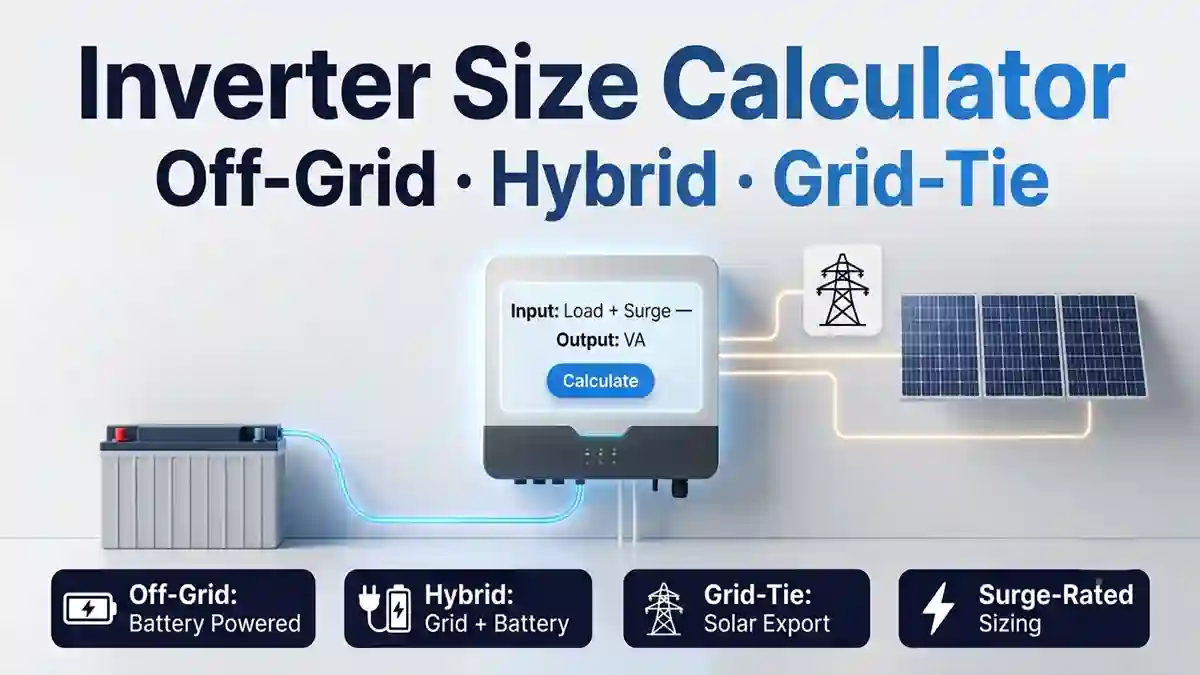
Free Inverter Size Calculator — Find the exact VA rating and surge capacity for your inverter. Covers resistive, motor, and mixed loads for solar and backup systems.
Please enter a valid load value greater than zero.
Use our free Inverter Size Calculator to find the exact VA rating and surge capacity your inverter needs to run your appliances safely and reliably. Enter your total connected load, load type, and power factor to get an instant, engineering-grade recommendation — including the correct DC current draw for your battery cables.
Note: This calculator sizes an inverter based on your connected appliance load and starting surge — the correct method for off-grid systems and for hybrid inverters operating in battery/backup mode. If you are sizing a grid-tie inverter to match a solar panel array for grid export, sizing is based on array kW rather than appliance load; consult an installer or your inverter manufacturer’s DC-to-AC ratio guidelines for that scenario.
Off-Grid Inverter: Powers your home independently of the utility grid, using battery storage. Must be sized for connected load and motor starting surge — this is what this calculator covers.
Hybrid Inverter: Works with both the grid and a battery bank. In backup or off-grid mode it must be sized the same way as an off-grid inverter, using this calculator.
Grid-Tie Inverter: Exports solar power directly to the utility grid with no battery. Sized by matching the solar panel array’s kW output, not household appliance load — a different calculation from the one below.
String Inverter: One central inverter connects multiple panels wired together in a series “string.” Cost-effective for residential roofs with consistent, unshaded sun exposure, but shading or a fault on one panel can reduce output across the whole string.
Micro Inverter: A small inverter installed on each solar panel instead of one central unit. Shading or a fault on one panel does not affect the others. Higher cost per watt than string inverters, but better performance on roofs with partial shading or multiple angles.
1. Why an Inverter Size Calculator Must Account for Surge, Not Just Running Load
The single most common inverter sizing mistake is matching the inverter’s continuous wattage rating to the sum of appliance wattages and stopping there. This approach works for purely resistive loads like lights and heaters, but fails immediately for any load containing an electric motor — refrigerators, water pumps, air conditioners, washing machines, and power tools.
Motors draw a large surge current for a fraction of a second at startup, often 3 to 7 times their rated running current, before settling into normal operation. An inverter sized only for the running wattage will trip, shut down, or fail to start the motor at all. A proper Inverter Size Calculator must separately calculate both the continuous VA requirement and the surge VA requirement, then recommend an inverter whose surge rating exceeds the highest expected starting demand.
Engineer’s Note: Always check the inverter’s surge rating in the manufacturer’s datasheet, not just its continuous power rating. A common industry standard is a surge rating of 2x continuous power for 1-3 seconds, but budget inverters sometimes offer only 1.5x, which is insufficient for starting a compressor-based air conditioner or a submersible water pump. Confirm the exact surge multiplier and duration before purchasing, especially for motor-heavy loads.
2. The Inverter Size Calculator Formula
Continuous VA = Total Load (W) ÷ Power Factor
Surge VA = Continuous VA × Load Surge Factor
Recommended Inverter (VA) = Continuous VA × (1 + Safety Margin)
Example: Total load: 1,500W (fridge + pump + lights) | Power factor: 0.8 | Surge factor: 3x (motor loads) | Safety margin: 25%
Calculation: 1500 ÷ 0.8 = 1,875 VA continuous | 1,875 × 3 = 5,625 VA surge | 1,875 × 1.25 = 2,344 VA recommended continuous rating
For this example, select an inverter rated at a minimum of 2,500 VA continuous with a surge rating of at least 5,625 VA to reliably start all connected motor loads.
Engineer’s Note: Power factor represents the ratio between real power (Watts) and apparent power (VA). Most inverters are rated in VA, while appliance labels typically show Watts. Dividing your total wattage by a realistic power factor (commonly 0.8 for mixed residential loads) converts your load into the VA figure that actually matches how inverters are rated — skipping this step is a common cause of underestimating true inverter requirements by 20-25%.
3. Understanding Load Types in Your Inverter Size Calculation
Different appliance categories place very different demands on an inverter. Correctly classifying your loads before running the calculation is essential for an accurate result.
- Resistive Loads (Surge 1.0x): Incandescent bulbs, electric heaters, toasters, irons. No significant starting surge — running wattage equals starting wattage.
- Mixed Electronic Loads (Surge 1.5x): LED lights, televisions, laptops, small fans, routers. Modest starting surge from capacitor charging in switched-mode power supplies.
- Motor and Pump Loads (Surge 3x): Refrigerators, water pumps, ceiling fans, washing machines, split air conditioners. Significant starting surge from induction motor magnetizing current.
- Heavy Motor and Compressor Loads (Surge 5x): Well pumps, large compressors, table saws, elevator motors. Very high starting surge requiring careful inverter surge rating verification.
Engineer’s Note: When sizing an inverter for a home or off-grid cabin with multiple motor loads, never simply add up each device’s individual surge requirement — in practice, appliances rarely all start simultaneously. Instead, size the continuous VA for the sum of all loads running together, but size the surge VA for your single largest motor load starting while all other loads are already running. This realistic approach prevents extreme oversizing while still ensuring reliable operation.
4. Inverter Size Calculator Examples by Application
Small Off-Grid Cabin
Load: LED lights (40W) + laptop (65W) + small fan (60W) + phone charger (10W) = 175W total, all mixed electronic loads
Result: 175 ÷ 0.9 = 194 VA continuous | Surge: 194 × 1.5 = 291 VA | Recommended: 250-300 VA inverter, widely available as a compact 300W-500W unit
Home Backup System with Refrigerator
Load: Refrigerator (150W running) + LED lights (60W) + fan (75W) + TV (100W) + router (15W) = 400W total, motor load present
Result: 400 ÷ 0.8 = 500 VA continuous | Surge (refrigerator compressor): 500 × 3 = 1,500 VA | Recommended: 650 VA continuous, 1,500+ VA surge inverter
Solar Water Pump System
Load: 1 HP submersible pump (746W rated, motor start) + control panel (20W) = 766W total, heavy motor load
Result: 766 ÷ 0.8 = 958 VA continuous | Surge: 958 × 5 = 4,790 VA | Recommended: 1,200 VA continuous, minimum 5,000 VA surge inverter
Whole Home Backup System
Load: Refrigerator (150W) + AC unit (1,500W) + lights (200W) + TV (100W) + washing machine (500W) + misc (300W) = 2,750W total, multiple motor loads
Result: 2,750 ÷ 0.8 = 3,438 VA continuous | Largest surge (AC compressor): additional ~4,500 VA momentary | Recommended: 4,500-5,000 VA continuous inverter with hybrid or pure sine wave output
Engineer’s Note: For any load involving an air conditioner or heat pump compressor, always request the specific locked-rotor amperage (LRA) rating from the AC unit’s nameplate rather than relying on a generic surge multiplier. Air conditioner compressors can draw 5-8 times their running current momentarily, which is significantly higher than the general motor surge factor and is the single most common cause of undersized inverters failing to start AC units in solar and backup power systems.
5. Quick Reference Inverter Size Calculator Table
| Total Load | Load Type | Continuous VA | Surge VA | Recommended Inverter |
| 200 W | Mixed Electronic | 250 VA | 375 VA | 300-500 VA |
| 500 W | Motor / Fridge | 625 VA | 1,875 VA | 1,000 VA |
| 1,000 W | Motor / Pump | 1,250 VA | 3,750 VA | 2,000 VA |
| 1,500 W | Mixed + Motor | 1,875 VA | 5,625 VA | 3,000 VA |
| 2,500 W | Heavy Motor / AC | 3,125 VA | 15,625 VA | 5,000 VA |
| 5,000 W | Whole Home | 6,250 VA | 18,750 VA | 8,000 VA |
6. Pure Sine Wave vs Modified Sine Wave Inverters
Inverter output waveform quality directly affects which loads it can safely and efficiently run, and this decision should factor into your Inverter Size Calculator sizing since waveform type affects real-world surge handling and appliance compatibility.
Pure Sine Wave Inverters
Produce a clean, smooth AC waveform nearly identical to grid power. Required for sensitive electronics, variable-speed motors, medical equipment, and modern appliances with electronic controllers. Pure sine wave inverters handle motor starting surge more gracefully and are the standard recommendation for any solar or off-grid system in 2026.
Modified Sine Wave Inverters
Produce a stepped, approximate sine wave at a lower manufacturing cost. Suitable for simple resistive loads and basic motors but can cause humming, reduced efficiency, or malfunction in variable-speed motors, LED dimmers, and some electronic devices. Modified sine wave inverters are increasingly rare in 2026 as pure sine wave technology has become cost-competitive.
Engineer’s Note: Always choose a pure sine wave inverter for any system that includes a refrigerator compressor, air conditioner, well pump, or modern variable-speed motor appliance. The small additional cost is quickly justified by improved motor starting reliability, reduced audible humming, and compatibility with the electronic control boards found in nearly all modern appliances manufactured after 2020.
7. Frequently Asked Questions About Inverter Sizing
What size inverter do I need for a refrigerator?
A typical residential refrigerator draws 100-200W running but can surge to 3-5 times that at compressor startup, meaning a 150W refrigerator needs an inverter with at least 450-750 VA of surge capacity, even though its continuous draw is modest. Always check the compressor’s locked-rotor amperage on the appliance nameplate for precise sizing.
Can I use a smaller inverter if I don’t run everything at once?
Yes, but size for your realistic worst-case scenario — the sum of all loads you expect to run simultaneously, plus the surge of your single largest motor starting during that period. Undersizing based on optimistic assumptions about usage patterns is a common cause of inverter overload trips.
Why does my inverter shut down when the air conditioner starts?
This almost always indicates the inverter’s surge rating is insufficient for the AC compressor’s locked-rotor starting current. Check the compressor’s LRA rating on the unit nameplate and confirm your inverter’s surge VA rating and duration exceed this value with adequate margin.
Should I size my inverter based on Watts or VA?
Inverters are rated in VA (apparent power), while most appliance labels show Watts (real power). Convert your total wattage to VA by dividing by your system’s power factor (typically 0.8 for mixed loads) before comparing to an inverter’s VA rating, to avoid underestimating the required capacity.
How much bigger should my inverter be than my calculated load?
A minimum 20-25% safety margin above your calculated continuous VA requirement is recommended to accommodate future load additions, inverter efficiency losses, and normal operating headroom. For systems with heavy motor loads such as well pumps or air conditioners, ensure the surge rating specifically — not just the continuous rating — has adequate margin above your largest motor’s starting demand.
Also Check Our Related Calculators
- Watt-Hours to Watts Calculator
- Watts to Watt-Hours Calculator
- kWh to kW Calculator
- kW to HP Calculator
- Amps to Watts Calculator
- Solar Battery Size Calculator
- Solar Panel Size Calculator
- Watts to Amps Calculator
- Volts to Watts Calculator
Related guides on SolarVisionAI.com
- Monocrystalline Solar Panels 2026: Still Worth It or Hype
- Polycrystalline Solar Panels: Worth Buying in 2026?
- Thin-film Solar Panels: When They Beat Silicon (2026)
- BIPV Solar Panels: Building-Integrated PV Complete Guide
- Portable Solar Panels: Engineer’s Buyer’s Guide 2026
- CPV Solar Panels: Concentrated Photovoltaic Explained
- Skin Solar Panel: What “Solar Skin” Actually Means
- Solar Fence Post Lights: Cap Sizes, Types & Install Guide
- Bifacial Solar Panels in 2026: How to Boost Energy Output
- Solar Charge Controller: The Complete Guide
- MC4 Connectors: Solar Safety & Installation Guide
- Solar Panel Types, Efficiency & Benefits
- Solar Water Pump Guide
- Commercial Solar Panel Installation: Engineering Guide
- Solar Fence Post Lights: Cap Sizes, Types & Install Guide
- BESS — Battery Energy Storage System Guide
- Commercial Solar Panel Installation
- Solar Refrigerator & DC Fridge — Complete 2026 Guide
- Bifacial Solar Panel Albedo Effect Guide
- TOPCon: Why TOPCon Solar Panel is a Proven Smart Investment in 2026
- HJT: Why TOPCon Solar Panel is a Proven Smart Investment in 2026
- PERC: PERC Solar Panel: Still Relevant or Already Outdated?
- Perovskite: Perovskite Solar Panels: The 2026 Reality Check
- N-Type vs P-Type: N-Type vs P-Type Solar Panels: Honest Comparison
- ABC: ABC (all back contact) Solar Panel: Back Contact Technology Explained
- IBC: IBC Solar Panels: Interdigitated Back Contact Guide
- Tandem: Tandem Solar Panels: Are Stacked Cells Ready for Rooftops?