
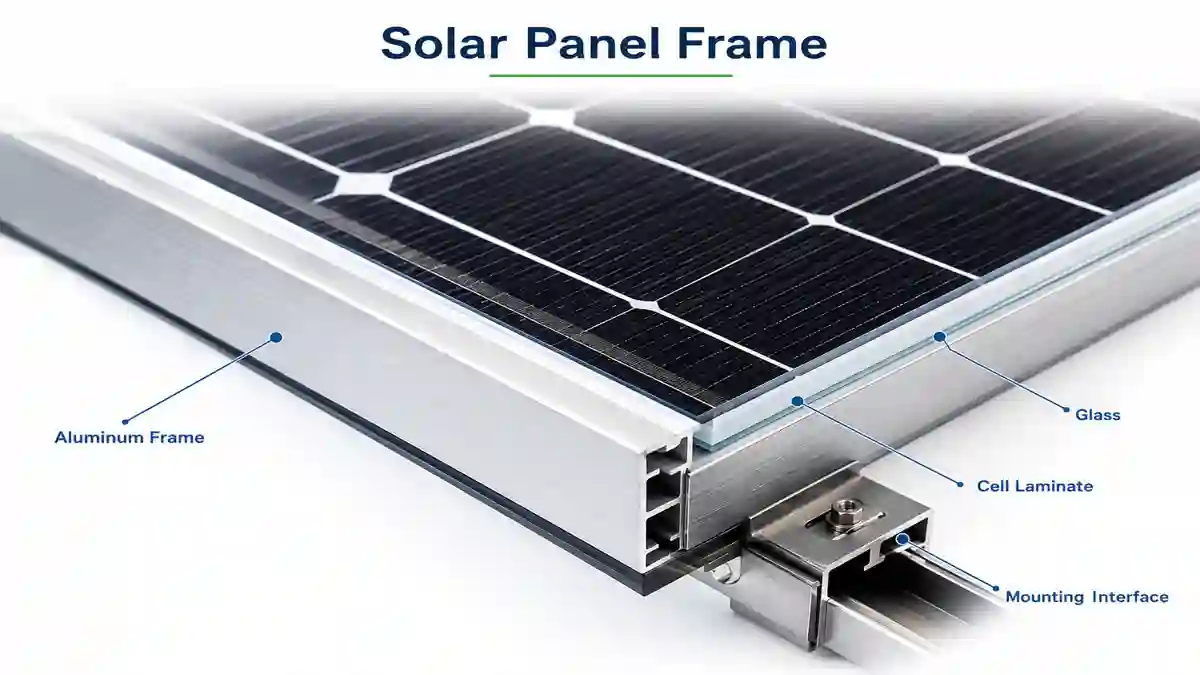
Solar panel frame materials explained by a registered engineer — alloy grades, thickness, and what actually determines structural reliability.
The aluminum frame around a solar panel does far more than give the module a finished appearance. It provides structural support, carries wind and snow loads, creates the mounting interface with the racking system, protects the module edges, and contributes to the panel’s long-term durability outdoors.
Yet frame specifications are often overlooked when buyers compare solar panels.
All framed panels may look similar, but the alloy grade, frame geometry, thickness, anodizing quality, corner construction, color, and grounding arrangement can vary significantly between manufacturers.
This guide explains what actually matters when evaluating a solar panel frame—from structural materials and black vs silver finishes to grounding and long-term reliability.
For the broader components of a PV module, see our Frameless Solar Panels guide.
What Is a Solar Panel Frame?
A solar panel frame is the structural perimeter surrounding a framed PV module. It is typically manufactured from aluminum extrusion and serves several important functions.
The frame:
- Supports the module structure
- Provides mounting points for the racking system
- Helps distribute mechanical loads
- Protects the glass and module edges
- Helps maintain structural integrity during transportation and installation
- Provides a bonding and grounding interface where required
- Protects the module from long-term outdoor exposure
The frame itself does not generate electricity, but its design can directly affect how reliably the module survives its operating environment.
Solar Panel Frame Materials: Aluminum Alloy Matters
The overwhelming majority of framed solar panels use aluminum because it combines low weight, corrosion resistance, and useful structural strength.
Two alloy designations commonly encountered are 6063-T5 and 6061-T6.
Both are established aluminum alloys, but their mechanical properties differ.
6063-T5
6063-T5 is widely used for aluminum extrusions and remains a practical choice for many standard-load applications.
It can provide:
- Good corrosion resistance
- Good extrusion characteristics
- Adequate structural performance for many installations
- A relatively economical solution
For standard residential installations in moderate environments, a quality 6063-T5 frame can be a perfectly reasonable choice.
6061-T6
6061-T6 generally provides higher mechanical strength than 6063-T5.
That makes it particularly relevant where the module may experience demanding structural loads, such as:
- High-wind locations
- High-snow-load regions
- Commercial installations
- Projects where additional structural margin is desirable
Engineer’s Note: I check the specific alloy grade on solar commercial projects where wind or snow loading is a serious design consideration.
The difference between 6063-T5 and 6061-T6 isn’t simply marketing terminology. Their mechanical properties are different, and that difference can matter when a module is being loaded close to its design limits
Aluminum Alloy Grades
The overwhelming majority of framed solar panels use aluminum, with 6063-T5 and 6061-T6 among the commonly encountered structural alloy specifications.
Both are legitimate aluminum grades, but they have different mechanical properties. 6061-T6 generally provides higher strength, while 6063-T5 is widely used for extruded architectural and structural applications where its properties are suitable.
For demanding applications, the alloy should therefore be considered together with the complete frame design and the manufacturer’s tested wind and snow load ratings.
Engineer’s Note: I check the specific alloy specification on commercial projects, particularly where wind or snow loading is significant. However, I don’t evaluate a solar panel frame by alloy grade alone. The extrusion geometry, mounting configuration and tested load rating are equally important.
Does Solar Panel Frame Thickness Matter?
Yes, but thickness should not be considered in isolation.
Frame wall thickness can influence rigidity and resistance to deformation, but the overall structural behavior also depends on the alloy, extrusion geometry, corner construction, mounting points and load distribution.
A thicker frame is therefore not automatically a stronger or better frame.
For buyers, the manufacturer’s tested wind and snow load rating is generally more useful than trying to judge frame quality simply by looking at the extrusion thickness.
Does Frame Thickness Matter?
Frame thickness (the gauge or wall thickness of the aluminum extrusion) does affect structural rigidity and load capacity, though within the range used by reputable manufacturers, the difference is generally less significant than alloy grade or overall frame geometry design. A frame that’s genuinely too thin for its application will show measurable flex under load, but this is more commonly an issue with unverified budget products than a meaningful differentiator between quality mainstream manufacturers.
| Frame Factor | What It Affects | What To Check | Industry Reference |
| Alloy grade (6063-T5 vs 6061-T6) | Yield strength, load capacity in extreme conditions | 6061-T6 for high wind/snow zones | Industry Standard |
| Frame thickness/gauge | Structural rigidity, resistance to flex under load | Manufacturer’s stated wind/snow load rating, not thickness alone | Industry Best Practice |
| Anodized coating quality | Corrosion resistance, particularly in coastal environments | Confirm anodizing thickness/quality for coastal installations | Industry Best Practice |
| Corner joint design | Structural integrity at frame corners, a common failure point | Look for robust corner bracket or welded joint design | Industry Best Practice |
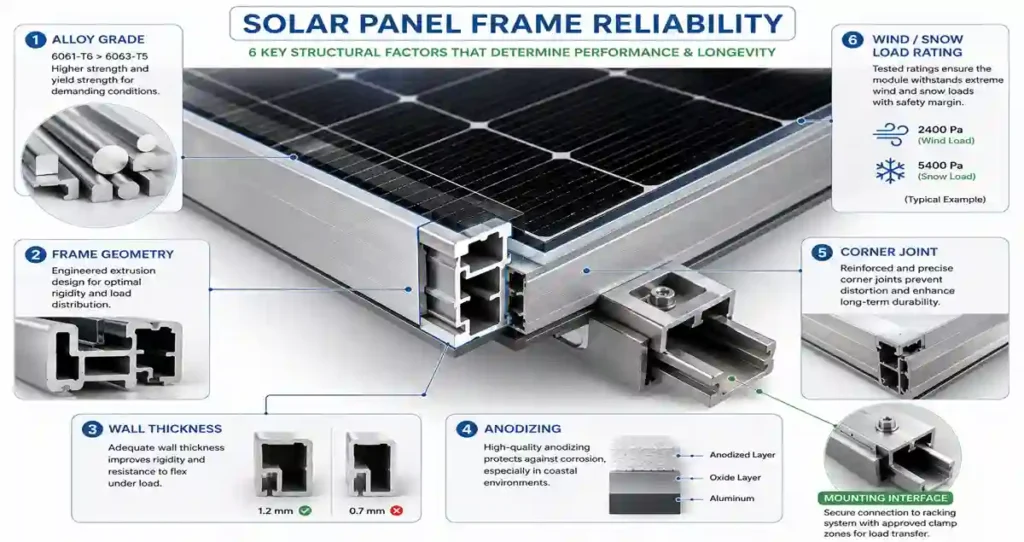
6061-T6 vs 6063-T5 Solar Panel Frames
| Frame Alloy | General Characteristics | Where It May Matter | What Buyers Should Check |
|---|---|---|---|
| 6061-T6 | Higher strength and yield strength | Demanding structural applications | Complete frame design and tested load rating |
| 6063-T5 | Commonly used extrusion alloy with suitable structural properties | Standard applications where the manufacturer’s design is appropriately rated | Manufacturer specification and load rating |
My Engineering Experience: Reducing Frame Cost Without Changing Panel Technology
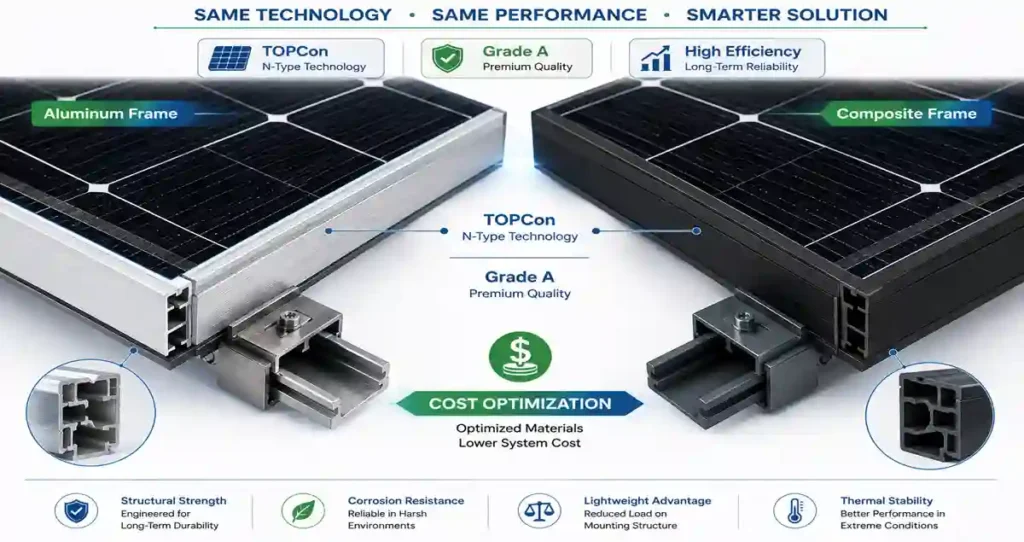
One example from my own project experience showed me why the solar panel frame should not be evaluated separately from the overall panel specification and project budget.
A client wanted the same TOPCon technology and Grade A panel quality we had originally quoted, but the quoted price was beyond their budget. Rather than immediately moving the client to a lower-cell technology or a lower product grade, I negotiated with the client and the manufacturing company to find another solution.
We ultimately finalized a composite-frame material that reduced the overall panel cost while allowing us to retain the same TOPCon technology and Grade A product specification required by the client.
The important lesson was that reducing cost does not necessarily mean reducing photovoltaic technology or panel grade. The frame is one component of the overall module, and an appropriately engineered alternative material can sometimes provide a more cost-effective solution when its structural, environmental, and mounting requirements are properly verified.
Engineer’s Note: This is why I don’t recommend telling a client simply to “buy the strongest frame available.” The better approach is to first establish the required cell technology, panel grade, mechanical load requirements, and site conditions, and then identify where the specification can be optimized without compromising the requirements that actually matter.
Which Solar Panel Technologies Use Frames?
Most conventional crystalline-silicon solar panels are available with framed construction. The frame surrounds the module and provides mechanical support regardless of the underlying cell technology.
Common technologies include:
- PERC solar panels — Traditionally available in framed designs, particularly in conventional residential and commercial modules.
- TOPCon solar panels — Commonly manufactured with aluminum frames for rooftop and utility-scale applications.
- HJT solar panels — Often use framed construction, although frameless and specialized designs also exist.
- IBC / Back-contact panels — Available in premium framed designs, with the frame providing the same basic structural and mounting functions.
- Bifacial solar panels — Frequently use aluminum frames, although some bifacial modules are designed with frameless or specialized structures to maximize rear-side light collection.
- Monocrystalline solar panels — Most mainstream monocrystalline modules use aluminum frames because they combine strength, weight, and corrosion resistance.
The important distinction is that cell technology and frame construction are separate design choices. A TOPCon, HJT or IBC panel is not automatically stronger because of its cell technology, and a premium-looking frame does not necessarily indicate better photovoltaic performance.
What Actually Determines Solar Panel Frame Reliability?
A solar panel frame should be evaluated as a complete structural system rather than by one specification.
| Frame Factor | What It Affects | What Buyers Should Check |
| Aluminum alloy | Strength and structural capacity | Manufacturer’s alloy specification |
| Frame geometry | Rigidity and load distribution | Extrusion design |
| Wall thickness | Resistance to flex and deformation | Manufacturer specification |
| Anodizing quality | Corrosion resistance | Coating specification |
| Corner joints | Long-term frame integrity | Joint construction |
| Mounting interface | Load transfer to racking | Approved mounting zones |
| Wind/snow rating | Structural performance under environmental loads | Manufacturer’s tested rating |
The strongest-looking frame is not necessarily the strongest. The complete design and tested performance matter more than appearance alone.
Why Wind and Snow Load Ratings Matter More Than Thickness
A solar panel can have a substantial-looking aluminum frame and still be unsuitable for a particular installation if its tested load rating does not meet the site’s requirements.
Wind and snow loads depend on factors such as:
- Module design
- Frame geometry
- Mounting position
- Clamp location
- Racking system
- Installation configuration
- Local environmental conditions
For this reason, buyers should check the manufacturer’s stated or tested wind and snow load rating rather than selecting a panel based only on frame thickness or alloy.
Engineer’s Note: For a commercial or high-wind project, the question I want answered isn’t simply “What alloy is the frame?” I want to know what load the complete module is designed and tested to withstand and under what mounting conditions.
Black vs Silver Solar Panel Frames: Does Color Matter?
Black and silver frames are primarily a matter of appearance and product design. Frame color alone does not establish structural strength, corrosion resistance, or overall module reliability.
A black frame can look more premium, but buyers should still verify the underlying specifications.
When comparing two solar panels, prioritize:
- Alloy specification
- Frame geometry
- Tested load rating
- Anodizing/coating quality
- Corner construction
- Manufacturer documentation
Do not confuse frame appearance with structural performance.
Black vs Silver Solar Panel Frame Comparison
| Factor | Black Frame | Silver Frame |
|---|---|---|
| Structural properties | Determined primarily by alloy and design | Determined primarily by alloy and design |
| Appearance | Uniform, discreet, modern | Traditional, more visible |
| Roof aesthetics | Popular for visible residential roofs | Conventional appearance |
| Heat absorption | Slightly higher surface absorption | Slightly lower |
| Electrical performance | Frame color is not a major performance factor | Frame color is not a major performance factor |
| Price | May carry a modest premium depending on manufacturer | Often baseline option |
| Main reason to choose | Appearance and architectural integration | Cost and traditional appearance |
Does a Black Frame Make a Solar Panel Less Efficient?
Not in any practically significant way based on frame color alone.
A darker surface can absorb somewhat more heat than a lighter surface, but the frame’s contribution to overall module temperature is small compared with factors such as:
- Ambient temperature
- Solar irradiance
- Mounting configuration
- Ventilation beneath the module
- Cell technology
- Temperature coefficient
Therefore, I would not reject a black-frame panel because of concerns that the frame color will significantly reduce electrical output.
Why Are Black Solar Panels So Popular?
The popularity of all-black modules is largely driven by aesthetics.
A black frame combined with black cells and a dark backsheet creates a more visually uniform array, which many homeowners prefer when the solar system is highly visible from the street.
I’ve seen this preference become increasingly common among clients who want the solar installation to integrate with the architecture of the building rather than look like an added piece of equipment.
For clients who prioritize cost and have no strong aesthetic preference, silver remains a completely reasonable choice.
Solar Panel Frame Grounding: The Safety Side
Structural design is only part of the story.
A metal solar panel frame is electrically conductive and can potentially become energized if an internal electrical fault occurs.
For example, damaged insulation, wiring problems, or water-related faults could create an unintended electrical path.
Proper grounding and bonding provide a deliberate safety path for fault conditions rather than allowing exposed metal parts to remain at a hazardous potential.
How Is a Solar Panel Frame Grounded?
Grounding and bonding arrangements vary according to the module, racking system, and applicable electrical requirements.
Common approaches include:
| Method | How It Works | Typical Application |
|---|---|---|
| Grounding lug/hole | Dedicated attachment point bonds the frame to a grounding conductor | Framed PV modules |
| Grounding clips | Connection bonds the module frame to the racking system | Rail-mounted systems |
| Continuous grounding conductor | Connects bonded module/racking components into the system grounding path | Complete PV systems |
The exact installation method should follow the module manufacturer’s instructions and applicable local electrical requirements.
Grounding Is Not the Same as Positive/Negative Wiring
This is one of the most important distinctions for anyone inspecting a solar system.
The module’s positive and negative conductors are part of the normal DC power circuit.
The frame grounding system is a safety system.
Grounding does not normally carry the module’s operating current. Its purpose is to provide a safe fault-current path if something goes wrong.
Engineer’s Note: Grounding and the DC positive/negative circuit are two separate electrical systems that happen to exist on the same solar panel.
A system can generate power normally while still having a compromised grounding path. That’s why normal operation alone cannot prove that grounding is functioning correctly.
Why Grounding Connections Can Degrade
Grounding connections can be affected by long-term outdoor exposure.
Potential concerns include:
- Corrosion
- Loose clips or fasteners
- Poor initial installation
- Thermal cycling
- Environmental exposure
- Incompatible connection materials
This is especially important in coastal or high-corrosion environments.
Field Note: I identified a grounding connection at a coastal installation that had corroded significantly.
The system was operating normally, and there was no obvious indication during a casual visual inspection that the safety path had been compromised.
A deliberate continuity check during maintenance identified the problem.
That’s why grounding integrity should not be assumed simply because the solar system continues to produce electricity.
How Solar Panel Frame Design Affects Long-Term Reliability
A solar panel frame can remain almost invisible for years while continuously experiencing environmental stress.
Over its service life, it may be exposed to:
- Strong winds
- Snow loads
- Rain
- Salt air
- Humidity
- Thermal expansion and contraction
- Transportation and installation stresses
- Mechanical loading from the mounting system
This is why frame quality should be considered as part of the module’s overall reliability rather than as a cosmetic specification.
A useful evaluation considers the complete combination of:
Alloy + geometry + thickness + joints + coating + load rating + grounding + installation
No single specification tells the whole story.
Solar Panel Frames in Coastal Environments
Coastal installations introduce an additional concern: prolonged exposure to salt-laden air.
Aluminum naturally forms a protective oxide layer, and quality anodizing can provide additional protection. However, inadequate coating quality, damaged surfaces, joints and corners can become vulnerable to corrosion over time.
The important point is that 6061-T6 is not automatically a “better solar panel frame” in every application. A properly engineered 6063-T5 frame can be suitable when its geometry, mounting system and tested load rating meet the requirements of the installation.
For coastal installations, buyers should pay particular attention to:
- Anodizing or surface-treatment quality
- Frame corners and joints
- Mounting hardware compatibility
- Exposure to salt air
- Manufacturer suitability recommendations
Field Note: I inspected a coastal installation showing visible corrosion around frame corners after several years. The base aluminum alloy was not the primary problem — the surface protection was inadequate for the site’s salt-air exposure. It is a good example of why the frame alloy alone does not tell the whole story.
Advantages and Disadvantages of Framed Construction
| Advantages | Disadvantages |
| Provides structural rigidity and a standardized racking mounting interface | Adds weight compared to frameless alternatives |
| Protects panel edges from impact and moisture ingress | Frame corners are a documented common point of long-term wear |
| Well-understood, mature manufacturing with decades of field history | Aesthetic preference increasingly favors frameless or black-frame designs |
| Higher alloy grades offer genuine structural margin for extreme conditions | Verifying alloy grade requires reading the datasheet, not just visual inspection |
Real-World Applications
I specify 6061-T6 framing as standard practice for any commercial or high-wind-zone project, since the structural margin is meaningful and the cost difference over 6063-T5 is modest relative to overall project cost. For standard residential installations in moderate climates, 6063-T5 remains a perfectly reasonable, well-proven choice that I don’t hesitate to recommend when it’s what a quality manufacturer offers.
Field Note: I inspected a coastal installation showing visible corrosion at the frame corners after several years, tracing back to inadequate anodizing quality for that specific salt-air environment. The base aluminum alloy was fine — the coating protecting it wasn’t adequate for the site’s specific corrosion exposure, which is exactly the kind of detail that doesn’t show up on a basic spec sheet comparison.
Common Misconceptions Worth Clearing Up
People sometimes assume all aluminum frames are functionally interchangeable since they look similar. Alloy grade, thickness, anodizing quality, and corner joint design all vary meaningfully between manufacturers, and these differences matter most precisely during the extreme wind or snow events the frame is ultimately there to withstand — not during normal day-to-day operation when the differences are invisible.
Common Misconceptions About Solar Panel Frames
All aluminum frames are basically the same
Not necessarily. Alloy, geometry, thickness, coating quality, joints, and load ratings can vary between manufacturers.
A thicker solar panel frame is always better
Not by itself. Structural performance depends on the complete frame design and tested load rating.
6061-T6 automatically means a better panel
No. It provides higher strength than 6063-T5, but suitability depends on the application and complete module design.
Black frames are stronger than silver frames
Frame color does not establish structural strength.
A high wind-load rating depends only on the frame
No. Mounting configuration, clamp location, racking and installation conditions also matter.
Solar panel frames never corrode
Quality aluminum frames can resist corrosion well, but coastal and salt-air environments require appropriate surface protection and installation practices.
Buying Checklist
- Verify alloy grade (6061-T6 preferred for high-wind or high-snow-load zones)
- Before purchasing a solar panel, check:
- Verify the solar panel frame alloy specification.
- Check the manufacturer’s tested wind load rating.
- Check the manufacturer’s tested snow load rating where applicable.
- Don’t judge frame quality by thickness alone.
- Review the frame geometry and mounting interface.
- Check the approved clamp/mounting zones.
- For coastal projects, verify appropriate anodizing or surface protection.
- Inspect corner-joint construction where documentation is available.
- Don’t assume black frames provide better structural performance.
- Match the module’s tested specifications to the actual site conditions.
For the alternative frameless design approach, see our Frameless Solar Panels guide. For the electrical grounding requirements tied to frame design, see Solar Panel Frame Grounding.
My closing thought on frame materials: this is a genuinely low-visibility spec that quietly does its job for 25 years, right up until an extreme wind or snow event tests it for real. Verifying alloy grade and load rating costs nothing beyond reading a datasheet carefully, and it’s exactly the kind of due diligence that separates a system built to last from one that merely looks complete on installation day.
How This Fits Into a Broader Purchasing Decision
Frame material verification is one of several datasheet checks I run through with clients, alongside cell technology, grade, and manufacturer tier — none of these individually make or break a purchasing decision, but together they build a complete picture of a panel’s likely 25-year reliability. Skipping the frame check specifically because it feels like a minor detail is exactly how a genuinely important structural weakness goes unnoticed until a severe weather event exposes it.
My Engineer’s Closing Thought
What’s holding your solar panel together for the next 25 years?
Most people focus on cells, efficiency, power output, and warranty. But the frame quietly protects the entire module through years of wind, rain, heat, humidity, salt air, and thermal cycling.
That’s why it deserves more attention.
Frequently Asked Questions
What is the best aluminum alloy for a solar panel frame?
6061-T6 generally provides higher mechanical strength than 6063-T5 and can be advantageous for high-wind, high-snow-load, or demanding commercial applications. 6063-T5 remains a well-established option for many standard-load installations.
Does thicker solar panel frame material always mean a better panel?
No. Thickness is only one factor. Alloy grade, frame geometry, corner construction, mounting configuration, and the manufacturer’s mechanical load rating also matter.
Are black frame solar panels worse than silver frame panels?
Generally, frame color should not be treated as a significant electrical-performance difference. Black surfaces absorb somewhat more heat, but the frame’s contribution to overall cell temperature is relatively small compared with environmental and mounting factors.
Why do black frame solar panels sometimes cost more?
Some manufacturers charge a modest premium for black-anodized configurations because of additional finishing or product-line costs. The difference varies by manufacturer.
Are black and silver solar panel frames made from the same material?
They can be. Frame color comes from the surface finishing process, while the underlying structural properties are primarily determined by the aluminum alloy and frame design.
Why does a solar panel frame need grounding?
Grounding provides a safety path for fault conditions that could otherwise cause an exposed metal frame to become energized. It is part of the electrical safety system rather than the normal power circuit.
How can I check whether solar panel frame grounding is working?
Visual inspection alone cannot confirm electrical continuity. Grounding continuity should be verified by a qualified technician using appropriate testing equipment and following the applicable electrical requirements.
Is solar panel frame grounding the same as positive and negative wiring?
No. Positive and negative conductors form the normal DC power circuit. Frame grounding is a separate safety system intended primarily to provide a fault-current path.
Do solar panel frames corrode?
Quality aluminum frames with suitable protective finishes can resist corrosion well, but environmental exposure matters. Coastal and high-salt-air locations require particular attention to coating quality, joints, fasteners, and grounding connections.
References
The frame material and structural considerations in this guide are based on the manufacturer’s specifications and established engineering practices for aluminum alloys and photovoltaic modules. Module-specific wind, snow and mounting requirements should always be verified against the manufacturer’s current technical documentation.
Related guides on SolarVisionAI.com
- Monocrystalline Solar Panels 2026: Still Worth It or Hype
- Polycrystalline Solar Panels: Worth Buying in 2026?
- Thin-film Solar Panels: When They Beat Silicon (2026)
- BIPV Solar Panels: Building-Integrated PV Complete Guide
- Portable Solar Panels: Engineer’s Buyer’s Guide 2026
- CPV Solar Panels: Concentrated Photovoltaic Explained
- Skin Solar Panel: What “Solar Skin” Actually Means
- Solar Fence Post Lights: Cap Sizes, Types & Install Guide
- Bifacial Solar Panels in 2026: How to Boost Energy Output
- Solar Charge Controller: The Complete Guide
- MC4 Connectors: Solar Safety & Installation Guide
- Solar Panel Types, Efficiency & Benefits
- Solar Water Pump Guide
- Commercial Solar Panel Installation: Engineering Guide
- Solar Fence Post Lights: Cap Sizes, Types & Install Guide
- BESS — Battery Energy Storage System Guide
- Commercial Solar Panel Installation
- Solar Refrigerator & DC Fridge — Complete 2026 Guide
- Bifacial Solar Panel Albedo Effect Guide
- TOPCon: Why TOPCon Solar Panel is a Proven Smart Investment in 2026
- HJT: Why TOPCon Solar Panel is a Proven Smart Investment in 2026
- PERC: PERC Solar Panel: Still Relevant or Already Outdated?
- Perovskite: Perovskite Solar Panels: The 2026 Reality Check
- N-Type vs P-Type: N-Type vs P-Type Solar Panels: Honest Comparison
- ABC: ABC (all back contact) Solar Panel: Back Contact Technology Explained
- IBC: IBC Solar Panels: Interdigitated Back Contact Guide
- Tandem: Tandem Solar Panels: Are Stacked Cells Ready for Rooftops?