
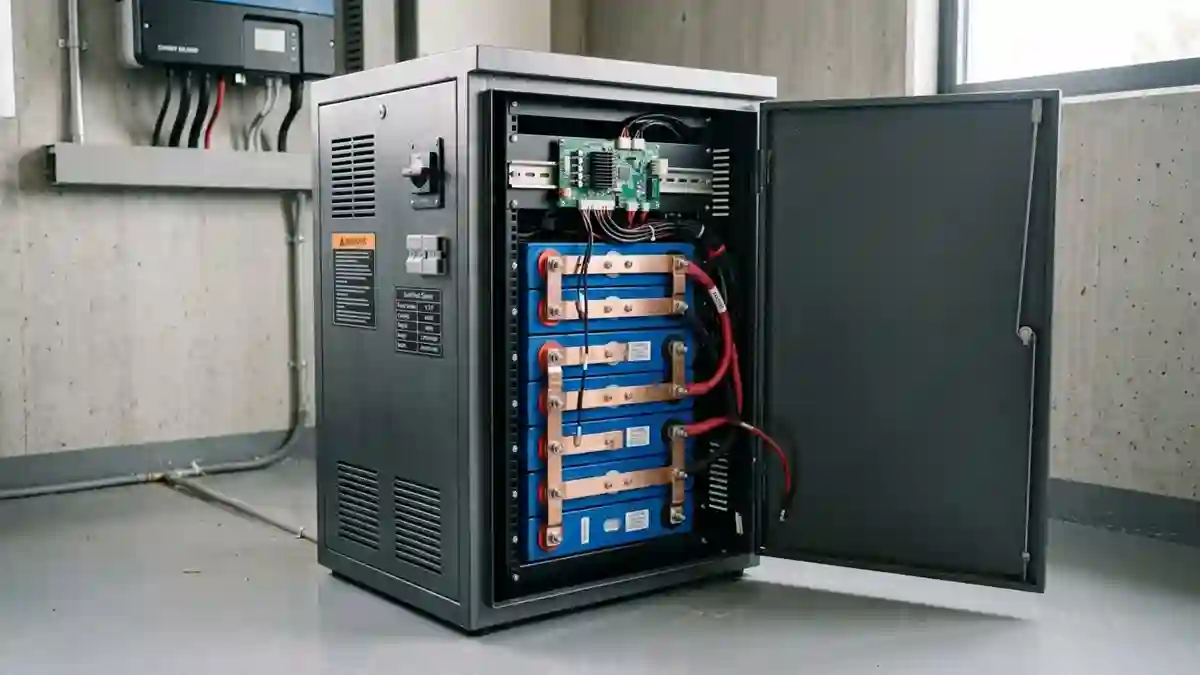
LFP battery explained: Learn how LiFePO4 chemistry works, its advantages, safety, cycle life, and uses in solar storage, home backup, EVs, and more.
If you are researching an LFP battery for solar energy storage, home backup power, an electric vehicle, or another energy storage application, understanding the chemistry behind the battery is just as important as knowing its capacity. LFP, or lithium iron phosphate, is a lithium-ion battery chemistry known for its long cycle life, thermal stability, and durable performance.
An LFP battery uses lithium iron phosphate (LiFePO₄) as its cathode material and is commonly used in residential solar systems, battery backup systems, RVs, marine applications, electric vehicles, and larger energy storage installations. Compared with some other lithium-ion chemistries, LFP generally offers excellent cycle life and thermal stability, although it has a lower energy density.
In this guide, we explain what an LFP battery is, how LiFePO₄ chemistry works, how individual cells are configured into 12V, 24V, and 48V-class battery systems, and how the battery management system (BMS) protects the cells. We also cover charging, cold-weather operation, safety, cycle life, LFP vs. NMC, and the factors to consider when selecting an LFP battery for a solar or energy storage system.
LFP cells are available in prismatic, cylindrical, and pouch formats, although large prismatic LFP cells are widely used in stationary energy storage and many electric vehicles.
If you are looking for the practical solar-storage side of the technology, see our detailed LiFePO4 battery guide.
What Is an LFP Battery?
LFP battery means lithium iron phosphate battery.
The abbreviation comes from the chemistry:
- L — Lithium
- F — Iron
- P — Phosphate
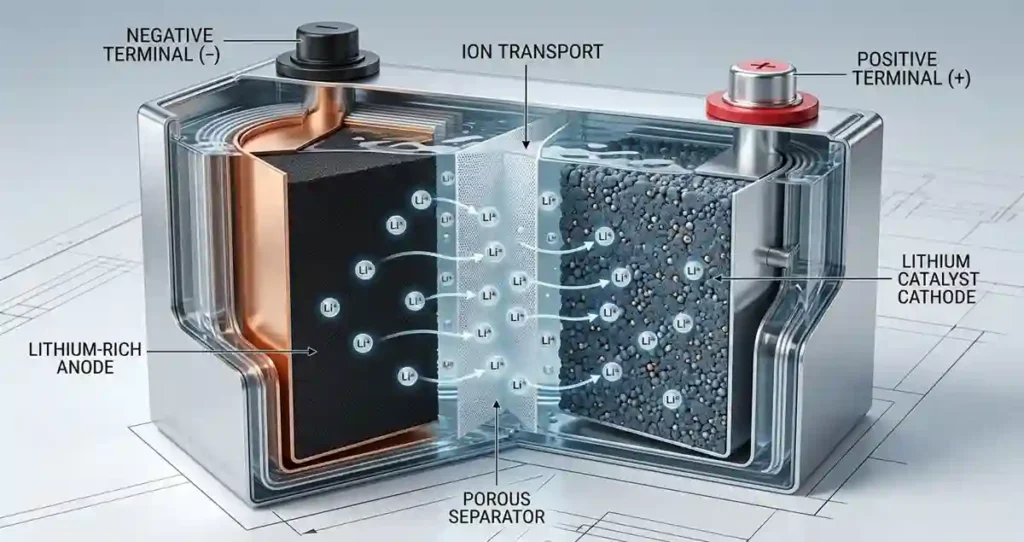
The chemical formula is LiFePO₄.
LFP is therefore one type of lithium-ion battery chemistry, not a battery technology separate from lithium-ion.
Other lithium-ion chemistries include:
- NMC — lithium nickel manganese cobalt oxide
- NCA — lithium nickel cobalt aluminum oxide
- LCO — lithium cobalt oxide
- LMO — lithium manganese oxide
The important distinction is the cathode material. In an LFP cell, the cathode uses lithium iron phosphate rather than a nickel- or cobalt-rich oxide.
LFP has become particularly important in stationary energy storage. The U.S. National Renewable Energy Laboratory’s battery-storage analysis identifies LFP and NMC as major lithium-ion chemistries and reports that LFP became the primary chemistry for stationary storage in its modeled market data.
LFP Battery Meaning: LFP vs. LiFePO₄
If you see LFP battery, LiFePO₄ battery, or lithium iron phosphate battery on a product page, they generally refer to the same underlying cathode chemistry.
The terminology varies by market.
LFP is common in:
- Electric vehicle specifications
- Battery manufacturing
- Industrial energy storage
- Engineering documentation
- Automotive discussions
LiFePO₄ is particularly common in:
- Solar batteries
- RV batteries
- Marine batteries
- Off-grid systems
- Portable power systems
So, when someone searches “what is an LFP battery?”, they are essentially asking what a lithium iron phosphate lithium-ion battery is and how it differs from other lithium-ion chemistries.
How Does an LFP Battery Work?
An LFP battery stores and releases electrical energy through the movement of lithium ions between two electrodes.
A typical LFP cell contains:
| Component | Function |
|---|---|
| Cathode | Lithium iron phosphate (LiFePO₄) |
| Anode | Usually graphite |
| Electrolyte | Conducts lithium ions between electrodes |
| Separator | Electrically separates the electrodes while allowing ion movement |
| Current collectors | Carry electrical current to and from the electrodes |
During discharge, lithium ions move through the electrolyte while electrons travel through the external electrical circuit, providing usable electrical power.
During charging, the process is reversed: the charger supplies electrical energy that drives lithium ions back toward their charged state.
The chemistry is based on an olivine-structured lithium iron phosphate cathode, a material that has been extensively studied as a lithium-ion battery electrode.
Typical LFP Cell Voltage
A conventional LFP cell has a nominal voltage of approximately 3.2 V.
A common engineering configuration is:
16 cells × 3.2 V = 51.2 V nominal
This is why many residential and commercial batteries marketed as “48 V lithium batteries” actually have a nominal voltage of 51.2 V when they use 16-series LFP cells.
For example:
3.2 V × 16 cells = 51.2 V
A 3.2 V, 200 Ah cell also contains approximately:
3.2 V × 200 Ah = 640 Wh
Sixteen such cells connected in series would produce:
51.2 V × 200 Ah = 10.24 kWh
This illustrates why cell voltage and amp-hour capacity are important when reading an LFP battery datasheet.
LFP Battery Chemistry Explained
The defining feature of an LFP battery is its lithium iron phosphate cathode.
Unlike nickel-rich NMC and NCA chemistries, LFP does not use nickel or cobalt in the cathode composition.
This gives LFP several important characteristics.
1. Strong thermal stability
The phosphate-based cathode structure is relatively stable compared with several other lithium-ion cathode chemistries.
That does not mean an LFP battery cannot overheat, catch fire, or experience thermal runaway.
It means the chemistry has favorable thermal and chemical stability characteristics.
A complete battery system still requires appropriate:
- Battery management
- Temperature monitoring
- Over-current protection
- Fusing
- Cell balancing
- Correct charging
- Mechanical protection
The cell chemistry is only one part of battery safety.
2. Long cycle life
LFP is widely selected where batteries may be charged and discharged frequently.
This is particularly useful for:
- Daily solar cycling
- Home energy storage
- Commercial energy storage
- Electric vehicles
- Backup systems
- Industrial equipment
However, cycle-life claims must always be read with their test conditions.
A manufacturer claiming 6,000 cycles has not necessarily demonstrated 6,000 cycles under every operating condition.
Cycle life depends on factors including:
- Depth of discharge
- Temperature
- Charge rate
- Discharge rate
- Upper and lower voltage limits
- Cell quality
- Time between cycles
- Battery-management strategy
NREL’s battery-life research similarly emphasizes that battery degradation depends on environmental and cycling conditions rather than being determined by chemistry alone.
3. No nickel or cobalt in the LFP cathode
One of the attractions of LFP chemistry is its use of iron and phosphate rather than nickel- and cobalt-based cathode materials.
This changes the material composition and contributes to the chemistry’s cost and supply-chain characteristics.
It also means that “lithium-ion” does not automatically mean “nickel and cobalt.”
LFP is itself a lithium-ion chemistry.
LFP Battery Cell Formats
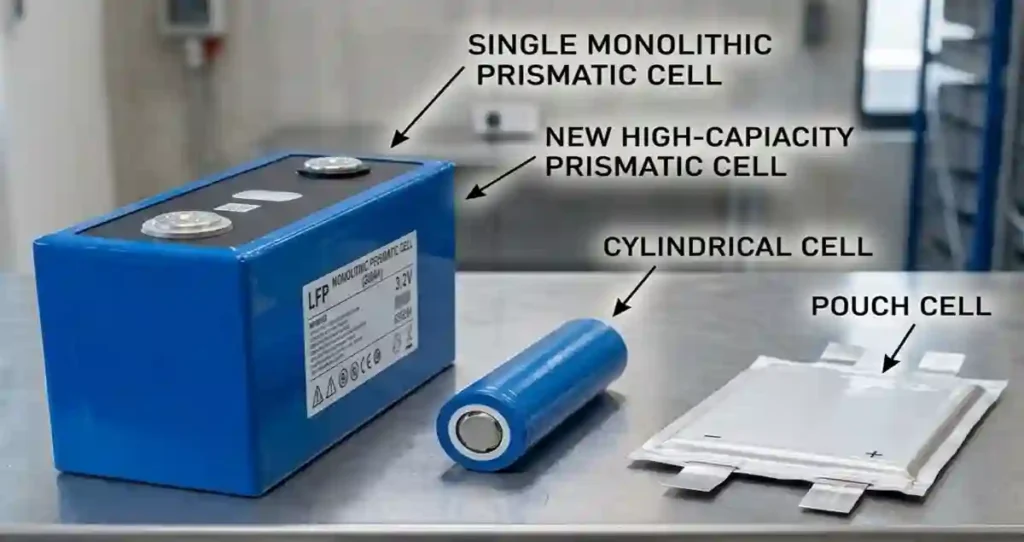
LFP cells are manufactured in several physical formats:
| Cell format | Construction | Common applications |
|---|---|---|
| Prismatic | Rectangular rigid case | EVs, solar storage, grid storage |
| Cylindrical | Round metal can | Portable equipment, tools, battery packs |
| Pouch | Flexible laminated enclosure | Applications requiring flexible packaging |
Prismatic LFP Cells
Large prismatic LFP cells are particularly common in energy-storage batteries.
A prismatic cell has a rigid rectangular enclosure and can provide substantially more capacity per cell than many small cylindrical cells.
For example, a manufacturer may offer a large cell around:
3.2 V × 200 Ah
which provides approximately:
640 Wh
Sixteen cells connected in series would produce a nominal:
51.2 V, 200 Ah
battery with approximately:
10.24 kWh
Large prismatic cells can reduce the number of individual cell-to-cell connections required compared with constructing an equivalent battery from hundreds of small cylindrical cells.
However, cell count is only one part of pack design. Busbars, fuses, contactors, thermal management, enclosure design, BMS architecture, and mechanical support all influence system performance and reliability.
Cylindrical LFP Cells
Cylindrical cells use a rigid round metal enclosure.
Examples of cylindrical formats include:
- 18650
- 26650
- 32700
A large battery pack may require many cylindrical cells connected in series and parallel.
Their standardized shape can support highly automated manufacturing, but the large number of cells also increases the number of electrical connections and individual cell-monitoring points required.
Pouch LFP Cells
Pouch cells use a flexible laminated enclosure rather than a rigid metal can.
They can provide packaging flexibility, but mechanical management becomes particularly important because the cell enclosure does not provide the same rigid structure as a prismatic metal case.
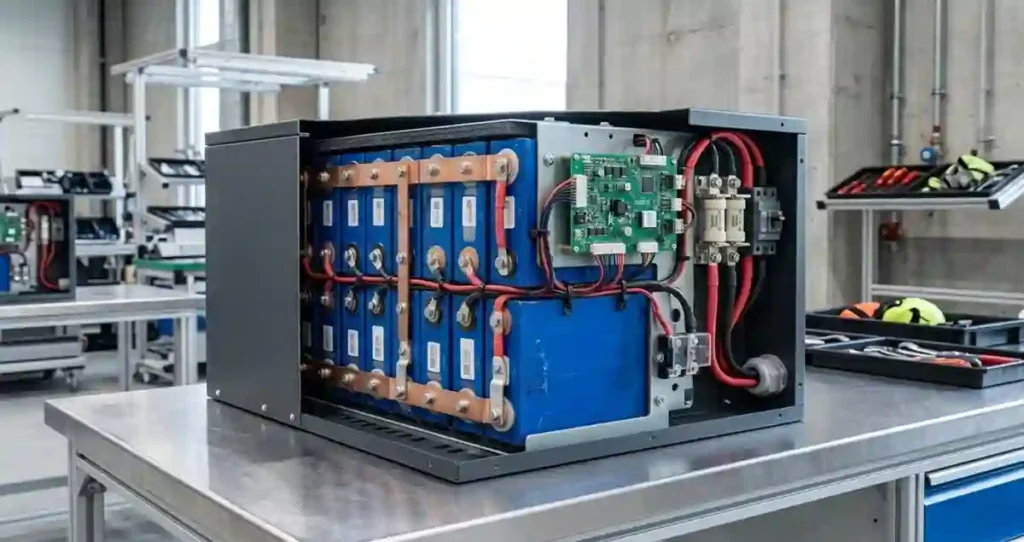
How an LFP Cell Becomes a Battery Pack
An individual LFP cell is only the basic building block.
A complete battery includes electrical, mechanical, thermal, and control systems.
A simplified progression is:
Cell → Series/parallel configuration → BMS → Protection → Enclosure → Battery pack
Step 1: Individual cells
Each cell has a defined:
- Nominal voltage
- Capacity
- Maximum charge voltage
- Discharge cutoff
- Maximum current
- Operating temperature range
Step 2: Series connection
Cells are connected in series to increase voltage.
For example:
16 × 3.2 V = 51.2 V nominal
Step 3: Parallel connection
Parallel strings increase capacity.
For example, two 16-cell strings of 200 Ah cells can provide approximately:
51.2 V × 400 Ah = 20.48 kWh
Step 4: Battery Management System
The BMS monitors and protects the cells.
Depending on the battery design, it can monitor:
- Individual cell voltage
- Pack voltage
- Current
- Cell temperature
- State of charge
- Fault conditions
- Cell balancing
The BMS may also control contactors or communicate with an inverter or charger.
Step 5: Mechanical enclosure
Cells are installed inside a protected enclosure with appropriate:
- Electrical insulation
- Mechanical support
- Thermal management
- Venting or pressure-management provisions where required
- Service connections
- Protection devices
The result is a complete battery rather than simply a collection of cells.
What Does 12V, 24V and 48V Mean in an LFP Battery?
The voltage label on an LFP battery normally represents the system configuration rather than the voltage of a single cell.
Typical configurations include:
| Battery designation | Typical LFP configuration | Nominal voltage |
|---|---|---|
| 12V LFP | 4 cells in series | 12.8 V |
| 24V LFP | 8 cells in series | 25.6 V |
| 48V LFP | 16 cells in series | 51.2 V |
These are nominal values.
The actual battery voltage changes during charging and discharging.
For example, a “12 V LiFePO₄ battery” is typically a 4S LFP battery, meaning four cells are connected in series:
3.2 V × 4 = 12.8 V nominal
Similarly:
3.2 V × 8 = 25.6 V
and:
3.2 V × 16 = 51.2 V
This distinction matters when selecting an inverter, charger, charge controller, fuse, or other system components.
For examples of larger battery configurations, see our guides to 24V 200Ah LiFePO4 batteries and 48V 200Ah LiFePO4 batteries.
Why Are LFP Batteries Used for Solar Energy Storage?
Solar energy storage is one of the strongest applications for LFP chemistry.
A solar battery may cycle almost every day, charging when solar production is available and discharging later when electricity is needed.
That operating pattern makes cycle life and thermal behavior important design considerations.
LFP batteries are used in:
- Residential solar-plus-storage systems
- Off-grid solar systems
- Commercial solar installations
- Microgrids
- Backup power systems
- Utility-scale battery storage
For a broader explanation of solar battery chemistry and system design, see our LiFePO4 batteries for solar guide.
LFP is also widely represented in stationary battery-storage technology. NREL’s technology assessments identify LFP as a major lithium-ion chemistry for stationary storage.
LFP Battery Advantages and Disadvantages
No battery chemistry is ideal for every application.
The useful question is not simply whether LFP is “good” or “bad,” but whether its characteristics match the application.
| LFP battery advantages | LFP battery limitations |
|---|---|
| Long cycle life | Lower energy density than many nickel-rich chemistries |
| Good thermal stability | Larger/heavier for the same stored energy in some applications |
| No nickel or cobalt in the cathode | Cold-temperature charging requires careful control |
| Suitable for frequent cycling | Flat voltage curve can make voltage-based SOC estimation difficult |
| Widely used for stationary storage | Performance depends strongly on temperature and operating conditions |
| Well suited to solar storage | Requires appropriate BMS and protection |
Lower Energy Density
One of the major trade-offs is energy density.
LFP generally stores less energy per unit mass or volume than high-nickel lithium-ion chemistries.
For a home battery or stationary solar installation, this may be relatively easy to accommodate because the battery is not moving.
For an electric vehicle, however, battery weight and physical volume directly affect vehicle design and range.
This is one reason automakers can use different lithium-ion chemistries for different vehicle applications.
Can LFP Batteries Be Charged in Cold Weather?
Cold-weather charging requires particular attention.
Many standard LFP cells specify 0°C (32°F) as the lower charging-temperature limit.
Charging lithium batteries below the manufacturer’s permitted temperature range can cause undesirable lithium-plating-related degradation.
However, this does not mean every LFP battery simply becomes unusable below 0°C.
Battery systems can incorporate:
- Low-temperature charging protection
- Cell heaters
- Thermal management
- Temperature-controlled charging
- BMS charge-current restrictions
Therefore, always check the specific manufacturer’s datasheet, rather than assuming every LFP battery has identical temperature limits.
Why Is LFP Battery State of Charge Harder to Estimate?
One characteristic of LFP chemistry is its relatively flat discharge-voltage curve over much of its operating range.
That creates a practical problem:
Battery voltage alone is not always a reliable indicator of state of charge.
For example, two LFP batteries can show similar terminal voltages while having meaningfully different states of charge depending on:
- Current
- Temperature
- Rest time
- Battery age
- Recent charging or discharging
This is why quality LFP battery systems commonly use BMS measurements and coulomb counting rather than relying only on instantaneous voltage.
LFP Battery vs NMC Battery
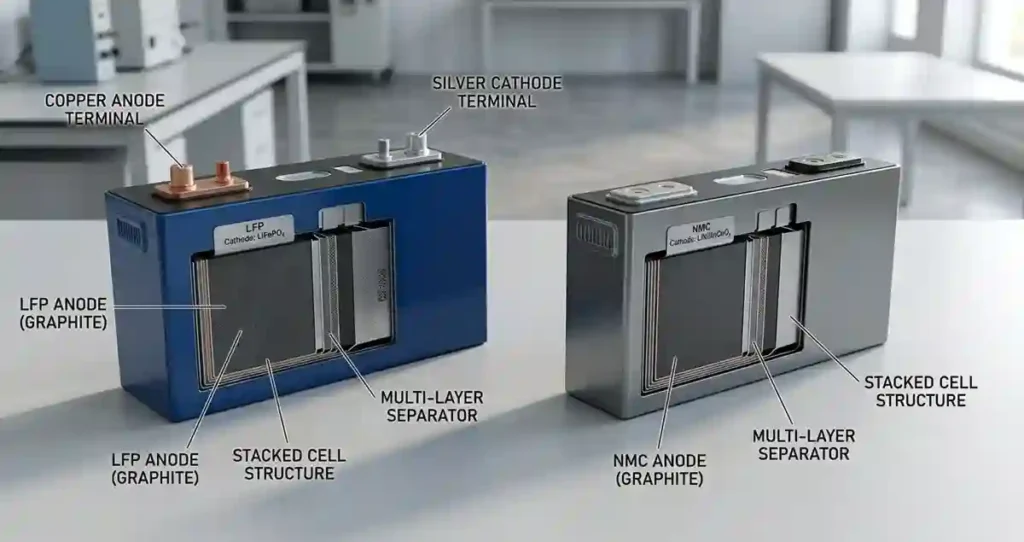
LFP and NMC are both lithium-ion chemistries, but they are optimized around different characteristics.
| Characteristic | LFP | NMC |
|---|---|---|
| Cathode | Lithium iron phosphate | Nickel manganese cobalt oxide |
| Nickel | No | Yes |
| Cobalt | No | Yes |
| Energy density | Generally lower | Generally higher |
| Thermal stability | Strong | Depends on formulation and design |
| Cycle-life potential | Generally strong | Depends strongly on formulation and operating conditions |
| Stationary storage | Widely used | Widely used |
| EV applications | Common, particularly where durability/cost are prioritized | Common where energy density is important |
The comparison should not be reduced to one chemistry being universally better.
For a stationary solar battery, physical size may be less important than cycle life and cost.
For an EV, energy density can become much more important because battery mass and volume affect vehicle range and packaging.
Why Do Tesla Vehicles Use LFP Batteries?
Tesla is one of the major automotive examples associated with LFP battery technology.
Tesla has publicly described LFP as a chemistry used in its standard-range vehicles, while its battery documentation also identifies LFP-equipped vehicles separately from other lithium-ion battery configurations.
The reason is straightforward from an engineering perspective: LFP offers a combination of durability, cost characteristics, and thermal behavior that can be attractive for vehicles where maximum energy density is not the only design objective.
Tesla’s own materials have also described LFP as suitable for standard-range vehicle applications because of its lower energy density compared with higher-energy-density chemistries.
How Can You Tell If a Tesla Has an LFP Battery?
Tesla’s owner documentation provides a practical method for identifying an LFP-equipped vehicle.
For certain Model 3 vehicles, Tesla states that the battery type can be displayed through:
Controls → Software → Additional Vehicle Information
Tesla also notes that LFP vehicles have different charging-limit guidance.
Because battery chemistry can vary by model, production period, market, and configuration, it is better to verify the specific vehicle rather than assume that every Tesla of a particular model has an LFP battery.
Applications and Uses of LFP Batteries
Because LFP chemistry prioritizes long cycle life, thermal stability, low levelized cost of storage (LCOS), and non-toxic materials over ultra-high energy density, it has become the dominant chemistry across several key industries:
1. Solar & Stationary Home Energy Storage
- Daily Cycling & Self-Consumption: Residential solar-plus-storage systems undergo heavy daily charge/discharge cycles. LFP’s ability to endure thousands of cycles at deep depth-of-discharge (80%–100% DoD) without rapid degradation makes it the standard for home energy management.
- Off-Grid & Remote Microgrids: In off-grid installations where service calls are expensive or difficult, LFP’s high reliability, maintenance-free nature, and safe thermal profile make it far superior to legacy lead-acid or volatile high-nickel chemistries.
2. Commercial & Utility-Scale Battery Energy Storage Systems (BESS)
- Peak Shaving & Load Arbitrage: Commercial and industrial facilities deploy containerized LFP BESS to charge during low-tariff off-peak hours and discharge during peak demand windows to reduce costly demand charges.
- Grid Stabilization: Utility-scale grid operators utilize large LFP battery banks for frequency regulation, voltage support, and smoothing out intermittent renewable generation from solar and wind farms.
- Uninterruptible Power Supplies (UPS): Data centers, hospitals, and critical infrastructure use LFP backup systems due to their rapid high-rate discharge capacity, low internal resistance, and low standby calendar aging.
3. Electric Vehicles (EVs)
- Standard-Range Passenger EVs: Major automakers (including Tesla, BYD, Ford, and Renault) equip standard-range electric passenger cars with LFP packs to reduce manufacturing costs, eliminate cobalt/nickel supply chain dependencies, and allow owners to safely charge to 100% state-of-charge daily.
- Commercial Fleets & Heavy Mobility: LFP is widely deployed in electric city buses, delivery vans, forklifts, three-wheelers, and mining equipment where daily heavy usage demands maximum lifespan and thermal safety over minimum pack weight.
4. Marine & RV Power Systems
- Recreational Vehicles (RVs) & Campers: Off-grid RVers use 12V, 24V, and 48V LFP house battery banks to run high-draw appliances (such as air conditioners, induction cooktops, and microwave ovens) without needing noisy, fuel-consuming generators.
- Marine House & Propulsion Systems: Boat owners and commercial vessels deploy LFP batteries to replace lead-acid house banks and power electric propulsion thrusters/motors due to their light weight relative to lead-acid, moisture/vibration tolerance, and reduced risk of onboard fire.
How to Read an LFP Battery Datasheet
A battery datasheet tells you considerably more than its advertised capacity.
Look for these specifications:
| Datasheet specification | What it tells you |
|---|---|
| Nominal voltage | Normal operating voltage of the battery |
| Rated capacity | Amp-hour capacity under specified test conditions |
| Energy | Approximate stored energy in Wh or kWh |
| Maximum charge voltage | Upper charging limit |
| Discharge cutoff | Lower voltage limit |
| Continuous charge current | Permitted sustained charging current |
| Continuous discharge current | Permitted sustained load current |
| Peak discharge current | Short-duration maximum current |
| Operating temperature | Permitted temperature range |
| Charging temperature | Temperature range permitted for charging |
| Cycle life | Expected cycles under stated test conditions |
| Internal resistance | Electrical resistance associated with voltage drop and heat |
| Dimensions | Physical installation requirements |
| Weight | Important for transport and structural design |
| BMS communication | CAN, RS485 or other communication interface where applicable |
Do Not Compare Cycle-Life Numbers Without Test Conditions
This is one of the most important points when comparing LFP batteries.
Suppose Battery A claims:
6,000 cycles
and Battery B also claims:
6,000 cycles.
That does not automatically mean the batteries have identical expected life.
Check:
- Depth of discharge
- Charge/discharge C-rate
- Temperature
- End-of-life capacity threshold
- Rest periods
- Charge voltage
- Discharge cutoff
- Test protocol
A cycle-life number without its test conditions is incomplete engineering information.
NREL’s battery research similarly treats battery lifespan as a function of cycling, environmental conditions, thermal behavior, and other operating variables.
LFP Battery Capacity: Ah vs kWh
Battery capacity is commonly expressed in amp-hours (Ah), while system energy is usually expressed in watt-hours (Wh) or kilowatt-hours (kWh).
The basic relationship is:
Energy (Wh) = Voltage (V) × Capacity (Ah)
For example:
51.2 V × 200 Ah = 10,240 Wh
or:
10.24 kWh
This distinction is important because two batteries can have the same Ah rating but different energy capacities if their voltages differ.
For example:
- 12.8 V × 200 Ah = 2.56 kWh
- 25.6 V × 200 Ah = 5.12 kWh
- 51.2 V × 200 Ah = 10.24 kWh
For solar-system sizing, you can also use our solar battery size calculator.
Does an LFP Battery Need a BMS?
Yes, a properly engineered multi-cell LFP battery requires appropriate battery-management and protection functions.
The BMS can protect the battery against conditions such as:
- Overcharging
- Excessive discharge
- Overcurrent
- Short circuit
- Excessive temperature
- Cell imbalance
Cell balancing is particularly important because series-connected cells do not remain perfectly identical throughout their operating life.
A battery pack is therefore much more than:
“16 lithium cells connected together.”
A reliable system combines:
Cells + BMS + protection + thermal management + mechanical design + appropriate charger/inverter
For solar installations, the charger and inverter must also be compatible with the battery’s voltage, current limits, charging profile, and communication requirements.
How Long Does an LFP Battery Last?
There is no single number that applies to every LFP battery.
Battery life depends on:
- Cell chemistry and manufacturing quality
- Depth of discharge
- Temperature
- Charge rate
- Discharge rate
- Average state of charge
- Calendar aging
- BMS control
- Cell balancing
- Charging voltage
- Installation conditions
A battery operated gently at moderate temperature may age very differently from the same chemistry operated at high temperature and high current.
Therefore, when evaluating an LFP battery, do not ask only:
“How many cycles does it have?”
Also ask:
“At what temperature, depth of discharge, C-rate, and end-of-life capacity was that cycle number measured?”
Are LFP Batteries Safe?
LFP batteries have favorable thermal and chemical stability characteristics, but no lithium-ion battery should be described as completely risk-free.
A complete battery system still requires:
- Correct charging equipment
- Proper BMS
- Over-current protection
- Fuses or circuit protection
- Appropriate wiring
- Mechanical protection
- Temperature monitoring
- Correct installation
- Manufacturer-approved operating limits
The safest battery is not simply the one with a particular chemistry. System design, cell quality, manufacturing quality, controls, installation, and operating conditions all matter.
LFP Battery: Key Specifications at a Glance
| Parameter | Typical LFP characteristic |
|---|---|
| Chemistry | Lithium iron phosphate |
| Chemical formula | LiFePO₄ |
| Battery family | Lithium-ion |
| Nominal cell voltage | About 3.2 V |
| Common 12 V configuration | 4S / 12.8 V nominal |
| Common 24 V configuration | 8S / 25.6 V nominal |
| Common 48 V configuration | 16S / 51.2 V nominal |
| Cathode | Lithium iron phosphate |
| Typical anode | Graphite |
| Nickel in cathode | No |
| Cobalt in cathode | No |
| Main advantages | Cycle life, thermal stability, durability |
| Main trade-off | Lower energy density than many nickel-rich chemistries |
| Common applications | Solar, storage, EVs, RVs, marine, industrial systems |
Frequently Asked Questions About LFP Batteries
Is LFP the same as LiFePO₄?
Yes. LFP is the abbreviation for lithium iron phosphate, while LiFePO₄ is its chemical formula. Both terms generally refer to the same lithium-ion battery chemistry.
Is an LFP battery a lithium-ion battery?
Yes. LFP is a lithium-ion battery chemistry. Other lithium-ion chemistries include NMC, NCA, LCO, and LMO.
What does LFP stand for?
LFP stands for lithium iron phosphate.
What is the voltage of an LFP cell?
A typical LFP cell has a nominal voltage of approximately 3.2 V. The exact operating voltage varies with state of charge and manufacturer specifications.
How many LFP cells make a 48V battery?
A common 48V-class LFP battery uses 16 cells in series:
16 × 3.2 V = 51.2 V nominal
This is why a battery marketed as a “48V LiFePO₄ battery” often has a nominal voltage of 51.2 V.
Why do EV manufacturers use LFP batteries?
LFP provides a combination of cycle durability, thermal stability, and cost characteristics that can be attractive for EV applications where maximum energy density is not the only design requirement. Tesla, for example, identifies LFP as a chemistry used in standard-range vehicles.
Are LFP batteries safer than other lithium batteries?
LFP chemistry has favorable thermal stability characteristics compared with some nickel-rich lithium-ion chemistries, but it is not risk-free. Proper BMS protection, charging, thermal management, electrical protection, and installation remain essential.
Can LFP batteries be charged below freezing?
Many conventional LFP cells do not permit charging below 0°C (32°F) unless the battery has an appropriate low-temperature charging strategy, such as heating. Always follow the manufacturer’s specifications.
Are LFP batteries good for solar?
LFP is widely used for solar energy storage because its cycle-life characteristics and operating profile are well suited to repeated charging and discharging. The correct battery still depends on the required capacity, power, temperature, inverter compatibility, and system design.
Are LFP batteries better than NMC batteries?
Neither chemistry is universally better. LFP generally trades lower energy density for characteristics such as strong cycle-life potential and thermal stability, while NMC can provide higher energy density. The appropriate chemistry depends on the application.
What is a prismatic LFP battery cell?
A prismatic LFP cell is a rectangular, rigid-cased cell containing lithium iron phosphate chemistry. Large prismatic cells are widely used in EV and stationary energy-storage applications.
Final Takeaway
An LFP battery is a lithium-ion battery based on lithium iron phosphate (LiFePO₄) chemistry.
Its engineering characteristics explain why it has become important across solar energy storage, electric vehicles, backup power, RVs, marine systems, and larger stationary storage.
The main reasons for choosing LFP include:
- Long cycle-life potential
- Strong thermal stability
- No nickel or cobalt in the cathode
- Suitability for frequent cycling
- Broad use in stationary energy storage
Its main trade-off is lower energy density than many nickel-rich lithium-ion chemistries, along with temperature-related charging limitations that must be respected.
For solar applications, LFP is therefore not simply a trend or a marketing term. It is a specific lithium-ion chemistry whose characteristics need to be evaluated alongside battery capacity, inverter compatibility, BMS design, temperature, depth of discharge, charge rate, and installation requirements.
For the next step into solar-system design, read our LiFePO4 battery guide and LiFePO4 batteries for solar resources.
Related Guides
- 24V 200Ah LiFePO4 Battery: Specs, Uses & Buying Guide
- LiFePO4 vs Lithium-Ion: Which Battery Should You Buy?
- LiFePO4 Battery: How It Works, Specs & Buying Guide
- LiFePO4 Batteries for Solar: How to Choose & Size Right
- 48V 200Ah LiFePO4 Battery: Specs, Sizing & Home Storage Guide
- LiFePO4 Battery Charger: Voltage, Amps & Settings
- NMC Battery: Specs, Chemistry & How It Compares to LiFePO4
- Solar Panel Repair Guide: Diagnose Problems, Costs & Fixes
- IRS Form 5695 for 2025: Solar Tax Credit Guide
Related guides on SolarVisionAI
- Monocrystalline Solar Panels 2026: Still Worth It or Hype
- LiFePO4 Battery: How It Works, Specs & Buying Guide
- Polycrystalline Solar Panels: Worth Buying in 2026?
- Thin-film Solar Panels: When They Beat Silicon (2026)
- BIPV Solar Panels: Building-Integrated PV Complete Guide
- Portable Solar Panels: Engineer’s Buyer’s Guide 2026
- CPV Solar Panels: Concentrated Photovoltaic Explained
- Skin Solar Panel: What “Solar Skin” Actually Means
- Solar Fence Post Lights: Cap Sizes, Types & Install Guide
- Bifacial Solar Panels in 2026: How to Boost Energy Output
- Solar Charge Controller: The Complete Guide
- MC4 Connectors: Solar Safety & Installation Guide
- Solar Panel Types, Efficiency & Benefits
- Solar Water Pump Guide
- BESS — Battery Energy Storage System Guide
- Commercial Solar Panel Installation
- Solar Refrigerator & DC Fridge — Complete 2026 Guide
- Bifacial Solar Panel Albedo Effect Guide
- TOPCon: Why TOPCon Solar Panel is a Proven Smart Investment in 2026
- HJT: Why Heterojunction Is the Hot Climate Champion
- PERC: PERC Solar Panel: Still Relevant or Already Outdated?
- Perovskite: Perovskite Solar Panels: The 2026 Reality Check
- N-Type vs P-Type: N-Type vs P-Type Solar Panels: Honest Comparison
- ABC: ABC (all back contact) Solar Panel: Back Contact Technology Explained
- IBC: IBC Solar Panels: Interdigitated Back Contact Guide
- Tandem: Tandem Solar Panels: Are Stacked Cells Ready for Rooftops?