
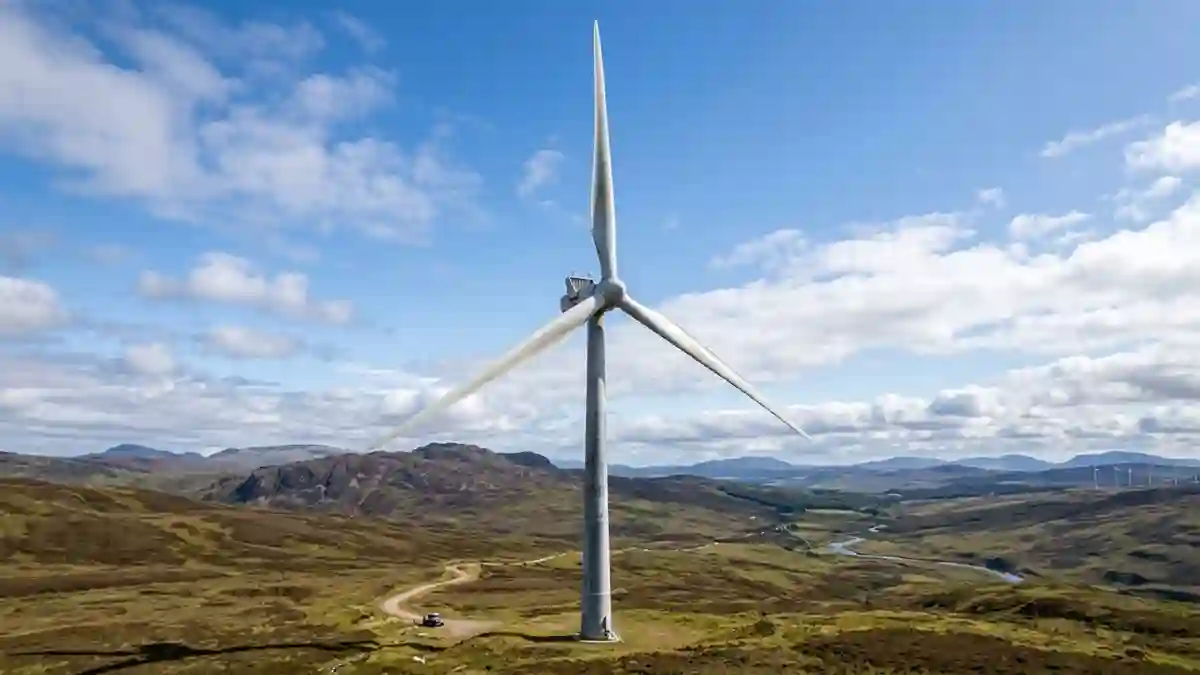
Learn how wind turbine blade length affects rotor size, swept area and power output. Explore blade dimensions, design factors and practical examples.
Wind turbine blade length is one of the most important factors affecting how much wind energy a turbine can capture. Longer blades create a larger rotor swept area, allowing the turbine to intercept more moving air and potentially generate more electricity.
However, blade length alone does not determine a wind turbine’s output. Wind speed, rotor diameter, blade shape, generator capacity, control system and installation height all influence performance.
A small residential wind turbine may have blades measuring less than a few metres, while modern utility-scale turbines use blades extending tens of metres. Some large offshore turbine blades exceed 100 metres in length.
Understanding blade dimensions is important when selecting a turbine, estimating energy production or comparing different wind power systems. see our guide to wind turbine parts and their functions.
This guide explains wind turbine blade length, typical sizes, rotor diameter, blade design, power calculations, transportation challenges and the engineering factors that influence performance.
1. What Is Wind Turbine Blade Length?
Wind turbine blade length is the distance from the blade root, where it connects to the rotor hub, to the blade tip.
The blades rotate around the hub, creating a circular area known as the rotor swept area.
For a horizontal-axis wind turbine (HAWT), the rotor diameter is approximately twice the blade length when the hub radius is small relative to the blade.
For more accurate calculations:
Rotor radius = Blade length + Hub radius
Rotor diameter = 2 × Rotor radius
The hub is the central component connecting the blades to the turbine’s main shaft.
For example, consider a turbine with:
- Blade length: 5 metres
- Hub radius: 0.5 metres
Rotor radius:
5 + 0.5 = 5.5 metres
Rotor diameter:
2 × 5.5 = 11 metres
This distinction matters when calculating the swept area and comparing turbine specifications.
To understand how the blades connect to the rest of the turbine, see our guide to wind turbine parts and their functions.
2. How Long Are Wind Turbine Blades?
Wind turbine blade lengths vary considerably depending on the turbine’s rated capacity, design, intended application and installation location.
A small residential turbine may use blades measuring less than one metre to several metres. Commercial land-based turbines use much longer blades, while offshore turbines can use blades exceeding 100 metres.
The following table provides broad illustrative size categories, not mandatory industry classifications or exact product specifications.
| Turbine Application | Approximate Blade Length | Typical Use |
|---|---|---|
| Small micro wind turbine | Below 1 metre | Small loads, demonstrations and specialized applications |
| Small residential turbine | 1–3 metres | Selected homes and remote properties |
| Larger small wind turbine | 3–10 metres | Farms, remote facilities and distributed generation |
| Medium-scale turbine | 10–30 metres | Commercial and specialized wind installations |
| Large land-based turbine | 30–70 metres | Utility-scale wind farms |
| Large offshore turbine | 70–110+ metres | Offshore wind energy projects |
Actual blade dimensions vary between manufacturers and models. Some small turbines use different rotor configurations, so their dimensions should be checked against the manufacturer’s technical documentation.
Examples of modern large wind turbine blades
Modern utility-scale wind turbines have become larger over time.
The US Department of Energy reports that modern land-based turbine blades commonly exceed 52 metres, while very large offshore turbine blades can reach approximately 107 metres.
These larger blades allow turbines to capture wind across a much larger rotor area.
The actual blade length should always be distinguished from the complete rotor diameter. A turbine with a 120-metre rotor diameter does not have 120-metre-long blades.
3. Wind Turbine Blade Length vs Rotor Diameter
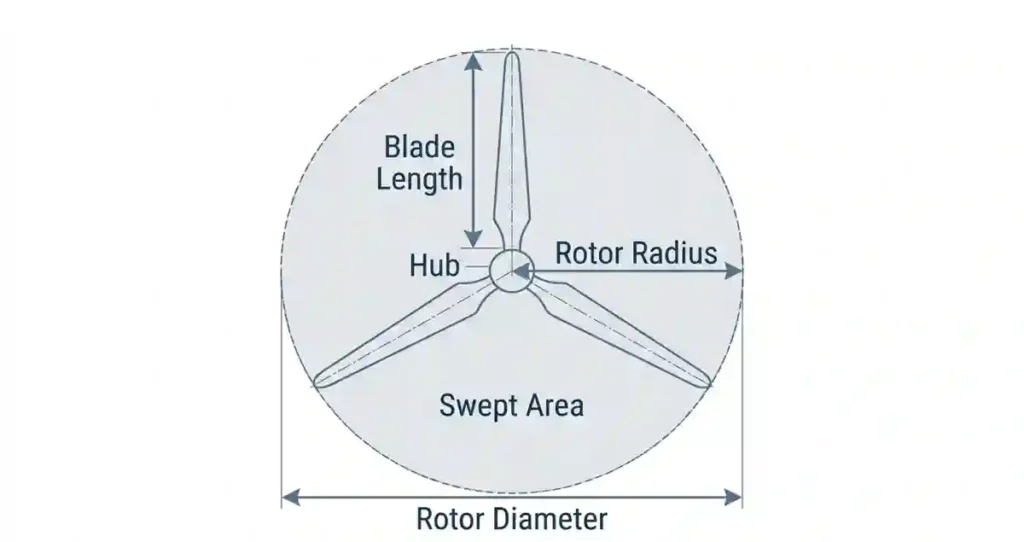
Blade length and rotor diameter are closely related, but they are not exactly the same measurement.
Blade length measures an individual blade from its root to its tip. Rotor diameter measures the full circular distance covered by the rotating blade tips.
For a simplified calculation where hub radius is ignored:
Rotor diameter = 2 × Blade length
| Blade Length | Approximate Rotor Diameter | Approximate Swept Area |
|---|---|---|
| 1 metre | 2 metres | 3.14 m² |
| 2 metres | 4 metres | 12.57 m² |
| 3 metres | 6 metres | 28.27 m² |
| 4 metres | 8 metres | 50.27 m² |
| 5 metres | 10 metres | 78.54 m² |
| 6 metres | 12 metres | 113.10 m² |
| 8 metres | 16 metres | 201.06 m² |
| 10 metres | 20 metres | 314.16 m² |
These are simplified examples. Actual swept area should be calculated using the manufacturer’s rotor diameter, which accounts for the hub and blade geometry.
How to calculate rotor swept area
The rotor swept area is the circular area covered by the rotating blades.
The formula is:
A = π × D² ÷ 4
Where:
- A = Rotor swept area in square metres
- D = Rotor diameter in metres
- π = Approximately 3.1416
For a turbine with a 10-metre rotor diameter:
A = 3.1416 × 10² ÷ 4
A = 3.1416 × 100 ÷ 4
A = 78.54 m²
This means the turbine’s rotor sweeps an area of approximately 78.54 square metres during one complete rotation.
The swept area is important because it determines how much of the moving air stream passes through the rotor.
4. How Does Blade Length Affect Wind Turbine Power Output?
Longer blades generally increase wind turbine power potential because they increase rotor swept area.
For a horizontal-axis wind turbine, swept area increases with the square of rotor radius.
This means doubling the rotor radius produces four times the swept area, assuming the hub and other geometric factors are negligible.
For example:
| Blade Radius | Rotor Swept Area | Relative Area |
|---|---|---|
| 2 metres | 12.57 m² | 1× |
| 4 metres | 50.27 m² | 4× |
| 6 metres | 113.10 m² | 9× |
| 8 metres | 201.06 m² | 16× |
The relationship is important, but it does not mean that doubling blade length will automatically produce four times the actual electrical output.
The turbine must also be designed to handle the increased aerodynamic forces, rotational speed, mechanical loads and generator requirements.
Understanding the wind power equation
The theoretical power available in the wind passing through the rotor area can be estimated using:
Pwind = 0.5 × ρ × A × V³
Where:
- Pwind = Power available in the wind, watts
- ρ = Air density, kg/m³
- A = Rotor swept area, m²
- V = Wind speed, m/s
The turbine cannot convert all the available wind power into electricity.
The aerodynamic power captured by the rotor can be estimated using:
Protor = 0.5 × ρ × A × V³ × Cp
Where Cp is the rotor power coefficient.
The theoretical Betz limit is approximately 59.3%, but actual turbine performance is lower and varies with operating conditions.
Electrical output is further reduced by mechanical and electrical losses.
Practical calculation example
Consider a small wind turbine with:
- Rotor diameter: 10 metres
- Wind speed: 8 m/s
- Air density: 1.225 kg/m³
- Assumed power coefficient: 0.35
Step 1: Calculate rotor swept area
A = π × D² ÷ 4
A = 3.1416 × 10² ÷ 4
A = 78.54 m²
Step 2: Calculate available wind power
Pwind = 0.5 × 1.225 × 78.54 × 8³
Pwind = 0.6125 × 78.54 × 512
Pwind ≈ 24,624 watts
Available wind power is approximately 24.6 kW.
Step 3: Estimate aerodynamic power captured
Protor = 24,624 × 0.35
Protor ≈ 8,618 watts
The estimated aerodynamic power captured is approximately 8.62 kW.
This is not a guaranteed electrical output or a rated turbine capacity. Actual electrical production depends on generator efficiency, power electronics, turbine control, operating limits and wind conditions.
The example also assumes a constant wind speed and air density, which do not represent a complete annual energy assessment.
5. Wind Turbine Blade Design and Shape
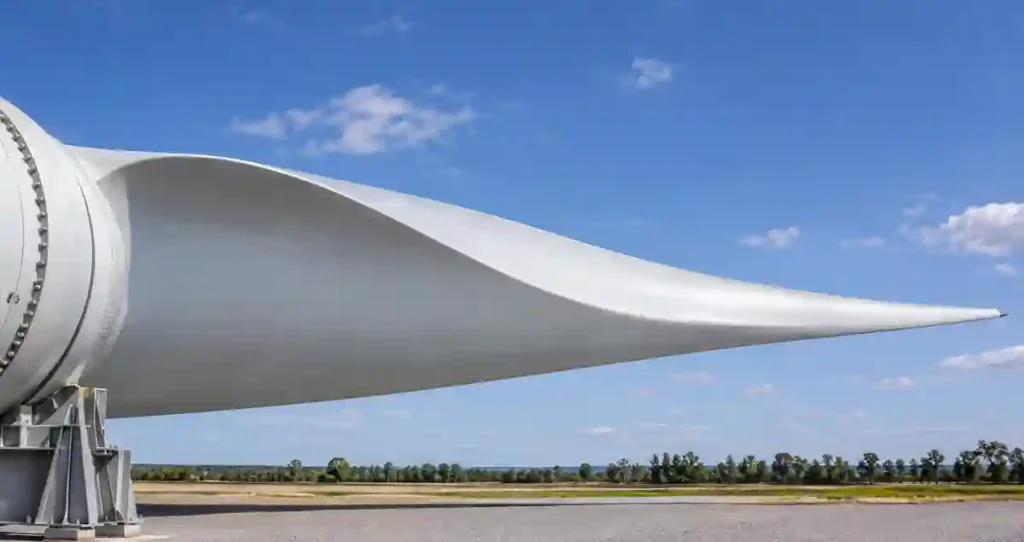
Wind turbine blades are aerodynamic components designed to convert wind energy into rotational force.
Modern horizontal-axis turbine blades work mainly through aerodynamic lift, similar to an aircraft wing.
Their design is more complex than simply making a flat blade longer.
Important design features include:
Blade airfoil
The blade cross-section is shaped to create aerodynamic lift as air moves across its surface.
The airfoil profile changes along the blade to maintain suitable aerodynamic performance under different local operating conditions.
Blade twist
Wind speed relative to the rotating blade changes along its length.
The blade is therefore twisted so different sections can operate at suitable angles of attack.
This helps maintain aerodynamic performance from the root to the tip.
Blade chord
Chord is the distance between the leading edge and trailing edge of the blade.
The chord generally varies along the blade. It is often wider near the root and narrower toward the tip.
Blade pitch
Blade pitch is the angle of the blade relative to the rotor plane or another defined reference.
Pitch-control systems can adjust blade angles to regulate power, improve operating performance and protect the turbine under high-wind conditions.
Blade materials
Large wind turbine blades commonly use composite materials, including:
- Fiberglass-reinforced composites
- Carbon-fibre composites in selected designs
- Resin systems
- Structural cores and reinforcement materials
Material selection depends on strength, stiffness, fatigue resistance, weight, manufacturing requirements and cost.
Small wind turbines may use different materials depending on their design and rated capacity.
6. Why Do Modern Wind Turbines Have Longer Blades?
Modern wind turbines have progressively increased in size, including their rotor diameter and blade length.
There are several engineering reasons for this development.
Larger swept area: Longer blades allow the turbine to capture wind across a larger area.
Improved low-wind energy capture: A larger rotor can increase energy capture at suitable sites, including locations with lower average wind speeds.
Greater annual energy production: A larger rotor may increase annual energy generation when the generator, controls and site conditions are appropriately matched.
Improved project economics: More annual electricity from a turbine can help improve the economics of a wind project, although larger equipment also increases manufacturing, transport, installation and maintenance costs.
Better use of available wind resources: Larger rotors can capture more energy from the wind passing through the swept area.
However, increasing blade length creates engineering challenges.
Longer blades experience greater structural loading, require more advanced materials and can make transportation and installation more difficult.
The tower, nacelle, drivetrain, foundation and control system must also be designed for the turbine’s loads and operating conditions.
Transportation and Logistics Challenges for Large Wind Turbine Blades
One important practical challenge associated with larger wind turbine blades is transportation. As blade length increases, moving the equipment from the manufacturing facility to the installation site becomes more complicated and expensive.
In some countries, wind turbine blades, generators, controllers and other specialized components are not manufactured locally. Developers may need to import this equipment from international suppliers.
This creates additional requirements for international shipping, customs clearance, port handling, road transportation and final delivery to the project site.
For some projects, transportation logistics can become a major part of the overall project cost and schedule.
1. International shipping and imports
When wind turbine blades or other major components are imported, they may need to travel by specialized cargo vessels.
Project developers must consider:
- Availability of suitable shipping services
- International freight costs
- Port handling facilities
- Customs clearance and import documentation
- Import duties, taxes and applicable regulations
- Delivery schedules and possible shipping delays
A delay at the port or during customs clearance can affect the project timeline, particularly when equipment is being imported from another country.
2. Oversized road transportation
Large wind turbine blades cannot normally be transported using ordinary trucks. They often require specialized trailers, suitable turning space and carefully planned transport routes.
Road transportation may be restricted by:
- Bridge height and load limitations
- Road width and sharp turns
- Overhead power lines and other obstacles
- Road gradients and uneven surfaces
- Traffic restrictions and local transport permits
- Access roads leading to remote wind farm locations
In some locations, roads may require temporary modifications or infrastructure improvements before large components can be delivered.
3. Port and site accessibility
Importing large wind turbine components requires suitable port infrastructure, lifting equipment and storage areas.
Even when a component successfully reaches the destination port, transporting it from the port to the project site can be difficult.
Remote wind farm locations may have limited road access or insufficient infrastructure for oversized cargo.
Therefore, port capacity and the route between the port and the final installation site should be evaluated before equipment procurement.
4. Transportation cost and project budget
Specialized shipping, oversized trailers, route surveys, lifting equipment, permits and additional handling can increase project costs.
These expenses should be considered during project feasibility and procurement rather than treated as unexpected costs after equipment selection.
For large projects, transportation and installation costs can influence the choice of turbine model and manufacturing supplier.
5. Installation scheduling
Transportation and installation must be coordinated with crane availability, site preparation, weather conditions and delivery schedules.
A delay in transporting one major component can affect the installation sequence and postpone project commissioning.
Practical Engineering Consideration
Before selecting a large wind turbine, developers should assess not only its rated capacity, blade length and expected energy production but also whether the equipment can physically reach the installation site.
For international projects, an early logistics assessment should include:
- Manufacturing location and supplier availability
- Shipping route and freight arrangements
- Destination port facilities
- Customs clearance and import requirements
- Road transportation route and bridge restrictions
- Specialized trailer and lifting requirements
- Final site access and storage arrangements
- Installation schedule and crane availability
Engineering takeaway: A turbine may be technically suitable for a wind project, but if its blades and other major components cannot be transported economically and safely to the site, the project may become difficult or financially impractical to execute.
7. What Factors Determine the Correct Wind Turbine Blade Length?
Selecting blade length requires more than looking at the desired generator capacity.
The turbine must be matched to the available wind resource and the intended application.
Wind speed
Wind speed is one of the most important factors affecting energy production.
The theoretical wind power available increases with the cube of wind speed.
For example, increasing wind speed from 5 m/s to 10 m/s increases the theoretical power in the wind by a factor of eight, assuming the same air density and swept area.
Rotor diameter
Rotor diameter determines the area through which the turbine captures wind.
A larger rotor can increase energy capture, but the turbine’s generator and control system must be designed to handle the resulting operating conditions.
Turbine rated capacity
The rotor and generator must be appropriately matched.
A large rotor connected to an undersized generator may experience power limitation or require a different operating strategy.
The turbine’s power curve should be reviewed before selecting equipment.
Tower height
Wind conditions generally improve with height at many sites because ground-level obstacles and surface friction affect wind flow.
However, the actual wind profile depends on terrain, surface roughness, atmospheric conditions and local obstacles.
A larger blade cannot compensate for an unsuitable installation location.
Air density
Air density affects the energy available in the wind.
It changes with altitude, temperature and atmospheric pressure.
At higher elevations or under hot conditions, air density may be lower, affecting turbine power potential.
Structural strength
Longer blades experience significant aerodynamic and structural loads.
Blade design must account for:
- Bending loads
- Centrifugal forces
- Fatigue
- Vibration
- Extreme wind conditions
- Material strength
- Blade-to-tower clearance
Blade length should never be increased without confirming that the complete turbine structure is designed for the new rotor.
Transportation feasibility
Transportation should also be considered during turbine selection.
A turbine with very long blades may offer greater energy capture, but the components may require specialized shipping, road permits, larger trailers and suitable installation equipment.
The availability of local manufacturing and maintenance support can also influence the overall project decision.
8. Residential Wind Turbine Blade Length
Residential wind turbines generally have much smaller blades than utility-scale turbines.
Their size depends on the rated capacity, rotor design, wind resource and manufacturer specifications.
A small residential turbine may use a rotor diameter of a few metres, while larger distributed wind systems can use considerably larger rotors and towers.
For a homeowner or property owner, the most important selection factors are:
- Average wind speed at the proposed hub height
- Turbine power curve
- Rotor diameter and swept area
- Tower height and structural design
- Local planning and setback requirements
- Electrical output and system voltage
- Battery and inverter compatibility, where applicable
- Maintenance access and manufacturer support
- Availability of replacement parts
- Transportation and installation costs
A turbine with longer blades is not automatically a better residential investment.
For example, a large rotor installed in a turbulent location surrounded by buildings may perform worse than a smaller, properly selected turbine installed in a suitable open location.
Read our home wind turbine guide for more information about residential turbine selection, cost and expected output.
For properties that need electricity independent of the utility grid, see our guide to off-grid wind turbines.
9. Horizontal-Axis vs Vertical-Axis Wind Turbine Blade Length
Blade length and design also depend on the type of wind turbine.
Horizontal-axis wind turbines (HAWT)
Horizontal-axis wind turbines are the most common design used in modern utility-scale wind generation.
Their rotor axis is generally horizontal, and the blades rotate in a plane facing the wind.
Common characteristics include:
- Two or three aerodynamic blades in many modern designs
- Large rotor swept areas
- Aerodynamic lift-based operation
- Tower-mounted rotor and nacelle
- Yaw systems in many upwind designs
- Pitch control in many larger turbines
The blade length is directly related to rotor radius, although the hub dimensions must be considered.
Vertical-axis wind turbines (VAWT)
Vertical-axis wind turbines have a rotor axis that is vertical.
Their blade or rotor geometry differs from conventional horizontal-axis turbines.
Common examples include:
- Savonius turbines
- Darrieus turbines
- Helical vertical-axis turbines
The blade dimensions of a VAWT cannot be compared directly with the blade length of a conventional HAWT using the same simple rotor-radius relationship.
For a VAWT, rotor height, rotor diameter, blade profile and swept area are important design parameters.
Read our guide to vertical wind turbines for home applications for more information.
10. Common Wind Turbine Blade Length Mistakes
Selecting or evaluating wind turbine blades without understanding the complete system can lead to poor performance and safety problems.
Avoid these common mistakes:
1. Comparing blade length instead of swept area
Two turbines may have different blade configurations and hub dimensions. Compare rotor diameter and swept area using manufacturer specifications.
2. Assuming longer blades always produce more electricity
Longer blades increase potential energy capture, but actual production depends on wind speed, turbine design and operating limits.
3. Ignoring the turbine power curve
Rated capacity alone does not show how much energy a turbine produces at different wind speeds.
4. Ignoring structural loading
Longer blades increase structural and aerodynamic demands. The rotor, drivetrain, tower and foundation must be suitable for the design.
5. Selecting a turbine without assessing the site
Wind speed and turbulence can vary considerably across short distances and different heights.
6. Ignoring transportation and logistics
Large blades may require international shipping, customs clearance, oversized road transport, specialized trailers and route surveys. Check port facilities, road access, bridge restrictions and installation logistics before finalizing turbine specifications.
7. Modifying existing blades without approval
Changing blade length or rotor geometry can alter rotational speed, loading, braking requirements and turbine safety. Never modify a turbine rotor unless the manufacturer or a qualified engineering design process explicitly supports the change.
11. Maintenance and Inspection of Wind Turbine Blades
Wind turbine blades operate under changing aerodynamic and environmental loads.
Regular inspection is important for maintaining performance and identifying damage before it becomes more serious.
Common inspection points include:
- Surface cracks
- Leading-edge erosion
- Lightning protection system condition
- Delamination
- Structural damage
- Loose or damaged blade connections
- Unusual vibration
- Contamination or surface deterioration
For small wind turbines, inspection intervals should follow the manufacturer’s maintenance instructions.
Large turbines may use specialized inspection methods, including rope-access inspections, drones and other condition-monitoring technologies.
Blade repair should be carried out using approved procedures and qualified personnel.
12. Can AI Improve Wind Turbine Blade Performance?
Artificial intelligence and digital monitoring can support wind turbine operation and maintenance.
AI-based systems can analyse operating data to identify unusual vibration, changing performance and possible equipment faults.
Applications include:
- Blade damage detection using inspection images
- Predictive maintenance
- Vibration monitoring
- Power-curve performance analysis
- Wind condition forecasting
- Operational performance optimization
AI does not replace aerodynamic engineering, structural design or physical inspection.
It can, however, help operators identify maintenance requirements and improve the management of wind energy assets.
Engineering Standards and References
Wind turbine blades are part of a complete turbine system and must be designed according to applicable safety and engineering requirements.
The following references are useful starting points:
| Standard / Reference | Main Application | Official Link |
|---|---|---|
| IEC 61400-1 | Design requirements for wind turbines, including structural integrity and loading | IEC Catalogue |
| IEC 61400-2 | Safety and design requirements for small wind turbines | IEC 61400-2 |
| IEC 61400-5 | Wind turbine blade design requirements | IEC Catalogue |
| IEC 61400-23 | Full-scale structural testing of rotor blades | IEC Catalogue |
The applicable standard depends on turbine size, design, certification scope and jurisdiction. Confirm the current edition and applicable requirements before specifying or installing equipment.
Engineer’s Note
Wind turbine blade length has a direct relationship with rotor swept area, which is an important factor in determining the amount of wind energy available to a turbine.
However, blade length should never be evaluated independently of wind conditions, turbine power curves, structural loading and generator capacity.
For practical project assessment, I recommend reviewing rotor diameter, swept area, annual energy production and the manufacturer’s certified performance data together.
Transportation is another important consideration, particularly for large turbines and projects that depend on imported equipment. A technically suitable turbine may still create project difficulties if its blades cannot be delivered to the site safely, on time and within budget.
A larger rotor can provide an advantage, but the complete turbine must be engineered to operate safely and efficiently under the expected site conditions.
Engineer’s Field Notes
Before selecting a wind turbine based on blade length, consider these engineering checks:
- Confirm the turbine’s rated power and rotor diameter.
- Check the actual blade length and hub dimensions.
- Calculate the rotor swept area.
- Review the manufacturer’s power curve.
- Assess wind speed at the proposed hub height.
- Check the turbine’s operating and cut-out wind speeds.
- Confirm tower, foundation and structural requirements.
- Review blade inspection and maintenance requirements.
- Check electrical compatibility with the controller, inverter and battery system.
- Confirm that the complete turbine is suitable for the installation location.
- Check whether the equipment is locally available or needs to be imported.
- Review shipping, customs clearance, port handling and road transportation requirements.
- Confirm that specialized trailers, lifting equipment and installation access are available.
- Include transportation and logistics costs in the project budget.
Frequently Asked Questions
1. How long are wind turbine blades?
Blade length varies by turbine size and application. Small residential turbines may have blades measuring less than a few metres, while modern utility-scale turbines can have blades extending tens of metres. Some large offshore turbines use blades exceeding 100 metres.
2. What is the relationship between blade length and rotor diameter?
Rotor diameter is approximately twice the rotor radius. For a simple HAWT calculation, rotor radius is approximately equal to blade length. The hub radius should be included for greater accuracy.
3. Do longer wind turbine blades generate more electricity?
Longer blades increase rotor swept area and can improve energy capture. However, actual electricity generation also depends on wind speed, aerodynamic performance, generator capacity and control systems.
4. What is the swept area of a wind turbine?
Swept area is the circular area covered by the rotating blades. It is calculated using A = π × D² ÷ 4, where D is the rotor diameter.
5. How much power can a wind turbine generate with 5-metre blades?
There is no fixed output based on blade length alone. A 5-metre blade provides an approximate 10-metre rotor diameter if hub radius is ignored, but actual output depends on wind speed, turbine design and generator rating.
6. Why are wind turbine blades twisted?
Wind speed relative to the rotating blade changes along its length. Blade twist helps maintain suitable aerodynamic angles across different sections of the blade.
7. Why do large offshore wind turbines have longer blades?
Longer blades provide a larger swept area, allowing turbines to capture more wind energy. Offshore projects can also support large equipment and specialized installation infrastructure.
8. Are three-blade wind turbines better than two-blade turbines?
Three-blade designs are common because they offer a useful balance of aerodynamic performance, rotor loading, vibration and operational characteristics. The best configuration depends on the complete turbine design.
9. Can I increase the blade length of an existing wind turbine?
Not without an approved engineering assessment. Changing blade length affects rotor loading, rotational speed, structural strength, braking and generator operating conditions. It may make the turbine unsafe.
10. Does blade length affect wind turbine cost?
Yes. Longer blades can increase material, manufacturing, transportation, installation and structural costs. The economic benefit depends on additional annual energy production and the overall turbine design.
11. Why is transporting large wind turbine blades difficult?
Large blades are oversized cargo and often require specialized ships, trailers, route planning and lifting equipment. Road width, bridge restrictions, overhead obstacles and access to remote project sites can create additional challenges.
12. Do wind turbine blades need to be imported?
It depends on the country and availability of local manufacturers. In markets where specialized blades are not manufactured locally, developers may need to import them. This can add shipping costs, customs procedures, port handling and delivery time to a project.
Final Thoughts
Wind turbine blade length is an important factor in determining rotor swept area and the potential energy a turbine can capture.
Longer blades can improve energy capture by increasing the area exposed to moving air. However, turbine output also depends on wind speed, aerodynamic design, generator capacity, control systems and structural requirements.
Transportation and logistics are also important parts of wind project planning. Large blades may need international shipping, specialized road transport and careful coordination between ports, suppliers and installation teams. These practical requirements can affect both project cost and completion time.
When comparing wind turbines, do not focus only on blade length. Review rotor diameter, swept area, power curve, rated capacity, expected annual energy production and transportation feasibility.
A correctly selected turbine should match the available wind resource and installation conditions rather than simply having the longest blades.
References and Further Reading
- US Department of Energy – Small Wind Guidebook
- US Department of Energy – Wind Turbines: The Bigger, the Better
- US Department of Energy – How Do Wind Turbines Work?
- US Energy Information Administration – Types of Wind Turbines
- IEC Webstore – Wind Energy Standards
Related guides
- Solar and Wind Hybrid System: Design, Sizing, Cost, and Working
- Wind and Solar Hybrid Controller: Wiring, Inputs and Protection
- Home Wind Turbine: Cost, Output, Sizing and Is It Worth It?
- Wind Turbine Inverter: Grid-Tie, Off-Grid and Hybrid Options
- Home Wind Turbine Kits: What You Need and How to Choose
- Wind Turbine Parts Explained: Components and Their Functions
- Off-Grid Wind Turbine: Sizing, Batteries and System Design
- 7 Powerful Benefits of Solar Power and Wind Power
- Solar and Wind Energy: 7 Key Differences, Pros, Cons and Best Uses
- Wind Energy: How It Works, Benefits and Limitations
- Wind Energy Advantages and Disadvantages: 12 Key Pros and Cons
- Wind Turbine Nacelle: Components, Function and How It Works
- Wind Turbine Height: How Tall Are Wind Turbines?
Related guides on SolarVisionAI.com
- Monocrystalline Solar Panels 2026: Still Worth It or Hype
- Polycrystalline Solar Panels: Worth Buying in 2026?
- Thin-film Solar Panels: When They Beat Silicon (2026)
- BIPV Solar Panels: Building-Integrated PV Complete Guide
- Portable Solar Panels: Engineer’s Buyer’s Guide 2026
- CPV Solar Panels: Concentrated Photovoltaic Explained
- Skin Solar Panel: What “Solar Skin” Actually Means
- Solar Fence Post Lights: Cap Sizes, Types & Install Guide
- Bifacial Solar Panels in 2026: How to Boost Energy Output
- Solar Charge Controller: The Complete Guide
- MC4 Connectors: Solar Safety & Installation Guide
- Solar Panel Types, Efficiency & Benefits
- Solar Water Pump Guide
- Commercial Solar Panel Installation: Engineering Guide
- Solar Fence Post Lights: Cap Sizes, Types & Install Guide
- BESS — Battery Energy Storage System Guide
- Commercial Solar Panel Installation
- Solar Refrigerator & DC Fridge — Complete 2026 Guide
- Bifacial Solar Panel Albedo Effect Guide
- TOPCon: Why TOPCon Solar Panel is a Proven Smart Investment in 2026
- HJT: Why TOPCon Solar Panel is a Proven Smart Investment in 2026
- PERC: PERC Solar Panel: Still Relevant or Already Outdated?
- Perovskite: Perovskite Solar Panels: The 2026 Reality Check
- N-Type vs P-Type: N-Type vs P-Type Solar Panels: Honest Comparison
- ABC: ABC (all back contact) Solar Panel: Back Contact Technology Explained
- IBC: IBC Solar Panels: Interdigitated Back Contact Guide
- Tandem: Tandem Solar Panels: Are Stacked Cells Ready for Rooftops?