
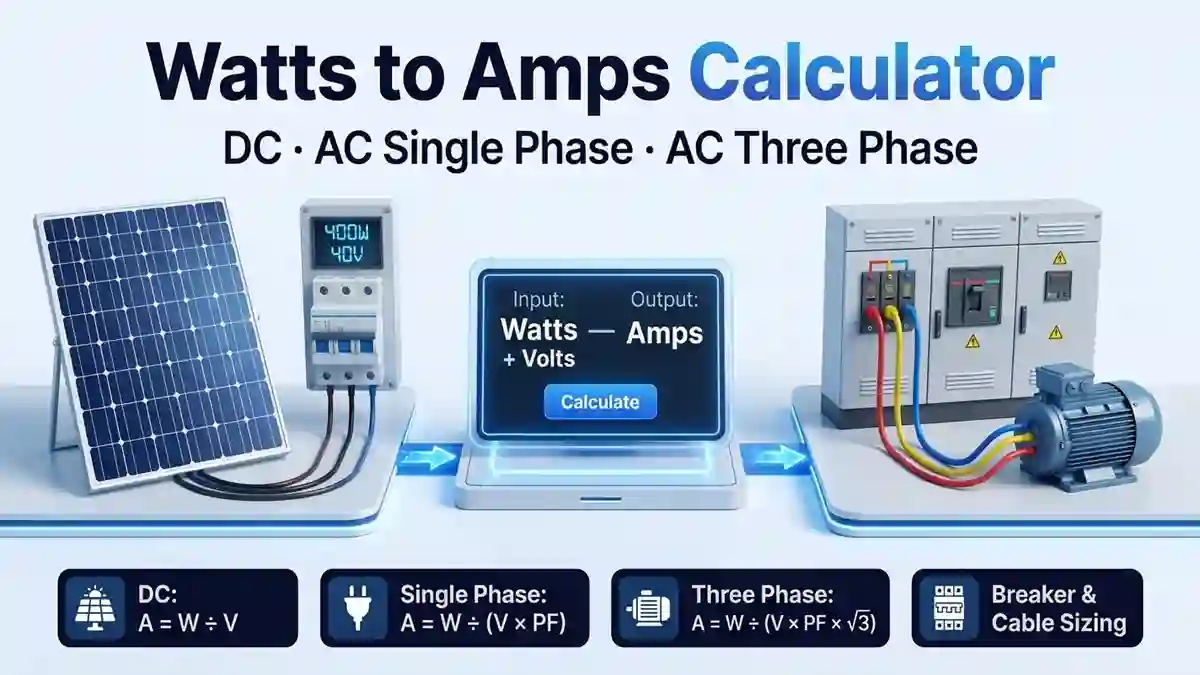
Free Watts to Amps Calculator — Convert W to A instantly for DC, AC single-phase, and three-phase circuits. Built for solar systems, cable sizing, and breaker selection.
Please enter valid values greater than zero.
Formula: A = W ÷ V
Use our free Watts to Amps Calculator to instantly convert electrical power to current for DC circuits, AC Single Phase, and AC Three Phase systems. Whether you are sizing a circuit breaker, checking cable capacity, calculating solar panel current, or verifying an appliance’s amp draw, this tool delivers fast and accurate results.
1. Why You Need a Watts to Amps Calculator for Cable and Breaker Sizing
Appliance and equipment labels almost always show power in Watts, but the components that actually protect and carry electricity — circuit breakers, fuses, and cable gauges — are rated in Amps. A Watts to Amps Calculator bridges this gap, converting the power rating you can see on a nameplate into the current rating you need to select the correct breaker size and wire gauge.
Undersizing a breaker or cable based on a Watts figure alone, without converting to Amps first, is one of the most common and dangerous mistakes in DIY electrical and solar installation work. A cable rated below the actual current draw overheats, and a breaker rated too high fails to trip during a fault, creating a real fire risk.
Engineer’s Note: Always add a minimum 25% safety margin on top of the calculated amp value before selecting your breaker and cable size, in line with standard electrical code practice (such as the NEC 125% continuous load rule). A device drawing a calculated 16A should use a minimum 20A-rated breaker and cable, not a 16A-rated one sized exactly to the calculation.
2. The Watts to Amps Calculator Formula
DC Circuit
Formula: Amps (A) = Watts (W) ÷ Volts (V)
Example: A 100W solar panel at 20V produces: 100 ÷ 20 = 5 Amps
AC Single Phase
Formula: Amps (A) = Watts (W) ÷ (Volts (V) × Power Factor)
Example: A 1,500W air conditioner on 230V with PF 0.85: 1500 ÷ (230 × 0.85) = 7.67 Amps
AC Three Phase
Formula: Amps (A) = Watts (W) ÷ (Volts (V) × Power Factor × √3)
Example: A 10,000W three-phase motor on 400V with PF 0.8: 10000 ÷ (400 × 0.8 × 1.732) = 18.04 Amps
Engineer’s Note: Watts to Amps conversion for AC circuits requires the correct power factor to be accurate. Using PF = 1.0 for a motor or air conditioner (which typically operates at PF 0.8-0.9) will understate the actual current draw by 10-20%, leading to an undersized breaker and cable that may nuisance-trip or overheat under real operating conditions.
3. Watts to Amps Calculator: Practical Applications
Solar Panel Current Calculation
Solar panel datasheets list rated Wattage and Voltage (Vmp), but the actual DC current flowing through your combiner box and charge controller must be calculated in Amps. A 400W panel at 40V Vmp produces 10A at maximum power point — this figure determines your combiner box fuse rating and DC cable gauge.
Circuit Breaker and Cable Sizing
Before wiring any appliance or panel to your electrical system, convert its watt rating to amps and add the appropriate safety margin to select a correctly sized breaker and cable gauge. This is standard practice in every residential and solar electrical installation.
Extension Cord and Power Strip Ratings
Extension cords and power strips are rated in Amps, but the devices plugged into them are rated in Watts. Adding up the total wattage of everything on a single extension cord and converting to Amps confirms you are not exceeding the cord’s safe current rating — a common cause of overheating and fire in household wiring.
Generator and Inverter Load Planning
Generators and inverters are rated in both VA/Watts and, on some models, maximum Amps per outlet. Converting your total connected Watts to Amps confirms you are not exceeding a single circuit’s amp rating even if the generator’s overall wattage capacity has headroom remaining.
Engineer’s Note: On a solar combiner box with multiple parallel-connected panel strings, each string’s individual amp rating (not just the combined array wattage) determines the correct fuse size for that string. Undersizing a string fuse based on total array wattage instead of per-string amperage is a common and dangerous DIY solar wiring mistake.
4. Quick Reference Watts to Amps Conversion Table
| Power (W) | Voltage (V) | Power Factor | Circuit Type | Current (A) |
| 100 W | 12 V | 1.0 (DC) | DC | 8.33 A |
| 400 W | 40 V | 1.0 (DC) | DC | 10 A |
| 1,000 W | 48 V | 1.0 (DC) | DC | 20.83 A |
| 1,500 W | 230 V | 0.85 | AC Single Phase | 7.67 A |
| 3,000 W | 230 V | 0.90 | AC Single Phase | 14.49 A |
| 5,000 W | 400 V | 0.80 | AC Three Phase | 9.02 A |
| 10,000 W | 400 V | 0.85 | AC Three Phase | 16.99 A |
| 20,000 W | 415 V | 0.90 | AC Three Phase | 30.92 A |
5. Common Mistakes When Converting Watts to Amps
- Ignoring Power Factor on AC Loads: Using the DC formula (A = W ÷ V) for AC motors and inductive loads understates true current draw. Always apply the correct power factor for AC circuits.
- Using the Wrong Voltage: Confusing panel Vmp with system nominal voltage, or single-phase voltage with three-phase line voltage, produces significantly incorrect amp values.
- No Safety Margin on Breaker Sizing: Selecting a circuit breaker or cable rated exactly to the calculated amp value, with zero margin, does not meet standard electrical code practice and risks nuisance tripping or overheating.
- Mixing Up Watts and VA: Inverters and generators are rated in VA, not Watts. For resistive loads these are equal, but for inductive AC loads, VA and Watts differ by the power factor — always confirm which rating you are working with.
- Forgetting Voltage Drop Over Long Cable Runs: The calculated amp value assumes voltage stays constant. On long DC cable runs (common in solar installations), voltage drop increases actual current draw for a fixed wattage load, requiring a larger cable than the basic calculation suggests.
Engineer’s Note: For any DC cable run longer than 5 meters between a solar panel or battery and its load, calculate voltage drop separately and verify the cable gauge selected from your Watts to Amps result is still adequate under worst-case voltage drop conditions. A cable that is technically rated for the calculated current can still cause excessive voltage drop and power loss over long runs if undersized for the distance.
6. Frequently Asked Questions About Watts to Amps Conversion
How do I convert watts to amps for a 12V solar system?
For a 12V DC system: Amps = Watts ÷ 12. A 100W solar panel or load on a 12V system draws 8.33 Amps. Always confirm whether you are using the panel’s rated voltage (Vmp) or the system’s nominal battery voltage, as these can differ.
What size breaker do I need for a 1500 watt appliance?
On a 230V single-phase circuit with PF 0.85: 1500 ÷ (230 × 0.85) = 7.67A. Adding a 25% safety margin gives approximately 9.6A, so a standard 10A or 15A breaker (whichever is the next standard size) is appropriate depending on other loads sharing the circuit.
How many amps does a 3000 watt inverter draw at 12V?
On the DC input side: 3000 ÷ 12 = 250 Amps. This very high current draw is why 3000W-class inverters are almost always specified for 24V or 48V battery systems rather than 12V, since higher system voltage dramatically reduces the DC current and required cable size.
Do I need to know the power factor to convert watts to amps?
For DC circuits, no — power factor does not apply. For AC circuits, yes — power factor is required for an accurate result unless the load is purely resistive (PF = 1.0), such as a simple heater or incandescent bulb. Most real-world AC loads, including motors and appliances with electronic power supplies, have a power factor below 1.0.
How do I calculate amps for a three-phase solar inverter?
Use the three-phase formula: A = W ÷ (V × PF × 1.732). For a 10,000W three-phase inverter output at 400V with PF 0.85: 10000 ÷ (400 × 0.85 × 1.732) = 16.99A per phase. This figure determines the correct AC output breaker and cable sizing on the grid-tie side of the inverter.
Also Check Our Related Calculators
- Watt-Hours to Watts Calculator
- Watts to Watt-Hours Calculator
- kWh to kW Calculator
- kW to HP Calculator
- Amps to Watts Calculator
- Solar Battery Size Calculator
- Solar Panel Size Calculator
- Inverter Size Calculator
- Volts to Watts Calculator
Related guides on SolarVisionAI.com
- Monocrystalline Solar Panels 2026: Still Worth It or Hype
- Polycrystalline Solar Panels: Worth Buying in 2026?
- Thin-film Solar Panels: When They Beat Silicon (2026)
- BIPV Solar Panels: Building-Integrated PV Complete Guide
- Portable Solar Panels: Engineer’s Buyer’s Guide 2026
- CPV Solar Panels: Concentrated Photovoltaic Explained
- Skin Solar Panel: What “Solar Skin” Actually Means
- Solar Fence Post Lights: Cap Sizes, Types & Install Guide
- Bifacial Solar Panels in 2026: How to Boost Energy Output
- Solar Charge Controller: The Complete Guide
- MC4 Connectors: Solar Safety & Installation Guide
- Solar Panel Types, Efficiency & Benefits
- Solar Water Pump Guide
- Commercial Solar Panel Installation: Engineering Guide
- Solar Fence Post Lights: Cap Sizes, Types & Install Guide
- BESS — Battery Energy Storage System Guide
- Commercial Solar Panel Installation
- Solar Refrigerator & DC Fridge — Complete 2026 Guide
- Bifacial Solar Panel Albedo Effect Guide
- TOPCon: Why TOPCon Solar Panel is a Proven Smart Investment in 2026
- HJT: Why TOPCon Solar Panel is a Proven Smart Investment in 2026
- PERC: PERC Solar Panel: Still Relevant or Already Outdated?
- Perovskite: Perovskite Solar Panels: The 2026 Reality Check
- N-Type vs P-Type: N-Type vs P-Type Solar Panels: Honest Comparison
- ABC: ABC (all back contact) Solar Panel: Back Contact Technology Explained
- IBC: IBC Solar Panels: Interdigitated Back Contact Guide
- Tandem: Tandem Solar Panels: Are Stacked Cells Ready for Rooftops?