

Compare home wind turbine kits, components, costs and system types. Learn what equipment you need and how to choose a suitable wind power kit.
Home wind turbine kits provide homeowners with an opportunity to generate electricity from wind and reduce their dependence on conventional power sources. These systems can be useful for rural properties, farms, remote homes and locations with suitable wind conditions. Depending on the package, a kit may include a wind turbine, generator, controller, tower, inverter, batteries and electrical protection equipment.
However, not every home wind turbine kit includes everything required for a complete installation. Some manufacturers supply only the turbine and controller, while other packages offer additional equipment for battery charging or household electricity generation. Understanding what is included is important before comparing prices or choosing a system.
As a solar and renewable energy engineer, I approach wind turbine selection as a complete system-design task. The turbine, tower, generator, controller, inverter, and battery storage must work together. A kit with a high advertised power rating is not necessarily the right choice if its electrical specifications, installation requirements, or actual energy production do not match the property.
In this guide, I will explain the components of home wind turbine kits, compare different system configurations, discuss installation and cost considerations, and help you choose a suitable package for your energy requirements.
What Is a Home Wind Turbine Kit?
A home wind turbine kit is a collection of equipment designed to generate electricity from wind. The turbine captures wind energy through its blades and converts the resulting rotation into mechanical power. A generator then converts this mechanical energy into electricity.
Depending on the system design, the electricity may pass through a rectifier and wind controller before reaching a battery bank or inverter. The inverter can then supply AC electricity to household appliances or connect to an approved grid-interconnection system.
A basic home wind turbine kit may contain the turbine, generator, charge controller and mounting hardware. A more complete package may also include a tower, rectifier, diversion load, inverter, batteries and electrical protection equipment. Before purchasing, check the manufacturer’s complete equipment list rather than assuming that the advertised package includes everything needed for installation.
If you are still comparing turbine types, read our guide to home wind turbines, their cost, output and sizing. It explains the factors that influence residential wind energy production and helps establish whether a property is suitable for a turbine.
Main Components of a Home Wind Turbine Kit
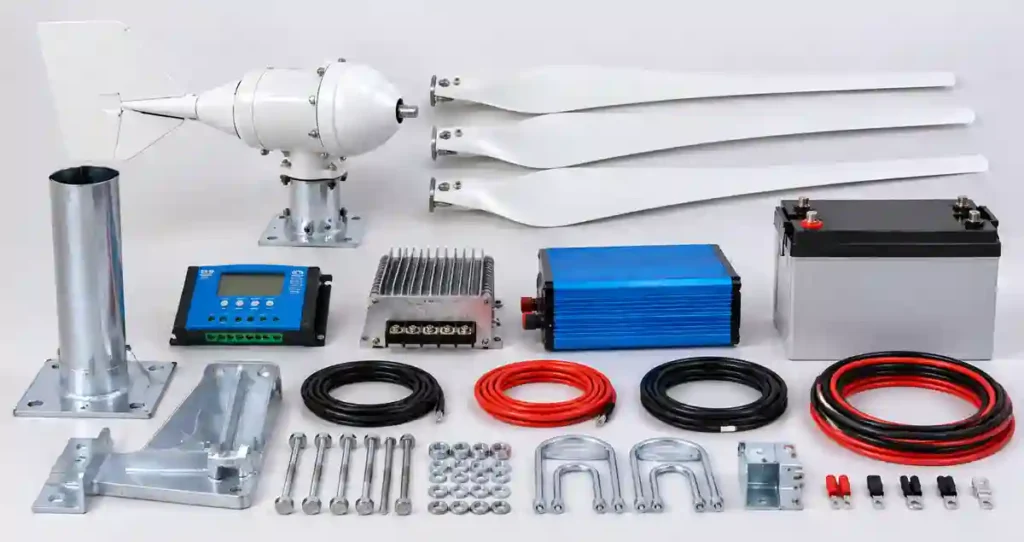
Wind Turbine and Blades
The wind turbine is the main energy-producing component. Its blades capture moving air and rotate a shaft connected to the generator. The amount of electricity produced depends on the turbine design, rotor size, wind speed, and operating conditions.
Residential turbines are generally available in horizontal-axis and vertical-axis designs. Horizontal-axis wind turbines (HAWTs) commonly have two or three blades mounted around a horizontal shaft. They are widely used for small wind generation where there is sufficient open space and suitable wind exposure.
Vertical-axis wind turbines (VAWTs) rotate around a vertical shaft. Many designs can accept wind from different directions without requiring the same yaw arrangement used by horizontal-axis turbines. However, their performance and installation requirements vary significantly between models.
Neither design is automatically better for every property. Compare the manufacturer’s power curve, structural requirements, maintenance access and independently tested performance before selecting a turbine.
Generator or Alternator
The generator converts the mechanical rotation of the turbine into electrical energy. Many small wind turbines use permanent-magnet generators, although other generator designs are also available.
When comparing kits, check the generator’s rated power, operating speed, output voltage and electrical output type. Some generators produce three-phase AC electricity with changing voltage and frequency, while other systems have integrated power-conditioning equipment.
A turbine advertised as a 5 kW model does not produce 5 kW continuously. Its actual output changes with wind speed. For this reason, request the manufacturer’s power curve rather than relying only on the rated capacity.
Wind Turbine Charge Controller
The wind turbine controller manages the electrical output from the generator and helps protect the system. In battery-based installations, it regulates charging according to the battery and turbine specifications. Depending on the design, it may also control a diversion load or provide other turbine protection functions.
A wind controller is not automatically interchangeable with a solar MPPT charge controller. Solar panels and wind generators have different electrical characteristics and operating requirements.
If you want to understand the difference between solar and wind charging equipment, read our guide to the MPPT solar charge controller. For a combined renewable energy installation, our article on the wind and solar hybrid controller explains how separate charging systems can work together.
Rectifier
Some small wind turbine generators produce three-phase AC electricity with variable voltage and frequency. A rectifier converts this AC output into DC electricity for a compatible controller or charging system.
Not every kit requires a separate rectifier. Some manufacturers integrate the rectifier into the controller or generator assembly. The correct arrangement depends on the turbine’s electrical design, so always follow the manufacturer’s wiring diagram and equipment specifications.
Tower and Mounting Structure
The tower supports the turbine at a height where it can access suitable wind conditions. It is a major part of the installation and must be designed for the turbine’s weight, rotor diameter, wind loading and mounting arrangement.
Home wind turbine kits may include guyed towers, freestanding towers or tilt-down tower arrangements. Some packages supply only the turbine and mounting hardware, leaving the tower and foundation to be designed and installed separately.
Tower height is important because nearby buildings, trees and other obstacles can reduce wind speed and create turbulence. However, increasing tower height also affects structural design, foundation requirements, installation cost and maintenance access.
For more information about turbine placement and support structures, see our guide to home wind turbine installation requirements. Before finalizing a tower design, a site assessment and appropriate structural calculations should be completed.
Wind Turbine Inverter
The inverter converts suitable DC electricity into AC electricity for household appliances or grid-connected operation. The required inverter depends on whether the kit is designed for off-grid, grid-tied or hybrid operation.
An off-grid system generally uses a battery-compatible inverter. A grid-connected system requires approved grid-interconnection equipment, while a hybrid installation may use a hybrid inverter with a separate wind controller or an approved wind interface.
A standard solar inverter should not be connected directly to a wind turbine unless the manufacturer specifically approves that arrangement. Wind generators can have different voltage and frequency characteristics from solar panels.
Our detailed guide to the wind turbine inverter explains grid-tied, off-grid and hybrid options, including important compatibility and protection requirements. You can also read our hybrid inverter guide to understand how battery storage and multiple energy sources can be integrated.
Battery Storage
Battery storage is normally required when a standalone wind turbine system needs to supply electricity during periods of low or no wind. The battery stores surplus energy and makes it available when the turbine is not generating enough power.
Common battery options include lead-acid, AGM, gel and lithium iron phosphate (LiFePO4) batteries. Each type has different charging requirements, operating characteristics and expected service life.
The battery bank must be compatible with the wind controller and inverter. Its nominal voltage, usable capacity, charging current and battery management system requirements should be checked before purchasing the kit.
Read our LiFePO4 battery guide to understand lithium iron phosphate technology. Our guide to battery storage for solar energy systems also explains battery types, capacity and storage considerations.
Diversion Load and Electrical Protection
Some battery-based wind systems use a diversion load to absorb excess electrical energy when the controller needs to limit battery charging. This is important because a wind turbine may continue rotating even when the battery is fully charged.
The diversion load must be correctly rated for the turbine and controller. It should not be treated as a replacement for the turbine’s approved braking or safety arrangements.
A complete installation may also require suitable circuit breakers, fuses, disconnect switches, grounding and bonding equipment, surge protection and correctly rated cables. The exact equipment depends on the turbine design, electrical arrangement and local requirements.
Types of Home Wind Turbine Kits

Small Battery-Charging Wind Turbine Kits
Small battery-charging kits are designed for applications where the primary requirement is to charge a battery bank or power low-power electrical equipment. They may be suitable for remote monitoring equipment, small cabins, communication systems and supplementary power applications.
These packages may include a small turbine, a generator, a controller, and mounting hardware. The battery and inverter may need to be purchased separately.
A small battery-charging kit should not automatically be considered suitable for an entire home. Its actual energy production must be compared with the property’s daily electricity consumption.
Off-Grid Home Wind Turbine Kits
Off-grid wind turbine kits are designed for properties that do not depend on a utility electricity connection. A typical arrangement includes the turbine, wind controller, battery bank and off-grid inverter. Depending on the equipment, a rectifier and diversion load may also be required.
The general power flow is:
Wind Turbine → Wind Controller → Battery Bank → Off-Grid Inverter → Household Loads
The battery stores energy when wind generation is available and supplies electricity when the turbine output decreases. The battery capacity should be selected according to energy consumption, required backup time and the operating limits of the equipment.
If you are planning a standalone renewable energy installation, our off-grid solar system guide explains how batteries, inverters and renewable energy sources work together. You can also use our solar battery size calculator as a starting point for understanding storage requirements.
Grid-Tied Wind Turbine Kits
Grid-tied wind turbine kits are designed to operate alongside the utility electricity supply. They use compatible power-conditioning equipment to supply electricity to local loads and, where permitted, export surplus electricity to the grid.
The inverter must meet the applicable grid-interconnection requirements. The utility may also require approval, metering arrangements, protective equipment and inspection before the system can operate in parallel with the grid.
An important point is that a standard grid-following inverter normally disconnects during a utility outage because of anti-islanding protection. Therefore, a grid-tied wind turbine should not be assumed to provide household backup during a power failure.
Before purchasing a grid-connected kit, confirm that the turbine and inverter combination is approved for the intended application and accepted by the local utility.
Solar and Wind Hybrid Kits
Solar and wind hybrid kits combine electricity generation from solar panels and wind turbines. Solar panels can produce electricity during sunny periods, while the turbine can contribute whenever suitable wind is available.
A common arrangement uses a separate solar MPPT controller and a dedicated wind controller connected to a compatible battery bank. A hybrid inverter then supplies AC electricity to the household loads.
Solar Panels → Solar MPPT Controller
Wind Turbine → Wind Controller
Both charging systems → Compatible Battery Bank → Hybrid Inverter → AC Loads
The actual wiring depends on the equipment and manufacturer’s approved design. A wind turbine must not be connected directly to a solar MPPT input unless the manufacturer specifically permits it.
Our guide to the solar and wind hybrid system explains how both energy sources can be combined. For a broader understanding of PV equipment, see our solar array guide and solar panel installation guide.
How to Choose the Right Home Wind Turbine Kit
Assess the Available Wind Resource
Wind availability is one of the most important factors affecting the performance of a home wind turbine. Before purchasing a kit, investigate the average wind speed at the proposed tower height, seasonal changes, nearby obstructions and turbulence around the installation site.
A turbine installed behind buildings or trees may experience lower and more turbulent wind conditions than one installed in an open location. A general weather report from a nearby city is not a substitute for a site-specific wind assessment.
Where possible, use reliable local wind data or a professional site assessment. The U.S. Department of Energy’s Small Wind Guidebook provides useful guidance on small wind site assessment and turbine selection.
Calculate Your Electricity Requirements
Start by identifying how much electricity the property consumes. For example, assume a home uses 10 kWh of electricity per day.
Daily electricity consumption = 10 kWh
Monthly electricity consumption = 10 × 30 = 300 kWh
Annual electricity consumption = 10 × 365 = 3,650 kWh
This gives you a starting point for evaluating the energy required from the wind turbine.
However, do not select a turbine by simply dividing daily consumption by its rated power. Actual energy production depends on wind speed, turbine performance and operating conditions. The manufacturer’s power curve is essential for estimating annual generation.
If you are also evaluating solar generation, our solar panel size calculator can help estimate the PV capacity required for a property.
Check the Turbine’s Power Curve
A power curve shows how much electricity a wind turbine produces at different wind speeds. It is more useful for energy estimation than the rated power alone.
For example, a turbine may have a rated capacity of 5 kW at a specified wind speed, but its output may be much lower at the wind speeds available at your property.
Before purchasing, request the manufacturer’s power curve and review the cut-in wind speed, rated wind speed, rated power and cut-out wind speed, where applicable. Also check whether annual energy production figures are based on independent testing or manufacturer estimates.
Select the Correct Turbine Design
Horizontal-axis and vertical-axis turbines have different mechanical arrangements and installation requirements. Horizontal-axis turbines are commonly used where open wind exposure and suitable tower installation are available. Vertical-axis turbines may offer different installation and wind-direction characteristics, depending on their design.
When reduced maintenance access difficulty or a particular support arrangement is a priority, compare suitable vertical-axis models. However, a vertical turbine does not automatically require less civil work, cost less or generate more electricity.
The selection should be based on actual tested performance, structural requirements, site conditions and total installed cost. Our article on vertical wind turbines for homes can provide a more detailed comparison once that article is published.
Check Tower Height and Foundation Requirements

The tower and foundation must be suitable for the turbine and local wind conditions. The design should account for turbine weight, rotor diameter, wind loading, tower height, soil conditions and the selected support arrangement.
A supplier may offer a turbine kit without the tower or foundation. These missing items can significantly increase the total installation cost.
Before ordering, request the manufacturer’s tower specifications, foundation requirements and installation instructions. A qualified professional should review the structural design and local site conditions.
Confirm Controller and Inverter Compatibility
The generator, rectifier, wind controller, inverter and battery must be compatible. Check the generator output type, normal and maximum voltage, controller power and current ratings, battery voltage, inverter input range and protection requirements.
Do not purchase a kit simply because it includes a controller or inverter. Confirm that the equipment is designed to work together and that the manufacturer supports the complete configuration.
Our power inverter technical guide explains inverter ratings and electrical characteristics. This is useful when comparing the AC output requirements of different residential systems.
Decide Whether Battery Storage Is Required
A battery bank is generally required for an off-grid system that must supply electricity when the wind is unavailable. Grid-connected systems may operate without batteries, while hybrid systems often include storage to support backup operation.
Battery capacity should be based on daily energy demand, required backup time, depth of discharge and the charging limits of the selected equipment. Do not select a battery only by its nominal voltage or advertised capacity.
For a more detailed understanding of storage, read our home battery backup guide.
Check Warranty, Certification and Spare Parts
A wind turbine operates outdoors and is exposed to changing wind conditions, vibration and mechanical loading. Before purchasing, check the warranty period, generator and bearing coverage, blade replacement availability, controller and inverter warranty, technical support and availability of spare parts.
Independent performance and safety certification can also help buyers compare equipment. In the United States, the Small Wind Certification Council provides information about certified small wind turbines. Always verify the exact model and certification scope rather than relying on a general statement from the seller.
What Does a Home Wind Turbine Kit Cost?
The cost of a home wind turbine kit depends on its rated capacity, turbine design, tower, foundation, controller, inverter, battery bank and installation requirements.
A small turbine package may cost considerably less than a complete residential installation. However, the lower-priced package may exclude important items such as the tower, foundation, batteries, inverter and electrical protection.
When comparing quotations, request a complete equipment list and separate prices for installation and civil work. Include the cost of the turbine, tower, foundation, controller, rectifier, inverter, battery bank, wiring, protection equipment, labour, commissioning and any required permits.
The total installed cost is more useful than the advertised kit price because it shows the actual investment required to operate the system safely.
You can also compare wind system economics with other renewable energy options using our solar power system cost and ROI guide. Remember that wind and solar systems have different resource conditions and should be assessed using their own energy-production estimates.
Questions to Ask Before Buying Home Wind Turbine Kits
Before placing an order, ask the supplier whether the package includes the tower, mounting hardware, controller, rectifier, inverter and battery bank. Confirm the turbine’s rated power, rated wind speed and independent power curve. Ask whether a diversion load or braking arrangement is included where required and whether the equipment is designed to work together.
You should also request the tower and foundation specifications, electrical wiring diagram, installation manual, warranty conditions and spare-parts information. If the system is grid-connected, confirm the applicable utility approval and inverter interconnection requirements.
These checks help identify incomplete packages and reduce the risk of purchasing equipment that cannot be safely integrated into the intended installation.
Common Mistakes When Buying Home Wind Turbine Kits
One common mistake is selecting a kit only by its advertised power rating. A high-capacity turbine may still produce very little electricity if the site does not have sufficient wind. The manufacturer’s power curve and a proper site assessment are more important than the headline wattage.
Another mistake is ignoring the tower and foundation. A turbine without a suitable support structure is not a complete installation. Tower height, foundation design and local wind loading must be considered before purchase.
Some buyers also assume that every kit includes an inverter or battery bank. In reality, many packages are designed only for battery charging or supply basic turbine equipment. Check the bill of materials and confirm what additional equipment is required.
Finally, never connect a wind turbine to a standard solar charge controller or inverter without checking manufacturer compatibility. Wind generators have different electrical characteristics and may require dedicated control and protection equipment.
Can You Combine a Home Wind Turbine Kit with an Existing Solar System?

Yes. A home wind turbine can be integrated with an existing solar installation when the electrical equipment and system design support it.
A common arrangement uses the existing solar panels and MPPT controller alongside a separate wind turbine and wind controller. Both charging systems can supply a shared battery bank when their voltage settings, current limits and battery compatibility are properly coordinated.
The hybrid inverter then supplies AC power to the household loads. Depending on the system, AC coupling or a specialized wind interface may also be used.
Before adding a turbine, check the battery charging limits, inverter specifications, controller compatibility and protection arrangements. The turbine must retain its approved braking and excess-energy management functions.
Can AI Help Monitor a Home Wind Turbine System?
AI-based monitoring can help analyze wind speed, turbine output, battery voltage, energy production and inverter performance. Monitoring software may identify unusual generation patterns, repeated inverter interruptions or changes in operating performance that require inspection.
However, AI monitoring should support the system rather than replace the turbine controller, electrical protection devices or professional maintenance. Safety-critical control functions must remain within the approved equipment design.
Engineer’s Note
When evaluating a home wind turbine kit, I first check whether the package is suitable for the intended application. A small battery-charging kit, an off-grid residential system and a grid-connected installation require different equipment and protection arrangements.
I then review the turbine’s power curve, generator output, tower requirements, controller specifications and inverter compatibility. I also check whether the proposed battery bank can accept the expected charging current and whether the turbine has an approved method of managing excess energy.
My recommendation is to compare the complete installed cost rather than the advertised turbine price. Missing tower, foundation, wiring, electrical protection and installation items can significantly change the project budget.
Engineer’s Field Notes
Before approving a home wind turbine kit, I would verify the available wind conditions at the proposed installation height, turbine performance data, generator voltage and output type, tower and foundation specifications, controller and rectifier compatibility, inverter and battery ratings, diversion load and braking arrangements, electrical protection, grounding and local permits.
I would also check the manufacturer’s warranty, maintenance instructions and availability of replacement blades, bearings and electrical components.
A properly selected kit should be treated as a complete renewable energy system. Every component must be suitable for the site and compatible with the other equipment.
Engineering Standards and Electrical Codes: IEC, IEEE, NFPA, NEC and UL
A home wind turbine kit must be selected and installed according to applicable equipment standards, electrical codes and local authority requirements.
- IEC 61400-2 – Small Wind Turbines: Covers design and safety requirements for small wind turbines, including installation, maintenance, operation, support structures and electrical subsystems.
- UL 6142 – Small Wind Turbine Systems: Covers safety requirements for small wind turbine systems and their electrical subassemblies. The current second edition was published in December 2025.
- NFPA 70 (NEC) – National Electrical Code: Covers electrical installation safety, including applicable requirements for small wind systems, wiring, grounding, overcurrent protection and equipment connections.
- IEEE 1547 – Distributed Energy Resource Interconnection: Relevant when a wind turbine kit is connected in parallel with the utility grid. It addresses technical interconnection requirements.
- IEEE 1547.1 – Interconnection Testing: Provides test procedures for verifying equipment compliance with applicable IEEE 1547 requirements.
Important Engineering Note: IEC 61400-2 and UL 6142 address small wind turbine safety, while NFPA 70 covers electrical installation and IEEE 1547 addresses grid interconnection. Not every standard applies to every kit. The applicable edition and legal requirements depend on the project location, equipment, and authority having jurisdiction.
Frequently Asked Questions
What is included in a home wind turbine kit?
A basic kit may include a turbine, generator, controller and mounting hardware. A more complete package may also include a tower, inverter, battery bank, wiring and electrical protection. Always check the manufacturer’s equipment list before purchasing.
Do home wind turbine kits include batteries?
Not always. Some kits are designed to charge a separately purchased battery bank, while others include storage. Grid-connected systems may not require batteries at all.
Can a home wind turbine kit power an entire house?
It depends on the turbine’s actual annual energy production and the home’s electricity consumption. A small turbine may only provide supplementary electricity rather than meeting the entire household demand.
Are vertical wind turbine kits better for homes?
Not automatically. Vertical-axis turbines may offer certain installation and wind-direction advantages, but their energy performance, structural requirements and maintenance needs vary by model. Compare independently tested data before purchasing.
Can I install a home wind turbine kit myself?
Some small systems are marketed for DIY installation, but tower construction, foundations, electrical connections and turbine protection can involve significant safety risks. Follow the manufacturer’s instructions and use qualified professionals where required.
Do I need an inverter for a home wind turbine kit?
If you want to operate standard AC household appliances from a battery-based DC system, you generally need a suitable inverter. Some small applications may use DC loads directly.
Can I use a wind turbine kit with solar panels?
Yes. A compatible wind controller and solar charge controller can be integrated into a shared battery system, provided their voltage and charging limits are coordinated. The complete arrangement must follow the manufacturers’ approved specifications.
What is the most important factor when buying a wind turbine kit?
The available wind resource is one of the most important factors. Even a good-quality turbine may perform poorly at a site with insufficient wind or excessive turbulence.
Final Thoughts
Home wind turbine kits can provide a practical way to generate renewable electricity, but the right package depends on the property, wind conditions and electrical requirements.
Before purchasing, check the turbine’s power curve, tower and foundation requirements, controller, inverter, battery compatibility and protection equipment. Compare the complete installed cost rather than the advertised price of the turbine alone.
A properly assessed and correctly designed wind energy system is more valuable than a high-capacity kit that does not suit the site.
Related guides
- Solar and Wind Hybrid System: Design, Sizing, Cost, and Working
- Wind and Solar Hybrid Controller: Wiring, Inputs and Protection
- Home Wind Turbine: Cost, Output, Sizing and Is It Worth It?
- Wind Turbine Inverter: Grid-Tie, Off-Grid and Hybrid Options
- Wind Turbine Parts Explained: Components and Their Functions
- Vertical Wind Turbine for Home: Output, Pros, Cons, and Limits
- Off-Grid Wind Turbine: Sizing, Batteries and System Design
Related guides on SolarVisionAI.com
- Monocrystalline Solar Panels 2026: Still Worth It or Hype
- Polycrystalline Solar Panels: Worth Buying in 2026?
- Thin-film Solar Panels: When They Beat Silicon (2026)
- BIPV Solar Panels: Building-Integrated PV Complete Guide
- Portable Solar Panels: Engineer’s Buyer’s Guide 2026
- CPV Solar Panels: Concentrated Photovoltaic Explained
- Skin Solar Panel: What “Solar Skin” Actually Means
- Solar Fence Post Lights: Cap Sizes, Types & Install Guide
- Bifacial Solar Panels in 2026: How to Boost Energy Output
- Solar Charge Controller: The Complete Guide
- MC4 Connectors: Solar Safety & Installation Guide
- Solar Panel Types, Efficiency & Benefits
- Solar Water Pump Guide
- Commercial Solar Panel Installation: Engineering Guide
- Solar Fence Post Lights: Cap Sizes, Types & Install Guide
- BESS — Battery Energy Storage System Guide
- Commercial Solar Panel Installation
- Solar Refrigerator & DC Fridge — Complete 2026 Guide
- Bifacial Solar Panel Albedo Effect Guide
- TOPCon: Why TOPCon Solar Panel is a Proven Smart Investment in 2026
- HJT: Why TOPCon Solar Panel is a Proven Smart Investment in 2026
- PERC: PERC Solar Panel: Still Relevant or Already Outdated?
- Perovskite: Perovskite Solar Panels: The 2026 Reality Check
- N-Type vs P-Type: N-Type vs P-Type Solar Panels: Honest Comparison
- ABC: ABC (all back contact) Solar Panel: Back Contact Technology Explained
- IBC: IBC Solar Panels: Interdigitated Back Contact Guide
- Tandem: Tandem Solar Panels: Are Stacked Cells Ready for Rooftops?