
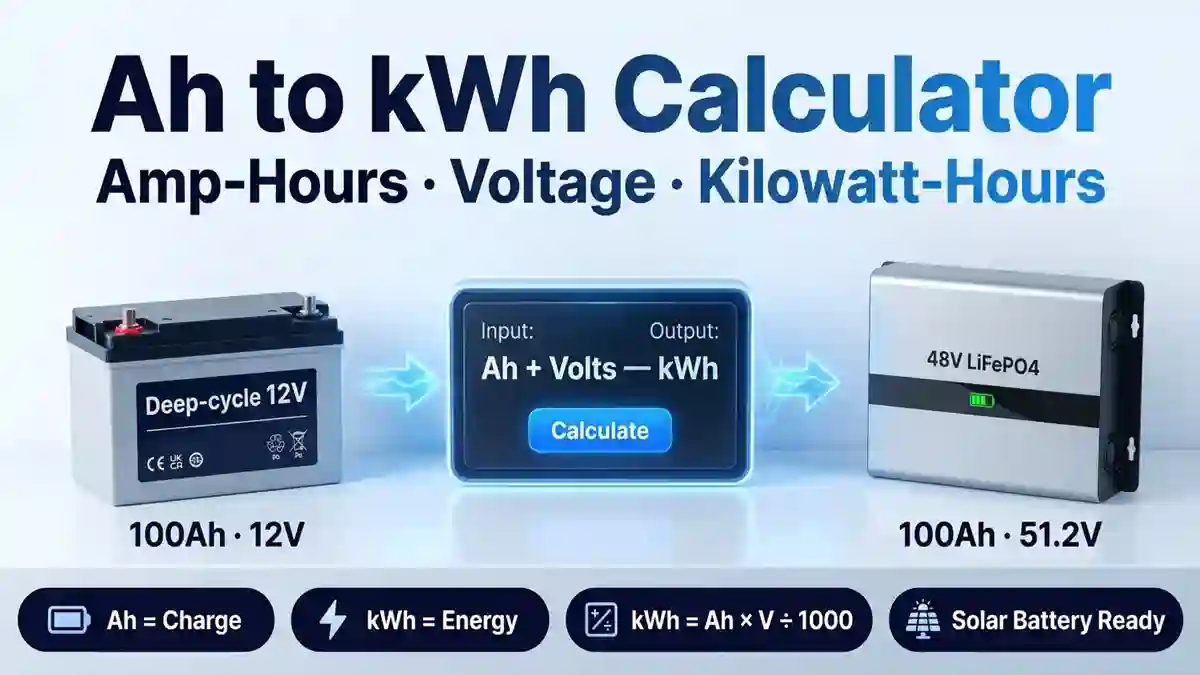
Free Ah to kWh Calculator — Convert amp-hours to kilowatt-hours instantly both ways. Built for solar batteries, LiFePO4 banks, 12V, 24V and 48V systems.
Please enter valid values greater than zero.
Formula: kWh = (Ah × V) ÷ 1000
Use our free Ah to kWh Calculator to instantly convert a battery’s amp-hour (Ah) rating into kilowatt-hours (kWh) of stored energy, and back again. Whether you are comparing car batteries, sizing a LiFePO4 bank for a solar system, checking an e-bike pack, or reading the spec sheet of a home battery, this tool turns a charge rating into the energy figure that actually matters.
1. Why You Need an Ah to kWh Calculator to Compare Batteries Fairly
Amp-hours (Ah) measure electric charge — how much current a battery can deliver over time. Kilowatt-hours (kWh) measure energy — how much actual work that battery can do. A battery’s Ah rating on its own does not tell you how much energy it stores, because energy also depends on the voltage at which that charge is delivered.
This is why two batteries with the same Ah rating can store very different amounts of energy. A 100Ah battery at 12V holds 1.2 kWh, while a 100Ah battery at 48V holds 4.8 kWh — four times the energy for the same Ah number. Car batteries, deep-cycle batteries, and solar storage banks are usually sold by Ah, while home batteries, EVs, and electricity bills use kWh, so converting between the two is the only reliable way to compare them.
Engineer’s Note: Never compare two batteries by Ah alone unless you have confirmed they run at the same voltage. Marketing material often highlights the biggest Ah number available, even when the batteries operate at completely different system voltages. Converting to kWh first removes that ambiguity and shows the true energy capacity side by side.
2. The Ah to kWh Calculator Formula
Ah to kWh: kWh = (Ah × Voltage) ÷ 1000
kWh to Ah: Ah = (kWh × 1000) ÷ Voltage
Example 1: A 100Ah battery at 12V: (100 × 12) ÷ 1000 = 1.2 kWh
Example 2: A 200Ah battery at 48V: (200 × 48) ÷ 1000 = 9.6 kWh
Example 3 (reverse): A 5 kWh battery at 48V needs: (5 × 1000) ÷ 48 = 104.2 Ah
Engineer’s Note: Always use the battery’s nominal voltage in this formula, not the voltage you measure at a given moment. A 12V lead acid battery reads about 12.7V when fully charged and under 12V when nearly empty, but its rated energy is calculated at the 12V nominal figure. Using a live voltage reading will overstate or understate the capacity depending on the state of charge.
3. Why Voltage Changes the Result
Voltage is the second half of the energy equation, and different battery chemistries and system types use different nominal voltages. Using the correct figure for your battery is the single most important input to the calculation.
- Lead Acid and AGM: 12V nominal per battery, built from six 2V cells. Banks are commonly wired to 24V or 48V.
- LiFePO4 (Lithium Iron Phosphate): 12.8V, 25.6V, and 51.2V nominal, built from 3.2V cells. A “12V” LiFePO4 battery is actually 12.8V, and a “48V” pack is actually 51.2V.
- Lithium-ion (NMC): 3.6V to 3.7V nominal per cell, used in power banks, laptops, e-bikes, and many EVs. Packs stack cells in series to reach 36V, 48V, or 400V and above.
- E-Bike and Scooter Packs: Typically 36V, 48V, or 52V nominal depending on the number of series cells.
Engineer’s Note: Check the datasheet for the true nominal voltage rather than assuming the rounded figure in the product name. A battery sold as “48V 100Ah” in LiFePO4 is usually 51.2V, which gives 5.12 kWh rather than 4.8 kWh — a difference of more than 6% that matters when you are sizing storage against a daily energy target.
4. Practical Applications of an Ah to kWh Calculator
Home and Solar Battery Banks
Solar storage is planned around daily energy use in kWh, but battery banks are often built from individual batteries rated in Ah. Converting each battery to kWh, then multiplying by the number of batteries wired in parallel and series, tells you the true bank capacity. This pairs directly with our Solar Battery Size Calculator when planning a complete system.
RV, Boat, and Van Battery Systems
Mobile systems typically run on 12V or 24V batteries rated in Ah. Converting to kWh shows how much energy you really have for lights, a fridge, and a water pump, and makes it easier to compare a lead acid setup against a lighter LiFePO4 alternative.
Electric Vehicles and E-Bikes
E-bike batteries are commonly listed in Ah and volts, while EVs are specified in kWh. A 48V 15Ah e-bike pack stores 0.72 kWh, and a 400V 150Ah EV pack stores 60 kWh. Converting both to kWh is what allows range and charging cost comparisons.
Comparing Batteries and Power Stations
Portable power stations are sold in Wh or kWh, while many replacement batteries are sold in Ah. Converting to a common unit shows which option actually gives more usable energy per dollar.
Backup Runtime Planning
Once you know a battery’s energy in kWh, you can estimate how long it will run a load. Usable energy in watt-hours divided by the load in watts gives a runtime estimate, before accounting for inverter losses and depth of discharge.
Engineer’s Note: The kWh figure from this calculator is the rated energy, not the usable energy. Multiply it by the safe depth of discharge to get what you can actually draw: roughly 50% for lead acid and 80% for LiFePO4. A 100Ah 12V lead acid battery holds 1.2 kWh but only about 0.6 kWh is safely usable, while a 100Ah 12.8V LiFePO4 battery holds 1.28 kWh with about 1.02 kWh usable — nearly double the usable energy from a similar Ah rating.
5. Quick Reference Ah to kWh Conversion Table
| Capacity (Ah) | Voltage (V) | Energy (kWh) | Common Use |
| 50 Ah | 12 V | 0.6 kWh | Small Deep-Cycle Battery |
| 100 Ah | 12 V | 1.2 kWh | Standard Lead Acid Battery |
| 100 Ah | 12.8 V | 1.28 kWh | 12V LiFePO4 Battery |
| 200 Ah | 12 V | 2.4 kWh | RV or Boat Battery Bank |
| 200 Ah | 24 V | 4.8 kWh | Off-Grid Cabin Bank |
| 100 Ah | 51.2 V | 5.12 kWh | 48V LiFePO4 Rack Battery |
| 200 Ah | 51.2 V | 10.24 kWh | Large Home Storage Battery |
| 150 Ah | 400 V | 60 kWh | Electric Vehicle Pack |
6. Common Mistakes When Converting Ah to kWh
- Forgetting the Voltage: Ah alone cannot be converted to kWh. Without the voltage the result is meaningless, which is why the calculator always asks for both values.
- Using Rounded Voltage: Treating a 51.2V LiFePO4 pack as 48V understates its energy by about 6%. Use the datasheet nominal voltage.
- Confusing Rated and Usable Energy: The calculated kWh is the full rated capacity. The energy you can safely use is lower once depth of discharge is applied.
- Mixing Ah and mAh: 1 Ah equals 1,000 mAh. Entering a mAh value into an Ah field produces a result that is 1,000 times too large.
- Ignoring Series and Parallel Wiring: Batteries wired in series add voltage, while batteries wired in parallel add Ah. Calculate bank energy from the total bank voltage and total bank Ah, not from a single battery.
Engineer’s Note: When adding up a battery bank, the safest method is to convert one battery to kWh first, then multiply by the total number of batteries regardless of whether they are wired in series or parallel. Total energy is always the sum of the energy in each battery, and this check catches wiring-configuration errors before they turn into an undersized system.
Quick Guide: Which Standard Covers What
| Standard | What It Covers | Why It Matters for Ah and kWh |
| IEEE 485 | Sizing lead-acid batteries for stationary float service | Applies temperature, aging, and margin to rated Ah |
| IEEE 1679.1 | Evaluating lithium-based batteries in stationary use | Compares LiFePO4 and other lithium chemistries objectively |
| UL 1973 | Safety of the battery unit and its BMS | Confirms the pack behind the kWh rating is safety tested |
| UL 9540 / 9540A | Complete system safety and the fire propagation test | Often required by local inspectors for home storage |
| IEC 62619 | Industrial and stationary lithium battery safety | International equivalent for large lithium packs |
| IEC 62133-2 / UN 38.3 | Portable lithium cells and shipping tests | Covers power banks, e-bike packs, and transport |
| NFPA 855 | Installation of stationary energy storage systems | Sets kWh limits per unit and per location |
| NEC 706 / 480 | Wiring and protection for storage systems and batteries | Sets disconnect and overcurrent requirements |
7. Ah to kWh Calculator: Frequently Asked Questions
How do I convert Ah to kWh?
Multiply the battery’s Ah rating by its nominal voltage, then divide by 1000. For a 100Ah battery at 12V: (100 × 12) ÷ 1000 = 1.2 kWh.
How many kWh is a 100Ah battery?
It depends on the voltage. A 100Ah battery holds 1.2 kWh at 12V, 2.4 kWh at 24V, and 4.8 kWh at 48V. A 100Ah 51.2V LiFePO4 battery holds 5.12 kWh.
How many Ah is 1 kWh?
Divide 1,000 by the voltage. At 12V, 1 kWh equals 83.3 Ah. At 24V it equals 41.7 Ah, and at 48V it equals 20.8 Ah.
Is a higher Ah battery always better?
Not necessarily. Ah only describes charge, so a high-Ah battery at a low voltage can store less energy than a lower-Ah battery at a higher voltage. Compare batteries in kWh to see which one really stores more.
What is the difference between Ah to kWh and mAh to Wh?
They use the same idea at different scales. Our mAh to Wh Calculator suits small batteries such as phones and power banks, while Ah to kWh suits larger batteries such as car, solar, and home storage systems.
Also Check Our Related Calculators
- Watt-Hours to Watts Calculator
- Watts to Watt-Hours Calculator
- kWh to kW Calculator
- kW to HP Calculator
- Amps to Watts Calculator
- Solar Battery Size Calculator
- Solar Panel Size Calculator
- Inverter Size Calculator
- Watts to Amps Calculator
Related Battery Guides
- LiFePO4 vs Lithium-ion
- LiFePO4 Batteries for Solar
- 48V 200Ah LiFePO4 Battery
- Home Battery Backup
- Hybrid Inverter Guide
Related guides on SolarVisionAI.com
- Monocrystalline Solar Panels 2026: Still Worth It or Hype
- Polycrystalline Solar Panels: Worth Buying in 2026?
- Thin-film Solar Panels: When They Beat Silicon (2026)
- BIPV Solar Panels: Building-Integrated PV Complete Guide
- Portable Solar Panels: Engineer’s Buyer’s Guide 2026
- CPV Solar Panels: Concentrated Photovoltaic Explained
- Skin Solar Panel: What “Solar Skin” Actually Means
- Solar Fence Post Lights: Cap Sizes, Types & Install Guide
- Bifacial Solar Panels in 2026: How to Boost Energy Output
- Solar Charge Controller: The Complete Guide
- MC4 Connectors: Solar Safety & Installation Guide
- Solar Panel Types, Efficiency & Benefits
- Solar Water Pump Guide
- Commercial Solar Panel Installation: Engineering Guide
- Solar Fence Post Lights: Cap Sizes, Types & Install Guide
- BESS — Battery Energy Storage System Guide
- Commercial Solar Panel Installation
- Solar Refrigerator & DC Fridge — Complete 2026 Guide
- Bifacial Solar Panel Albedo Effect Guide
- TOPCon: Why TOPCon Solar Panel is a Proven Smart Investment in 2026
- HJT: Why TOPCon Solar Panel is a Proven Smart Investment in 2026
- PERC: PERC Solar Panel: Still Relevant or Already Outdated?
- Perovskite: Perovskite Solar Panels: The 2026 Reality Check
- N-Type vs P-Type: N-Type vs P-Type Solar Panels: Honest Comparison
- ABC: ABC (all back contact) Solar Panel: Back Contact Technology Explained
- IBC: IBC Solar Panels: Interdigitated Back Contact Guide
- Tandem: Tandem Solar Panels: Are Stacked Cells Ready for Rooftops?